
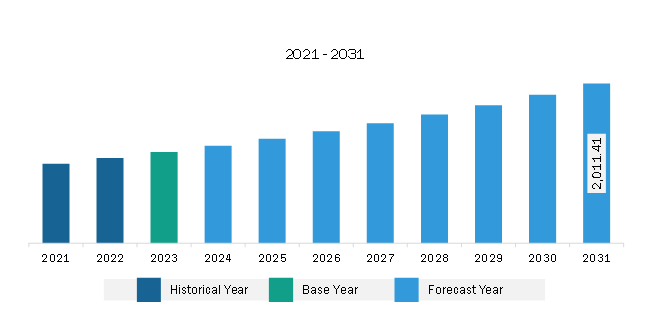
The Asia Pacific tea extracts market was valued at US$ 1,148.35 million in 2023 and is expected to reach US$ 2,011.41 million by 2031; it is estimated to register a CAGR of 7.3% from 2023 to 2031.
Wide Application Scope of Tea Extracts Boosts Asia Pacific Tea Extracts Market
Tea extracts have a wide range of applications in various end-use industries such as food and beverages, pharmaceuticals and nutraceuticals, personal care and cosmetics, and animal feed, among others. Tea extracts are used as natural flavorings, colorants, and preservatives in food and beverage products. Consumers increasingly seek clean-label products, driving the demand for natural ingredients such as tea extracts in food products. Also, there is an increasing demand for various herbal and botanical extracts in the beverage industry. Further, tea extracts are valued for their medicinal properties and health benefits in the pharmaceutical and nutraceutical industries. Tea extracts are considered important owing to their rich concentration of bioactive compounds, including polyphenols, catechins, and flavonoids. These compounds offer numerous health benefits, making tea extracts a popular ingredient in dietary supplements and pharmaceutical products aimed at improving overall well-being. Tea extracts are effective in protecting skin from environmental damage, soothing irritation, and reducing the appearance of lines and wrinkles. As a result, tea extracts are gaining popularity in personal care products as a functional ingredient. Tea extracts are also utilized in the animal feed industry to improve the overall health and performance of livestock and pets. The demand for natural and organic animal feed ingredients is driven by the need for sustainable and nutritionally dense feed options.
Thus, the wide range of applications of tea extracts across various end-use industries drives the tea extracts market.
Asia Pacific Tea Extracts Market Overview
The China tea extracts market is a vast and rapidly growing industry driven by rich tea culture. China is the world's largest tea producer and consumer. The market is characterized by a strong preference for high-quality tea extracts, particularly in traditional Chinese medicine and the pharmaceutical industry. Chinese manufacturers such as Tongrentang and Yunnan Baiyao used tea extracts to create medicine products such as tea-based supplements and tea-infused health tonics. Furthermore, China's thriving food and beverages industry, led by companies such as Hangzhou Wahaha Group and Nongfu Spring, is constantly seeking new and exciting ways to incorporate tea extracts into products, driving growth and innovation in the market.
Asia Pacific Tea Extracts Market Revenue and Forecast to 2031 (US$ Million)
Asia Pacific Tea Extracts Market Segmentation
The Asia Pacific tea extracts market is categorized into type, category, form, application, and country.
Based on type, the Asia Pacific tea extracts market is segmented into green tea, black tea, oolong tea, and others. The green tea segment held the largest market share in 2023.
In terms of form, the Asia Pacific tea extracts market is bifurcated into powder and liquid. The liquid segment held a larger market share in 2023.
By application, the Asia Pacific tea extracts market is segmented into food and beverages, bakery and confectionery, dairy and frozen dessert, beverages, other food and beverages, dietary supplements, personal care and cosmetics, and others. The food and beverages segment held the largest market share in 2023.
By category, the Asia Pacific tea extracts market is bifurcated into conventional and organic. The conventional segment held a larger market share in 2023.
By country, the Asia Pacific tea extracts market is segmented into China, Japan, India, Australia, South Korea, and the Rest of Asia-Pacific. China dominated the Asia Pacific tea extracts market share in 2023.
Finlays, Botanic Healthcare Group, Martin Bauer GmbH & Co KG, Firmenich International SA, Givaudan SA, International Flavors & Fragrances Inc, Kerry Group Plc, Archer Daniels Midland Company, Sensient Technologies Corp, Kemin Industries Inc, Medikonda Nutrients, Virginia Dare Extract Co Inc, Lipoid-Kosmetik, Florida Food Products, and Dohler GmbH are some of the leading companies operating in the Asia Pacific tea extracts market.
Asia Pacific Tea Extracts Market Strategic Insights

Asia Pacific Tea ExtractsMarket Report Highlights
| Report Attribute | Details |
| Market size in 2023 | US$ 1,148.35 Million |
| Market Size by 2031 | US$ 2,011.41 Million |
| CAGR (2023 - 2031) | 7.3% |
| Historical Data | 2021-2022 |
| Forecast period | 2024-2031 |
| Segments Covered |
By Type
|
|
Regions and Countries Covered
|
|
| Asia-Pacific | China, India, Japan, Australia, Rest of Asia-Pacific |
| Market leaders and key company profiles |
|
Asia Pacific Tea Extracts Market Country and Regional Insights



