Analysis – by Type [Nanosatellite (1 to 10 Kg) and Microsatellite (10 to 150 Kg)], Payload [Automatic Identification System (AIS), Transmitter, Imaging Devices, and Others], Application (Earth Observation, Communication and Navigation, and Scientific Research), and Vertical (Government, Military, and Commercial)
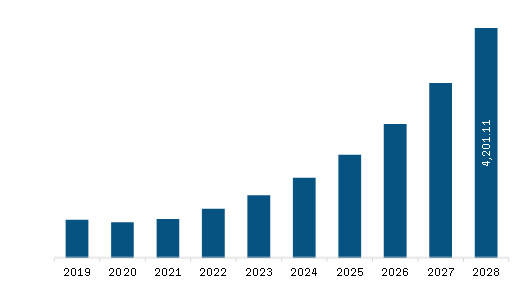
The Asia Pacific small satellite market is expected to grow from US$ 888.57 million in 2022 to US$ 4,201.11 million by 2028; it is estimated to grow at a CAGR of 29.6% from 2022 to 2028.
Increasing Adoption of Small Satellites for Military Applications
Small satellites can be highly useful in military applications due to their short development time, low cost, and assembly line manufacturing processes. Many small satellite applications envision systems comprising the constellations of hundreds of satellites offer several advantages such as an increase in temporal resolution, revisit rate, and formation flying. Military officers can use small satellites to acquire real-time information, which can help them in decision making. Therefore, various countries are investing in small satellites. The project includes small satellites, satellite communications, space deterrence and reduction of on-orbit space debris, and launch. Similarly, in November 2021, Air Force Research Laboratory Space Vehicles Directorate announced that they had signed a contract with Tyvak Nano-Satellite Systems for experimenting in very low Earth orbit. Tyvak was awarded US$ 8.4 million for the satellite launch project and is projected to launch in 2024. Also, in July 2022, the Indian Army announced that they wanted a small satellite for training its signals officers. For this, the army issued a request for information (RFI) to the Indian companies to design and develop the communication satellite. Thus, the growing use of small satellites for military applications will further boost the market growth during the forecast period.
Market Overview
The Asia Pacific small satellite market, based on country, is segmented into Australia, China, India, Japan, South Korea, and the rest of Asia Pacific. The space industry across the region is majorly dominated by China, India, and Japan. In March 2022, the Wuhan government announced its intentions to invest US$ 7.88 million to expand the country’s space sector to US$ 15.7 billion by 2025. The government investment is intended to be used for satellite, rocket, and spacecraft development. Additionally, South Korea, Indonesia, Taiwan, Thailand, Malaysia, the Philippines, Vietnam, Singapore, Australia, New Zealand, and other Asia Pacific countries are also engaged in the rapid development of their space capabilities. In 2022, the Taiwan government announced to invest US$ 900 million in developing its space industry in the next 10 years. These factors are expected to increase the production of small satellites across Asia Pacific, thereby bolstering the growth of the small satellite market in the region.
Asia Pacific Small Satellite Market Revenue and Forecast to 2028 (US$ Million)
Asia Pacific Small Satellite Market Segmentation
The Asia Pacific small satellite market is segmented on the basis of type, payload, application, vertical, and country. Based on type, the Asia Pacific small satellite market is bifurcated into nanosatellite (1 to 10 Kg) and microsatellite (10 to 150 Kg). The microsatellite (10 to 150 Kg) segment held a larger market share in 2022.
Based on payload, the Asia Pacific small satellite market is segmented into automatic identification system (AIS), transmitter, imaging devices, and others. The automatic identification system (AIS) segment held the largest market share in 2022.
Based on application, the Asia Pacific small satellite market is segmented into earth observation, communication and navigation, and scientific research. The earth observation segment held the largest market share in 2022.
Based on vertical, the Asia Pacific small satellite market is segmented into government, military, and commercial. The commercial segment held the largest market share in 2022.
Based on country, the Asia Pacific small satellite market is segmented into China, India, Japan, Australia, South Korea, and the Rest of Asia Pacific. China dominated the market share in 2022.
Lockheed Martin Corp; Northrop Grumman Corp; Raytheon Technologies Corp; and Thales SA are the leading companies operating in the Asia Pacific small satellite market.
Asia Pacific Small Satellite Market Strategic Insights
Get more information on this report
Asia Pacific Small Satellite Market Segmentation Analysis
Asia Pacific Small Satellite Market Report Highlights
Asia Pacific Small Satellite Report Scope
Report Attribute
Details
Market size in 2022
US$ 888.57 Million
Market Size by 2028
US$ 4,201.11 Million
CAGR (2022 - 2028)
29.6%
Historical Data
2020-2021
Forecast period
2023-2028
Segments Covered
By Type
Nanosatellite
Microsatellite
By Payload
Automatic Identification System
Transmitter
Imaging Devices
By Application
Earth Observation
Communication and Navigation
Scientific Research
By Vertical
Government
Military
Commercial
Regions and Countries Covered
Asia-Pacific
China, India, Japan, Australia, Rest of Asia-Pacific
Market leaders and key company profiles
Lockheed Martin Corp
Northrop Grumman Corp
Raytheon Technologies Corp
Thales SA
Get more information on this report
Asia Pacific Small Satellite Market Country and Regional Insights
Get more information on this report
Identical Market Reports with other Region/Countries
The List of Companies - Asia Pacific Small Satellite Market
Lockheed Martin CorpNorthrop Grumman Corp Raytheon Technologies CorpThales SA
Frequently Asked Questions
How big is the Asia Pacific Small Satellite Market?
The Asia Pacific Small Satellite Market is valued at US$ 888.57 Million in 2022, it is projected to reach US$ 4,201.11 Million by 2028.
What is the CAGR for Asia Pacific Small Satellite Market by (2022 - 2028)?
As per our report Asia Pacific Small Satellite Market, the market size is valued at US$ 888.57 Million in 2022, projecting it to reach US$ 4,201.11 Million by 2028. This translates to a CAGR of approximately 29.6% during the forecast period.
What segments are covered in this report?
The Asia Pacific Small Satellite Market report typically cover these key segments-
Application (Earth Observation, Communication and Navigation, Scientific Research)
Vertical (Government, Military, Commercial)
What is the historic period, base year, and forecast period taken for Asia Pacific Small Satellite Market?
The historic period, base year, and forecast period can vary slightly depending on the specific market research report. However, for the Asia Pacific Small Satellite Market report:
Historic Period : 2020-2021
Base Year : 2022
Forecast Period : 2023-2028
Who are the major players in Asia Pacific Small Satellite Market?
The Asia Pacific Small Satellite Market is populated by several key players, each contributing to its growth and innovation. Some of the major players include:
Lockheed Martin Corp
Northrop Grumman Corp
Raytheon Technologies Corp
Thales SA
Who should buy this report?
The Asia Pacific Small Satellite Market report is valuable for diverse stakeholders, including:
Investors: Provides insights for investment decisions pertaining to market growth, companies, or industry insights. Helps assess market attractiveness and potential returns.
Industry Players: Offers competitive intelligence, market sizing, and trend analysis to inform strategic planning, product development, and sales strategies.
Suppliers and Manufacturers: Helps understand market demand for components, materials, and services related to concerned industry.
Researchers and Consultants: Provides data and analysis for academic research, consulting projects, and market studies.
Financial Institutions: Helps assess risks and opportunities associated with financing or investing in the concerned market.
Essentially, anyone involved in or considering involvement in the Asia Pacific Small Satellite Market value chain can benefit from the information contained in a comprehensive market report.





 Get Free Sample For Asia Pacific Small Satellite Market