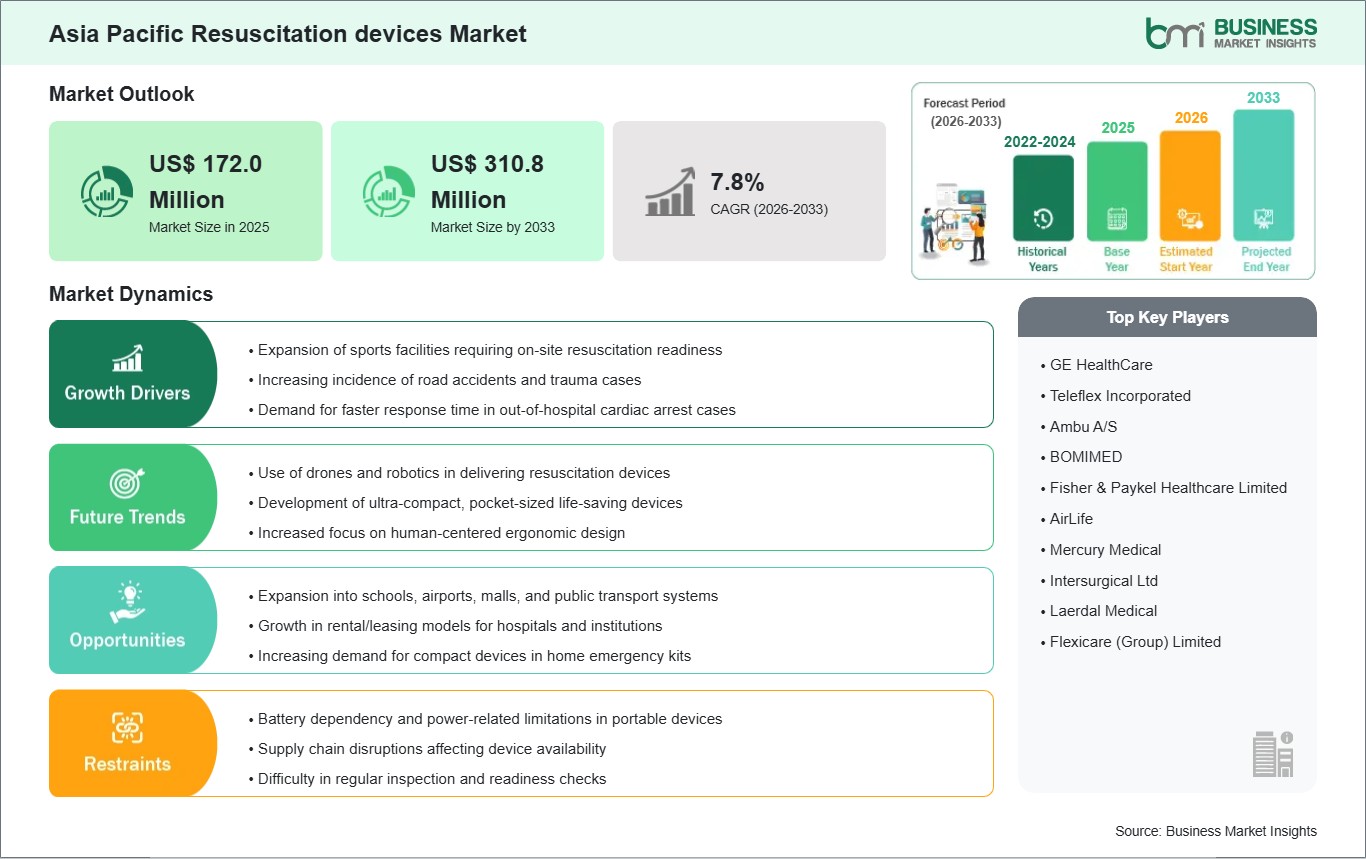
The Asia Pacific resuscitation devices market size is expected to reach US$ 310.8 million by 2033 from US$ 172.0 million in 2025. The market is estimated to record a CAGR of 7.8% from 2026 to 2033.
The Asia Pacific resuscitation devices market is witnessing tremendous growth and changes owing to the heightened awareness about heart attacks, the expansion of the health care infrastructure, and governmental efforts to enhance the capacity of emergency response systems. This region encompasses countries like China, Japan, India, Australia, South Korea, and the Southeast Asian countries, with China being the dominant player in this market. Market expansion in the region is driven by the rise in cardiovascular disease cases, the increased number of surgeries, and a greater emphasis on survival rates during cardiac emergencies in hospitals as well as out-of-hospitals. Hospitals and emergency medical service providers are employing resuscitation devices like automated external defibrillators, manual defibrillators, mechanical CPR machines, and sophisticated monitoring systems to increase the efficacy of resuscitation efforts. Portable resuscitation devices are increasingly available in Chinese urban EMS systems, enabling faster action in densely populated metropolitan cities. The key market restrictions in the region are the uneven availability of resuscitation technologies in urban and rural regions, tight budgets in public hospitals, and the requirement for comprehensive training programs to guarantee correct use of the devices. In spite of these limitations, the continued investment in emergency healthcare facilities, public CPR training initiatives, and collaboration with international medical equipment makers are fueling the development of the resuscitation devices market in the Asia Pacific region.

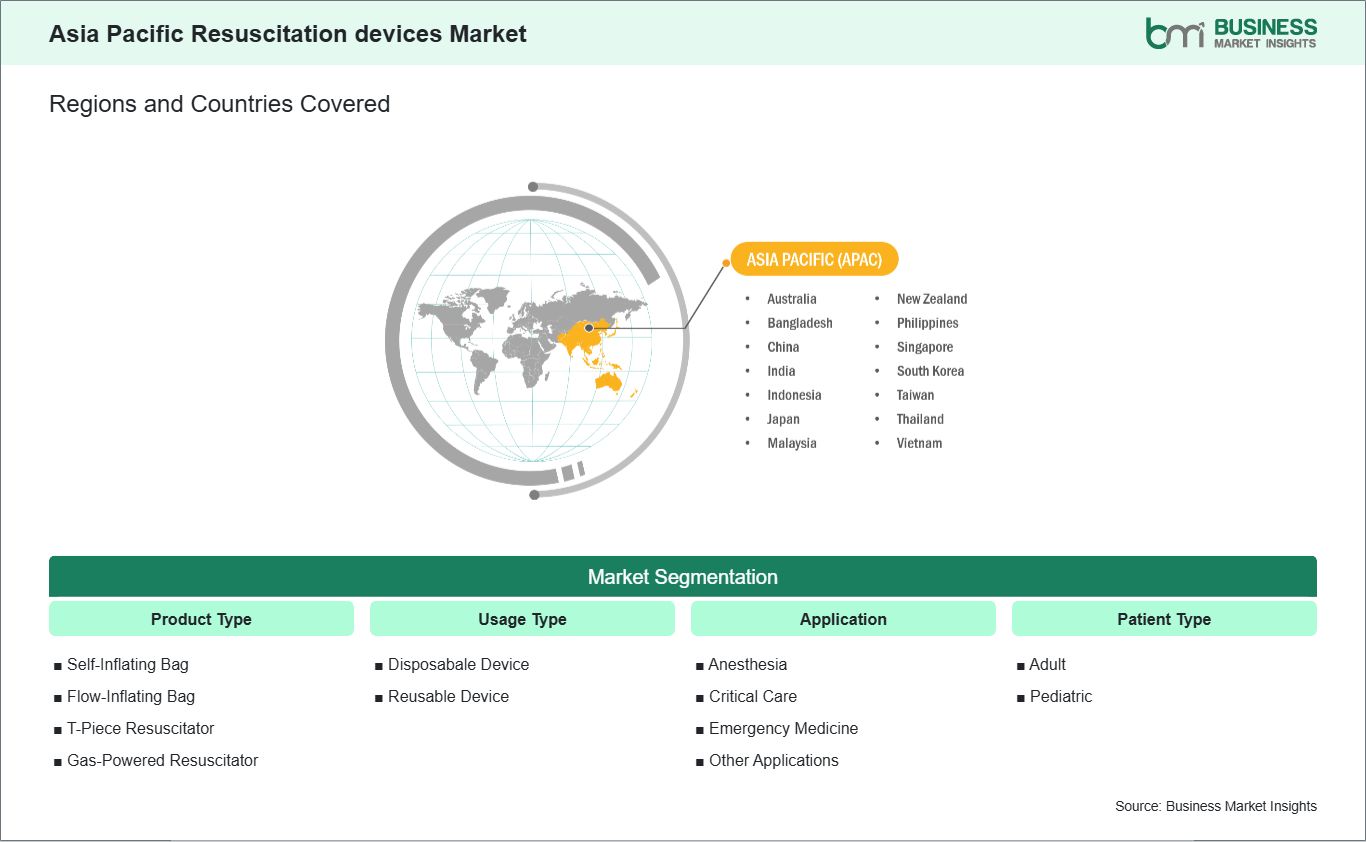
Key segments that contributed to the derivation of the Asia Pacific resuscitation devices market analysis are product type, usage type, application, patient type, and end user.
The Asia-Pacific region's market for resuscitation devices is getting more influenced by the fast-growing trend of building sports venues and ensuring the safety of athletes. Countries like Australia, Japan, and South Korea have witnessed a boom in the construction of professional and recreational sports venues, including stadiums, gyms, and sports multiplexes. The increase in the number of people who are involved in sports activities has made it necessary to provide resuscitation equipment at such venues.
In urban locations like Sydney, Tokyo, and Seoul, professional sports clubs, as well as city administrators, are integrating resuscitation plans as part of their event planning process. The staff of medics attending games at sports venues is equipped with training on the use of AEDs as well as other resuscitation equipment as a sign of preparation for emergency scenarios. As a result of this proactive trend, more compact, easy-to-use, and low-maintenance devices are being purchased, especially as there are large gatherings of fans at events.
Developing markets in Southeast Asia, like Malaysia, Thailand, and Indonesia, are doing the same, as they build state-of-the-art sports facilities to promote better community health and youth participation. In even smaller venues, from indoor arenas to health clubs, more basic training programs using AEDs and CPR instruction are being adopted. As sporting facilities continue to develop in the Asia-Pacific region, resuscitation preparedness has become an increasingly significant factor, creating direct market opportunities for resuscitation equipment.
Availability of defibrillation devices to the general population is rapidly becoming a growing trend in the Asia Pacific region. More emphasis is being placed by governments and private entities on early action in cases of heart attacks. In Japan, South Korea, and Singapore, schools are fitting in AED machines and conducting CPR classes among the teaching staff. This ensures that the younger generation is kept safe through education in life-saving practices and the need arises for rugged defibrillators.
Airports, shopping malls, and mass transit systems are also becoming areas of focus for deploying devices. Major metropolitan cities in India, China, and Australia have been using AEDs at transport nodes and shopping malls. Such locations call for devices that are user-friendly and robust enough to withstand environmental changes since any situation can arise unexpectedly. Linking the location of such devices to mobile applications and public alerts will help trained people locate the devices quickly to save the life of the person who has suffered from an out-of-hospital arrest.
Smart AED network solutions, which involve linking AEDs to emergency management centers, are being tested in Hong Kong and Malaysia. These networks help keep track of the functioning of AEDs and ensure proper maintenance. The initiative will also raise awareness about resuscitation practices. Public education and campaigns to promote the use of such devices are growing as well. The increase in urban population in the Asia Pacific region suggests that the placement of resuscitation devices will continue to be important in the years to come.

The Asia Pacific resuscitation devices market is experiencing steady growth, with market size and share analysis reflecting evolving treatment preferences and competitive dynamics among key players. The report evaluates important subsegments categorized within product type, usage type, application, patient type, and end user, highlighting their respective contributions to market performance.
By product type, the self-inflating Bag subsegment dominated the market in 2025, as they are easy to use and do not require external gas or power sources, making them ideal for emergencies. They allow precise manual control of ventilation, which is crucial in critical care. Their portability makes them suitable for both hospital wards and transport situations.
Based on usage type, the disposable devices subsegment dominated the market in 2025 due to their ability to prevent cross-contamination and infection. They eliminate the need for complex sterilization processes, saving time and reducing operational costs. In high-volume hospital settings, disposables improve workflow efficiency. This makes them highly preferred in emergency rooms, ICUs, and surgical units.
On the basis of application, the anesthesia subsegment dominated the market in 2025, as resuscitation devices are essential for safe ventilation during induction and recovery. They provide backup support if mechanical ventilators fail. Their precise control helps manage patients with varying lung compliances. Hospitals rely on these devices to prevent hypoxia and ensure patient safety during surgeries.
In terms of patient type, the adult subsegment dominated the market in 2025, as they experience more surgical procedures and critical emergencies than pediatric populations. Their larger lung capacity requires devices designed for adult ventilation. High prevalence of cardiac and respiratory conditions in adults increases usage frequency.
Based on end user, the hospitals subsegment dominated the market in 2025 due to constant emergency and surgical care needs. ICUs, operating rooms, and emergency departments require rapid access to resuscitation devices. High patient volume and stringent safety protocols make hospitals the key market driver. Their centralized procurement and standardized protocols ensure widespread device adoption.
| Report Attribute | Details |
|---|---|
| Market size in 2025 | US$ 172.0 Million |
| Market Size by 2033 | US$ 310.8 Million |
| CAGR (2026 - 2033) | 7.8% |
| Historical Data | 2022-2024 |
| Forecast period | 2026-2033 |
| Segments Covered | By Product Type
|
|
Regions and Countries Covered
| |
| Asia Pacific | China, Japan, South Korea, India, Australia, New Zealand, Indonesia, Malaysia, Philippines, Singapore, Thailand, Vietnam, Taiwan, Bangladesh |
| Market leaders and key company profiles |
|
The "Asia Pacific Resuscitation Devices Market Size And Forecast (2022–2033)" report provides a detailed analysis of the market covering below areas:
The geographical scope of the Asia Pacific resuscitation devices market report is divided into: China, Japan, South Korea, India, Australia, New Zealand, Indonesia, Malaysia, the Philippines, Singapore, Thailand, Vietnam, Taiwan, Bangladesh, and the Rest of Asia. China held the largest share in 2025.
China dominates the resuscitation devices market owing to its well-developed health infrastructure, the rapid development of its hospitals, and the emphasis placed on emergency medical care. The advanced resuscitation equipment being used in the hospitals of cities like Beijing, Shanghai, and Guangzhou include intelligent defibrillators, CPR machines, and emergency kits. A key factor driving China’s dominance is the integration of public awareness campaigns and professional training programs. CPR and AED training have been increasingly incorporated into community programs, schools, and corporate workplaces, improving early intervention capabilities in cases of out-of-hospital cardiac arrest. Emergency medical services in urban centers are becoming highly organized, with ambulances equipped with state-of-the-art resuscitation devices, ensuring rapid deployment in life-threatening situations. China also benefits from collaborations between domestic and international medical device manufacturers, ensuring a steady supply of reliable resuscitation products. Government support for upgrading emergency care infrastructure, combined with the growing adoption of technology-driven solutions and professional training, positions China as the leading contributor to the Asia Pacific resuscitation devices market.

The Asia Pacific resuscitation devices market is evaluated by gathering qualitative and quantitative data post primary and secondary research, which includes important corporate publications, association data, and databases. A few of the key developments in the Asia Pacific resuscitation devices market are:
The Asia Pacific Resuscitation devices Market is valued at US$ 172.0 Million in 2025, it is projected to reach US$ 310.8 Million by 2033.
As per our report Asia Pacific Resuscitation devices Market, the market size is valued at US$ 172.0 Million in 2025, projecting it to reach US$ 310.8 Million by 2033. This translates to a CAGR of approximately 7.8% during the forecast period.
The Asia Pacific Resuscitation devices Market report typically cover these key segments-
The historic period, base year, and forecast period can vary slightly depending on the specific market research report. However, for the Asia Pacific Resuscitation devices Market report:
The Asia Pacific Resuscitation devices Market is populated by several key players, each contributing to its growth and innovation. Some of the major players include:
The Asia Pacific Resuscitation devices Market report is valuable for diverse stakeholders, including:
Essentially, anyone involved in or considering involvement in the Asia Pacific Resuscitation devices Market value chain can benefit from the information contained in a comprehensive market report.
Please tell us your area of interest
(Market Segments/ Regions and Countries/ Companies)