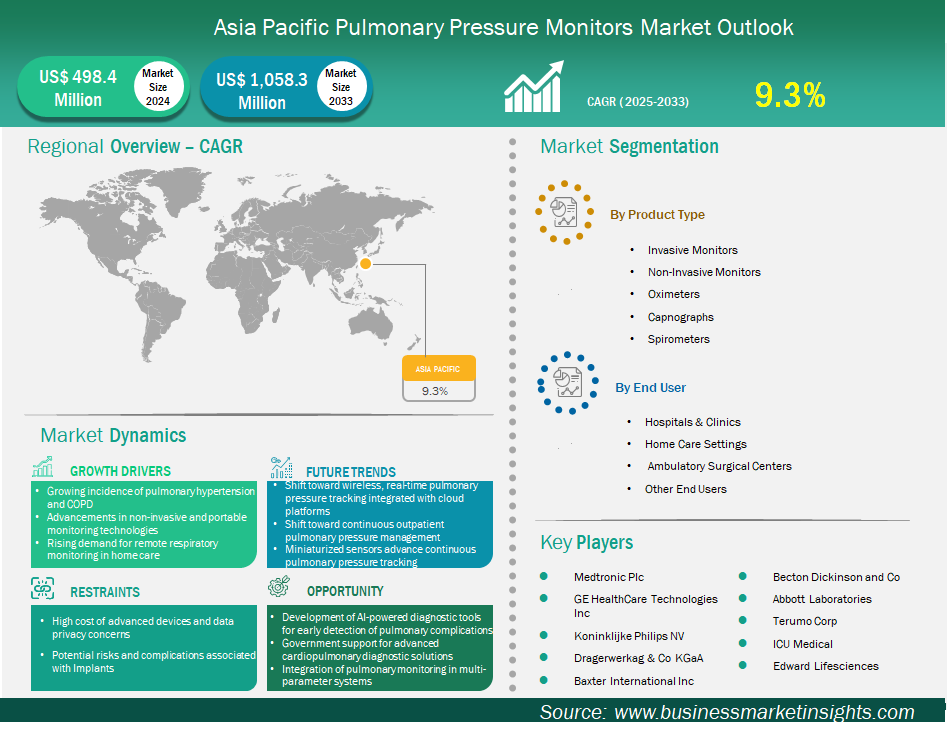
The Asia Pacific pulmonary pressure monitors market size is expected to reach US$ 1,058.3 million by 2033 from US$ 498.4 million in 2024. The market is estimated to record a CAGR of 9.3% from 2025 to 2033.
Executive Summary and Asia Pacific Pulmonary Pressure Monitors Market Analysis:
The pulmonary pressure monitors market in the Asia Pacific is experiencing significant growth driven by the growing incidence of pulmonary hypertension and COPD, advancements in non-invasive and portable monitoring technologies, and rising demand for remote respiratory monitoring in home care. The Asia-Pacific pulmonary pressure monitors market is a complex mixture of factors such as high-growth potential, an evolving healthcare infrastructure, and an awareness of diseases that is on the rise. The region is facing a rise in the occurrence of cardiopulmonary diseases, mostly in populous countries like China and India, where urbanization and lifestyle changes are leading to an increase in the incidence of these diseases. As a result, there is an increasing demand for invasive as well as non-invasive monitoring technologies in tertiary hospitals and specialty clinics. There are many players in this market, which comprise multinational corporations, regional manufacturers, and local distributors who compete in terms of pricing, innovation, and service delivery. Investments by the public sector in healthcare modernization—mainly in Southeast Asia—are facilitating the diagnostic process to a larger extent, while private healthcare providers are the ones who make use of the advanced, integrated monitoring systems, and thus, they drive the demand for them. The conditions for regulation are very different from one country to another, thus affecting market entry strategies and product lifecycle durations. In spite of difficulties in terms of logistics and reimbursement in the remote areas, the market is still strong, due to favourable demographic trends and an increase in healthcare expenditure.
Asia Pacific Pulmonary Pressure Monitors Market Segmentation Analysis:
Key segments that contributed to the derivation of the pulmonary pressure monitors market analysis are product and end user.
- By product, the pulmonary pressure monitors market is segmented into invasive monitors, non-invasive monitors, oximeters, capnographs, and spirometers. The invasive monitors segment dominated the market in 2024. Invasive monitors are the largest segment due to their critical use in high-acuity cardiopulmonary cases across advanced care settings in the Asia Pacific.
- By end user, the market is segmented into hospitals and clinics, home-care settings, ambulatory surgical centers, and other end users. The hospitals and clinics segment held the largest market share in 2024. Hospitals and clinics are the largest segment due to their central role in delivering specialized pulmonary diagnostics supported by expanding infrastructure and skilled personnel.
Asia Pacific Pulmonary Pressure Monitors Market Outlook
The pulmonary pressure monitors market in the Asia Pacific will significantly benefit from the integration of digital health, preventive care, and decentralized diagnostics. When governments across the region are committed to providing universal health coverage and managing chronic diseases, the focus on the early detection and continuous monitoring of lung diseases increases. This is the reason for the rising demand for portable, easy-to-use devices that are available both in clinics and at home. Telemedicine platforms are extending their reach, especially in Australia, South Korea, and Singapore, thus creating new distribution channels for a non-invasive and wearable monitor. Besides, the region is turning into a center for medical device innovation and production with countries such as China, India, and Malaysia, which are investing in R&D and local production capabilities. It is anticipated that the strategic collaborations between global MedTech firms and local healthcare providers will facilitate the technology transfer and market penetration at a rapid pace. The market is ready for a steady, innovation-driven expansion as the reimbursement structures change and the digital infrastructure gets stronger.
Asia Pacific Pulmonary Pressure Monitors Market Country Insights
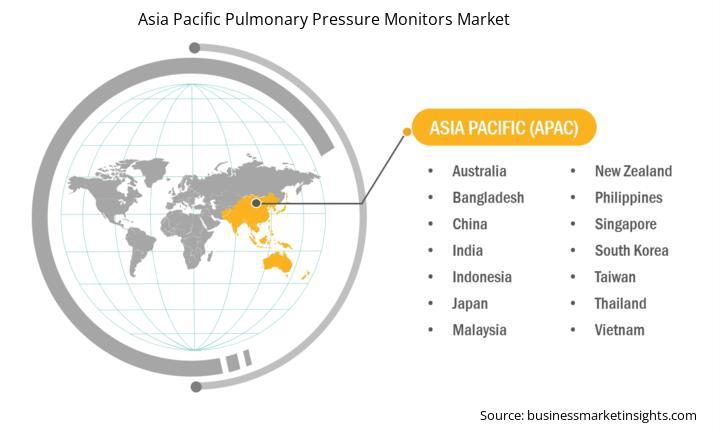
Based on country, the Asia Pacific pulmonary pressure monitors market is segmented into China, India, Japan, Australia, Bangladesh, Indonesia, Malaysia, New Zealand, the Philippines, Singapore, South Korea, Taiwan, Thailand, and Vietnam. China held the largest share in 2024.
The analysis of the Asia Pacific market for pulmonary pressure monitors at the country level shows different trends, the differences between the countries being mainly influenced by the degree of economic development, the healthcare policy, and clinical capacity. China is a good example of such a market, as it features two distinct scenarios: on the one hand, there is the urban market, which is fiercely competitive and is mainly innovation-driven, and on the other hand, there is the countryside market, which is limited in terms of affordability and access. Japan and South Korea are technology leaders and have very advanced clinical practices; hospitals are now equipping themselves with state-of-the-art monitoring devices as part of the integrated cardiopulmonary care model. Australia and New Zealand are practice models for each other in the space of preventive care and remote monitoring, these being enabled by a well-developed digital infrastructure and attractive reimbursement schemes. By contrast, India, Indonesia, and Vietnam, as emerging markets, are concentrating their efforts on increasing the availability of basic diagnostic tools, and their public health initiatives are directed towards the most deprived segments of the population. The small countries are taking steps towards the improvement of their healthcare delivery systems through programs funded by donors and collaborations with the region, apart from the disparities between urban and rural areas, which are still significant growth throughout the region owing to investments in healthcare infrastructure and staff training.
Asia Pacific Pulmonary Pressure Monitors Market Company Profiles
Medtronic Plc, GE HealthCare Technologies Inc, Koninklijke Philips NV, Baxter International Inc, Becton Dickinson and Co, Abbott Laboratories, Terumo Corp, Dragerwerk AG & Co KGaA, ICU Medical, and Edwards Lifesciences, are among the key players operating in the market. These players adopt strategies such as expansion, product innovation, and mergers and acquisitions to stay competitive in the market and offer innovative products to their consumers.
Asia Pacific Pulmonary Pressure Monitors Market Research Methodology:
The following methodology has been followed for the collection and analysis of data presented in this report:
Secondary Research
The research process begins with comprehensive secondary research, utilizing both internal and external sources to gather qualitative and quantitative data for each market. Commonly referenced secondary research sources include, but are not limited to:
- Company websites, annual reports, financial statements, broker analyses, and investor presentations
- Industry trade journals and other relevant publications
- Government documents, statistical databases, and market reports
- News articles, press releases, and webcasts specific to companies operating in the market
Note: All financial data included in the Company Profiles section has been standardized to US$. For companies reporting in other currencies, figures have been converted to US$ using the relevant exchange rates for the corresponding year.
Primary Research
Business Market Insights conducts a significant number of primary interviews each year with industry stakeholders and experts to validate and analyze the data and gain valuable insights. These research interviews are designed to:
- Refine findings from secondary research
- Enhance the expertise and market understanding of the analysis team
- Gain insights into market size, trends, growth patterns, competitive dynamics, and future prospects
Primary research is conducted via email interactions and telephone interviews with industry experts across various markets, categories, segments, and sub-segments in different regions. Participants typically include:
- Industry stakeholders: Vice Presidents, business development managers, market intelligence managers, and national sales managers
- External experts: Valuation specialists, research analysts, and key opinion leaders with industry-specific expertise
Key Sources Referred:
- World Health Organization (WHO)
- Organisation for Economic Co-operation and Development (OECD)
- The World Bank Group
- Worldometer
- The Lancet
- BMC Medical Education
- Eurostat
Asia Pacific Pulmonary Pressure Monitors Market Strategic Insights
Asia Pacific Pulmonary Pressure MonitorsMarket Report Highlights
| Report Attribute | Details |
| Market size in 2024 | US$ 498.4 Million |
| Market Size by 2033 | US$ 1,058.3 Million |
| CAGR (2025 - 2033) | 9.3% |
| Historical Data | 2022-2023 |
| Forecast period | 2025-2033 |
| Segments Covered |
By Product
|
|
Regions and Countries Covered
|
|
| Asia Pacific | China, Japan, South Korea, India, Australia, New Zealand, Indonesia, Malaysia, Philippines, Singapore, Thailand, Vietnam, Taiwan, Bangladesh |
| Market leaders and key company profiles |
|
Asia Pacific Pulmonary Pressure Monitors Market Country and Regional Insights