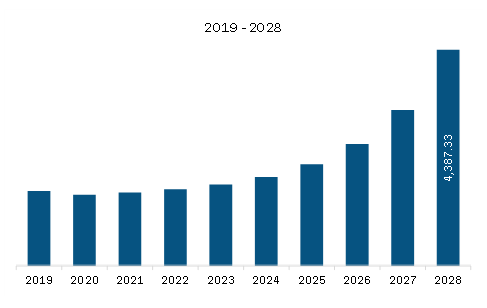
The plastic to fuel market in Asia Pacific is expected to grow from US$ 1,554.95 million in 2022 to US$ 4,387.33 million by 2028. It is estimated to grow at a CAGR of 18.9% from 2022 to 2028.
Increasing Energy Requirement
Electricity is at the heart of modern economies, and it accounts for an increasing proportion of energy services. As a result of increased family incomes, electrification of transportation and heat, and a rise in demand for digital linked gadgets and air conditioning, the energy demand is expected to rise even more. Based on the current stated policies Scenario, the global electricity consumption will grow at a rate of 2.1% per year until 2040, more than double the rate of primary energy demand. As a result, electricity's share of total final energy consumption will increase from 19% in 2018 to 24% in 2040. In emerging nations, the increase in energy consumption is projected to be particularly large. Government policies, market conditions, and available technology all work together in the Stated Policies Scenario to shift energy supply toward low-carbon sources, with their share growing from 36% (current share) to 52% in 2040. Furthermore, the rising electricity demand was one of the main reasons why global CO2 emissions from the power sector reached a new high in 2018. However, the commercial availability of a diverse range of low-emission generation technologies places electricity at the forefront of efforts to combat climate change and pollution, which is increasing the demand for alternate solutions, thereby resulting in PTF market expansion.
Market Overview
Australia, China, India, Japan, South Korea, and rest of Asia Pacific are the key contributors to the plastic to fuel market in the Asia Pacific. China alone produces 59,079,741 tons of plastic every year. These plastic wastes are either dumped into landfills or the ocean, thereby populating the environment and leaving long-term adverse impacts worldwide. Moreover, Asia Pacific accounts for the major share in marine plastic pollution with major contributors such as China, Indonesia, Sri Lanka, Vietnam, and the Philippines. Inefficient waste management infrastructure and the lack of awareness regarding the adverse impact of single-use plastic are the main reasons contributing to the rise in plastic waste across the region. The rising investments by both the governments and private organizations to promote recycling of plastic to further reusable materials are propelling the growth of the Asia Pacific plastic to fuel market across the region. In 2020, Circulate Capital, an investment management organization, announced its investment of US$ 19 million in four privately held Indian recycling companies – Srichakra Polyplast, Dalmia Polypro Industries, Deeya Panel Products, and Rapidue Technologies. Similarly, in 2020, Circulate Capital Ocean Fund (CCOF) invested US$ 39 million to create the largest investment portfolio devoted to fighting ocean plastic waste across India. Hence, constant investments by government and private companies to fight the adverse impact of plastic across countries in Asia Pacific are expected to contribute to the growth of the market. Owing to the rise in investments in plastic waste recycling across the region, plastic to fuel market players is also investing in expanding their business across the region. Moreover, local companies are investing in the market. For instance, Singapore-based Environmental Solutions (Asia) Pte Ltd offers plastic to fuel services in the country. Similarly, with the help of pyrolysis technology, newoil converts millions of tons of plastic every year. In 2020, the company announced its plan to convert 20,000 tons of plastic waste into diesel fuel for transportation applications across Singapore.
Asia Pacific Plastic to Fuel Market Revenue and Forecast to 2028 (US$ Million)
Based on technology, the market is segmented into pyrolysis, gasification, and depolymerization. The pyrolysis segment registered the largest market share in 2022.
Based on end product, the market is segmented into crude oil, hydrogen, and others. The crude oil segment held a largest market share in 2022.
Based on country, the market is segmented into Australia, China, India, Japan, South Korea, and rest of APAC. China dominated the market share in 2022.
Agilyx; Klean Industries Inc; Plastic2Oil, Inc; Cassandra Oil AB; MK Aromatics Limited; and OMV Aktiengesellschaft are the leading companies operating in the Asia Pacific plastic to fuel market in the region.
Asia-Pacific Plastic to Fuel Market Strategic Insights
Get more information on this report
Asia-Pacific Plastic to Fuel Market Segmentation Analysis
Asia-Pacific Plastic to Fuel Market Report Highlights
Asia-Pacific Plastic to Fuel Report Scope
Report Attribute
Details
Market size in 2022
US$ 1,554.95 Million
Market Size by 2028
US$ 4,387.33 Million
CAGR (2022 - 2028)
18.9%
Historical Data
2020-2021
Forecast period
2023-2028
Segments Covered
By Technology
Pyrolysis
Gasification
Depolymerization
By End Product
Crude Oil
Hydrogen
Regions and Countries Covered
Asia-Pacific
China, India, Japan, Australia, Rest of Asia-Pacific
Market leaders and key company profiles
Agilyx.
Klean Industries Inc.
Plastic2Oil, Inc.
Cassandra Oil AB.
Plastic Advanced Recycling Corg.
OMV Aktiengesellschaft.
Get more information on this report
Asia-Pacific Plastic to Fuel Market Country and Regional Insights
Get more information on this report
Identical Market Reports with other Region/Countries
The List of Companies - Asia-Pacific Plastic to Fuel Market
Agilyx.Klean Industries Inc.Plastic2Oil, Inc.Cassandra Oil AB.Plastic Advanced Recycling Corg.OMV Aktiengesellschaft.
Frequently Asked Questions
How big is the Asia-Pacific Plastic to Fuel Market?
The Asia-Pacific Plastic to Fuel Market is valued at US$ 1,554.95 Million in 2022, it is projected to reach US$ 4,387.33 Million by 2028.
What is the CAGR for Asia-Pacific Plastic to Fuel Market by (2022 - 2028)?
As per our report Asia-Pacific Plastic to Fuel Market, the market size is valued at US$ 1,554.95 Million in 2022, projecting it to reach US$ 4,387.33 Million by 2028. This translates to a CAGR of approximately 18.9% during the forecast period.
What segments are covered in this report?
The Asia-Pacific Plastic to Fuel Market report typically cover these key segments-
What is the historic period, base year, and forecast period taken for Asia-Pacific Plastic to Fuel Market?
The historic period, base year, and forecast period can vary slightly depending on the specific market research report. However, for the Asia-Pacific Plastic to Fuel Market report:
Historic Period : 2020-2021
Base Year : 2022
Forecast Period : 2023-2028
Who are the major players in Asia-Pacific Plastic to Fuel Market?
The Asia-Pacific Plastic to Fuel Market is populated by several key players, each contributing to its growth and innovation. Some of the major players include:
Agilyx.
Klean Industries Inc.
Plastic2Oil, Inc.
Cassandra Oil AB.
Plastic Advanced Recycling Corg.
OMV Aktiengesellschaft.
Who should buy this report?
The Asia-Pacific Plastic to Fuel Market report is valuable for diverse stakeholders, including:
Investors: Provides insights for investment decisions pertaining to market growth, companies, or industry insights. Helps assess market attractiveness and potential returns.
Industry Players: Offers competitive intelligence, market sizing, and trend analysis to inform strategic planning, product development, and sales strategies.
Suppliers and Manufacturers: Helps understand market demand for components, materials, and services related to concerned industry.
Researchers and Consultants: Provides data and analysis for academic research, consulting projects, and market studies.
Financial Institutions: Helps assess risks and opportunities associated with financing or investing in the concerned market.
Essentially, anyone involved in or considering involvement in the Asia-Pacific Plastic to Fuel Market value chain can benefit from the information contained in a comprehensive market report.





 Get Free Sample For Asia-Pacific Plastic to Fuel Market