Analysis – by Product Type (Slices and Strips, Rolls, and Roasts) and Distribution Channel (Supermarkets and Hypermarkets, Convenience Stores, Online Retail, and Others)
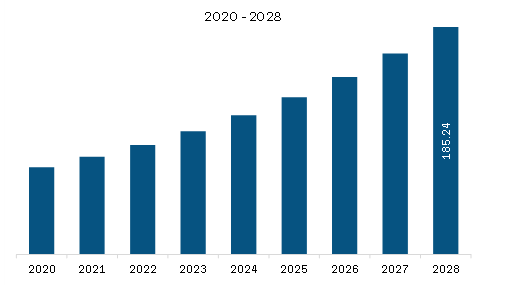
The Asia Pacific plant-based ham market is expected to grow from US$ 89.07 million in 2022 to US$ 185.24 million by 2028. It is estimated to grow at a CAGR of 13.0% from 2022 to 2028.
Product Innovation will be Driving the Asia Pacific Plant-Based Ham Market
Plant-based ham manufacturers are making significant investments in product innovation to offer organic, gluten-free, non-GMO, and allergen-free products for attracting a large number of consumers. Moreover, they are using plant proteins other than soy and pea protein to differentiate their products from their competitors. Plant-based ham manufacturers are also developing products that address the local needs of consumers. For instance, pork is one of the most consumed meats in Asia; however, a limited number of plant-based pork manufacturers operate in this region. As a result, startups such as OmniPork entered Asia in 2018, and in its first two years of operation, the product has witnessed tremendous growth in not only its native Hong Kong but also in Singapore, Macau, Mainland China, Thailand, Taiwan, where around one million OmniPork products have been sold every single week since their launch in January. These developments are expected to surge the demand for plant-based ham.
Asia Pacific Plant-Based Ham Market Overview
The Asia Pacific plant-based ham market is further segmented into Australia, China, Japan, South Korea, and the rest of Asia Pacific. In addition to health consciousness among consumers, religious beliefs contribute to the demand for plant-based meat products in this region. The excessive intake of animal-based food has been linked to diet-related disorders, including obesity, Type 2 diabetes, heart disease, and cancer. According to the “International Diabetes Federation (IDF),” India had 77 million diabetic patients in 2019, which is the world's second-largest diabetic population nationwide; this population is further expected to reach 101 million by 2030. Per the IDF data, ~114 million adults in China had diabetes in 2019. With the high prevalence of diabetes and other similar diseases, consumers are increasingly becoming aware of the importance of a healthy diet and an active lifestyle, resulting in greater public attention toward plant-based products, including ham. In December 2020, Nestlé SA launched a new range of plant-based deli meat under the Harvest Gourmet brand in China. The product line includes meatless alternatives to ham, salami, and sausages. The increasing cases of diseases caused by microbial contamination in food—such as trichinosis from pork, salmonella from poultry, scrapie from lamb, and vibrio illness and norovirus infections from fish—are driving consumer inclination toward plant-based alternatives. Additionally, the busy lifestyle of the urban middle-class population and the lack of nutrients in an individual’s diet are the other factors supporting the Asia Pacific plant-based ham market growth.
Asia Pacific Plant-Based Ham Market Revenue and Forecast to 2028 (US$ Million)
Asia Pacific Plant-Based Ham Market Segmentation
The Asia Pacific plant-based ham market is segmented into product type, distribution channel, and country.
Based on product type, the Asia Pacific plant-based ham market is segmented into slices and strips, rolls, and roasts. In 2022, the slices and strips segment registered a largest share in the Asia Pacific plant-based ham market.
Based on distribution channel, the Asia Pacific plant-based ham market is segmented into supermarkets and hypermarkets, convenience stores, online retail, and others. In 2022, the supermarkets and hypermarkets segment registered a largest share in the Asia Pacific plant-based ham market.
Based on country, the Asia Pacific plant-based ham market is segmented into Australia, China, Japan, South Korea, and the Rest of Asia Pacific. In 2022, China segment registered a largest share in the Asia Pacific plant-based ham market.
Hain Celestial Canada ULC; Mantra Food Thailand Co Ltd; Meliora Foods Pty Ltd; Nestle SA; Quorn Foods Ltd; and VBites Foods Ltd are the leading companies operating in the Asia Pacific plant-based ham market.
Asia Pacific Plant-Based Ham Market Strategic Insights
Get more information on this report
Asia Pacific Plant-Based Ham Market Segmentation Analysis
Asia Pacific Plant-Based Ham Market Report Highlights
Asia Pacific Plant-Based Ham Report Scope
Report Attribute
Details
Market size in 2022
US$ 89.07 Million
Market Size by 2028
US$ 185.24 Million
CAGR (2022 - 2028)
13.0%
Historical Data
2020-2021
Forecast period
2023-2028
Segments Covered
By Product Type
Slices and Strips
Rolls
Roasts
By Distribution Channel
Supermarkets and Hypermarkets
Convenience Stores
Online Retail
Regions and Countries Covered
Asia-Pacific
China, India, Japan, Australia, Rest of Asia-Pacific
Market leaders and key company profiles
Hain Celestial Canada ULC
Mantra Food Thailand Co Ltd
Meliora Foods Pty Ltd
Nestle SA
Quorn Foods Ltd
VBites Foods Ltd
Get more information on this report
Asia Pacific Plant-Based Ham Market Country and Regional Insights
Get more information on this report
Identical Market Reports with other Region/Countries
The List of Companies - Asia Pacific Plant-Based Ham Market
Hain Celestial Canada ULCMantra Food Thailand Co LtdMeliora Foods Pty LtdNestle SAQuorn Foods Ltd VBites Foods Ltd
Frequently Asked Questions
How big is the Asia Pacific Plant-Based Ham Market?
The Asia Pacific Plant-Based Ham Market is valued at US$ 89.07 Million in 2022, it is projected to reach US$ 185.24 Million by 2028.
What is the CAGR for Asia Pacific Plant-Based Ham Market by (2022 - 2028)?
As per our report Asia Pacific Plant-Based Ham Market, the market size is valued at US$ 89.07 Million in 2022, projecting it to reach US$ 185.24 Million by 2028. This translates to a CAGR of approximately 13.0% during the forecast period.
What segments are covered in this report?
The Asia Pacific Plant-Based Ham Market report typically cover these key segments-
Product Type (Slices and Strips, Rolls, Roasts)
Distribution Channel (Supermarkets and Hypermarkets, Convenience Stores, Online Retail)
What is the historic period, base year, and forecast period taken for Asia Pacific Plant-Based Ham Market?
The historic period, base year, and forecast period can vary slightly depending on the specific market research report. However, for the Asia Pacific Plant-Based Ham Market report:
Historic Period : 2020-2021
Base Year : 2022
Forecast Period : 2023-2028
Who are the major players in Asia Pacific Plant-Based Ham Market?
The Asia Pacific Plant-Based Ham Market is populated by several key players, each contributing to its growth and innovation. Some of the major players include:
Hain Celestial Canada ULC
Mantra Food Thailand Co Ltd
Meliora Foods Pty Ltd
Nestle SA
Quorn Foods Ltd
VBites Foods Ltd
Who should buy this report?
The Asia Pacific Plant-Based Ham Market report is valuable for diverse stakeholders, including:
Investors: Provides insights for investment decisions pertaining to market growth, companies, or industry insights. Helps assess market attractiveness and potential returns.
Industry Players: Offers competitive intelligence, market sizing, and trend analysis to inform strategic planning, product development, and sales strategies.
Suppliers and Manufacturers: Helps understand market demand for components, materials, and services related to concerned industry.
Researchers and Consultants: Provides data and analysis for academic research, consulting projects, and market studies.
Financial Institutions: Helps assess risks and opportunities associated with financing or investing in the concerned market.
Essentially, anyone involved in or considering involvement in the Asia Pacific Plant-Based Ham Market value chain can benefit from the information contained in a comprehensive market report.





 Get Free Sample For Asia Pacific Plant-Based Ham Market