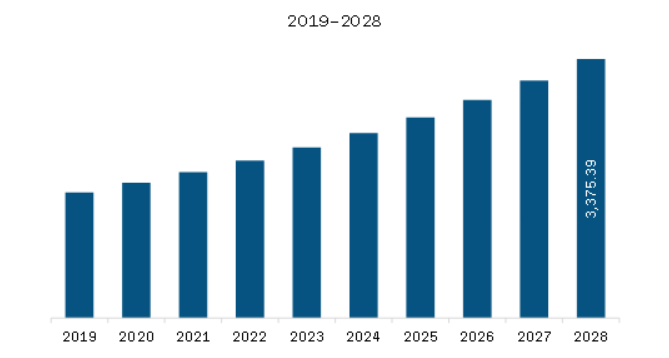
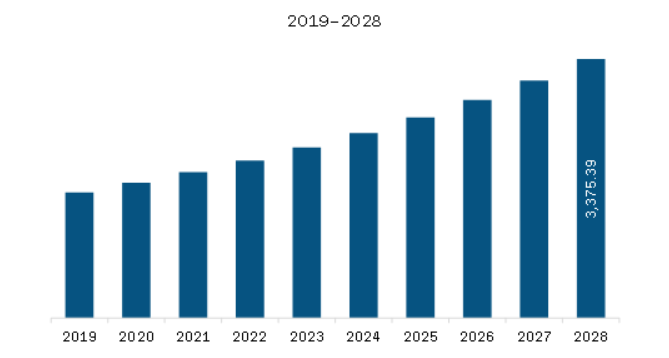
The liver cancer diagnostics market in Asia Pacific is expected to grow from US$ 1,902.85 million in 2021 to US$ 3,375.39 million by 2028. It is estimated to grow at a CAGR of 8.5% from 2021 to 2028.
There are several types of liver cancer in adults, and the two most common types are hepatocellular carcinoma (HCC) and intrahepatic cholangiocarcinoma (ICC). HCC is the most common form of liver cancer among adults, and ICC is a type of liver cancer that occurs in parts of the bile ducts within the liver. Rising advancements in three-dimensional reconstruction image processing technology transformed liver two-dimensional image data into three-dimensional stereoscopic models, and three-dimensional reconstructed images can be restored to real physical models by 3D printing technology.
Further, intuitively exhibiting comprehensive information, such as variations of intrahepatic blood arteries, in greater accuracy and detail is now possible with computer-generated 3D visualization or 3D printed modeling. Moreover, liver volume computation to surgical navigation is vastly improved due to 3D visualization or 3D printed modeling, which allowed for detailed classification of hepatic vessels and liver segmentation, known as Fang's segmentation, used in diagnosing and treating primary liver cancer.
According to a multi-center study from China, postoperative liver failure and perioperative mortality rates in patients who used 3D visualization were 0.8% and 0.2%, respectively, significantly lower than those who did not use 3D visualization, as reported in comparative international literature. Moreover, according to a pilot study by Virginia Commonwealth University (VCU) Massey Cancer Center researcher Andrew Poklepovic, M.D., new technology from ApoCell, Inc. that can detect liver cancer cells circulating in a patient's bloodstream was expected to remove the need for potentially dangerous liver biopsies, to be used as a screening tool and, ultimately, speed up drug development. In addition, ApoCell's capture technique relies on differences in electrical charges between cancer cells and normal blood cells. Due to the difference in charges, cancer cells are attracted to an electrical frequency emanating from a plate in the device, whereas blood cells are repulsed. Further, alternative capture techniques rely on antibodies attached to magnetic beads that bind to epithelial cellular adhesion molecules (EpCAM) on the cancer cells. These alternatives are limited to collecting cancer cells that express significant amounts of EpCAM, expressed in less than one-third of all HCC tumors. Tumor cells are fixed in the alternatives' capture process and cannot be manipulated after collecting them.
Furthermore, due to the rapid development in computer science in the last several decades, especially in artificial intelligence (AI), concepts like machine learning, deep learning, and big data have been applied in many aspects. Deep learning based on artificial neural networks expands the scope of artificial intelligence in the medical field. The research of Radiomics of deep learning is one of the most popular research fields at present. The study of liver diseases by radiomics will contribute to the early diagnosis and treatment of liver diseases and improve survival and cure rates of liver diseases. Thus, the rising emergence of new technologies will fuel the market's growth during the forecast period.
With new features and technologies, vendors can attract new customers and expand their footprints in emerging markets. This factor is likely to drive the Asia Pacific Liver cancer diagnostics market at a substantial CAGR during the forecast period.
Asia Pacific Liver Cancer Diagnostics Market Revenue and Forecast to 2028 (US$ Million)
Asia Pacific Liver Cancer Diagnostics Market Segmentation
The Asia Pacific liver cancer diagnostics market is analyzed on the basis of type, end user, and country. Based on type, the market is segmented into laboratory tests, imaging, endoscopy, biopsy, and others. In 2021, the laboratory tests segment held the largest share of the market, and the imaging segment is expected to register a higher CAGR during the forecast period.
Based on laboratory tests, the market is segmented into blood tests and biomarkers. In 2021, the blood tests segment held a larger market share, and the same segment is expected to register the highest CAGR in the market during the forecast period.
Based on end user, the market is segmented into hospitals and diagnostic laboratories, academic and research institutes, and CRO laboratories. In 2021, the hospitals and diagnostic laboratories segment held the largest share of the market, and the same segment is expected to register a higher CAGR during the forecast period.
Based on country, the Asia Pacific liver cancer diagnostics market is segmented into China, Japan, India, South Korea, Australia, and the Rest of APAC. In 2021, China held the largest market share, and Japan is expected to grow at the fastest CAGR during the forecast period.
Abbott; bioMerieux SA; F. HOFFMANN-LA ROCHE LTD.; Illumina, Inc.; Koninklijke Philips N.V.; QIAGEN; Siemens Healthineers AG; THERMO FISHER SCIENTIFIC INC.; GE Healthcare; and Perspectum are the leading companies in the Asia Pacific liver cancer diagnostics market.
Asia Pacific Liver Cancer Diagnostics Market Strategic Insights
Get more information on this report
Asia Pacific Liver Cancer Diagnostics Market Segmentation Analysis
Asia Pacific Liver Cancer Diagnostics Market Report Highlights
Asia Pacific Liver Cancer Diagnostics Report Scope
Report Attribute
Details
Market size in 2021
US$ 1,902.85 Million
Market Size by 2028
US$ 3,375.39 Million
CAGR (2021 - 2028)
8.5%
Historical Data
2019-2020
Forecast period
2022-2028
Segments Covered
By Type
Laboratory Tests
Endoscopy
Imaging
Biopsy
By End User
Hospitals and Diagnostic Laboratories
Academic and Research Institutes
CRO Laboratories
Regions and Countries Covered
Asia-Pacific
China, India, Japan, Australia, Rest of Asia-Pacific
Market leaders and key company profiles
Abbott
bioMerieux SA
F. HOFFMANN-LA ROCHE LTD.
Illumina, Inc.
Koninklijke Philips N.V.
QIAGEN
Siemens Healthineers AG
THERMO FISHER SCIENTIFIC INC.
GE Healthcare
Perspectum
Get more information on this report
Asia Pacific Liver Cancer Diagnostics Market Country and Regional Insights
Get more information on this report
Identical Market Reports with other Region/Countries
The List of Companies - Asia Pacific Liver Cancer Diagnostics Market
AbbottbioMerieux SAF. HOFFMANN-LA ROCHE LTD.Illumina, Inc.Koninklijke Philips N.V.QIAGENSiemens Healthineers AGTHERMO FISHER SCIENTIFIC INC.GE HealthcarePerspectum
Frequently Asked Questions
How big is the Asia Pacific Liver Cancer Diagnostics Market?
The Asia Pacific Liver Cancer Diagnostics Market is valued at US$ 1,902.85 Million in 2021, it is projected to reach US$ 3,375.39 Million by 2028.
What is the CAGR for Asia Pacific Liver Cancer Diagnostics Market by (2021 - 2028)?
As per our report Asia Pacific Liver Cancer Diagnostics Market, the market size is valued at US$ 1,902.85 Million in 2021, projecting it to reach US$ 3,375.39 Million by 2028. This translates to a CAGR of approximately 8.5% during the forecast period.
What segments are covered in this report?
The Asia Pacific Liver Cancer Diagnostics Market report typically cover these key segments-
Type (Laboratory Tests, Endoscopy, Imaging, Biopsy)
End User (Hospitals and Diagnostic Laboratories, Academic and Research Institutes, CRO Laboratories)
What is the historic period, base year, and forecast period taken for Asia Pacific Liver Cancer Diagnostics Market?
The historic period, base year, and forecast period can vary slightly depending on the specific market research report. However, for the Asia Pacific Liver Cancer Diagnostics Market report:
Historic Period : 2019-2020
Base Year : 2021
Forecast Period : 2022-2028
Who are the major players in Asia Pacific Liver Cancer Diagnostics Market?
The Asia Pacific Liver Cancer Diagnostics Market is populated by several key players, each contributing to its growth and innovation. Some of the major players include:
Abbott
bioMerieux SA
F. HOFFMANN-LA ROCHE LTD.
Illumina, Inc.
Koninklijke Philips N.V.
QIAGEN
Siemens Healthineers AG
THERMO FISHER SCIENTIFIC INC.
GE Healthcare
Perspectum
Who should buy this report?
The Asia Pacific Liver Cancer Diagnostics Market report is valuable for diverse stakeholders, including:
Investors: Provides insights for investment decisions pertaining to market growth, companies, or industry insights. Helps assess market attractiveness and potential returns.
Industry Players: Offers competitive intelligence, market sizing, and trend analysis to inform strategic planning, product development, and sales strategies.
Suppliers and Manufacturers: Helps understand market demand for components, materials, and services related to concerned industry.
Researchers and Consultants: Provides data and analysis for academic research, consulting projects, and market studies.
Financial Institutions: Helps assess risks and opportunities associated with financing or investing in the concerned market.
Essentially, anyone involved in or considering involvement in the Asia Pacific Liver Cancer Diagnostics Market value chain can benefit from the information contained in a comprehensive market report.




 Get Free Sample For Asia Pacific Liver Cancer Diagnostics Market