
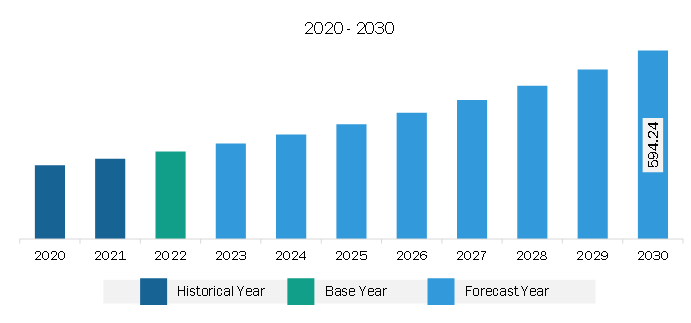
The Asia Pacific laser distance sensor market was valued at US$ 277.09 million in 2022 and is expected to reach US$ 594.24 million by 2030; it is estimated to register at a CAGR of 10.0% from 2022 to 2030.
Rise in Demand for Sensors in Automotive Applications Boosts Asia Pacific Laser Distance Sensor Market
The automotive industry is growing rapidly with rising technological developments. Vehicles rely on effective sensing to allow automated systems to assist drivers and provide better safety, comfort, and convenience. Laser distance sensors are used in autonomous vehicles for various purposes, such as localization, obstacle detection, and picking or placing objects. The technology helps detect objects and provides information on their position and movements within the three-dimensional space. It also assists in identifying the object by detecting its size, shape, and orientation.
The continuous transformation across the automotive industry has triggered the demand for advanced driver-assistance systems (ADAS). With the increasing emphasis on requirements for high levels of accuracy and heterogeneous signal redundancy in ADAS applications, the demand for laser distance sensors is rising. Thus, various automotive manufacturing giants are focusing on ADAS technology. In October 2022, Volkswagen (a German automaker) partnered with Horizon Robotics (a Chinese software company) to develop ADAS and autonomous driving (AD) systems to cater to the rising demand for ADAS systems in the Chinese market. Thus, the adoption of ADAS technology by automakers generates the demand for laser distance sensors to enhance the reliability required for advanced levels of automation in vehicles, which further fuels the laser distance sensor market growth.
Asia Pacific Laser Distance Sensor Market Overview
The Asia Pacific laser distance sensor market is segmented into Australia, China, India, Japan, South Korea, and the Rest of Asia Pacific. The automotive industry across Asia Pacific is experiencing significant growth. According to the International Organization of Motor Vehicle Manufacturers, countries such as India, China, Indonesia, South Korea, and Thailand have experienced a significant rise in vehicle production volume in 2022. Additionally, regional and global automotive manufacturers are investing in establishing new vehicle production plants across the region. For instance, in March 2022, Triton Electric Vehicle LLC announced the launch of its new production plant in Gujarat, India. In addition, in June 2022, BMW announced the opening of its new electric vehicle production plant in China with an investment of US$ 2.2 billion. Thus, the development of the automotive industry requires laser distance sensors for advanced lighting systems for longer-range visibility. Automobile Laser distance sensors are also used for advanced driver assistance systems (ADAS) and other sensing requirements. Thus, the growing automotive industry fosters the laser distance sensor market in the region.
Asia Pacific Laser Distance Sensor Market Revenue and Forecast to 2030 (US$ Million)
Asia Pacific Laser Distance Sensor Market Segmentation
The Asia Pacific laser distance sensor market is segmented based on distance, accuracy, end user, and country.
Based on distance, the Asia Pacific laser distance sensor market is segmented into between 2 and 10 meters, between 11 and 100 meters, between 101 and 200 meters, and between 201 and 500 meters. The between 11 and 100 meters segment held the largest share in 2022.
In terms of accuracy, the Asia Pacific laser distance sensor market is segmented into 1 mm at 2 sigma, 3 mm with 2 sigma, and 5 mm at 2 sigma. The 3 mm with 2 sigma segment held the largest share in 2022.
By end user, the Asia Pacific laser distance sensor market is segmented into manufacturing, construction, automotive and robotics, aerospace and defense, geospatial industry, and others. The automotive and robotics segment held the largest share in 2022.
Based on country, the Asia Pacific laser distance sensor market is categorized into Australia, China, India, Japan, South Korea, and the Rest of Asia Pacific. China dominated the Asia Pacific laser distance sensor market in 2022.
Sick AG, ifm Electronic GmbH, Baumer Holding AG, Keyence Corp, Leuze electronic GmbH & Co KG, Pepperl-Fuchs SE, and Jenoptik AG are some of the leading companies operating in the Asia Pacific laser distance sensor market.
Asia Pacific Laser Distance Sensor Market Strategic Insights

Asia Pacific Laser Distance Sensor Market Report Highlights
| Report Attribute | Details |
| Market size in 2022 | US$ 277.09 Million |
| Market Size by 2030 | US$ 594.24 Million |
| CAGR (2022 - 2030) | 10.0% |
| Historical Data | 2020-2021 |
| Forecast period | 2023-2030 |
| Segments Covered |
By Distance
|
|
Regions and Countries Covered
|
|
| Asia-Pacific | China, India, Japan, Australia, Rest of Asia-Pacific |
| Market leaders and key company profiles |
|
Asia Pacific Laser Distance Sensor Market Country and Regional Insights



