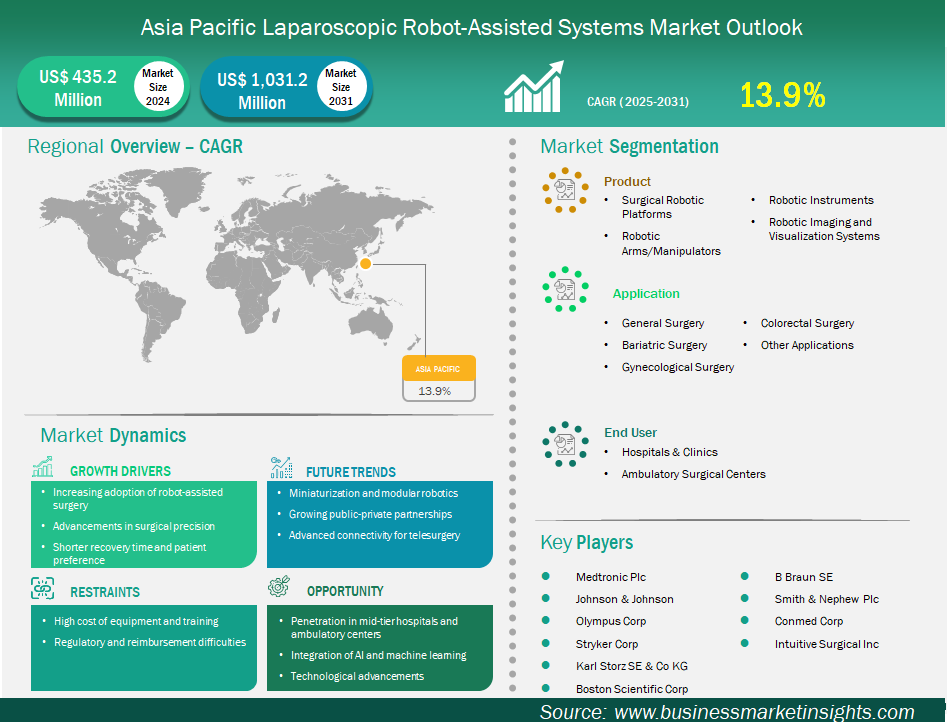
The Asia Pacific laparoscopic robot-assisted systems market size is expected to reach US$ 1,031.2 million by 2031 from US$ 435.2 million in 2024. The market is estimated to record a CAGR of 13.9% from 2025 to 2031.
Executive Summary and Asia Pacific Laparoscopic Robot-Assisted Systems Market Analysis:
The laparoscopic robot-assisted systems market in the Asia Pacific is experiencing significant growth, driven by the increasing adoption of robot-assisted surgery, advancements in surgical precision, shorter recovery times, and patient preference. In the Asia Pacific region, laparoscopic robot-assisted systems are gaining acceptance from medium-level hospitals which are influenced by surgical demand, technological capability, and policy support. Considerable factors for growth are the increase in population of chronic diseases, specifically oncological, metabolic, and age-related diseases, which result in the demand of minimally invasive surgery (MIS) and its benefits, among which improved accuracy, lessened complications, and enhanced recovery. Cost is one of the biggest challenges: capital costs, consumables, maintenance, and surgeon training are very expensive, especially in lower-income Asia Pacific countries. The regulatory environment is diverse, for example, countries like Japan and South Korea have mature appeal processes and reimbursement models while many countries in Southeast Asia and South Asia either take longer for regulatory approvals or there is no approval or reimbursement process.
Asia Pacific Laparoscopic Robot Assisted Systems Market Segmentation Analysis:
Key segments that contributed to the derivation of the laparoscopic robot-assisted systems market analysis are product, application, and end user.
- By product, the laparoscopic robot-assisted systems market is segmented into surgical robotic platforms, robotic arms/manipulators, robotic instruments, and robotic imaging and visualization systems. The surgical robotic platforms segment dominated the market in 2024. Surgical robotic platforms are the largest segment due to their central role in enabling robotic-assisted laparoscopic procedures across multiple specialties.
- In terms of application, the market is segmented into general surgery, bariatric surgery, gynecological surgery, colorectal surgery, and other applications. The general surgery segment held the largest market share in 2024. General surgery is the largest segment by application due to its broad procedural volume and early adoption of robotic systems for minimally invasive techniques.
- By end user, the market is segmented into hospitals and clinics, and ambulatory surgical centers. The hospitals and clinics segment held the largest market share in 2024. Hospitals and clinics are the largest segment by end user due to their infrastructure readiness, access to funding, and higher patient intake requiring advanced surgical interventions.
Asia Pacific Laparoscopic Robot-Assisted Systems Market Outlook
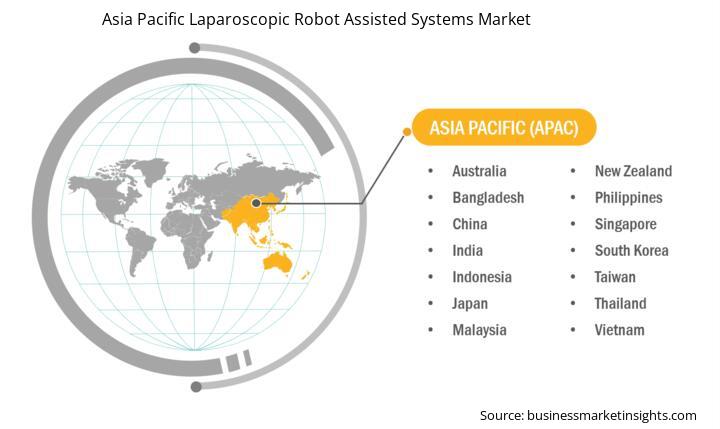
The APAC laparoscopic robot-assisted systems market is segmented into China, India, Japan, Australia, Bangladesh, Indonesia, Malaysia, New Zealand, the Philippines, Singapore, South Korea, Taiwan, Thailand, and Vietnam. The laparoscopic robot-assisted systems market in the Asia Pacific region is anticipated to expand in several areas. Applications are likely to become more specialized, with a more rapid expansion of bariatric, colorectal, gynecologic, and complex oncological MIS robotics, as hospitals seek to treat higher volumes of disease burden in these areas. The technological trends will shift towards smaller, modular robotic systems, accompanied by a reduction in costs to purchase and maintain. Additionally, advancements in AI-augmented visual displays, instrument miniaturization, and haptic feedback will enhance usability for surgeons and expand the potential user community. Another growing area of focus is local manufacturing: initiatives to grow or create domestic capabilities (hardware, software, maintenance) will reduce some level of dependency on imports, shorten latent lead times in the supply chain, and improve price competitiveness for healthcare providers. There will be an expansion of simulation centers. On the risk side of the outlook, economic instability, spending on infrastructure, gaps in reliable electricity, and uneven regulatory approval timelines may slow uptake in developing regions.
Asia Pacific Laparoscopic Robot-Assisted Systems Market Country Insights
Based on country, the Asia Pacific laparoscopic robot-assisted systems market is further segmented into China, India, Japan, Australia, Bangladesh, Indonesia, Malaysia, New Zealand, the Philippines, Singapore, South Korea, Taiwan, Thailand, and Vietnam. China held the largest share in 2024.
The Asia Pacific region is characterized by great diversity, as countries adopt and develop laparoscopic robot-assisted systems differently, based on factors specific to their own situations. China is an outlier as the largest volume and innovation leader, with a large population, rapidly increasing healthcare expenditures, government support for digital health, and domestic manufacturing. Additionally, urban tier-1 and tier-2 hospitals are adopting advanced robotic systems. However, access to care in rural areas varies. Japan has a well-established basic infrastructure and a strong insurance infrastructure, making it an early adopter, especially in urology, gastric, and oncology surgery, with regulatory clarity, and an aging population driving demand for MIS solutions. South Korea and Singapore are innovation and clinical research hubs where clinical hospitals serve as referral centers and have adopted robotics, including cutting-edge imaging and AI integration, as early as possible. India has significant growth potential, as barriers to robotics adoption are limited by capital costs and training. However, the combination of rising medical tourism, increasing interest and subsidies from the Ministry of Health, expanding private hospital chains, and a burgeoning middle class is rapidly creating demand for robotic surgery in the major urban centres. Still, the pace of adoption will be modified by differences across states regarding regulation, insurance reimbursement, and state budgets.
Asia Pacific Laparoscopic Robot Assisted Systems Market Company Profiles
Medtronic Plc; Johnson & Johnson; Olympus Corp; Stryker Corp; Karl Storz SE & Co KG, Boston Scientific Corp, B Braun SE, Smith & Nephew Plc, Conmed Corp, and Intuitive Surgical Inc., are among the key players operating in the market. These players adopt strategies such as expansion, product innovation, and mergers and acquisitions to stay competitive in the market and offer innovative products to their consumers.
Asia Pacific Laparoscopic Robot-Assisted Systems Market Research Methodology:
The following methodology has been followed for the collection and analysis of data presented in this report:
Secondary Research
The research process begins with comprehensive secondary research, utilizing both internal and external sources to gather qualitative and quantitative data for each market. Commonly referenced secondary research sources include, but are not limited to:
- Company websites, annual reports, financial statements, broker analyses, and investor presentations
- Industry trade journals and other relevant publications
- Government documents, statistical databases, and market reports
- News articles, press releases, and webcasts specific to companies operating in the market
Note: All financial data included in the Company Profiles section has been standardized to US$. For companies reporting in other currencies, figures have been converted to US$ using the relevant exchange rates for the corresponding year.
Primary Research
Business Market Insights conducts a significant number of primary interviews each year with industry stakeholders and experts to validate and analyze the data and gain valuable insights. These research interviews are designed to:
- Refine findings from secondary research
- Enhance the expertise and market understanding of the analysis team
- Gain insights into market size, trends, growth patterns, competitive dynamics, and future prospects
Primary research is conducted via email interactions and telephone interviews with industry experts across various markets, categories, segments, and sub-segments in different regions. Participants typically include:
- Industry stakeholders: Vice Presidents, business development managers, market intelligence managers, and national sales managers
- External experts: Valuation specialists, research analysts, and key opinion leaders with industry-specific expertise
Key Sources Referred:
- World Health Organization (WHO)
- The World Bank Group
- Worldometer
- The Lancet
- BMC Medical Education
- Eurostat
Asia Pacific Laparoscopic Robot Assisted Systems Market Strategic Insights
Asia Pacific Laparoscopic Robot Assisted SystemsMarket Report Highlights
| Report Attribute | Details |
| Market size in 2024 | US$ 435.2 Million |
| Market Size by 2031 | US$ 1,031.2 Million |
| CAGR (2025 - 2031) | 13.9% |
| Historical Data | 2021-2023 |
| Forecast period | 2025-2031 |
| Segments Covered |
By Product
|
|
Regions and Countries Covered
|
|
| Asia Pacific | China, Japan, South Korea, India, Australia, New Zealand, Indonesia, Malaysia, Philippines, Singapore, Thailand, Vietnam, Taiwan, Bangladesh |
| Market leaders and key company profiles |
|
Asia Pacific Laparoscopic Robot Assisted Systems Market Country and Regional Insights