
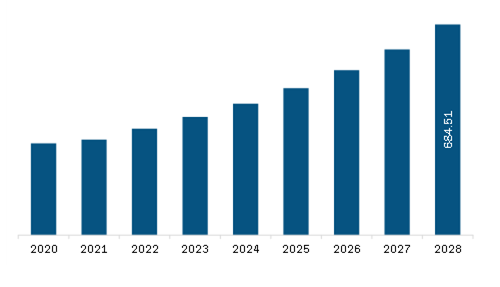
The Asia Pacific hybrid composites market is expected to grow from US$ 383.18 million in 2023 to US$ 684.51 million by 2028. It is estimated to grow at a CAGR of 12.3% from 2023 to 2028.
Rise in Adoption of Biocomposites Fuels Asia Pacific Hybrid Composites Market
Bio-based polymer matrices are environment-friendly and are the subject of extensive research in various fields. Bio-based matrices are also lightweight and exhibit long-term sustainability, which drives their use in commercial applications. Further, the easy availability of natural raw materials to produce bio-based resin is fueling its supply and demand. Bio-based matrices and biocomposites are employed in several secondary applications in aerospace, automobiles, packaging, electronics, and construction sectors. In the construction industry, biocomposites are generally used to produce doors, windows, terrace decking, insulation material, and acoustic components. According to the report from the Global Alliance for Building and Construction, construction is one of the most harmful sectors to the environment. The study conducted by the alliance at the end of 2019 stated that the construction sector is responsible for 39% of the carbon dioxide emissions dispersed in the environment, 36% of global energy consumption, and 50% of the extraction of raw materials. Conventional construction materials are highly resource- and energy-intensive. Hence, owing to the rising concern and awareness about the social and environmental impacts of conventional building materials, manufacturers of composites are shifting toward environment-friendly raw materials. Thus, the growing adoption of bio-based matrices or resins sourced from carbohydrates, vegetable fats and oils, starch, bacteria, and other biological materials, over petroleum-derived plastic matrices is expected to emerge as an important trend in the hybrid composites market during the forecast period.
Asia Pacific Hybrid Composites Market Overview
The Asia Pacific hybrid composites market is segmented into China, Japan, India, South Korea, Australia, and the Rest of Asia Pacific. Of these, China and India are among the world’s top five countries with installed wind power. Hybrid composite is increasingly utilized for wind energy applications. Asia Pacific is home to significant semiconductor and automobile players across the world, e.g., Samsung Electronics Co., Ltd.; Sony Group Corporation; SK Hynix Inc.; Toyota Motor Corporation; Tata Motors Ltd.; Hyundai Motor Company; Nissan Motor Co., Ltd.; and Honda Motor Co., Ltd. These companies are focused on expansion, research and development, and product innovation. Thus, prominent semiconductors and automobile players in the region have increased the demand for hybrid composites.
Asia Pacific Hybrid Composites Market Revenue and Forecast to 2028 (US$ Million)
Asia Pacific Hybrid Composites Market Segmentation
The Asia Pacific hybrid composites market is segmented into fiber type, resin, application, and country.
Based on fiber type, the Asia Pacific hybrid composites market is segmented into carbon/aramid, carbon/glass, high-modulus polypropylene (HMPP)/carbon, ultra high molecular weight polyethylene (UHMWPE)/ carbon, and others. The carbon/aramid segment held the largest share of the Asia Pacific hybrid composites market in 2023.
Based on resin, the Asia Pacific hybrid composites market is segmented into thermoset and thermoplastic. The thermoset segment held a larger share of the Asia Pacific hybrid composites market in 2023.
Based on application, the Asia Pacific hybrid composites market is segmented into automotive, aerospace, marine, wind energy, sporting goods, and others. The automotive segment held the largest share of the Asia Pacific hybrid composites market in 2023.
Based on country, the Asia Pacific hybrid composites market is segmented into China, Japan, India, South Korea, Australia, and the Rest of Asia Pacific. China dominated the Asia Pacific hybrid composites market in 2023.
Avient Corp, Gurit Holding AG, Hexcel Corp, Lanxess AG, Mitsubishi Chemical Holdings Corp, PGTEX China Co Ltd, SGL Carbon SE, Solvay SA, Teijin Ltd, and Toray Industries Inc are the leading companies operating in the Asia Pacific hybrid composites market.
Asia Pacific Hybrid Composites Market Strategic Insights

Asia Pacific Hybrid Composites Market Report Highlights
| Report Attribute | Details |
| Market size in 2023 | US$ 383.18 Million |
| Market Size by 2028 | US$ 684.51 Million |
| CAGR (2023 - 2028) | 12.3% |
| Historical Data | 2021-2022 |
| Forecast period | 2024-2028 |
| Segments Covered |
By Fiber Type
|
|
Regions and Countries Covered
|
|
| Asia-Pacific | China, India, Japan, Australia, Rest of Asia-Pacific |
| Market leaders and key company profiles |
|
Asia Pacific Hybrid Composites Market Country and Regional Insights



