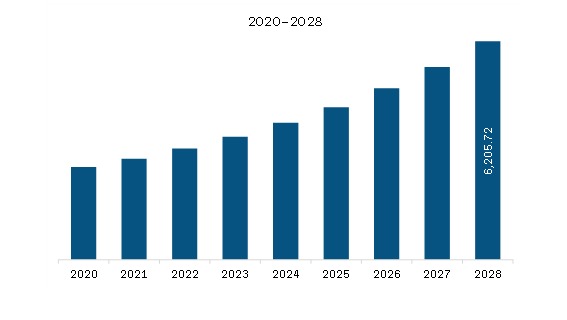
The Asia Pacific gynecology device market is expected to reach value of US$ 6,205.72 million by 2028 from an estimated value of US$ 3,158.43 million in 2022; it is projected to grow at a CAGR of 11.9% from 2022 to 2028.
Major factors responsible to drive the market growth include, rising number of gynecological diseases, utilization of artificial intelligence in gynecology and increasing advancements in devices used for women. However, the limited access to contraception is likely to hamper the market growth during forecast period.
The increase in awareness about gynecological diseases leads to the diagnosis and treatment of gynecological cancer. The healthcare service and facilities providers are aiming to offer more advanced equipment and technologies for the treatment. Artificial intelligence (AI) is growing exponentially in various fields, such as gynecology. For instance, in a report by Norwitz et al., an AI software was created to predict prognosis in patients with ovarian cancer more precisely than current methods and effective treatment for every patient’s diagnosis. Researchers at Brigham and Women’s Hospital and Dana-Farber Cancer Institute have been using AI to change large amounts of micro ribonucleic acid (RNA) data to develop models that can potentially diagnose early ovarian cancer. AI can improve patient outcomes, reduce healthcare costs, and decrease the workload for clinicians.
AI has surpassed human experts in interpreting cervical pre-cancer images. AI deep learning algorithms can gather many images related to cervical cancer screening and identify diseased tissue appropriately. It also ensures that the test is convenient, accurate, and cost-effective. It can help surgeons by providing better imaging and spatial awareness before and during gynecological surgeries. Further, AI has helped decrease operative time and accuracy, thereby reducing operative complications using augmented reality. Moreover, robotics is an example of computer systems assisting in surgery. Incorporating robotics by trained gynecologists is boosting the demand for various surgical instruments. With its help, the possibility of switching to a minimally invasive route during surgery becomes easy and can help reduce invasive surgeries, their associated risks, and operation time. Gynecologic robotic surgery uses equipment that helps in minimally invasive surgical procedures. Further, a few robotics can even decrease tremors to promote accuracy during surgery.
Cancer and other gynecologic conditions can be successfully treated with this innovative technology. Moreover, medical device makers are leaning on leveraging the strength of robotics surgeries to expand their profit. Further, the rapidly growing traction of automation technologies, such as robotics, in the treatment of gynecological disorders is expected to boost the growth of the gynecology devices market.
Asia Pacific Gynecology Devices Market Revenue and Forecast to 2028 (US$ Mn)
ASIA PACIFIC GYNECOLOGY DEVICES MARKET SEGMENTATION
The Asia Pacific gynecology devices market based on the product is segmented into surgical device, hand instruments, and diagnostic imaging systems. The Asia Pacific gynecology devices market based on the end user is segmented into
hospitals, diagnostic centers, clinics, and others. Geographically, the Asia Pacific gynecology device market is divided into India, China, Japan, South Korea, South Africa, and the Rest of Asia Pacific.
Boston Scientific Corporation; CooperSurgical, Inc; Ethicon; General Electric Company; Hologic, Inc.; KARL STORZ SE & Co. KG; Medtronic; Olympus Corporation; Richard Wolf GmbH.; and Stryker are among the leading companies operating in the Asia Pacific gynecology device market.
Asia Pacific Gynecology Devices Market Strategic Insights
Get more information on this report
Asia Pacific Gynecology Devices Market Segmentation Analysis
Asia Pacific Gynecology Devices Market Report Highlights
Asia Pacific Gynecology Devices Report Scope
Report Attribute
Details
Market size in 2022
US$ 3,158.43 Million
Market Size by 2028
US$ 6,205.72 Million
CAGR (2022 - 2028)
11.9%
Historical Data
2020-2021
Forecast period
2023-2028
Segments Covered
By Product
Surgical Devices
Hand Instruments
Diagnostic Imaging System
By End User
Hospitals
Diagnostic Centers
Clinics
Regions and Countries Covered
Asia-Pacific
China, India, Japan, Australia, Rest of Asia-Pacific
Market leaders and key company profiles
Boston Scientific Corporation
CooperSurgical, Inc
Ethicon
General Electric Company
Hologic, Inc.
KARL STORZ SE & Co. KG
Medtronic
Olympus Corporation
Richard Wolf GmbH.
Stryker
Get more information on this report
Asia Pacific Gynecology Devices Market Country and Regional Insights
Get more information on this report
Identical Market Reports with other Region/Countries
The List of Companies - Asia Pacific Gynecology Devices Market
Boston Scientific CorporationCooperSurgical, IncEthiconGeneral Electric CompanyHologic, Inc.KARL STORZ SE & Co. KGMedtronicOlympus CorporationRichard Wolf GmbH.Stryker
Frequently Asked Questions
How big is the Asia Pacific Gynecology Devices Market?
The Asia Pacific Gynecology Devices Market is valued at US$ 3,158.43 Million in 2022, it is projected to reach US$ 6,205.72 Million by 2028.
What is the CAGR for Asia Pacific Gynecology Devices Market by (2022 - 2028)?
As per our report Asia Pacific Gynecology Devices Market, the market size is valued at US$ 3,158.43 Million in 2022, projecting it to reach US$ 6,205.72 Million by 2028. This translates to a CAGR of approximately 11.9% during the forecast period.
What segments are covered in this report?
The Asia Pacific Gynecology Devices Market report typically cover these key segments-
Product (Surgical Devices, Hand Instruments, Diagnostic Imaging System)
End User (Hospitals, Diagnostic Centers, Clinics)
What is the historic period, base year, and forecast period taken for Asia Pacific Gynecology Devices Market?
The historic period, base year, and forecast period can vary slightly depending on the specific market research report. However, for the Asia Pacific Gynecology Devices Market report:
Historic Period : 2020-2021
Base Year : 2022
Forecast Period : 2023-2028
Who are the major players in Asia Pacific Gynecology Devices Market?
The Asia Pacific Gynecology Devices Market is populated by several key players, each contributing to its growth and innovation. Some of the major players include:
Boston Scientific Corporation
CooperSurgical, Inc
Ethicon
General Electric Company
Hologic, Inc.
KARL STORZ SE & Co. KG
Medtronic
Olympus Corporation
Richard Wolf GmbH.
Stryker
Who should buy this report?
The Asia Pacific Gynecology Devices Market report is valuable for diverse stakeholders, including:
Investors: Provides insights for investment decisions pertaining to market growth, companies, or industry insights. Helps assess market attractiveness and potential returns.
Industry Players: Offers competitive intelligence, market sizing, and trend analysis to inform strategic planning, product development, and sales strategies.
Suppliers and Manufacturers: Helps understand market demand for components, materials, and services related to concerned industry.
Researchers and Consultants: Provides data and analysis for academic research, consulting projects, and market studies.
Financial Institutions: Helps assess risks and opportunities associated with financing or investing in the concerned market.
Essentially, anyone involved in or considering involvement in the Asia Pacific Gynecology Devices Market value chain can benefit from the information contained in a comprehensive market report.





 Get Free Sample For Asia Pacific Gynecology Devices Market