Analysis By Component (Solution (Payment Gateways, Payment Processing, Payment Security and Fraud Management, Point of Sale, and Payment Wallet) and Services (Professional Services and Managed Services)), Deployment (Cloud-Based and On-Premises), Organization Size (Large Enterprises and SMEs), and Industry (BFSI, Retail and Ecommerce, Healthcare, Travel and Hospitality, Media and Entertainment, IT and Telecom, and Others)
No. of Pages:156
Report Code:
TIPRE00028681
Category:
Banking, Financial Services, and Insurance
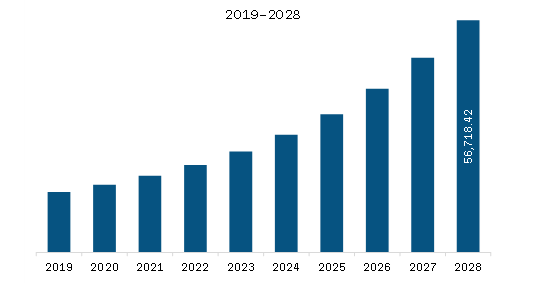
The APAC digital payment market is expected to grow from US$ 18,669.91 million in 2021 to US$ 56,718.42 million by 2028; it is estimated to grow at a CAGR of 17.2% from 2021 to 2028.
Financial services companies are emphasizing open banking initiatives and application programming interfaces. Traditional banks understand that they must improve their digital capabilities to compete in the sector, and use superior offers and services to avoid being disintermediated by new entrants. Companies such as PayPal and Visa are supporting open banking projects. Also, in several countries, open banking initiatives are progressively becoming the norm because banks are legally required to make account information accessible via APIs. Open Banking APIs boost a bank's attractiveness and enable it to meet the changing expectations of existing clients, along with attracting new ones. The APIs may also be used as a one-of-a-kind solution to boost customer interaction and respond to consumer requirements in a safe, agile, and future-proof way. Open Banking APIs are significant assets for financial services organizations because they allow them to expand service offerings, boost client interaction, and create new digital income channels.
China is the most crucial manufacturer and industrial producer, as it trades more manufacturing goods than any other country across the world. A study by Center for Strategic and International Studies reported a drop in the Gross Domestic Product (GDP) of China in 2020. Other major economies, such as India, South Korea, Australia, and Japan, have also been impacted by the pandemic, and they experienced a sharp decline in growth in 2020. However, the increasing number of COVID-19 cases and high death rates in countries, such as India and various Southeast Asian countries, had a slight effect on the digital payment market growth in 2020. Mobility restrictions and cancellation/postponement of various business conferences and events also hampered the overall market in APAC. However, since employees of many enterprises started working from home, the demand for digital payment solutions increased gradually in 2020, which helped mitigate the initial repercussions of the pandemic.
With the new features and technologies, vendors can attract new customers and expand their footprints in emerging markets. This factor is likely to drive the APAC digital payment market. The APAC digital payment market is expected to grow at a good CAGR during the forecast period.
APAC Digital Payment Market Revenue and Forecast to 2028 (US$ Million)
APAC Digital Payment Market Segmentation
APAC Digital Payment Market, by Component
Solution
Payment Gateway
Payment Processing
Payment Security and Fraud Management
Point of Sale
Payment Wallet
Services
Professional Services
Managed Services
APAC Digital Payment Market, by Deployment
On-Premise
Cloud-Based
APAC Digital Payment Market, by Organization Size
SMEs
Large Enterprises
APAC Digital Payment Market, by Industry
BFSI
Retail and Ecommerce
Healthcare
Travel and Hospitality
Media and Entertainment
IT and Telecom
Others
APAC Digital Payment Market, by Country
China
Japan
India
Australia
South Korea
Rest of APAC
APAC Digital Payment Market – Companies Mentioned
ACI Worldwide, Inc.
Adyen
Block, Inc.
Financial Software & Systems Pvt. Ltd.
Fiserv, Inc.
Global Payments Inc.
Novatti Group Ltd
PayPal Holdings, Inc.
PayU
Asia Pacific Digital Payment Market Strategic Insights
Get more information on this report
Asia Pacific Digital Payment Market Segmentation Analysis
Asia Pacific Digital Payment Market Report Highlights
Asia Pacific Digital Payment Report Scope
Report Attribute
Details
Market size in 2021
US$ 18,669.91 Million
Market Size by 2028
US$ 56,718.42 Million
CAGR (2021 - 2028)
17.2%
Historical Data
2019-2020
Forecast period
2022-2028
Segments Covered
By Component
Solution
Services
By Deployment
Cloud-Based
On-Premises
By Organization Size
Large Enterprises
SMEs
By Industry
BFSI
Retail and Ecommerce
Healthcare
Travel and Hospitality
Media and Entertainment
IT and Telecom
Regions and Countries Covered
Asia-Pacific
China, India, Japan, Australia, Rest of Asia-Pacific
Market leaders and key company profiles
ACI Worldwide, Inc.
Adyen
Block, Inc.
Financial Software & Systems Pvt. Ltd.
Fiserv, Inc.
Global Payments Inc.
Novatti Group Ltd
PayPal Holdings, Inc.
PayU
Get more information on this report
Asia Pacific Digital Payment Market Country and Regional Insights
Get more information on this report
Identical Market Reports with other Region/Countries
The List of Companies - Asia Pacific Digital Payment Market
ACI Worldwide, Inc.AdyenBlock, Inc.Financial Software & Systems Pvt. Ltd.Fiserv, Inc.Global Payments Inc. Novatti Group LtdPayPal Holdings, Inc. PayU
Frequently Asked Questions
How big is the Asia Pacific Digital Payment Market?
The Asia Pacific Digital Payment Market is valued at US$ 18,669.91 Million in 2021, it is projected to reach US$ 56,718.42 Million by 2028.
What is the CAGR for Asia Pacific Digital Payment Market by (2021 - 2028)?
As per our report Asia Pacific Digital Payment Market, the market size is valued at US$ 18,669.91 Million in 2021, projecting it to reach US$ 56,718.42 Million by 2028. This translates to a CAGR of approximately 17.2% during the forecast period.
What segments are covered in this report?
The Asia Pacific Digital Payment Market report typically cover these key segments-
Component (Solution, Services)
Deployment (Cloud-Based, On-Premises)
Organization Size (Large Enterprises, SMEs)
Industry (BFSI, Retail and Ecommerce, Healthcare, Travel and Hospitality, Media and Entertainment, IT and Telecom)
What is the historic period, base year, and forecast period taken for Asia Pacific Digital Payment Market?
The historic period, base year, and forecast period can vary slightly depending on the specific market research report. However, for the Asia Pacific Digital Payment Market report:
Historic Period : 2019-2020
Base Year : 2021
Forecast Period : 2022-2028
Who are the major players in Asia Pacific Digital Payment Market?
The Asia Pacific Digital Payment Market is populated by several key players, each contributing to its growth and innovation. Some of the major players include:
ACI Worldwide, Inc.
Adyen
Block, Inc.
Financial Software & Systems Pvt. Ltd.
Fiserv, Inc.
Global Payments Inc.
Novatti Group Ltd
PayPal Holdings, Inc.
PayU
Who should buy this report?
The Asia Pacific Digital Payment Market report is valuable for diverse stakeholders, including:
Investors: Provides insights for investment decisions pertaining to market growth, companies, or industry insights. Helps assess market attractiveness and potential returns.
Industry Players: Offers competitive intelligence, market sizing, and trend analysis to inform strategic planning, product development, and sales strategies.
Suppliers and Manufacturers: Helps understand market demand for components, materials, and services related to concerned industry.
Researchers and Consultants: Provides data and analysis for academic research, consulting projects, and market studies.
Financial Institutions: Helps assess risks and opportunities associated with financing or investing in the concerned market.
Essentially, anyone involved in or considering involvement in the Asia Pacific Digital Payment Market value chain can benefit from the information contained in a comprehensive market report.




 Get Free Sample For Asia Pacific Digital Payment Market