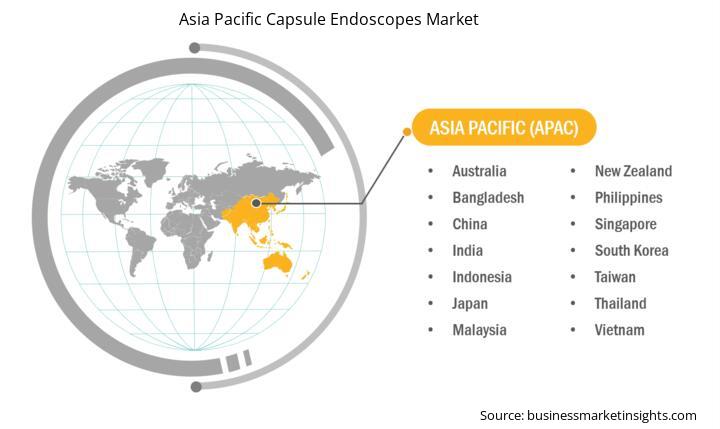
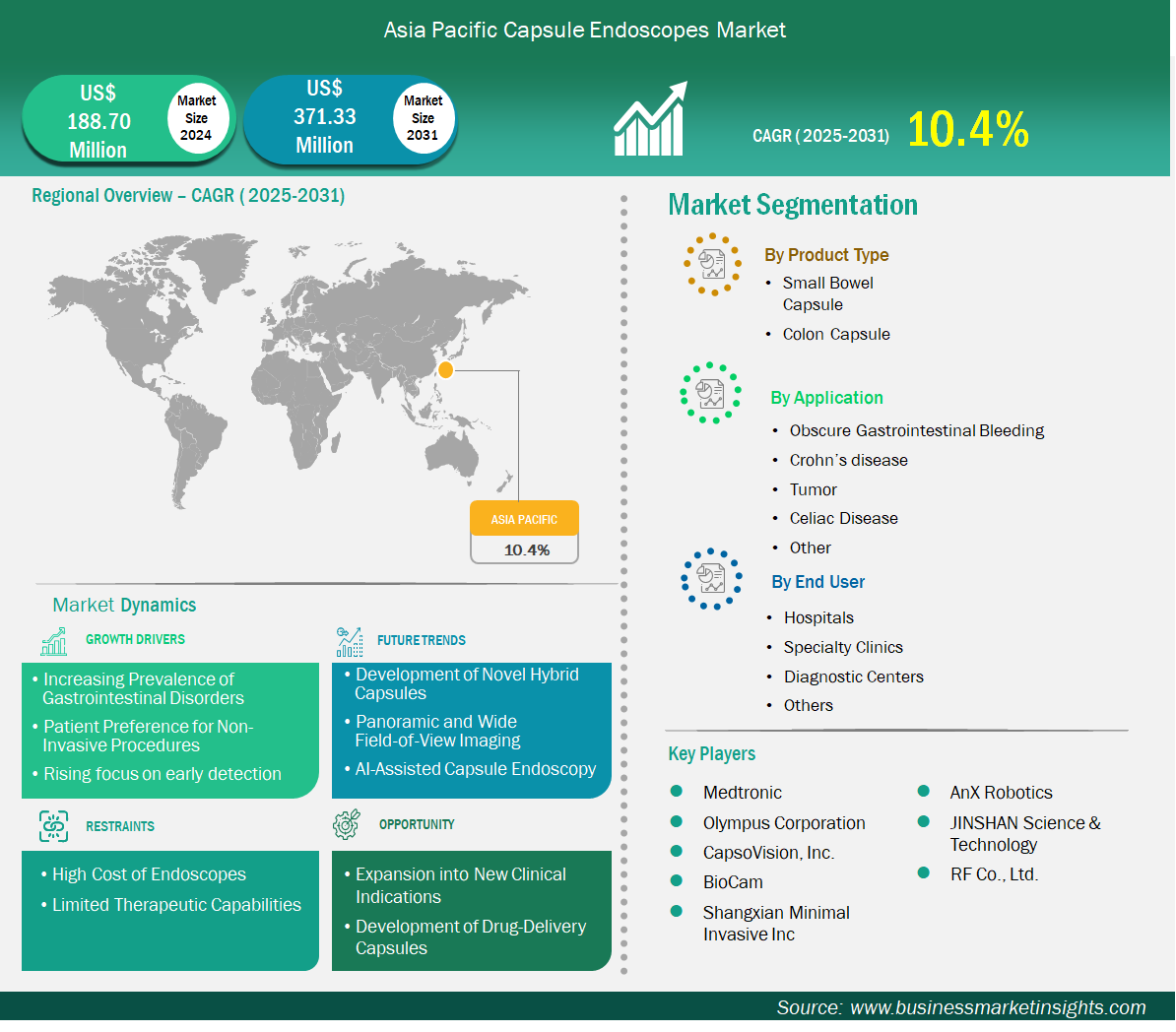
The Asia Pacific capsule endoscopes market size is expected to reach US$ 371.33 million by 2031 from US$ 188.70 million in 2024. The market is estimated to record a CAGR of 10.4% from 2025 to 2031.
Executive Summary and Asia Pacific Capsule Endoscopes Market Analysis:
The Asia Pacific capsule endoscopes market is seeing rapid growth, primarily in response to an increase in healthcare investment, an aging population, and a higher prevalence of gastrointestinal disease across the region. Countries within the Asia Pacific, particularly those with established public health systems, are following non-invasive diagnostic pathways to meet the growing demands of their patient populations for early detection and comfort. Urbanization and improved healthcare access have also increased demand in the region. China is emerging as a regional leader due to its expansive healthcare reforms and digital health evolution. The local manufacturing capacity in combination with government support for MedTech innovations are also fueling market growth. Although rural disparities remain prevalent, mobile health initiatives are improving previous diagnostic gaps related to socioeconomic status. Additionally, expansion into new outpatient settings and rising disposable incomes with an expanding middle class and increased awareness of health will continue to add to the trend toward capsule endoscopy as a preferred diagnostic tool, particularly in low-acuity settings where patient preference for comfort and convenience is paramount.
Asia Pacific Capsule Endoscopes Market Segmentation Analysis:
Key segments that contributed to the derivation of the capsule endoscopes market analysis are product type, application, and end user.
- By product type, the capsule endoscopes market is segmented into small bowel capsule and colon capsule. The small bowel capsule segment dominated the market in 2024.
- By application, the capsule endoscopes market is segmented into obscure gastrointestinal bleeding, Crohn's disease, tumors, celiac disease, and others. The obscure gastrointestinal bleeding segment dominated the market in 2024.
- By end user, the market is segmented into hospitals, specialty clinics, diagnostic centers, and others. The hospitals segment held the largest share of the market in 2024.
Asia Pacific Capsule Endoscopes Market Outlook
Capsule endoscopy in this region is transitioning from being viewed as a more niche procedure to becoming more widely utilized. Hospitals appreciate the procedure's non-invasive, quick, and potentially comfortable aspects for patients when compared to traditional endoscopy. The driving force behind increased use is rising incidence of GI disorders, including ulcers, Crohn’s disease, and intestinal bleeding. Urban hospitals and specialty clinics have been the first adopters, typically providing capsule endoscopy as a premium diagnostic service. Local manufacturing in China and Japan is helping to marginally lower costs, while a training program, conducted by device companies, are making doctors comfortable with the technology. Rural communities continue to be underserved, but telemedicine and mobile health initiatives are starting to cross the divide. Patients continue to prefer procedures that are less invasive, while hospitals are recognizing the potential that capsule endoscopy represents in terms of improved workflow and accuracy, as well as improved early diagnosis, all of which are slowly moving the market along.
Asia Pacific Capsule Endoscopes Market Country Insights
Based on country, the Asia Pacific capsule endoscopes market is segmented into China, Japan, South Korea, India, Australia, New Zealand, Indonesia, Malaysia, Philippines, Singapore, Thailand, Vietnam, Taiwan, Bangladesh, and the Rest of Asia. China held the largest share in 2024.
China is the leader in the Asia Pacific capsule endoscopy market. The larger population of the country, the expansion of private hospitals within the country, as well as ongoing healthcare reform make it the most attractive market in the region. Hospitals in cities such as Beijing, Shanghai, and Guangzhou, have adopted capsule endoscopy not only for patient comfort but also for efficiency of diagnosis. The local manufacturing of the devices has ensured these are more available while Government support for innovation in medical technology has catalyzed investment. Training programs for doctors, along with piloting with tertiary hospitals, has built confidence to use the technology. The adoption of capsule endoscopy in rural areas is still low, however, mobile health programs are beginning to reach patients in smaller cities. China's leadership in the market will set the developments expected within all other countries and should drive future regional growth for the foreseeable future.
Asia Pacific Capsule Endoscopes Market Company Profiles
Medtronic, Olympus Corporation, CapsoVision, Inc., BioCam, Shangxian Minimal Invasive Inc., AnX Robotics, JINSHAN Science & Technology and RF Co., Ltd. are among the key players operating in the market. These players adopt strategies such as expansion, product innovation, and mergers and acquisitions to stay competitive in the market and offer innovative products to their consumers.
Asia Pacific Capsule Endoscopes Market Research Methodology:
The following methodology has been followed for the collection and analysis of data presented in this report:
-
Secondary Research
The research process begins with comprehensive secondary research, utilizing both internal and external sources to gather qualitative and quantitative data for each market. Commonly referenced secondary research sources include, but are not limited to:
- Company websites, annual reports, financial statements, broker analyses, and investor presentations
- Industry trade journals and other relevant publications
- Government documents, statistical databases, and market reports
- News articles, press releases, and webcasts specific to companies operating in the market
Note: All financial data included in the Company Profiles section has been standardized to US$. For companies reporting in other currencies, figures have been converted to US$ using the relevant exchange rates for the corresponding year.
-
Primary Research
Business Market Insights conducts a significant number of primary interviews each year with industry stakeholders and experts to validate and analyze the data and gain valuable insights. These research interviews are designed to:
- Refine findings from secondary research
- Enhance the expertise and market understanding of the analysis team
- Gain insights into market size, trends, growth patterns, competitive dynamics, and future prospects
Primary research is conducted via email interactions and telephone interviews with industry experts across various markets, categories, segments, and sub-segments in different regions. Participants typically include:
- Industry stakeholders: Vice Presidents, business development managers, market intelligence managers, and national sales managers
- External experts: Valuation specialists, research analysts, and key opinion leaders with industry-specific expertise
Key Sources Referred:
- The World Bank
- World Health Organization (WHO)
- Center for Disease Control and Prevention (CDC)
- American Society for Gastrointestinal Endoscopy
- European Society of Gastrointestinal Endoscopy
- World Endoscopy Organization
- Society of American Gastrointestinal and Endoscopic Surgeons
- Global Cancer Observatory
- Company website
- Company annual reports
- Company investor presentations
Asia Pacific Capsule Endoscopes Market Strategic Insights
Asia Pacific Capsule EndoscopesMarket Report Highlights
| Report Attribute | Details |
| Market size in 2024 | US$ 188.70 Million |
| Market Size by 2031 | US$ 371.33 Million |
| CAGR (2025 - 2031) | 10.4 % |
| Historical Data | 2021-2023 |
| Forecast period | 2025-2031 |
| Segments Covered |
By Product Type
|
|
Regions and Countries Covered
|
|
| Asia Pacific | China, Japan, South Korea, India, Australia, New Zealand, Indonesia, Malaysia, Philippines, Singapore, Thailand, Vietnam, Taiwan, Bangladesh |
| Market leaders and key company profiles |
|
Asia Pacific Capsule Endoscopes Market Country and Regional Insights