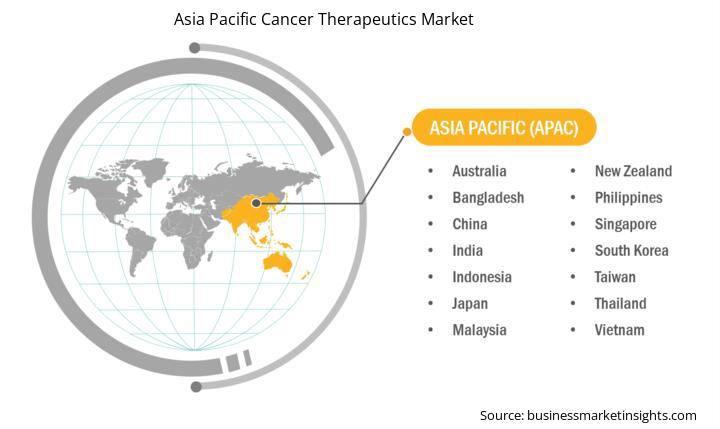
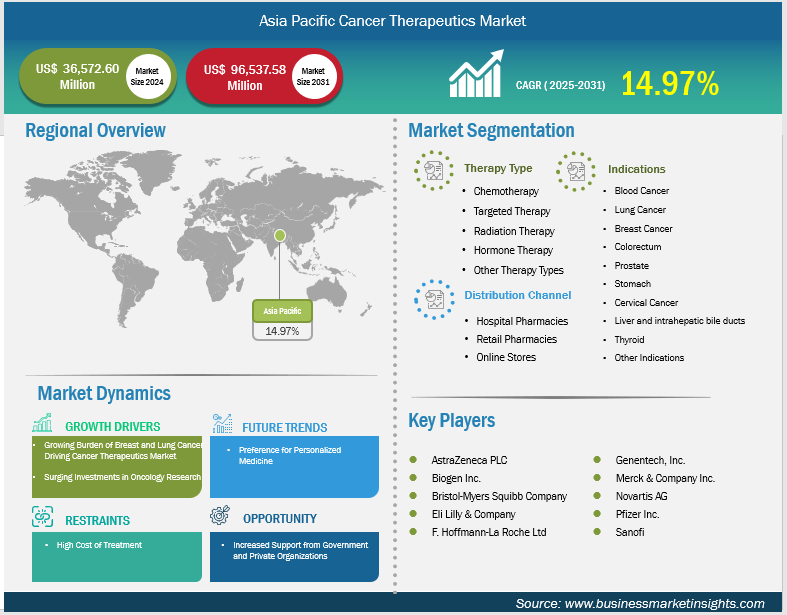
The Asia Pacific Cancer Therapeutics Market size is expected to reach US$ 96,537.58 million by 2031 from US$ 36,572.60 million in 2024. The market is estimated to record a CAGR of 14.97% from 2025 to 2031.
Executive Summary and Asia Pacific Cancer Therapeutics Market Analysis:
Cancer rates are escalating in these countries due to the rapidly aging population; increasing life expectancy; and lifestyle changes such as poor diet, smoking, and lack of physical activity. In 2023, the region accounted for a significant share of the global cancer incidence, recording a large number of new breast, lung, colorectal, and stomach cancer cases. The growth of healthcare infrastructure, coupled with access to advanced treatment options, is one of the key factors driving the market growth in this region. The rise of biosimilars as more affordable alternatives to expensive biologic drugs helps expand the accessibility of cancer treatments in Asia Pacific.
Asia Pacific Cancer Therapeutics Market Segmentation Analysis:
Key segments that contributed to the derivation of the cancer therapeutics market analysis are therapy type, indication, and distribution channel.
- By therapy type, the cancer therapeutics market is segmented into chemotherapy, targeted therapy, radiation therapy, hormone therapy, and other therapy types. The chemotherapy segment dominated the market in 2024.
- In terms of indications, the market is segmented into blood cancer, lung cancer, breast cancer, colorectum cancer, prostate cancer, stomach cancer, cervical cancer, liver and intrahepatic bile duct cancer, thyroid cancer, and other indications. The lung cancer segment held the largest share of the market in 2024.
- By distribution channel, the market is segmented into hospital pharmacies, retail pharmacies, and online stores. The hospital pharmacies segment held the largest share of the market in 2024
Asia Pacific Cancer Therapeutics Market Outlook
The rising drug approvals is fueling the growth in countries in Asia Pcific region. The Japanese Ministry of Health, Labor, and Welfare approved fam-trastuzumab deruxtecan-nxki in March 2023 to treat adult patients with HER2-low unresectable or recurrent breast cancer following chemotherapy. Similarly, in September 2024, Japan's Ministry of Health, Labour, and Welfare (MHLW) granted approval for Fruzaqla (fruquintinib) to treat patients with unresectable metastatic colorectal cancer (mCRC) who have shown disease progression after chemotherapy. This regulatory decision represents the first new targeted therapy approved for mCRC in Japan in over a decade, irrespective of biomarker status.
According to the Commonwealth of Australia report, in May 2023, the Minister of Health and Aged Care announced a plan to invest US$ 263.8 million to implement a National Lung Cancer Screening Program during 2023–2024, which will be followed by its commencement by July 2025. This program is co-designed with the First National Health Sector, and it is expected to maximize the treatment, prevention, and early detection of lung cancer, thus preventing over 500 lung cancer deaths annually. Such efforts allow for the development of advanced therapies and treatments for cancer patients in Australia.
Asia Pacific Cancer Therapeutics Market Country Insights
Based on region, Asia Pacific cancer therapeutics market is further segmented into China, Japan, India, South Korea, Australia, and the Rest of Asia Pacific. China held the largest share in 2024.
As one of the most populous countries in the world, China is facing a growing cancer burden, and the incidence of cancer continues to rise. According to the World Health Organization (WHO), ~4.5 million new cancer cases and 3 million deaths due to cancer were reported in China in 2020. The WHO estimates indicate that approximately seven people are diagnosed with cancer and four die due to cancer in the country every minute. The most common types of cancer diagnosed are lung cancer, stomach cancer, breast cancer, thyroid cancer, and leukemia.
The development of new and more effective therapies has significantly improved patient outcomes and survival rates, leading to a growing demand for these treatments. For instance, in July 2023, AstraZeneca and Daiichi Sankyo's Enhertu (trastuzumab deruxtecan) was approved in China as a monotherapy for the treatment of adult patients with unresectable or metastatic HER2-low (IHC 1+ or IHC 2+/ISH-) breast cancer who have received prior systemic therapy in the metastatic setting or developed disease recurrence during or within 6 months of completing adjuvant chemotherapy
Asia Pacific Cancer Therapeutics Market Company Profiles
Astellas Pharma Inc; Eli Lilly and Co; Novartis AG; Merck KGaA.; Johnson & Johnson; AstraZeneca; Pfizer Inc; Bristol Myers Squibb; F. Hoffmann-La Roche Ltd; and AbbVie are among the key players operating in the market. These companies are engaged in collaborative drug development to bring novel therapeutics for cancer in the market, aiming to stay ahead on competitive edge.
Asia Pacific Cancer Therapeutics Market Research Methodology:
The following methodology has been followed for the collection and analysis of data presented in this report:
- Secondary Research
The research process begins with comprehensive secondary research, utilizing both internal and external sources to gather qualitative and quantitative data for each market. Commonly referenced secondary research sources include, but are not limited to:
- Company websites, annual reports, financial statements, broker analyses, and investor presentations
- Industry trade journals and other relevant publications
- Government documents, statistical databases, and market reports
- News articles, press releases, and webcasts specific to companies operating in the market
Note: All financial data included in the Company Profiles section has been standardized to US$. For companies reporting in other currencies, figures have been converted to US$ using the relevant exchange rates for the corresponding year.
- Primary Research
The Insight Partners conducts a significant number of primary interviews each year with industry stakeholders and experts to validate and analyze the data and gain valuable insights. These research interviews are designed to:
- Refine findings from secondary research
- Enhance the expertise and market understanding of the analysis team
- Gain insights into market size, trends, growth patterns, competitive dynamics, and future prospects
Primary research is conducted via email interactions and telephone interviews with industry experts across various markets, categories, segments, and sub-segments in different regions. Participants typically include:
- Industry stakeholders: Vice Presidents, business development managers, market intelligence managers, and national sales managers
- External experts: Valuation specialists, research analysts, and key opinion leaders with industry-specific expertise
Key Sources Referred:
- The World Bank World Development Indicators
- World Health Organization (WHO)
- Global Cancer Observatory
- Medicines and Healthcare Products Regulatory Agency (MHRA)
Asia Pacific Cancer Therapeutics Market Strategic Insights
Asia Pacific Cancer TherapeuticsMarket Report Highlights
| Report Attribute | Details |
| Market size in 2024 | US$ 36,572.60 Million |
| Market Size by 2031 | US$ 96,537.58 Million |
| CAGR (2025 - 2031) | 14.97% |
| Historical Data | 2021-2023 |
| Forecast period | 2025-2031 |
| Segments Covered |
By Therapy Type
|
|
Regions and Countries Covered
|
|
| Asia Pacific | China, South Korea, India, Indonesia, Australia, Malaysia, Rest of Asia Pacific |
| Market leaders and key company profiles |
|
Asia Pacific Cancer Therapeutics Market Country and Regional Insights