Analysis – by Installation Type (Combiner HUD and Windshield HUD), Location [Conventional HUD and Augmented Reality HUD (AR HUD)], and Vehicle [Passenger Cars, Light Commercial Vehicles (LCV), and Heavy Commercial Vehicles (HCV)]
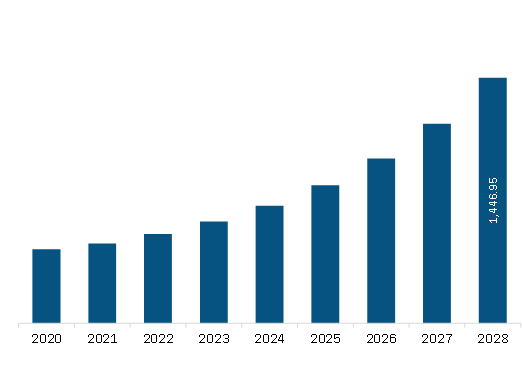
The Asia Pacific automotive HUD market is expected to grow from US$ 524.22 million in 2022 to US$ 1,446.95 million by 2028; it is estimated to grow at a CAGR of 18.4% from 2022 to 2028.
Automotive HUD communicates critical information such as speed, directions, warning messages, and radio information from vehicle to driver. Liquid crystal displays (LCD), light-emitting diodes (LED), and other advanced technologies are used in the display. New projection technologies, such as micro mirror-based devices based on electromechanical systems, are entering the market. By using these technologies, the screen displays information in colorful and bright format. Previously, head-up displays were available only in luxury vehicles. Now, OEMs are considering to installing it in all vehicles. Maruti Suzuki, a Japanese automaker, will sell an upgraded Baleno featuring a huge windshield HUD in the Indian market in 2022.
With the new features and technologies, vendors can attract new customers and expand their footprints in emerging markets. This factor is likely to drive the Asia Pacific automotive HUD market. The Asia Pacific automotive HUD market is expected to grow at a good CAGR during the forecast period.
Asia Pacific automotive HUD market Revenue and Forecast to 2028 (US$ Million)
sia Pacific automotive HUD market Segmentation
The Asia Pacific automotive HUD market is segmented based on by installation type, location, vehicle, and country. Based on installation type, the Asia Pacific automotive HUD market is divided into combiner HUD and windshield HUD. The windshield HUD segment dominated the Asia Pacific automotive HUD market in 2022. Based on location, the Asia Pacific automotive HUD market is categorized into conventional HUD and augmented reality HUD (AR HUD). The conventional HUD segment dominated the Asia Pacific automotive HUD market in 2022. Based on vehicle, the Asia Pacific automotive HUD market is categorized into passenger cars, light commercial vehicle (LCV), and heavy commercial vehicle (HCV). The passenger cars segment dominated the Asia Pacific automotive HUD market in 2022. Based on country, the Asia Pacific automotive HUD market is segmented into China, Japan, India, South Korea, Australia, and Rest of Asia Pacific. The China segment dominated the Asia Pacific automotive HUD market in 2022.
Key players dominating the Asia Pacific automotive HUD market are Continental AG; Denso Corporation; Robert Bosch GmbH; Harman International; Yazaki Corporation; Valeo; Nippon Seiki Co., Ltd; Panasonic Automotive Systems Europe GmbH; and Japan Display Inc. by Altair are among the leading companies in the Asia Pacific automotive HUD market.
Asia Pacific Automotive HUD Market Strategic Insights
Get more information on this report
Asia Pacific Automotive HUD Market Segmentation Analysis
Asia Pacific Automotive HUD Market Report Highlights
Asia Pacific Automotive HUD Report Scope
Report Attribute
Details
Market size in 2022
US$ 524.22 Million
Market Size by 2028
US$ 1,446.95 Million
CAGR (2022 - 2028)
18.4%
Historical Data
2020-2021
Forecast period
2023-2028
Segments Covered
By Installation Type
Combiner HUD
Windshield HUD
By Location
Conventional HUD
Augmented Reality HUD
By Vehicle
Passenger Cars
Light Commercial Vehicles
Heavy Commercial Vehicles
Regions and Countries Covered
Asia-Pacific
China, India, Japan, Australia, Rest of Asia-Pacific
Market leaders and key company profiles
Continental AG
Denso Corporation
Robert Bosch GmbH
Harman International
Yazaki Corporation
Valeo
Nippon Seiki Co., Ltd
Panasonic Automotive Systems Europe GmbH
Japan Display Inc.
Get more information on this report
Asia Pacific Automotive HUD Market Country and Regional Insights
Get more information on this report
Identical Market Reports with other Region/Countries
The List of Companies - Asia Pacific Automotive HUD Market
Continental AGDenso CorporationRobert Bosch GmbHHarman InternationalYazaki CorporationValeoNippon Seiki Co., LtdPanasonic Automotive Systems Europe GmbHJapan Display Inc.
Frequently Asked Questions
How big is the Asia Pacific Automotive HUD Market?
The Asia Pacific Automotive HUD Market is valued at US$ 524.22 Million in 2022, it is projected to reach US$ 1,446.95 Million by 2028.
What is the CAGR for Asia Pacific Automotive HUD Market by (2022 - 2028)?
As per our report Asia Pacific Automotive HUD Market, the market size is valued at US$ 524.22 Million in 2022, projecting it to reach US$ 1,446.95 Million by 2028. This translates to a CAGR of approximately 18.4% during the forecast period.
What segments are covered in this report?
The Asia Pacific Automotive HUD Market report typically cover these key segments-
Vehicle (Passenger Cars, Light Commercial Vehicles, Heavy Commercial Vehicles)
What is the historic period, base year, and forecast period taken for Asia Pacific Automotive HUD Market?
The historic period, base year, and forecast period can vary slightly depending on the specific market research report. However, for the Asia Pacific Automotive HUD Market report:
Historic Period : 2020-2021
Base Year : 2022
Forecast Period : 2023-2028
Who are the major players in Asia Pacific Automotive HUD Market?
The Asia Pacific Automotive HUD Market is populated by several key players, each contributing to its growth and innovation. Some of the major players include:
Continental AG
Denso Corporation
Robert Bosch GmbH
Harman International
Yazaki Corporation
Valeo
Nippon Seiki Co., Ltd
Panasonic Automotive Systems Europe GmbH
Japan Display Inc.
Who should buy this report?
The Asia Pacific Automotive HUD Market report is valuable for diverse stakeholders, including:
Investors: Provides insights for investment decisions pertaining to market growth, companies, or industry insights. Helps assess market attractiveness and potential returns.
Industry Players: Offers competitive intelligence, market sizing, and trend analysis to inform strategic planning, product development, and sales strategies.
Suppliers and Manufacturers: Helps understand market demand for components, materials, and services related to concerned industry.
Researchers and Consultants: Provides data and analysis for academic research, consulting projects, and market studies.
Financial Institutions: Helps assess risks and opportunities associated with financing or investing in the concerned market.
Essentially, anyone involved in or considering involvement in the Asia Pacific Automotive HUD Market value chain can benefit from the information contained in a comprehensive market report.





 Get Free Sample For Asia Pacific Automotive HUD Market