
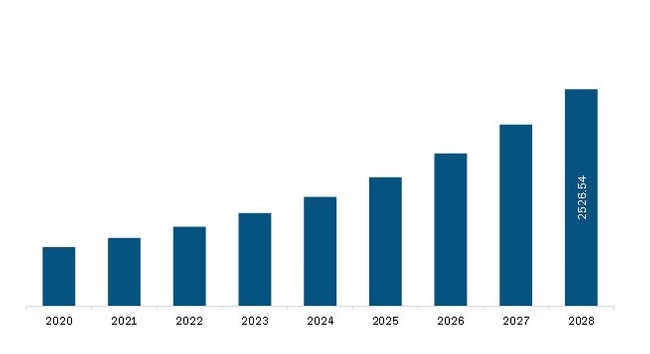
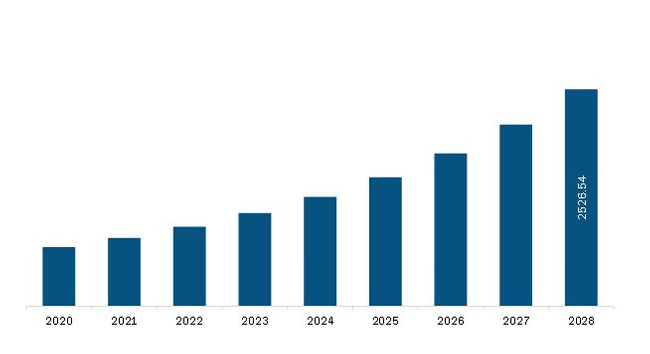
The Asia Pacific architecture software market is expected to reach US$ 2,526.54 million by 2028 from US$ 796.91 million in 2021; it is expected to grow at a CAGR of 17.9% from 2021 to 2028.
Digitalization has been around for a while, and it continues to influence increasingly high professions. Professionals in the architecture industry may employ digital technologies to visualize, develop, and process their ideas faster than conventional methods. The conventional processes in this industry involve a high reliance of architects, contractors, interior designers, and real estate developers on a large number of other individuals. The output of architects did not reach its full potential due to the lengthy and challenging procedure. Digitalization has altered this scenario, allowing architects to work more efficiently and effectively; it also allows them to work from their homes or other comfortable places. Furthermore, digitization has automated several tasks that architects no longer need to spend time on, accelerating the project planning and visualization phases. Architects can accomplish more in less time, increasing their productivity and potential. They not only learn and practice faster in this manner but also earn more professional experience that can be employed in future projects.Architects may produce more realistic representations and visualizations using digitalized tools and applications. Customers may also contribute to the project by highlighting what they wish to keep, amend, or remove while seeing enhanced images, videos, or animations. Digitalization also promotes mutual communication and cooperation. Digitization has also gained traction due to its ability to reduce or eliminate the use of numerous sheets of paper for blueprints, drawings, and plans, making it an environmentally friendly approach to bringing the most complicated projects to life. Furthermore, digital tools provide easy access to the work, allowing customers, architects, and other project participants to view project data remotely. People do not have to rush to their workplaces and book business excursions to analyze plans and propose ideas, as everything is made available online. Flexibility at work, especially while accessing, storing, and transmitting data, is another benefit of using digital tools in architecture projects. Thus, the growing inclination toward digitalization in architecture is expected to provide significant opportunities for the future growth of the architecture software market.
With the new features and technologies, vendors can attract new customers and expand their footprints in emerging markets. This factor is likely to drive the architecture software market. The Asia Pacific architecture software market is expected to grow at a good CAGR during the forecast period.
Asia Pacific Architecture Software Market Revenue and Forecast to 2028 (US$ Million)
Asia Pacific Architecture Software Market Segmentation
The Asia Pacific architecture software market is segmented into software and end user. Based on software, the market is segmented into basic, advance, and pro. Based on end user, the market is segmented into enterprises, institutions, and others. Geographically, the Asia Pacific architecture software market is segmented into China, Japan, India, South Korea, Australia, and the Rest of APAC.
Asia Pacific Architecture Software Market Companies
Corel Corporation; Autodesk Inc.; Dassault Systems; Bluebeam, Inc.; ProgeSOFT; Cadsoft; ActCAD; Trimble Inc.; Chief Architect, Inc.; and Vectorworks, Inc. are among the leading companies in the Asia Pacific architecture software market.
Asia Pacific Architecture Software Market Strategic Insights
Asia Pacific Architecture Software Market Report Highlights
| Report Attribute | Details |
| Market size in 2021 | US$ 796.91 Million |
| Market Size by 2028 | US$ 2,526.54 Million |
| CAGR (2021 - 2028) | 17.9% |
| Historical Data | 2019-2020 |
| Forecast period | 2022-2028 |
| Segments Covered |
By Software Type
|
|
Regions and Countries Covered
|
|
| Asia-Pacific | China, India, Japan, Australia, Rest of Asia-Pacific |
| Market leaders and key company profiles |
|
Asia Pacific Architecture Software Market Country and Regional Insights



