ASEAN Resuscitation Devices Market Outlook (2022-2033)

Historic Data: 2022-2024   |   Base Year: 2025   |   Forecast Period: 2026-2033
Report Content: Market Scope, Market Segmentation, Market Dynamics, and Competitive Analysis

Report Coverage:
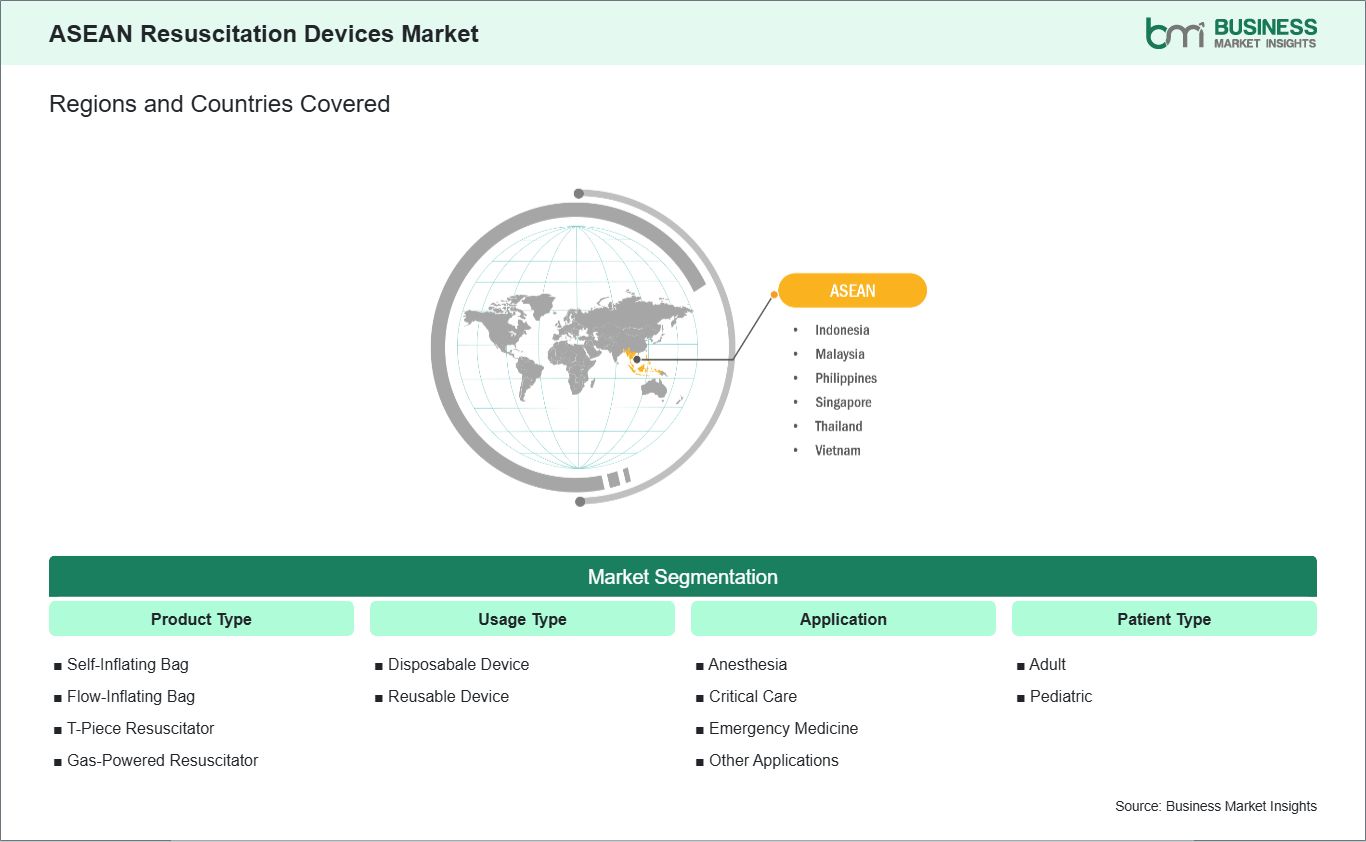
  • Product Type (Self-Inflating Bag, Flow-Inflating Bag, T-Piece Resuscitator, Gas-Powered Resuscitator)
  • Usage Type (Disposabale Device, Reusable Device)
  • Application (Anesthesia, Critical Care, Emergency Medicine, Other Applications)
  • Patient Type (Adult, Pediatric)

No. of Pages: 150
Report Code: BMIPUB00034929
Category: Life Sciences
ASEAN Resuscitation Devices Market

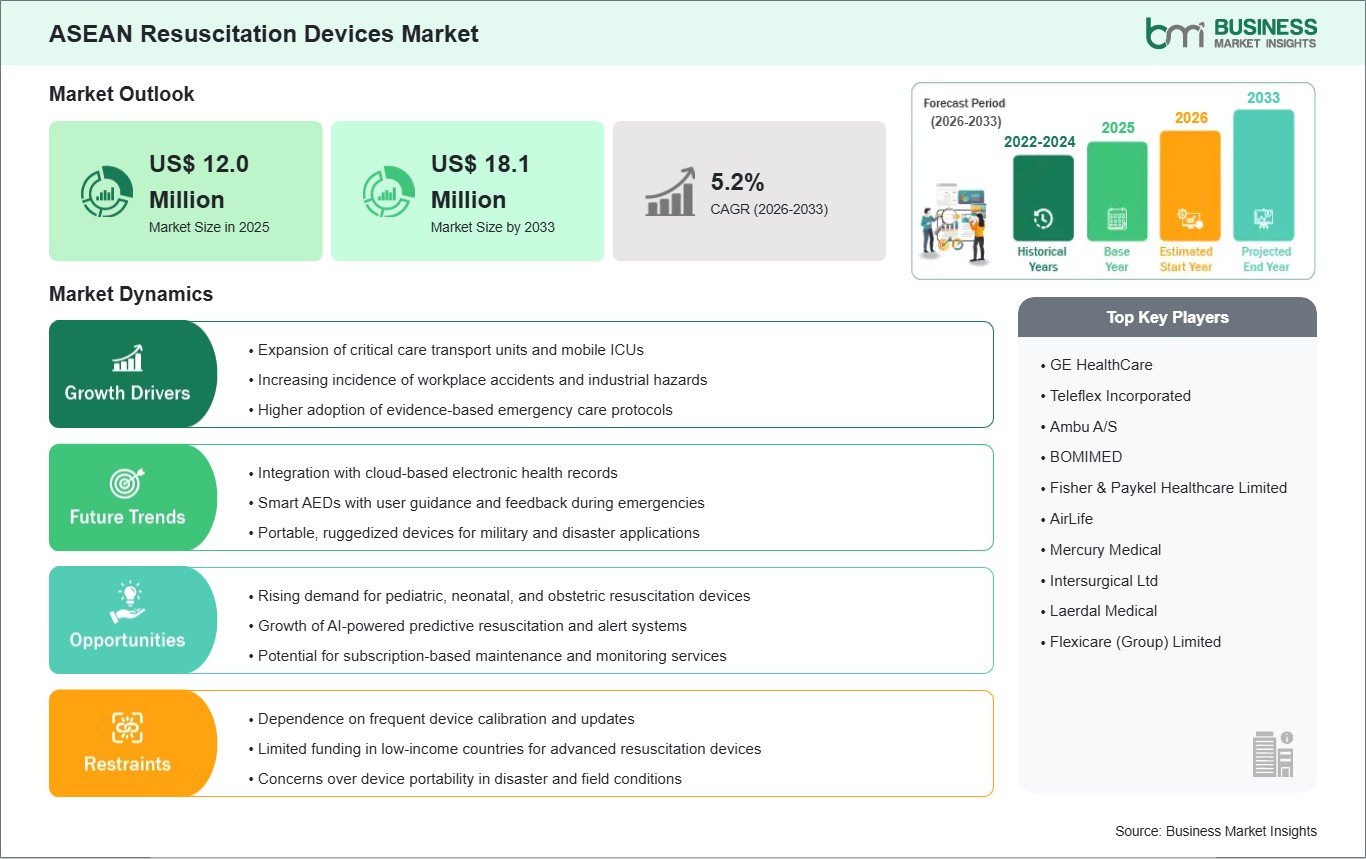
The ASEAN resuscitation devices market size is expected to reach US$ 18.1 million by 2033 from US$ 12.0 million in 2025. The market is estimated to record a CAGR of 5.2% from 2026 to 2033.

Executive Summary and ASEAN Resuscitation Devices Market Analysis:

The ASEAN resuscitation devices market is witnessing steady growth, driven by increasing awareness of cardiovascular emergencies, expanding healthcare infrastructure, and government initiatives to strengthen emergency medical services (EMS) across Southeast Asia. The region includes Indonesia, Thailand, Malaysia, Vietnam, the Philippines, and Singapore, with Indonesia dominating the market due to its large population, rapidly modernizing hospital systems, and rising focus on critical care technologies. The growth of the market will be driven by increased cases of cardiovascular disease, trauma cases, and surgical interventions, which will increase the demand for life-saving devices like Automated External Defibrillator (AED), manual defibrillator, mechanical cardiopulmonary resuscitation (CPR) device, and advanced monitoring systems. The adoption of portable resuscitation technology in hospitals and EMS in urban centers will increase the rate of intervention during critical situations, whereas campaigns about CPR and defibrillation will encourage out-of-hospital emergency interventions. The obstacles that the market in ASEAN may encounter include discrepancies in access to health care facilities between rural and urban areas, inadequate funding for innovative equipment, and regular training of professionals in resuscitation methods. Differences in regulations across various countries will further complicate the process of deployment of the equipment. However, continued investment in the upgrading of hospitals and development of EMS units, and collaborations with device companies from other countries will ensure the consistent implementation of resuscitation technologies in the ASEAN market.

ASEAN Resuscitation Devices Market - Strategic Insights:

global-market-strategic-framework
Get more information on this report

ASEAN Resuscitation Devices Market Segmentation Analysis:

Key segments that contributed to the derivation of the Africa resuscitation devices market analysis are product type, usage type, application, patient type, and end user.

  • By product type, the resuscitation devices market is segmented into self-inflating bag, flow-inflating bag, t-piece resuscitator, and gas-powered resuscitator. The self-inflating bag segment dominated the market in 2025.
  • In terms of usage type, the resuscitation devices market is segmented into disposabale device and reusable device. The disposable devices segment dominated the market in 2025.
  • Based on application, the resuscitation devices market is classified into anesthesia, critical care, emergency medicine, and other applications. The anesthesia segment dominated the market in 2025.
  • By patient type, the resuscitation devices market is segmented into adult and pediatric. The adult segment dominated the market in 2025.
  • By end user, the resuscitation devices market is categorized into hospitals, ambulatory surgical centers, emergency medical services, and other end user. The hospitals segment dominated the market in 2025.

ASEAN Resuscitation Devices Market Drivers and Opportunities:

Expansion of critical care transport units and mobile ICUs

A key driver for the ASEAN market for resuscitation devices is the establishment of critical care transport units and mobile intensive care units (ICU) throughout the ASEAN region. Singapore, Thailand, and Malaysia, among others, have been putting in place state-of-the-art ambulance facilities that are equipped with modern resuscitation devices. The benefit of having these mobile units is that critically ill patients can be attended to in real-time through resuscitation procedures such as defibrillation, advanced airway procedures, and continuous cardiac monitoring even before being brought to tertiary facilities for more comprehensive treatment.

In Singapore and Malaysia, there is an integration of mobile ICUs along with telemedicine facilities, where the paramedics will be able to contact specialists while transferring the patients from one place to another in the ambulance itself. This will make sure that the resuscitation of patients can take place with precision. The need is for small-sized devices, which can help in the simultaneous stabilization of patients with the help of respiration and circulation support systems.

In smaller nations like Cambodia, Vietnam, and the Philippines in ASEAN countries, the scope of mobile health services is being increased, especially when it comes to helping people who live in isolated areas prone to natural disasters. Battery-operated resuscitation devices are important here, and the health service teams can help such people without having to depend on hospital facilities all the time.

Rising Demand for Pediatric, Neonatal, and Obstetric Resuscitation Devices

In the market for resuscitation devices in ASEAN, there is an increasing trend towards buying pediatric, neonatal, and obstetric resuscitation devices as countries become more concerned about improving maternal and infant care. Governments of countries such as Indonesia, Thailand, and the Philippines have been running programs aimed at reducing mortality in newborns and mothers, thus making hospitals and birthing facilities buy resuscitation devices to be used in maternity wards and neonatal departments. Examples of such devices include infant defibrillator pads and neonatal ventilators.

The trend toward adoption of similar pediatric and neonatal resuscitation protocols by urban hospitals located in Bangkok, Jakarta, and Manila has led to availability of appropriate devices for all at-risk births. Educational programs are developed and conducted to train nurses, midwives, and pediatric specialists in handling resuscitation devices and treating neonatal asphyxia, congenital heart diseases, or childbirth complications with such equipment. Growing demand among healthcare providers for specialized care will lead to adoption of pediatric and neonatal resuscitation devices with options for adjustability of ventilation volume, feedback-driven compression system, and temperature monitoring.

Moreover, in remote and semi-urban territories, increasing deployment of mobile maternal and child health services has contributed significantly to growing demand for portable resuscitation devices. These devices will help healthcare professionals to provide first-line assistance to mothers and newborns during childbirth outside the hospitals and ICUs. Due to growing investments made by ASEAN nations into infrastructure for providing child and maternal health services, the market for pediatric, neonatal, and obstetric resuscitation devices is likely to witness considerable growth.

ASEAN Resuscitation Devices Market Size and Share Analysis:

The ASEAN resuscitation devices market is experiencing steady growth, with market size and share analysis reflecting evolving treatment preferences and competitive dynamics among key players. The report evaluates important subsegments categorized within product type, usage type, application, patient type, and end user, highlighting their respective contributions to overall market performance.

By product type, the self-inflating Bag subsegment dominated the market in 2025, as they are easy to use and do not require external gas or power sources, making them ideal for emergencies. They allow precise manual control of ventilation, which is crucial in critical care. Their portability makes them suitable for both hospital wards and transport situations.

Based on usage type, the disposable devices subsegment dominated the market in 2025 due to their ability to prevent cross-contamination and infection. They eliminate the need for complex sterilization processes, saving time and reducing operational costs. In high-volume hospital settings, disposables improve workflow efficiency. This makes them highly preferred in emergency rooms, ICUs, and surgical units.

On the basis of application, the anesthesia subsegment dominated the market in 2025, as resuscitation devices are essential for safe ventilation during induction and recovery. They provide backup support if mechanical ventilators fail. Their precise control helps manage patients with varying lung compliances. Hospitals rely on these devices to prevent hypoxia and ensure patient safety during surgeries.

In terms of patient type, the adult subsegment dominated the market in 2025, as they experience more surgical procedures and critical emergencies than pediatric populations. Their larger lung capacity requires devices designed for adult ventilation. High prevalence of cardiac and respiratory conditions in adults increases usage frequency.

Based on end user, the hospitals subsegment dominated the market in 2025 due to constant emergency and surgical care needs. ICUs, operating rooms, and emergency departments require rapid access to resuscitation devices. High patient volume and stringent safety protocols make hospitals the key market driver. Their centralized procurement and standardized protocols ensure widespread device adoption.

ASEAN Resuscitation Devices Market Report Highlights:

Report Attribute Details
Market size in 2025 US$ 12.0 Million
Market Size by 2033 US$ 18.1 Million
CAGR (2026 - 2033)5.2%
Historical Data 2022-2024
Forecast period 2026-2033
Segments Covered By Product Type
  • Self-Inflating Bag
  • Flow-Inflating Bag
  • T-Piece Resuscitator
  • Gas-Powered Resuscitator
By Usage Type
  • Disposabale Device
  • Reusable Device
By Application
  • Anesthesia
  • Critical Care
  • Emergency Medicine
  • Other Applications
By Patient Type
  • Adult
  • Pediatric
Regions and Countries Covered
ASEAN Indonesia, Malaysia, Philippines, Singapore, Thailand, Vietnam
Market leaders and key company profiles
  • GE HealthCare
  • Teleflex Incorporated
  • Ambu A/S
  • BOMIMED
  • Fisher & Paykel Healthcare Limited
  • AirLife
  • Mercury Medical
  • Intersurgical Ltd
  • Laerdal Medical
  • Flexicare (Group) Limited
Get more information on this report

ASEAN Resuscitation Devices Market Report Coverage and Deliverables:

The "ASEAN Resuscitation Devices Market Size and Forecast (2022–2033)" report provides a detailed analysis of the market covering below areas:

  • ASEAN resuscitation devices market size and forecast at the regional and country levels for segments covered under the scope
  • ASEAN resuscitation devices market trends, as well as drivers, restraints, and opportunities
  • ASEAN resuscitation devices market analysis covering key trends, regional framework, major players, regulations, and recent developments
  • Industry landscape and competition analysis covering market concentration, heat map analysis, prominent players, and recent developments for the ASEAN Resuscitation devices market
  • Detailed company profiles, including SWOT analysis

ASEAN Resuscitation Devices Market Geographic Insights:

The geographical scope of the ASEAN Resuscitation devices market report is divided into: Indonesia, Malaysia, the Philippines, Singapore, Thailand, and Vietnam. Indonesia held the largest share in 2025.

Indonesia leads the ASEAN resuscitation devices market due to its large population, growing healthcare infrastructure, and increasing awareness of emergency preparedness. Major hospitals in Jakarta, Surabaya, and Bali are integrating advanced resuscitation technologies, including smart defibrillators, mechanical CPR systems, and portable emergency response kits, to enhance patient outcomes during both hospital and pre-hospital emergencies. The factors contributing to the dominance of the Indonesian market in this area is the increasing focus on training and education. Hospitals and EMS professionals regularly engage in resuscitation drills using simulations for doctors, nurses, and paramedics to ensure effective usage of the equipment and immediate action in emergencies. Public awareness programs also encourage the use of AEDs at public locations like airports, schools, and businesses. Collaborations between local distributors and international companies manufacturing medical devices contribute to the availability of such devices in Indonesia. Urban hospitals have been using smart, connected equipment that provides immediate feedback to healthcare workers, leading to higher patient survival rates. Such factors help cement the position of Indonesia as the leader in providing resuscitation devices in ASEAN countries.

global-market-geography
Get more information on this report

ASEAN Resuscitation Devices Market Research Report Guidance:

  • The report includes qualitative and quantitative data in the ASEAN resuscitation devices market across product type, usage type, application, patient type, end user, and geography.
  • The report starts with the key takeaways (chapter 2), highlighting the key trends and outlook of the ASEAN resuscitation devices market.
  • Chapter 3 focuses on the research methodology of the study.
  • Chapter 4 includes ecosystem analysis.
  • Chapter 5 highlights the major industry dynamics in the ASEAN resuscitation devices market, including factors that are driving the market, prevailing deterrents, potential opportunities, as well as future trends. Impact analysis of these drivers and restraints is also covered in this section.
  • Chapter 6 discusses the ASEAN resuscitation devices market scenario, in terms of historical market revenues, and forecast till the year 2033.
  • Chapters 7 to 12 cover ASEAN resuscitation devices market segments by product type, usage type, application, patient type, end user, and geography across Indonesia, Malaysia, the Philippines, Singapore, Thailand, and Vietnam. They cover the market revenue, forecast, and factors driving the market.
  • Chapter 13 describes the competitive analysis along with the heat map analysis for the key players operating in the market.
  • Chapter 14 describes the industry landscape analysis. It provides detailed descriptions of business activities such as market initiatives, new developments, mergers, and joint ventures globally, along with a competitive landscape.
  • Chapter 15 provides detailed profiles of the major companies operating in the ASEAN resuscitation devices market. Companies have been profiled on the basis of their key facts, business descriptions, products, financial overview, SWOT analysis, and key developments.
  • Chapter 16, i.e., the appendix, is inclusive of a brief overview of the company, list of abbreviations, and disclaimer.

ASEAN Resuscitation Devices Market News and Key Development:

The ASEAN resuscitation devices market is evaluated by gathering qualitative and quantitative data post primary and secondary research, which includes important corporate publications, association data, and databases. A few of the key developments in the ASEAN resuscitation devices market are:

  • In September 2025, FPT Corporation announced that it partnered with Hanoi Medical University Hospital to launch the first public automated external defibrillator (AED) deployment project in Da Nang, Vietnam, aimed at installing AEDs in community and medical stations and training healthcare workers and community members in lifesaving CPR and defibrillation response.
  • In 2024, ZOLL Medical Corporation announced that it introduced next‑generation AI‑enabled AEDs with enhanced remote connectivity features into the Philippines market, enhancing emergency response capabilities and expanding its regional AED footprint.

Key Sources Referred:

  • The World Bank
  • World Health Organization (WHO)
  • Center for Disease Control and Prevention (CDC)
  • European Database on Medical Devices (EUDAMED)
  • European Society of Cardiology
  • American College of Cardiology
  • American Heart Association
  • Company Websites
  • Company Annual Reports
  • Company Investor Presentations
The List of Companies - ASEAN Resuscitation Devices Market
  • GE HealthCare
  • Teleflex Incorporated
  • Ambu A/S
  • BOMIMED
  • Fisher & Paykel Healthcare Limited
  • AirLife
  • Mercury Medical
  • Intersurgical Ltd
  • Laerdal Medical
  • Flexicare (Group) Limited
Frequently Asked Questions
How big is the ASEAN Resuscitation Devices Market?

The ASEAN Resuscitation Devices Market is valued at US$ 12.0 Million in 2025, it is projected to reach US$ 18.1 Million by 2033.

What is the CAGR for ASEAN Resuscitation Devices Market by (2026 - 2033)?

As per our report ASEAN Resuscitation Devices Market, the market size is valued at US$ 12.0 Million in 2025, projecting it to reach US$ 18.1 Million by 2033. This translates to a CAGR of approximately 5.2% during the forecast period.

What segments are covered in this report?

The ASEAN Resuscitation Devices Market report typically cover these key segments-

  • Product Type (Self-Inflating Bag, Flow-Inflating Bag, T-Piece Resuscitator, Gas-Powered Resuscitator)
  • Usage Type (Disposabale Device, Reusable Device)
  • Application (Anesthesia, Critical Care, Emergency Medicine, Other Applications)
  • Patient Type (Adult, Pediatric)

What is the historic period, base year, and forecast period taken for ASEAN Resuscitation Devices Market?

The historic period, base year, and forecast period can vary slightly depending on the specific market research report. However, for the ASEAN Resuscitation Devices Market report:

  • Historic Period : 2022-2024
  • Base Year : 2025
  • Forecast Period : 2026-2033
  • Who are the major players in ASEAN Resuscitation Devices Market?

    The ASEAN Resuscitation Devices Market is populated by several key players, each contributing to its growth and innovation. Some of the major players include:

  • GE HealthCare
  • Teleflex Incorporated
  • Ambu A/S
  • BOMIMED
  • Fisher & Paykel Healthcare Limited
  • AirLife
  • Mercury Medical
  • Intersurgical Ltd
  • Laerdal Medical
  • Flexicare (Group) Limited
  • Who should buy this report?

    The ASEAN Resuscitation Devices Market report is valuable for diverse stakeholders, including:

    • Investors: Provides insights for investment decisions pertaining to market growth, companies, or industry insights. Helps assess market attractiveness and potential returns.
    • Industry Players: Offers competitive intelligence, market sizing, and trend analysis to inform strategic planning, product development, and sales strategies.
    • Suppliers and Manufacturers: Helps understand market demand for components, materials, and services related to concerned industry.
    • Researchers and Consultants: Provides data and analysis for academic research, consulting projects, and market studies.
    • Financial Institutions: Helps assess risks and opportunities associated with financing or investing in the concerned market.

    Essentially, anyone involved in or considering involvement in the ASEAN Resuscitation Devices Market value chain can benefit from the information contained in a comprehensive market report.

    Available Report Formats

    pdf-format excel-format pptx-format
    Buy Now
    Sales Assistance
    +1 646 791 7070 (US & UK)
    Customization Form

    Please tell us your area of interest
    (Market Segments/ Regions and Countries/ Companies)