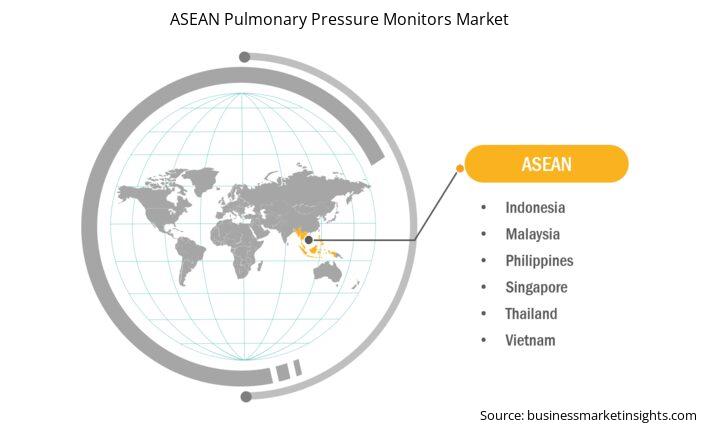
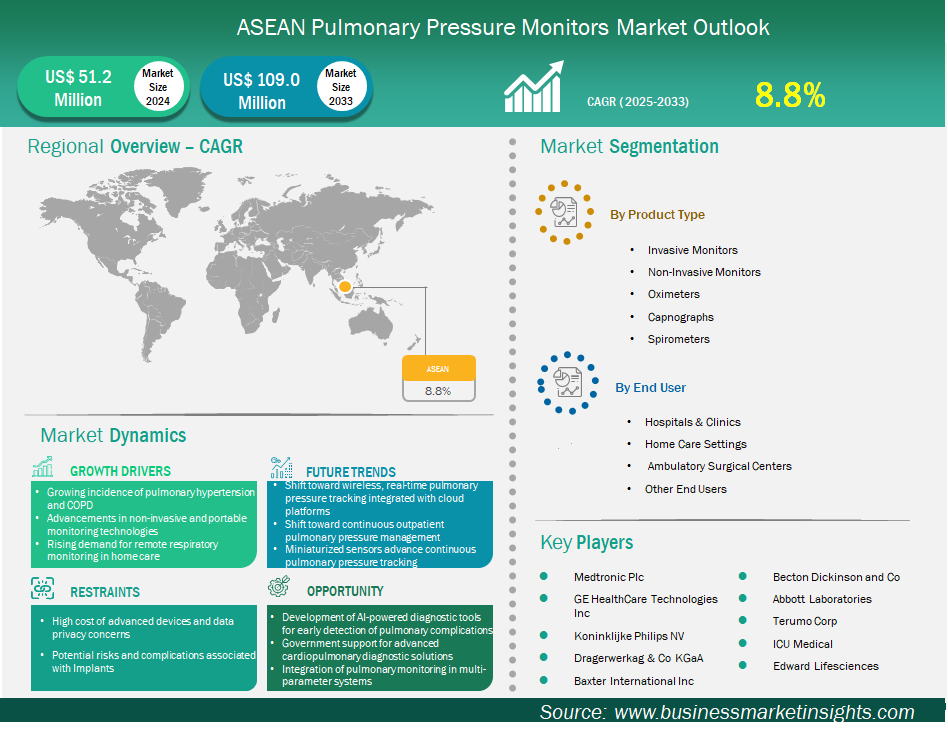
The ASEAN pulmonary pressure monitors market size is expected to reach US$ 109.0 million by 2033 from US$ 51.2 million in 2024. The market is estimated to record a CAGR of 8.8% from 2025 to 2033.
Executive Summary and ASEAN Pulmonary Pressure Monitors Market Analysis:
The pulmonary pressure monitors market in ASEAN is experiencing significant growth driven by the growing incidence of pulmonary hypertension and COPD, advancements in non-invasive and portable monitoring technologies, and rising demand for remote respiratory monitoring in home care. The ASEAN pulmonary pressure monitors market is influenced by a combination of newly built healthcare systems, the increasing chronic diseases, and the rising investments in diagnostic technologies. Along with a solid healthcare infrastructure and increasing demand for cardiopulmonary diagnostics, countries like Singapore, Malaysia, and Thailand are clinical adoption leaders in the region. Invasive monitors mostly dominate the product landscape as they are indispensable in the management of acute pulmonary conditions in tertiary care settings. The market is somewhat fragmented, with worldwide MedTech companies collaborating with regional distributors and local players providing cost-effective alternatives. There is a considerable public sector procurement mainly seen in Indonesia and Vietnam, where government-led health programs are the main drivers of device acquisition. Regulatory frameworks are different; Singapore provides easy approvals, whereas other countries have longer timelines due to decentralized oversight. The market, however, is getting more active due to regional health initiatives and increased pulmonary health awareness, despite the differences in infrastructure and access.
ASEAN Pulmonary Pressure Monitors Market Segmentation Analysis:
Key segments that contributed to the derivation of the pulmonary pressure monitors market analysis are product and end user.
- By product, the pulmonary pressure monitors market is segmented into invasive monitors, non-invasive monitors, oximeters, capnographs, and spirometers. The invasive monitors segment dominated the market in 2024. Invasive monitors are the largest segment due to their critical application in managing acute pulmonary conditions within ASEAN’s expanding tertiary care facilities.
- By end user, the market is segmented into hospitals and clinics, home-care settings, ambulatory surgical centers, and other end users. The hospitals and clinics segment held the largest market share in 2024. Hospitals and clinics are the largest segment due to their dominant role in delivering specialized diagnostics supported by government healthcare investments across the region.
ASEAN Pulmonary Pressure Monitors Market Outlook
The integration of digital health, policy reforms, and strategic investments into the management of chronic diseases deeply influences instruments for measuring pulmonary pressure in the ASEAN region. Governments throughout the region are putting a strong emphasis on early diagnosis and preventive care, thus opening up an opportunity for both invasive as well as non-invasive monitoring technologies. Telehealth platforms and mobile diagnostics are becoming more and more available, which, in turn, is providing wider access to the services, especially in rural and less advantaged areas. To facilitate decentralized care delivery, Thailand and the Philippines, for example, are investing not only in digital infrastructure but also in the training of medical staff. Also, reimbursement models are changing with some markets implementing value-based care frameworks that encourage early intervention and continuous monitoring. Manufacturers are being pushed to come up with innovations around reusable components and scalable solutions due to sustainability and affordability, which are becoming the main criteria for procurement. By leveraging ASEAN health forums, the region can expect to gain from the regulatory harmonization and technology sharing. In the long run, growth will be due to innovation with healthcare capacity-building and access strategies.
ASEAN Pulmonary Pressure Monitors Market Country Insights
Based on country, the ASEAN pulmonary pressure monitors market is segmented into Indonesia, Malaysia, the Philippines, Singapore, Thailand, and Vietnam. Indonesia held the largest share in 2024.
The country-level changes across ASEAN have uncovered a segmented pulmonary pressure monitor market that is diverse in nature. Both Indonesia and Vietnam are extending access via national health programs and donor-funded initiatives; however, there are still some infrastructural deficiencies in the less developed areas of their countries. The level of clinical sophistication in Singapore is rising as hospitals are incorporating state-of-the-art monitoring systems and getting involved in research projects of global significance. Malaysia and Thailand are exhibiting a robust increase in growth, which is a result of public-private partnerships and the extension of services in the field of specialty care. The Philippines is investing in digital health and telemedicine as a means of reaching out to the remote areas. Urban centers lead the use of devices, while rural areas are confronted with problems such as a lack of the necessary workforce and insufficient funding. There is an improvement in the regulatory settings, with steps being taken to standardize standards and make the approval process more efficient. The implementation of adaptable market strategies reflecting each country's healthcare priorities, procurement models, and clinical capacity will play a crucial role in the sustainable development of the ASEAN region.
ASEAN Pulmonary Pressure Monitors Market Company Profiles
Medtronic Plc, GE HealthCare Technologies Inc, Koninklijke Philips NV, Baxter International Inc, Becton Dickinson and Co, Abbott Laboratories, Terumo Corp, Dragerwerk AG & Co KGaA, ICU Medical, and Edwards Lifesciences are among the key players operating in the market. These players adopt strategies such as expansion, product innovation, and mergers and acquisitions to stay competitive in the market and offer innovative products to their consumers.
ASEAN Pulmonary Pressure Monitors Market Research Methodology:
The following methodology has been followed for the collection and analysis of data presented in this report:
Secondary Research
The research process begins with comprehensive secondary research, utilizing both internal and external sources to gather qualitative and quantitative data for each market. Commonly referenced secondary research sources include, but are not limited to:
- Company websites, annual reports, financial statements, broker analyses, and investor presentations
- Industry trade journals and other relevant publications
- Government documents, statistical databases, and market reports
- News articles, press releases, and webcasts specific to companies operating in the market
Note: All financial data included in the Company Profiles section has been standardized to US$. For companies reporting in other currencies, figures have been converted to US$ using the relevant exchange rates for the corresponding year.
Primary Research
Business Market Insights conducts a significant number of primary interviews each year with industry stakeholders and experts to validate and analyze the data and gain valuable insights. These research interviews are designed to:
- Refine findings from secondary research
- Enhance the expertise and market understanding of the analysis team
- Gain insights into market size, trends, growth patterns, competitive dynamics, and future prospects
Primary research is conducted via email interactions and telephone interviews with industry experts across various markets, categories, segments, and sub-segments in different regions. Participants typically include:
- Industry stakeholders: Vice Presidents, business development managers, market intelligence managers, and national sales managers
- External experts: Valuation specialists, research analysts, and key opinion leaders with industry-specific expertise
Key Sources Referred:
- World Health Organization (WHO)
- Organisation for Economic Co-operation and Development (OECD)
- The World Bank Group
- Worldometer
- The Lancet
- BMC Medical Education
- Eurostat
ASEAN Pulmonary Pressure Monitors Market Strategic Insights
ASEAN Pulmonary Pressure MonitorsMarket Report Highlights
| Report Attribute | Details |
| Market size in 2024 | US$ 51.2 Million |
| Market Size by 2033 | US$ 109.0 Million |
| CAGR (2025 - 2033) | 8.8% |
| Historical Data | 2022-2023 |
| Forecast period | 2025-2033 |
| Segments Covered |
By Product
|
|
Regions and Countries Covered
|
|
| ASEAN | Indonesia, Malaysia, Philippines, Singapore, Thailand, Vietnam |
| Market leaders and key company profiles |
|
ASEAN Pulmonary Pressure Monitors Market Country and Regional Insights