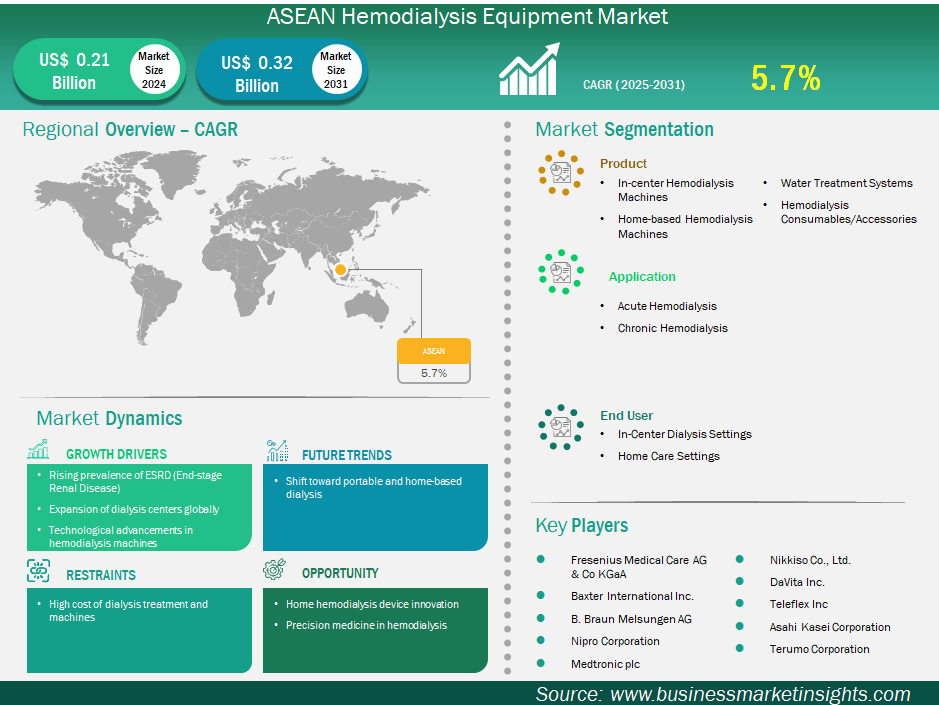
ASEAN hemodialysis equipment market size is expected to reach US$ 316.8 million by 2031 from US$ 214.3 million in 2024. The market is estimated to record a CAGR of 5.7% from 2025 to 2031.
Executive Summary and ASEAN Hemodialysis Equipment Market Analysis:
The hemodialysis equipment market in ASEAN is experiencing significant growth driven by rising prevalence of ESRD (End-Stage Renal Disease), expansion of dialysis centers globally, and technological advancements in hemodialysis machines. The ASEAN hemodialysis equipment market is a high-growth sector propelled by a significant increase in the prevalence of chronic kidney disease (CKD) and a notable expansion of healthcare infrastructure. The region, with a population exceeding 600 million, is witnessing a rapid demographic shift and lifestyle changes, leading to a surge in diabetes and hypertension, the primary drivers of CKD. The market is defined by a dichotomy between more developed economies like Singapore and Malaysia, which have robust and technologically advanced healthcare systems, and emerging economies like Indonesia and Vietnam, which are characterized by a large, underserved patient population and an immense need for basic dialysis access. Governments across the region are actively investing in public-private partnerships to build new dialysis centers and improve care delivery. This combination of a large patient base and strategic government initiatives makes ASEAN an attractive and competitive market for both international and local equipment manufacturers.
ASEAN Hemodialysis Equipment Market Segmentation Analysis:
Key segments that contributed to the derivation of the hemodialysis equipment market analysis are product, application, and end user.
- By product, hemodialysis equipment market is segmented into in-center hemodialysis machines, home-based hemodialysis machines, water treatment systems, and hemodialysis consumables/accessories. The in-center hemodialysis machines segment dominated the market in 2024. This is the largest segment due to the established clinical infrastructure and widespread reliance on conventional in-center hemodialysis as the primary treatment for the vast patient population.
- In terms of application, the market is segmented into acute hemodialysis and chronic hemodialysis. The chronic hemodialysis segment held a larger share of the market in 2024. This is a larger segment due to the rapidly rising prevalence of chronic kidney disease (CKD) and end-stage renal disease (ESRD) in the region, largely fueled by increasing rates of diabetes and hypertension.
- By end user, the market is segmented into in-center dialysis settings and home care settings. The in-center dialysis settings segment held a larger share of the market in 2024. This is a larger segment due to the high patient volume, the need for professional supervision and support for a complex procedure, and a lack of widespread infrastructure for home-based care in many parts of the region.
ASEAN Hemodialysis Equipment Market Outlook
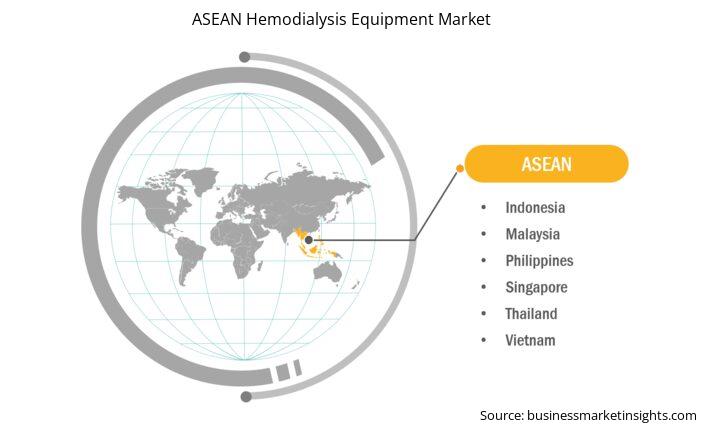
The ASEAN hemodialysis equipment market is segmented into Indonesia, Malaysia, the Philippines, Singapore, Thailand, and Vietnam. The outlook for the ASEAN hemodialysis equipment market is one of continued and accelerated growth, driven by key trends in technological adoption and healthcare policy. The market will see a steady increase in the demand for cost-effective and durable hemodialysis machines, especially in emerging economies where budget constraints are a major consideration. This will create opportunities for regional manufacturers who can provide reliable, affordable alternatives to global brands. Simultaneously, there will be a growing interest in and adoption of advanced modalities like high-volume hemodiafiltration (HDF) in major urban centers and private clinics, reflecting a desire to improve clinical outcomes and patient quality of life. Furthermore, a key future driver is the development of a more integrated healthcare ecosystem, with a focus on electronic health records (EHRs) and digital platforms for patient management and monitoring. This will not only improve efficiency but also lay the groundwork for a potential future shift toward home-based care.
ASEAN Hemodialysis Equipment Market Country Insights
Based on country, the ASEAN hemodialysis equipment market is segmented into Indonesia, Malaysia, the Philippines, Singapore, Thailand, and Vietnam. Indonesia held the largest share in 2024.
The hemodialysis equipment market in ASEAN comprises of different country-level dynamics. Indonesia and the Philippines represent some of the most promising markets due to their large and rapidly growing populations, which have created a substantial, unmet demand for dialysis services. The market in these countries is largely characterized by a high volume of conventional in-center hemodialysis and a strong focus on expanding the number of clinics to improve access to care. In contrast, Singapore has a highly advanced and well-regulated market, with a focus on cutting-edge technology and a very high per capita incidence of treated kidney failure. The market in Singapore is driven by a strong commitment to public health and a willingness to invest in the latest machines and therapies. Meanwhile, Vietnam is emerging as a growth hotspot, with a growing economy and a government that is modernizing its healthcare infrastructure. The market in Vietnam is seeing a rise in the adoption of both in-center and home-based dialysis technologies, supported by government initiatives to improve treatment accessibility and patient outcomes.
ASEAN Hemodialysis Equipment Market Company Profiles
Fresenius Medical Care AG & Co KGaA, Baxter International Inc., B. Braun SE, Nipro Corp, Medtronic Plc, Nikkiso Co Ltd, Teleflex Inc, Asahi Kasei Medical Co., Ltd., Terumo Corp, and DaVita Inc., are among the key players operating in the market. These players adopt strategies such as expansion, product innovation, and mergers and acquisitions to stay competitive in the market and offer innovative products to their consumers.
ASEAN Hemodialysis Equipment Market Research Methodology:
The following methodology has been followed for the collection and analysis of data presented in this report:
- Secondary Research
The research process begins with comprehensive secondary research, utilizing both internal and external sources to gather qualitative and quantitative data for each market. Commonly referenced secondary research sources include, but are not limited to:
- Company websites, annual reports, financial statements, broker analyses, and investor presentations
- Industry trade journals and other relevant publications
- Government documents, statistical databases, and market reports
- News articles, press releases, and webcasts specific to companies operating in the market
Note: All financial data included in the Company Profiles section has been standardized to US$. For companies reporting in other currencies, figures have been converted to US$ using the relevant exchange rates for the corresponding year.
- Primary Research
Business Market Insights conducts a significant number of primary interviews each year with industry stakeholders and experts to validate and analyze the data and gain valuable insights. These research interviews are designed to:
- Refine findings from secondary research
- Enhance the expertise and market understanding of the analysis team
- Gain insights into market size, trends, growth patterns, competitive dynamics, and future prospects
Primary research is conducted via email interactions and telephone interviews with industry experts across various markets, categories, segments, and sub-segments in different regions. Participants typically include:
- Industry stakeholders: Vice Presidents, business development managers, market intelligence managers, and national sales managers
- External experts: Valuation specialists, research analysts, and key opinion leaders with industry-specific expertise
Key Sources Referred:
- World Health Organization (WHO)
- United States Renal Data System (USRDS)
- The World Bank Group
- Worldometer
- The Lancet
- International Trade Administration
ASEAN Hemodialysis Equipment Market Strategic Insights
ASEAN Hemodialysis EquipmentMarket Report Highlights
| Report Attribute | Details |
| Market size in 2024 | US$ 214.3 Million |
| Market Size by 2031 | US$ 316.8 Million |
| CAGR (2025 - 2031) | 5.7% |
| Historical Data | 2021-2023 |
| Forecast period | 2025-2031 |
| Segments Covered |
By Product
|
|
Regions and Countries Covered
|
|
| ASEAN | Indonesia, Malaysia, Philippines, Singapore, Thailand, Vietnam |
| Market leaders and key company profiles |
|
ASEAN Hemodialysis Equipment Market Country and Regional Insights