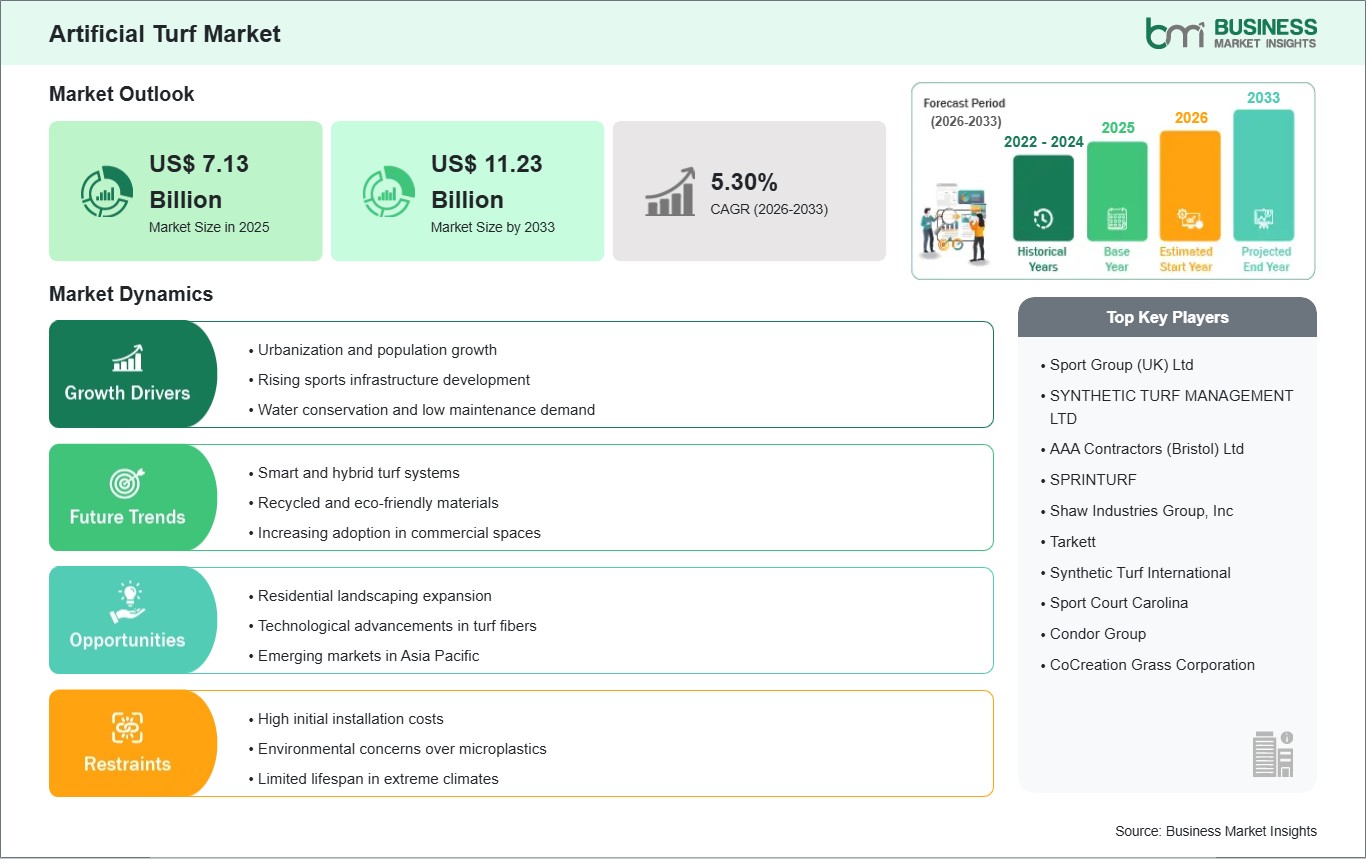
The artificial turf market size is expected to reach US$ 11.23 billion by 2033 from US$ 7.13 billion in 2025. The market is estimated to record a CAGR of 5.3% from 2026 to 2033.
Artificial turf is a synthetic surface that mimics the texture of natural grass. It's made from strong fibers such as polyethylene, polypropylene, or nylon, often mixed with infill materials like rubber granules or sand for cushioning, stability, and a realistic look. It's a low-maintenance option compared to natural grass, needing no watering, mowing, or fertilizing. It resists wear, weather, and heavy foot traffic. This material is gaining popularity in homes, commercial areas, and recreational areas because of its visual appeal, durability, and environmental advantages like water conservation and less pesticide use.
In residential lawns, artificial turf provides year-round greenery with little upkeep. This makes it suitable for homeowners who want appealing landscaping without maintenance hassle. For hardscape, patios, and pavers, it adds softness and an appealing texture to stone or concrete surfaces. Around pools, it offers slip resistance and comfort. On sports fields and playgrounds, turf provides consistent performance, shock absorption, and high durability for athletes and children. Commercial spaces, such as offices, malls, and hotels, use artificial turf to improve outdoor aesthetics. It's also used on balconies and rooftops to create green recreational spaces, and in gyms for training and fitness areas. Other uses include pet areas and event spaces, showing its versatility in various settings.

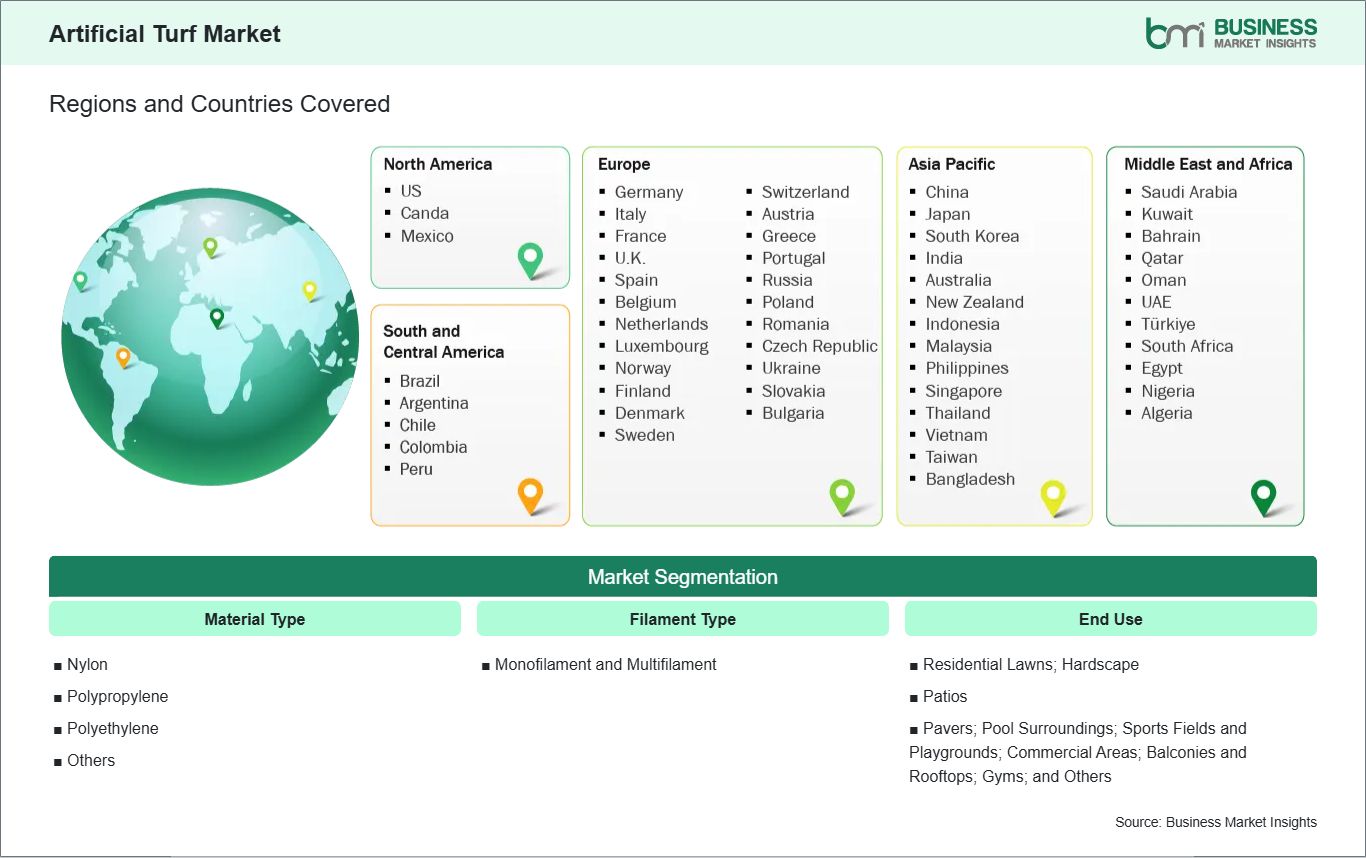
Key segments that contributed to the derivation of the artificial turf market analysis are material type, filament type, and application.
One of the main reasons for the growth of the artificial turf market is the increasing demand for low-maintenance landscaping solutions in residential, commercial, and public spaces. Artificial turf provides a consistently green and attractive surface all year round. It eliminates the need for regular watering, mowing, fertilizing, or applying pesticides, which are necessary for natural grass. This benefit is especially important in areas facing water shortages, droughts, or strict irrigation rules, such as parts of North America, Australia, and the Middle East.
Artificial turf is also very durable, handling heavy foot traffic, pet activities, and various weather conditions without losing its look or function. In commercial and municipal settings like parks, public gardens, and playgrounds, less maintenance leads to considerable cost savings and increased efficiency. The environmental benefits, including lower water usage and reduced reliance on chemical fertilizers and pesticides, make it even more appealing. These factors—visual attractiveness, long-term cost savings, durability, and environmental benefits—are driving widespread use, supporting steady market growth in both established and new regions worldwide. This makes artificial turf a popular choice for property developers, homeowners, and public authorities.
The artificial turf market offers considerable growth opportunities as its adoption increases in sports and recreational facilities around the world. Artificial turf is favored in these areas because it provides a smooth, high-quality surface that is durable, low-maintenance, and suitable for heavy use. The growth of professional sports leagues, urban development, and investments in educational and municipal sports complexes has created a rising need for synthetic turf fields that can handle frequent use while maintaining consistent playing conditions.
Emerging markets in Asia Pacific, the Middle East, and South and Central America are seeing significant investment in sports infrastructure, including stadiums, training grounds, and multi-use recreational spaces, providing a key growth area for turf manufacturers. Additionally, urban settings are increasingly using indoor and rooftop artificial turf for gyms, fitness centers, and leisure areas, allowing for recreation where natural grass isn't practical. Improvements in turf materials, such as better fiber quality, infill systems, and enhanced shock absorption, contribute to player safety, comfort, and performance. These innovations help manufacturers set their products apart and meet specific performance standards, supporting the growth of artificial turf in both competitive and recreational sports around the globe.

| Report Attribute | Details |
|---|---|
| Market size in 2025 | US$ 7.13 Billion |
| Market Size by 2033 | US$ 11.23 Billion |
| Global CAGR (2026 - 2033) | 5.30% |
| Historical Data | 2022 - 2024 |
| Forecast period | 2026-2033 |
| Segments Covered | By Material Type
|
|
Regions and Countries Covered
| |
| North America | US, Canada, Mexico |
| Europe | Belgium, Austria, Finland, Denmark, Greece, Poland, Romania, Russia, Ukraine, Czech Republic, Slovakia, Bulgaria, Italy, Luxembourg, Germany, Switzerland, France, Netherlands, Norway, Portugal, Spain, Sweden, United Kingdom |
| Asia-Pacific | Australia, China, India, Japan, South Korea, Indonesia, Malaysia, Philippines, Singapore, Thailand, Vietnam, Bangladesh, New Zealand, Taiwan |
| South and Central America | Brazil, Argentina, Peru, Chile, Colombia |
| Middle East and Africa | Bahrain, Kuwait, Oman, Qatar, Saudi Arabia, United Arab Emirates, Turkiye, South Africa, Egypt, Algeria, Nigeria |
| Market leaders and key company profiles |
|
The Artificial Turf Market Size and Forecast (2022-2033) report provides a detailed analysis of the market covering below areas:
The geographical scope of the artificial turf market report is divided into five regions: North America, Asia Pacific, Europe, the Middle East & Africa, and South & Central America. The artificial turf market in the Asia Pacific is expected to grow significantly during the forecast period.
Asia Pacific has emerged as the largest market for artificial turf due to urbanization, population growth, and rising investments in sports and recreational facilities. Rapid urban development in countries like China, India, Japan, and South Korea has increased the need for space-efficient landscaping solutions. Maintaining natural grass is challenging due to water shortages, high maintenance costs, and limited green spaces. Artificial turf offers a low-maintenance, durable, and attractive alternative that meets these requirements.
The region has also witnessed significant growth in sports facilities, fueled by government efforts, international sporting events, and increased participation in both professional and community sports. Schools, universities, and local authorities are using synthetic turf for football, soccer, rugby, and multi-use fields. Synthetic turf provides reliable performance, lowers maintenance costs, and can handle heavy use better than natural grass. Moreover, growing environmental awareness and water conservation issues have led to more homes, commercial buildings, rooftops, and recreational areas adopting artificial turf.

The artificial turf market is evaluated by gathering qualitative and quantitative data post-primary and secondary research, which includes important corporate publications, association data, and databases. A few of the key developments in the artificial turf market are:
The Artificial Turf Market is valued at US$ 7.13 Billion in 2025, it is projected to reach US$ 11.23 Billion by 2033.
As per our report Artificial Turf Market, the market size is valued at US$ 7.13 Billion in 2025, projecting it to reach US$ 11.23 Billion by 2033. This translates to a CAGR of approximately 5.30% during the forecast period.
The Artificial Turf Market report typically cover these key segments-
The historic period, base year, and forecast period can vary slightly depending on the specific market research report. However, for the Artificial Turf Market report:
The Artificial Turf Market is populated by several key players, each contributing to its growth and innovation. Some of the major players include:
The Artificial Turf Market report is valuable for diverse stakeholders, including:
Essentially, anyone involved in or considering involvement in the Artificial Turf Market value chain can benefit from the information contained in a comprehensive market report.
Please tell us your area of interest
(Market Segments/ Regions and Countries/ Companies)