Artificial Lift Systems Market Outlook (2022-2033)

Historic Data: 2022-2024   |   Base Year: 2025   |   Forecast Period: 2026-2033
Report Content: Market Scope, Market Segmentation, Market Dynamics, and Competitive Analysis

Report Coverage:
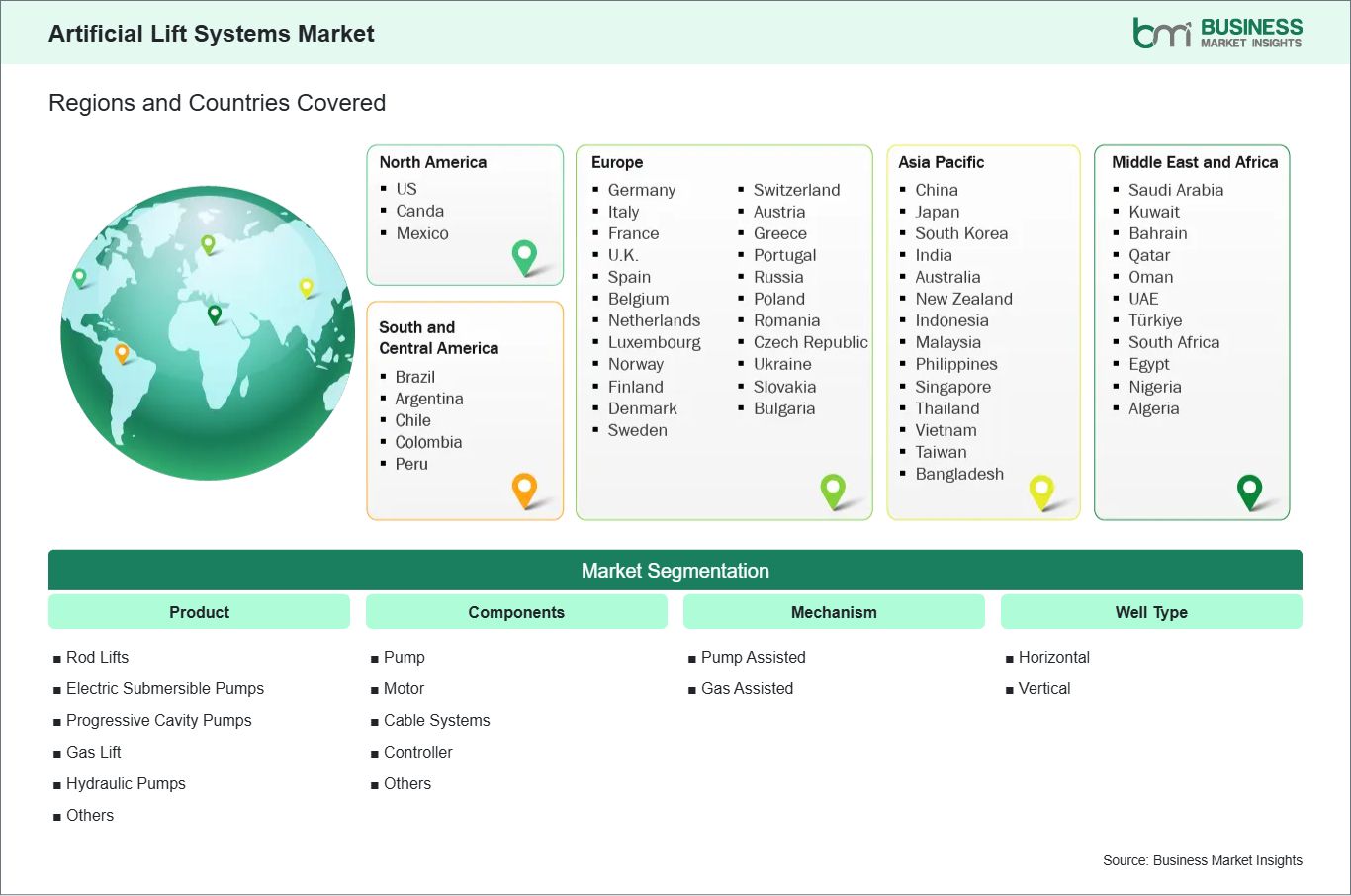
  • Product (Rod Lifts, Electric Submersible Pumps, Progressive Cavity Pumps, Gas Lift, Hydraulic Pumps, Others)
  • Components (Pump, Motor, Cable Systems, Controller, Others)
  • Mechanism (Pump Assisted, Gas Assisted)
  • Well Type ( Horizontal, Vertical)

No. of Pages: 400
Report Code: BMIPUB00033253
Category: Electronics and Semiconductor
Artificial Lift Systems Market

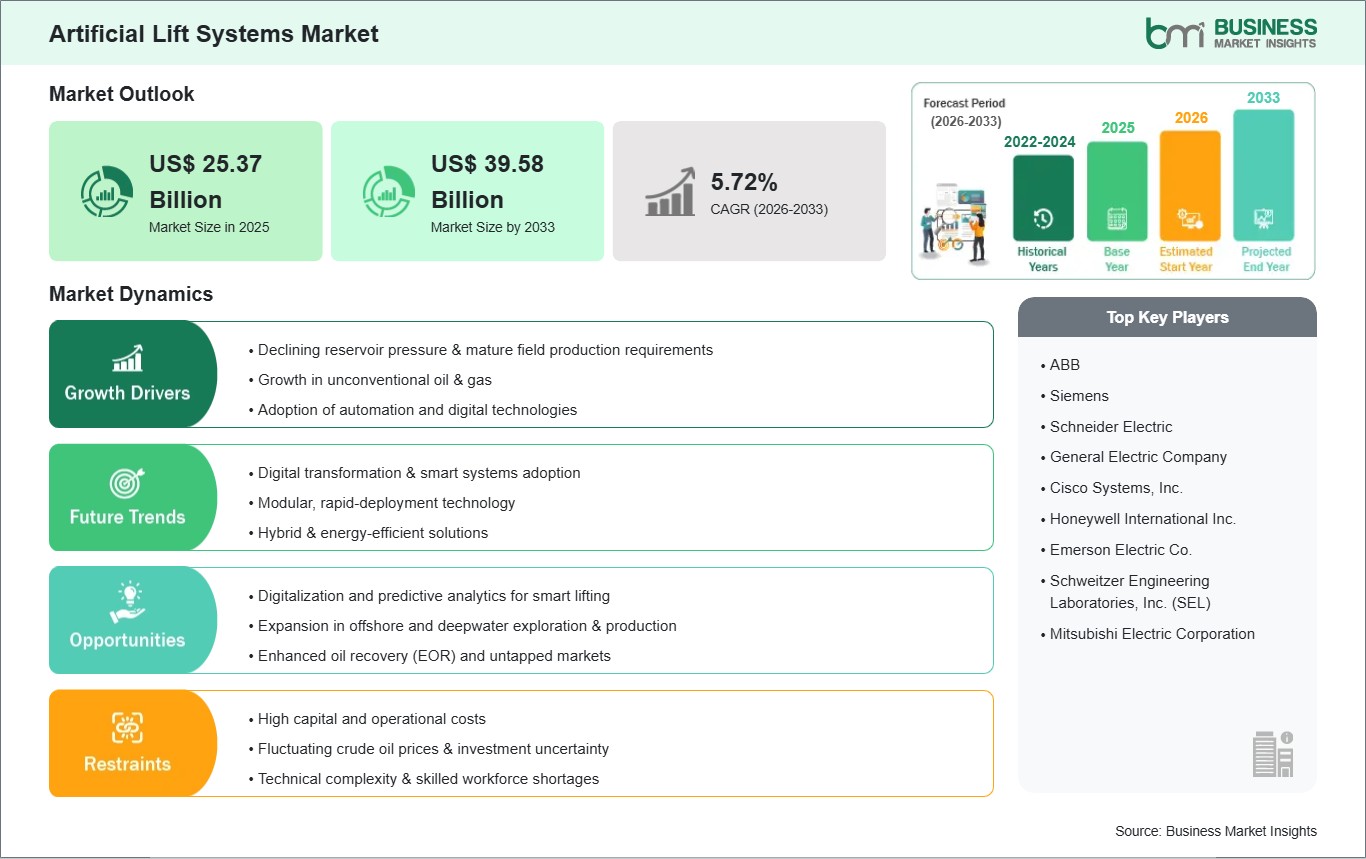
The Artificial Lift Systems Market size is expected to reach US$ 39.58 Billion by 2033 from US$ 25.37 Billion in 2025. The market is estimated to record a CAGR of 5.72% from 2026 to 2033.

Executive Summary and Global Market Analysis:

Artificial lift systems are engineered technologies used in the oil & gas industry to increase hydrocarbon production from wells where natural reservoir pressure is insufficient to bring fluids to the surface. These systems help sustain well productivity, extend the economic life of aging wells, and improve overall recovery rates, particularly in mature or unconventional fields where pressure declines quickly. By forcing or assisting fluid flow, artificial lift improves extraction efficiency, reduces downtime, and optimizes production rates while lowering operational costs compared with drilling new wells. They are widely applied across onshore and offshore environments in oilfields, gasfields, heavy oil reservoirs, and marginal or high‑water‑cut wells. Common types include electric submersible pumps (ESPs), gas lift systems, rod lift (beam pump) systems, progressive cavity pumps (PCPs), and hydraulic lift systems, each suited to particular well conditions and production needs.

The artificial lift systems market is driven primarily by the growing need to enhance production from depleted reservoirs and the rising global demand for hydrocarbons as energy consumption increases with industrialization and population growth. Mature oilfields with declining natural pressure require artificial lift technologies to maintain or boost output, creating a sustained demand for lift solutions, especially ESP and gas lift technologies. Additionally, advancements in digital monitoring, IoT integration, and smart lift systems present opportunities for improved operational efficiency and cost optimization, encouraging deeper adoption across operators. Expansion of unconventional oil and gas resources, particularly shale plays, also offers significant growth prospects.


Artificial Lift Systems Market - Strategic Insights:

global-market-strategic-framework
Get more information on this report

Artificial Lift Systems Market Segmentation Analysis:

Key segments that contributed to the derivation of the artificial lift systems market analysis are Component, Network Type, Network Connectivity, Deployment, and End-Use.

  • By Product, the artificial lift systems market is segmented into Rod Lifts, Electric Submersible Pumps, Progressive Cavity Pumps, Gas Lift, Hydraulic Pumps, and Others. The Electric Submersible Pumps segment dominated the market in 2024.
  • By Components, the artificial lift systems market is segmented into Pump, Motor, Cable Systems, Controller, and Others. The Pump segment dominated the market in 2024.
  • By Mechanism, the artificial lift systems market is segmented into Pump Assisted, Gas Assisted. The Pump Assisted segment dominated the market in 2024.
  • By Well Type, the artificial lift systems market is segmented into Horizontal, Vertical. The Verticalsegment dominated the market in 2024.
  • By Technology, the artificial lift systems market is segmented into Onshore, Offshore. The Offshore segment dominated the market in 2024.

Artificial Lift Systems Market Drivers and Opportunities:

Increasing Demand for Enhanced Oil Recovery in Mature Fields

A major driver of the artificial lift systems market is the rising need to maintain and enhance production from aging oil and gas fields. As reservoirs mature, natural pressure declines, making it difficult to sustain fluid flow to the surface. Artificial lift technologies, such as electric submersible pumps (ESPs) and rod lift systems, help operators maximize hydrocarbon extraction, extending the productive life of wells. This is especially important in regions with extensive legacy infrastructure where drilling new wells is cost-prohibitive. The consistent demand to optimize output from declining wells ensures continued adoption of artificial lift solutions globally, supporting market growth.

Integration of Digital and Smart Lift Technologies

The artificial lift systems market is increasingly benefiting from digital transformation and smart monitoring technologies, which represent a significant growth opportunity. IoT-enabled pumps, real-time performance analytics, and predictive maintenance systems allow operators to improve efficiency, reduce downtime, and optimize energy consumption. These innovations help minimize operational costs while maximizing production, particularly in complex or remote fields. Additionally, smart lift systems enable operators to make data-driven decisions for well management, boosting overall recovery rates. The adoption of intelligent artificial lift solutions is expected to accelerate in both mature and unconventional fields, creating a robust market opportunity for technology providers.

Artificial Lift Systems Market Size and Share Analysis:

By Product, the market is segmented into Rod Lifts, Electric Submersible Pumps, Progressive Cavity Pumps, Gas Lift, Hydraulic Pumps, and Others. The Electric Submersible Pumps segment dominated the market in 2024. Electric Submersible Pumps (ESPs) are a widely used artificial lift technology, designed to boost production in wells with declining reservoir pressure. Known for high efficiency, reliability, and the ability to handle large fluid volumes, ESPs are ideal for both onshore and offshore applications. Their versatility in heavy oil, high-temperature, and high-flow wells makes them a key market segment.

By Components, the market is segmented into Pump, Motor, Cable Systems, Controller, and Others. The Pump segment held the largest share of the market in 2024. Pumps are a critical component of artificial lift systems, responsible for lifting fluids from the wellbore to the surface efficiently. They include electric submersible pumps, progressive cavity pumps, and hydraulic pumps, designed to handle varying flow rates, fluid compositions, and well conditions. Reliable pumps enhance production, reduce downtime, and optimize overall well performance.

By Mechanism, the market is segmented into Pump Assisted, Gas Assisted. The Pump Assisted segment held the largest share of the market in 2024. The pump-assisted mechanism uses mechanical or hydraulic pumps to enhance fluid flow from wells with low natural pressure. This mechanism improves production efficiency by providing consistent lifting power, even in challenging well conditions such as high-viscosity oil or deep reservoirs. It is widely applied in onshore and offshore fields for reliable, high-volume extraction.

By Well Type, the market is segmented into Horizontal, Vertical. The Vertical segment held the largest share of the market in 2024. Vertical wells are traditional wellbores drilled straight down into the reservoir, making them suitable for conventional oil and gas fields. Artificial lift systems in vertical wells, such as rod pumps and electric submersible pumps, enhance production by overcoming declining reservoir pressure. Their simpler design allows easier installation, maintenance, and cost-effective operation compared to deviated or horizontal wells.

By Technology, the market is segmented into Onshore, Offshore. The Offshore segment held the largest share of the market in 2024. Offshore artificial lift systems are designed to enhance oil and gas production in subsea and deepwater wells. These systems, including electric submersible pumps and hydraulic lifts, withstand harsh marine conditions, high pressures, and corrosive environments. Offshore technologies ensure reliable, continuous fluid extraction, optimizing production from challenging reservoirs while reducing operational risks and downtime.

Artificial Lift Systems Market Report Highlights:

Report Attribute Details
Market size in 2025 US$ 25.37 Billion
Market Size by 2033 US$ 39.58 Billion
Global CAGR (2026 - 2033)5.72%
Historical Data 2022-2024
Forecast period 2026-2033
Segments Covered By Product
  • Rod Lifts
  • Electric Submersible Pumps
  • Progressive Cavity Pumps
  • Gas Lift
  • Hydraulic Pumps
  • Others
By Components
  • Pump
  • Motor
  • Cable Systems
  • Controller
  • Others
By Mechanism
  • Pump Assisted
  • Gas Assisted
By Well Type
  • Horizontal
  • Vertical
Regions and Countries Covered
North America US, Canada, Mexico
Europe Belgium, Austria, Finland, Denmark, Greece, Poland, Romania, Russia, Ukraine, Czech Republic, Slovakia, Bulgaria, Italy, Luxembourg, Germany, Switzerland, France, Netherlands, Norway, Portugal, Spain, Sweden, United Kingdom
Asia-Pacific Australia, China, India, Japan, South Korea, Indonesia, Malaysia, Philippines, Singapore, Thailand, Vietnam, Bangladesh, New Zealand, Taiwan
South and Central America Brazil, Argentina, Peru, Chile, Colombia
Middle East and Africa Bahrain, Kuwait, Oman, Qatar, Saudi Arabia, United Arab Emirates, Turkiye, South Africa, Egypt, Algeria, Nigeria
Market leaders and key company profiles
  • ABB
  • Siemens
  • Schneider Electric
  • General Electric Company
  • Cisco Systems, Inc.
  • Honeywell International Inc.
  • Emerson Electric Co.
  • Schweitzer Engineering Laboratories, Inc. (SEL)
  • Mitsubishi Electric Corporation
Get more information on this report

Artificial Lift Systems Market Report Coverage and Deliverables:

The "Artificial Lift Systems Market Size and Forecast (2022–2033)" report provides a detailed analysis of the market covering below areas:

  • Artificial lift systems market size and forecast at global, regional, and country levels for all the key market segments covered under the scope
  • Artificial lift systems market trends, as well as market dynamics such as drivers, restraints, and key opportunities
  • Artificial lift systems market analysis covering key market trends, global and regional framework, major players, regulations, and recent market developments
  • Industry landscape and competition analysis covering market concentration, heat map analysis, prominent players, and recent developments for the Artificial lift systems market
  • Detailed company profiles, including SWOT analysis

Artificial Lift Systems Market Geographic Insights:

The geographical scope of the artificial lift systems market report is divided into five regions: North America, Asia Pacific, Europe, Middle East & Africa, and South & Central America. The Artificial lift systems market in Asia Pacific is expected to grow significantly during the forecast period.

The Asia-Pacific Artificial lift systems market is segmented into China, Japan, South Korea, India, Australia, New Zealand, Indonesia, Malaysia, the Philippines, Singapore, Thailand, Vietnam, Taiwan, Bangladesh, and the Rest of Asia. The Asia Pacific artificial lift systems market is witnessing significant growth due to the rising energy demand and increasing exploration activities across the region. Countries such as China, India, Indonesia, and Malaysia are investing heavily in oil and gas production, particularly in onshore and offshore mature fields that require artificial lift solutions to maintain output. Electric submersible pumps (ESPs), rod lifts, and gas lift systems are increasingly deployed to optimize well performance and extend reservoir life.

Technological advancements, including smart lift systems and IoT-enabled monitoring, are being adopted to enhance operational efficiency and reduce downtime in remote or deepwater fields. The region’s growth is further supported by government initiatives to boost domestic energy production and reduce import dependency. However, fluctuating crude prices and high capital expenditure may pose challenges, making operational optimization a key focus for regional operators.       

global-market-geography
Get more information on this report

Artificial Lift Systems Market Research Report Guidance:

  • The report includes qualitative and quantitative data in the artificial lift systems market across Product, Component, Mechanism, Well Type, Technology and geography.
  • The report starts with the key takeaways (chapter 2), highlighting the key trends and outlook of the artificial lift systems market.
  • Chapter 3 includes the research methodology of the study.
  • Chapter 4 further includes ecosystem analysis.
  • Chapter 5 highlights the major industry dynamics in the Artificial lift systems market, including factors that are driving the market, prevailing deterrents, potential opportunities, as well as future trends. Impact analysis of these drivers and restraints is also covered in this section.
  • Chapter 6 discusses the Artificial lift systems market scenario, in terms of historical market revenues, and forecast till the year 2031.
  • Chapters 7 to 10 cover artificial lift systems market segments by Product, Component, Mechanism, Well Type, Technology and geography across North America, Europe, Asia Pacific, Middle East and Africa, and South and Central America. They cover the market volume revenue forecast and factors driving the market.
  • Chapter 11 describes the competitive analysis along with the heat map analysis for the key players operating in the market.
  • Chapter 12 describes the industry landscape analysis. It provides detailed descriptions of business activities such as market initiatives, new developments, mergers, and joint ventures globally, along with a competitive landscape.
  • Chapter 13 provides detailed profiles of the major companies operating in the Artificial lift systems market. Companies have been profiled on the basis of their key facts, business descriptions, products and services, financial overview, SWOT analysis, and key developments.
  • Chapter 14, i.e., the appendix is inclusive of a brief overview of the company, list of abbreviations, and disclaimer.

Artificial Lift Systems Market News and Key Development:

The Artificial lift systems market is evaluated by gathering qualitative and quantitative data post primary and secondary research, which includes important corporate publications, association data, and databases. A few of the key developments in the artificial lift systems market are:

  • In May 2024, Schneider Electric partnered with Crux to facilitate the acquisition of 45X advanced manufacturing equipment from Silfab Solar, a leading North American company specializing in the design and production of high-quality solar PV modules. The collaboration aims to accelerate the growth and expansion of solar energy manufacturing capabilities in the United States.
  • In January 2024, ABB acquired a majority stake in Meshmind, a research and development engineering firm, to advance its expertise in artificial intelligence, Industrial IoT, machine vision, and software-driven automation. This strategic investment is set to enhance ABB’s software development capabilities and accelerate the deployment of AI-powered industrial solutions.

Key Sources Referred:

  • World Bank – Global Trade Indicators
  • World Trade Organization (WTO)
  • International Monetary Fund (IMF)
  • International Trade Administration (ITA)
  • Company website
  • Company annual reports
  • Company investor presentations
The List of Companies - Artificial Lift Systems Market
  • ABB
  • Siemens
  • Schneider Electric
  • General Electric Company
  • Cisco Systems, Inc.
  • Honeywell International Inc.
  • Emerson Electric Co.
  • Schweitzer Engineering Laboratories, Inc. (SEL)
  • Mitsubishi Electric Corporation
Frequently Asked Questions
How big is the Artificial Lift Systems Market?

The Artificial Lift Systems Market is valued at US$ 25.37 Billion in 2025, it is projected to reach US$ 39.58 Billion by 2033.

What is the CAGR for Artificial Lift Systems Market by (2026 - 2033)?

As per our report Artificial Lift Systems Market, the market size is valued at US$ 25.37 Billion in 2025, projecting it to reach US$ 39.58 Billion by 2033. This translates to a CAGR of approximately 5.72% during the forecast period.

What segments are covered in this report?

The Artificial Lift Systems Market report typically cover these key segments-

  • Product (Rod Lifts, Electric Submersible Pumps, Progressive Cavity Pumps, Gas Lift, Hydraulic Pumps, Others)
  • Components (Pump, Motor, Cable Systems, Controller, Others)
  • Mechanism (Pump Assisted, Gas Assisted)
  • Well Type ( Horizontal, Vertical)

What is the historic period, base year, and forecast period taken for Artificial Lift Systems Market?

The historic period, base year, and forecast period can vary slightly depending on the specific market research report. However, for the Artificial Lift Systems Market report:

  • Historic Period : 2022-2024
  • Base Year : 2025
  • Forecast Period : 2026-2033
  • Who are the major players in Artificial Lift Systems Market?

    The Artificial Lift Systems Market is populated by several key players, each contributing to its growth and innovation. Some of the major players include:

  • ABB
  • Siemens
  • Schneider Electric
  • General Electric Company
  • Cisco Systems, Inc.
  • Honeywell International Inc.
  • Emerson Electric Co.
  • Schweitzer Engineering Laboratories, Inc. (SEL)
  • Mitsubishi Electric Corporation
  • Who should buy this report?

    The Artificial Lift Systems Market report is valuable for diverse stakeholders, including:

    • Investors: Provides insights for investment decisions pertaining to market growth, companies, or industry insights. Helps assess market attractiveness and potential returns.
    • Industry Players: Offers competitive intelligence, market sizing, and trend analysis to inform strategic planning, product development, and sales strategies.
    • Suppliers and Manufacturers: Helps understand market demand for components, materials, and services related to concerned industry.
    • Researchers and Consultants: Provides data and analysis for academic research, consulting projects, and market studies.
    • Financial Institutions: Helps assess risks and opportunities associated with financing or investing in the concerned market.

    Essentially, anyone involved in or considering involvement in the Artificial Lift Systems Market value chain can benefit from the information contained in a comprehensive market report.

    Available Report Formats

    pdf-format excel-format pptx-format
    Buy Now
    Sales Assistance
    +1 646 791 7070 (US & UK)
    Customization Form

    Please tell us your area of interest
    (Market Segments/ Regions and Countries/ Companies)