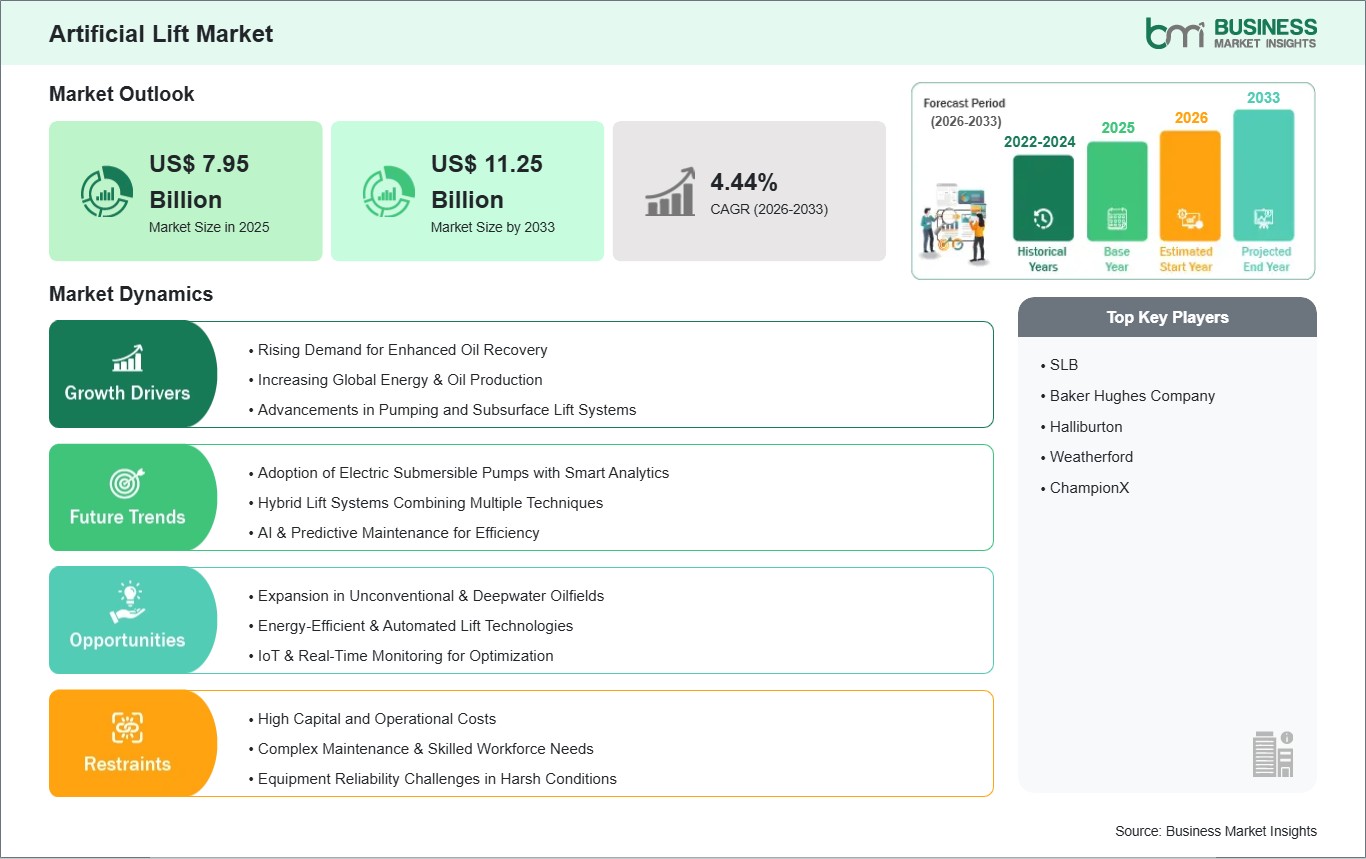
The Artificial Lift Market size is expected to reach US$ 11.25 Billion by 2033 from US$ 7.95 Billion in 2025. The market is estimated to record a CAGR of 4.44% from 2026 to 2033.
The global artificial lift market has become an important part of oilfield management. Technologies like rod pumps, gas lift systems, electric submersible pumps, and hydraulic lifts help operators keep wells producing as reservoir pressures decline. These systems do more than increase output; they also help use resources wisely, reduce operational strain, and support the long-term health of oil and gas assets. With tools like intelligent monitoring, automation, and real-time data analytics, operators can manage well performance, predict when maintenance is needed, and adjust lift settings as conditions change. These digital solutions improve efficiency, reduce downtime, save energy, and extend equipment life. Using advanced artificial lift systems, especially in deepwater or high-pressure wells, requires technical expertise and significant investment. Even so, their ability to boost recovery, make operations more predictable, and support energy-efficient production keeps artificial lift technologies essential for oil and gas extraction around the world.

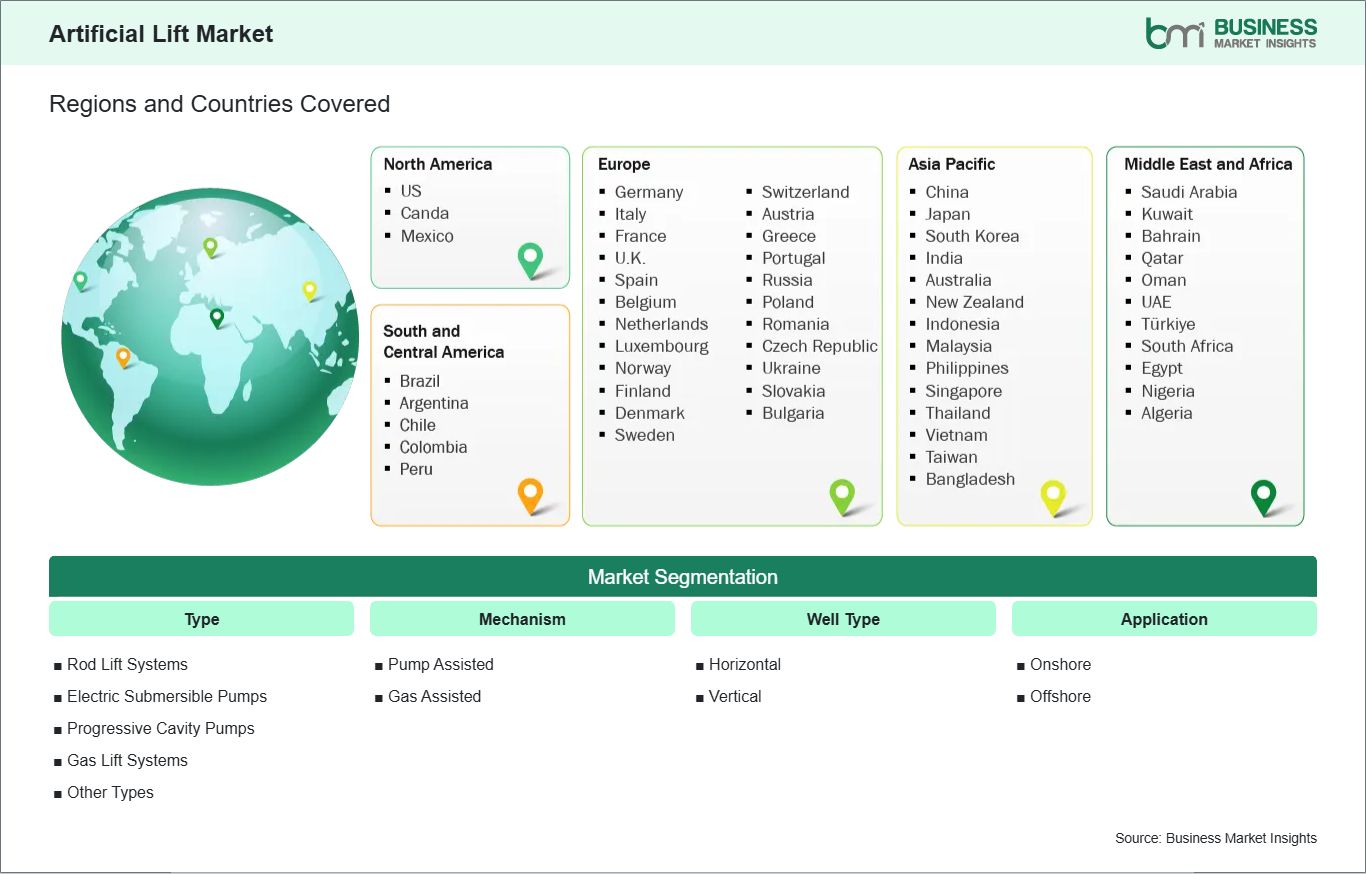
Key segments that contributed to the derivation of the artificial lift market analysis are type, mechanism, well type, and application.
The global artificial lift market is growing as operators look for ways to get more oil from aging reservoirs. As natural pressure drops over time, advanced artificial lift technologies like rod pumps, gas lift systems, and electric submersible pumps are used more often to keep flow rates steady, extend well life, and maintain field performance.
Growing global energy demand and the push for better production efficiency are making it more important for operators to keep output steady. Artificial lift systems help control well performance, reduce downtime, and improve reliability. By making extraction more efficient, these technologies also cut waste and boost the energy efficiency of oil production.
Ongoing innovation in artificial lift equipment is encouraging more operators to use these systems. Newer models with smart sensors, automated controls, and real-time monitoring help operators spot problems early, run pumps more efficiently, and plan maintenance better. These improvements make the systems more reliable and efficient, and the data they provide highlights the important role of artificial lift in getting the most from existing reservoirs.
The development of unconventional and deepwater oilfields represents a major growth avenue for the artificial lift market. Many new wells in these environments have low natural pressure, making conventional extraction methods insufficient. Artificial lift technologies are essential in enabling stable production from challenging reservoirs, including shale formations, tight oil deposits, and deepwater wells.
Modern artificial lift solutions help operators keep production steady, even when conditions are challenging. High-capacity pumps and specialized gas lift systems maintain flow in wells with lots of water or low permeability, which reduces interruptions. These advances improve recovery rates and can turn previously unprofitable wells into viable sources of oil.
Adding intelligent control and monitoring technologies is boosting the market even more. Automated systems and real-time tracking help operators make better decisions, plan maintenance, and use energy more efficiently. As exploration moves into tougher reservoirs, the need for reliable, high-performance artificial lift systems is likely to keep growing and support ongoing market growth.

The artificial lift market is experiencing steady growth, with market size and share analysis reflecting evolving treatment preferences and competitive dynamics among key players. The report evaluates important subsegments categorized within are type, mechanism, well type, and application, highlighting their respective contributions to overall market performance.
By type, the electric submersible pumps subsegment dominated the Artificial Lift Systems market in 2025. This is driven by their ability to handle high-volume production and provide reliable performance in both onshore and offshore wells. Electric submersible pumps are widely adopted in mature and deepwater oil fields due to their efficiency in lifting large volumes of fluid, making them a key revenue driver for manufacturers.
Based on mechanism, the pump assisted subsegment dominated the Artificial Lift Systems market in 2025. Pump assisted systems, including positive and dynamic displacement pumps, are preferred for their ability to maintain consistent production rates, reduce downtime, and optimize reservoir management. Their reliability and adaptability to various well conditions make them critical for efficient oil extraction.
In terms of well type, the horizontal subsegment dominated the Artificial Lift Systems market in 2025. Horizontal wells often produce higher yields than vertical wells, requiring advanced artificial lift systems to maintain optimal production levels. The increased adoption of horizontal drilling techniques has significantly driven demand for artificial lift solutions tailored for these wells.
By application, the onshore subsegment dominated the Artificial Lift Systems market in 2025. Onshore wells constitute the majority of oil production globally, and the deployment of artificial lift systems enhances production efficiency and reduces operational costs. The widespread availability of infrastructure and easier maintenance access further support the dominance of onshore applications.
| Report Attribute | Details |
|---|---|
| Market size in 2025 | US$ 7.95 Billion |
| Market Size by 2033 | US$ 11.25 Billion |
| Global CAGR (2026 - 2033) | 4.44% |
| Historical Data | 2022-2024 |
| Forecast period | 2026-2033 |
| Segments Covered | By Type
|
|
Regions and Countries Covered
| |
| North America | US, Canada, Mexico |
| Europe | Belgium, Austria, Finland, Denmark, Greece, Poland, Romania, Russia, Ukraine, Czech Republic, Slovakia, Bulgaria, Italy, Luxembourg, Germany, Switzerland, France, Netherlands, Norway, Portugal, Spain, Sweden, United Kingdom |
| Asia-Pacific | Australia, China, India, Japan, South Korea, Indonesia, Malaysia, Philippines, Singapore, Thailand, Vietnam, Bangladesh, New Zealand, Taiwan |
| South and Central America | Brazil, Argentina, Peru, Chile, Colombia |
| Middle East and Africa | Bahrain, Kuwait, Oman, Qatar, Saudi Arabia, United Arab Emirates, Turkiye, South Africa, Egypt, Algeria, Nigeria |
| Market leaders and key company profiles |
|
The "Artificial Lift Market Size and Forecast (2022 - 2033)" report provides a detailed analysis of the market covering below areas:
The geographical scope of the Air Circuit Breakermarket report is divided into five regions: North America, Asia Pacific, Europe, Middle East & Africa, and South & Central America. The Air Circuit Breakermarket in North America is expected to grow during the forecast period.
North America leads the global artificial lift market thanks to its strong oil and gas infrastructure, advanced technology, and established energy sector. The region has many onshore and offshore wells, including older reservoirs with falling natural pressure, which increases the need for artificial lift solutions to keep production steady and improve efficiency. Operators here often use electric submersible pumps and gas lift systems to boost well output, use energy more effectively, and lower operational risks. Continued investment in research and development has led to new lift technologies and the use of smart monitoring systems. Real-time data analytics and automated controls help operators monitor well performance, predict maintenance needs, and adjust lift settings as needed, which improves hydrocarbon recovery and reduces production downtime. Regulations that focus on safety, environmental protection, and operational excellence also support the use of advanced artificial lift solutions. By focusing on asset value, new technologies, and reliable operations, North America sets the standard for artificial lift deployment worldwide.

The artificial lift market is evaluated by gathering qualitative and quantitative data post primary and secondary research, which includes important corporate publications, association data, and databases. A few of the key developments in the artificial lift market are:
The Artificial Lift Market is valued at US$ 7.95 Billion in 2025, it is projected to reach US$ 11.25 Billion by 2033.
As per our report Artificial Lift Market, the market size is valued at US$ 7.95 Billion in 2025, projecting it to reach US$ 11.25 Billion by 2033. This translates to a CAGR of approximately 4.44% during the forecast period.
The Artificial Lift Market report typically cover these key segments-
The historic period, base year, and forecast period can vary slightly depending on the specific market research report. However, for the Artificial Lift Market report:
The Artificial Lift Market is populated by several key players, each contributing to its growth and innovation. Some of the major players include:
The Artificial Lift Market report is valuable for diverse stakeholders, including:
Essentially, anyone involved in or considering involvement in the Artificial Lift Market value chain can benefit from the information contained in a comprehensive market report.
Please tell us your area of interest
(Market Segments/ Regions and Countries/ Companies)