Market Summary
Executive Summary and Global Market Analysis
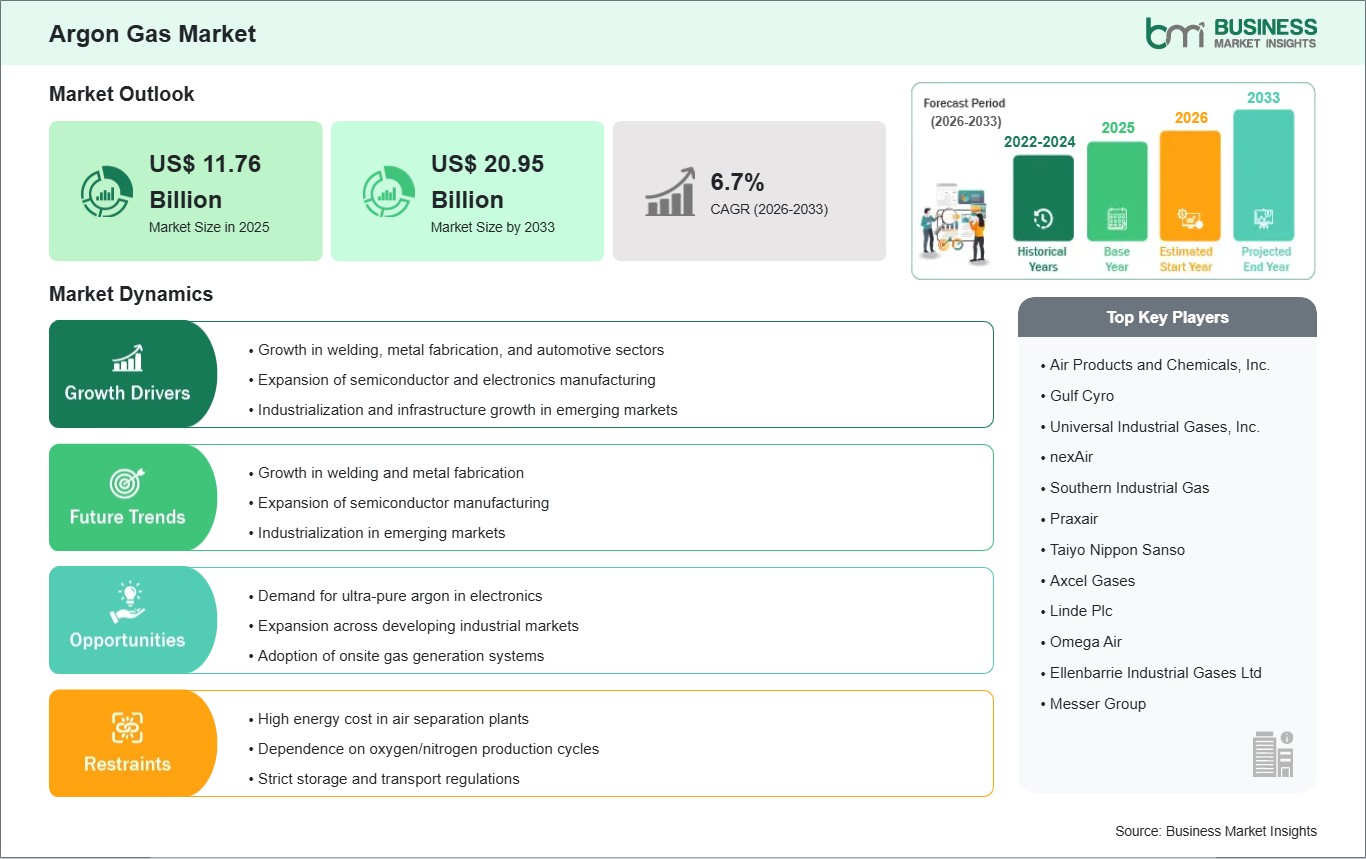
Argon gas is a noble gas widely used in welding, metal fabrication, lighting, and electronics. It also serves as an inert shielding gas in industrial processes. Argon is created as a byproduct of air separation, which isolates nitrogen, oxygen, and other gases from the atmosphere. Its chemical inertness, non-toxicity, and ability to create an oxygen-free environment make it suitable for arc welding, metal cutting, semiconductor manufacturing, and incandescent or fluorescent lighting.
Market growth comes from increasing industrialization, the expansion of the manufacturing and automotive sectors, and a growing demand for high-quality metal fabrication and electronics production in both developed and emerging economies. Argon plays an important role in energy-efficient lighting, aerospace applications, and additive manufacturing, which further supports demand.
However, factors like high production costs, energy-intensive separation processes, and supply limitations in areas with poor industrial gas infrastructure hinder market expansion. Fluctuations in energy prices and tshe presence of alternative inert gases, such as nitrogen or helium, could also affect growth. Nonetheless, rising investments in industrial automation, electronics manufacturing, and welding technology are likely to maintain steady growth in the argon gas market during the forecast period.
Segment Analysis
Argon Gas Market Segmentation
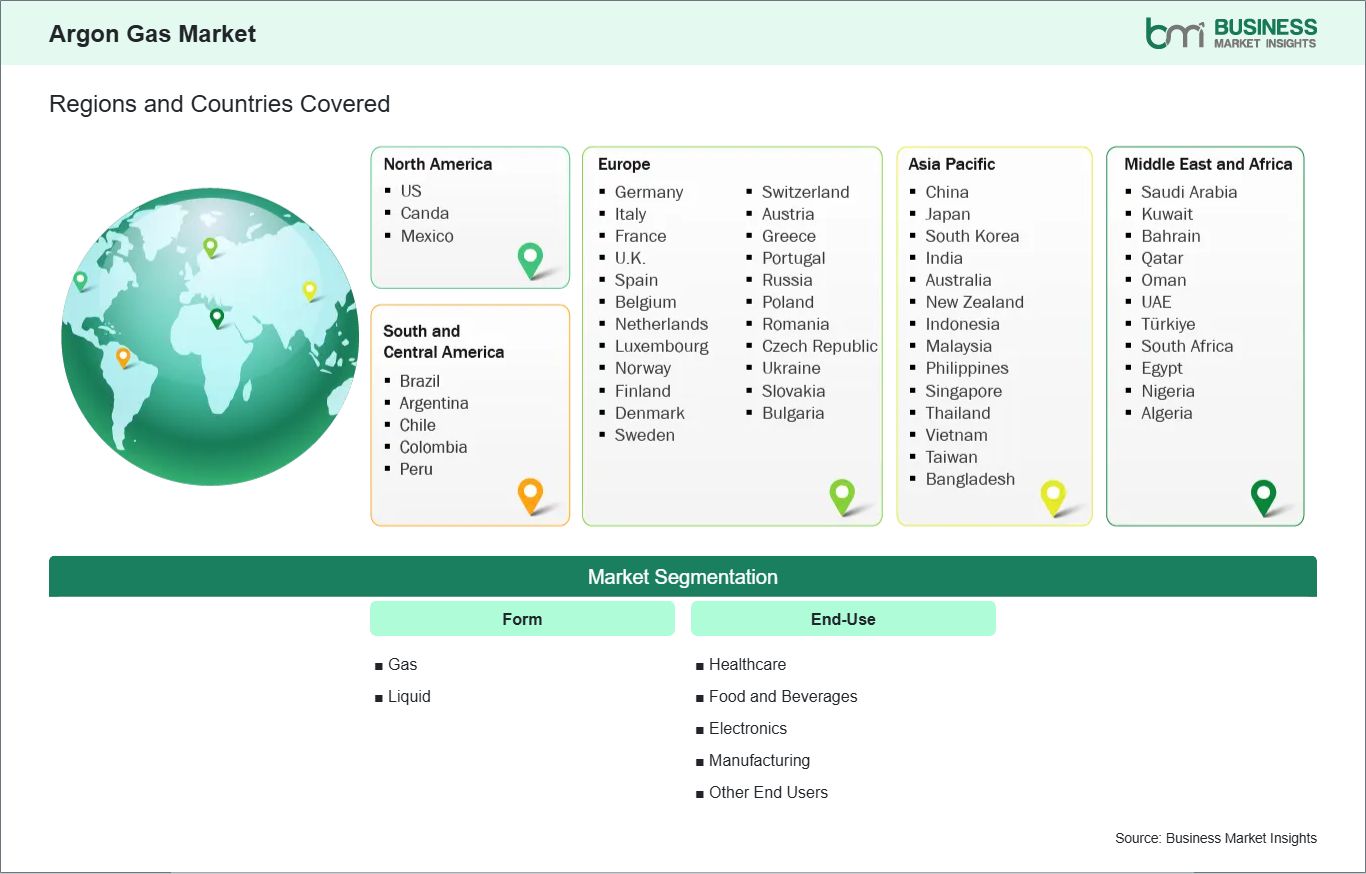
Key segments that contributed to the derivation of the argon gas market analysis are form and end-use.
- By form, the argon gas market is segmented into gas and liquid. The gas segment dominated the market in 2025.
- By end-use, the market is categorized into healthcare, food and beverages, electronics, manufacturing, and others. The manufacturing segment accounted for the largest market share in 2025.
Market Forces
Argon Gas Market Drivers and Opportunities
Expansion of Industrial Manufacturing and Metal Fabrication
Argon is commonly used as a shielding gas in arc welding processes like TIG and MIG welding, as it prevents oxidation and improves weld quality. Growth in sectors such as automotive, construction, shipbuilding, and heavy machinery boost the demand for high-purity argon. Infrastructure development projects and increased investments in manufacturing capacity, particularly in emerging economies, further strengthen this demand.
Additionally, argon is vital in steelmaking, where it is used to stir molten steel and enhance metallurgical properties. The need for higher productivity, better material performance, and fewer defects has led manufacturers to use more effective welding and processing techniques that depend heavily on argon. As industries concentrate on efficiency, automation, and consistent quality, argon's benefits and established role in key industrial processes continue to drive steady market growth.
Rising Demand from Electronics and Semiconductor Industries
Argon is widely used in semiconductor manufacturing, flat-panel displays, and photovoltaic cell production because it is inert and helps create controlled environments during sensitive manufacturing processes. The global rise in demand for consumer electronics, electric vehicles, renewable energy systems, and data centers is leading to increased production of semiconductors and advanced electronic components. This trend is particularly strong in Asia Pacific owing to growing investments in chip manufacturing facilities.
Additionally, the ongoing miniaturization of electronic components and the shift to new manufacturing technologies require ultra-high-purity gases. This creates chances for suppliers that provide specialized argon grades and dependable distribution. As governments and private companies focus on technological self-sufficiency and developing digital infrastructure, argon suppliers are positioned to gain from lasting demand growth in high-value, technology-driven applications.
Size and Share Analysis
Argon Gas Market Size and Share Analysis
The argon gas market demonstrates steady growth, with size and share analysis revealing evolving trends and competitive positioning among key players. The report examines subsegments categorized within form and end-use, offering insights into their contribution to overall market performance. By form, the gas subsegment dominates the market. Gas-phase argon is widely used in welding, metal fabrication, and industrial processes where an inert atmosphere is necessary. It is preferred for arc welding, metal cutting, and electronics manufacturing, where consistent performance and chemical inertness matter. The growth of this segment is driven by expanding manufacturing activities, increasing use of modern welding technologies, and greater industrialization in emerging economies. Ongoing work in energy-efficient production methods and innovations in industrial gas distribution are also encouraging broader use. These factors together make the gas segment a crucial part of the argon gas market, with steady demand expected in the coming years.
Report Coverage
Argon Gas Market Report Coverage and Deliverables
The " Argon Gas Market Size and Forecast (2022–2033)" report provides a detailed analysis of the market covering below areas:
- Argon gas market size and forecast at global, regional, and country levels for all the key market segments covered under the scope
- Argon gas market trends, as well as market dynamics such as drivers, restraints, and key opportunities
- Argon gas market analysis covering key market trends, global and regional framework, major players, regulations, and recent market developments
- Industry landscape and competition analysis covering market concentration, heat map analysis, prominent players, and recent developments for the argon gas market
- Detailed company profiles, including SWOT analysis
Geographic Insights
Argon Gas Market Geographic Insights
The geographical scope of the argon gas market report is divided into five regions: North America, Asia Pacific, Europe, the Middle East & Africa, and South & Central America. The Asia Pacific region leads the global argon gas market, making up the largest share of consumption and production. This leadership comes from the region's strong industrial base, large manufacturing capacity, and fast economic growth.
Countries like China, Japan, South Korea, and India are major users of argon because of their significant steel production, metal fabrication, electronics manufacturing, and chemical processing industries. China, in particular, is crucial as the world's largest steel producer and a major center for welding, construction, and heavy engineering, all of which greatly depend on argon gas. Additionally, the Asia Pacific region contains a large part of the global semiconductor and electronics manufacturing. High-purity argon is vital for controlled and inert processing environments in these sectors. Numerous air separation units and large industrial gas suppliers in the region help maintain its leading position by ensuring a stable supply and competitive prices.
Industry Activity
Recent Developments
The argon gas market is evaluated by gathering qualitative and quantitative data post-primary and secondary research, which includes important corporate publications, association data, and databases. A few of the key developments in the argon gas market are:
- In October 2025, INOX Air Products, began construction of a specialty gas facility in India to supply ultra-high-purity gases for the semiconductor industry. This plant will produce gases, such as nitrogen, oxygen, argon, and hydrogen to support Tata Electronics’ upcoming US$ 11 billion semiconductor fab project in collaboration with Taiwan’s Powerchip.
- In July 2025, Italy-based industrial gas companies SIAD and SOL Group opened a €50 million smart ASU near Zagreb, Croatia. The plant will produce essential gases, including argon, improving supply for local manufacturing, healthcare, and processing industries.
Trust & Transparency
Research Methodology
The market analysis combines proprietary research with secondary data from government agencies, company disclosures, regulatory filings, industry databases and expert interviews. Market estimates are validated through data triangulation, cross-market benchmarking and analyst
review.
View Full Research Methodology
Key Sources Referred:
World Bank – Global Trade IndicatorsWorld Trade Organization (WTO)International Monetary Fund (IMF)International Trade Administration (ITA)Company WebsitesCompany Annual ReportsCompany Investor PresentationsCompressed Gas Association (CGA)Asia Industrial Gases Association (AIGA)European Industrial Gases Association (EIGA)British Compressed Gases Association (BCGA)