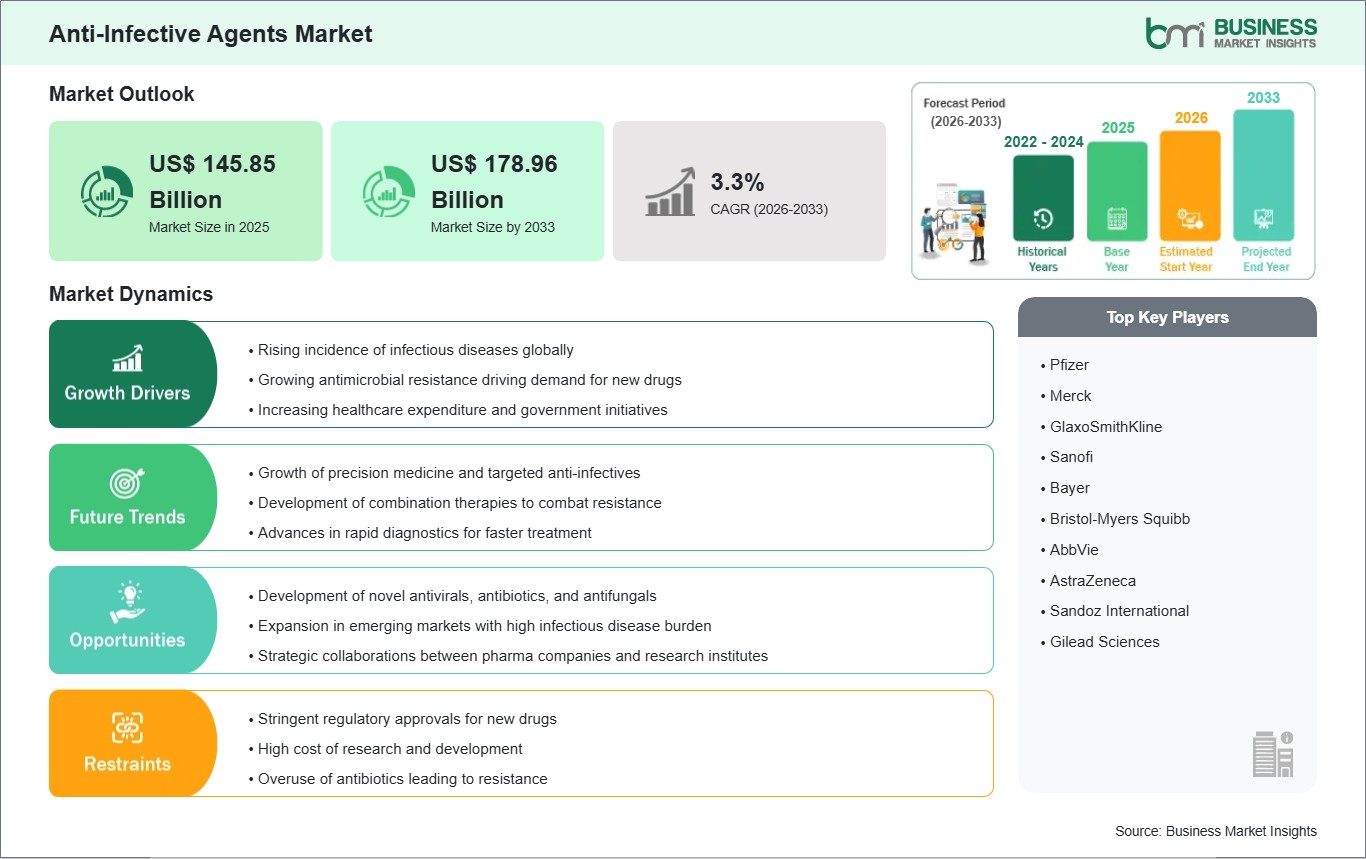
The Anti-Infective Agents Market size is expected to reach US$ 178.96 billion by 2033 from US$ 145.85 billion in 2025. The market is estimated to record a CAGR of 3.3% from 2026 to 2033.
Anti-infective agents, also referred to as antimicrobial drugs, are medications that fight against pathogenic microorganisms such as bacteria, viruses, fungi, and parasites. These agents can either kill the infective organisms or hinder their reproduction. So, the whole category of drugs consists of antibacterials (antibiotics), antivirals, antifungals, and antiparasitics, with each group of drugs designed for certain pathogens and for certain medical purposes. They play a vital role in treating infections from minor to serious ones, thereby minimizing the incidence and deaths from infections globally, and are used in hospitals, clinics, and among community healthcare services.
Various factors, such as continuous infectious disease outbreaks and increased AMR (antimicrobial resistance) levels, are working together to boost the demand for anti-infective agents in the world market, which in turn leads to the development of new treatment and diagnostic methods through innovation and investment. The COVID-19 pandemic pointed out the importance of antivirals and hastened their development alongside the cooperation among drug companies and regulatory authorities. The market dynamics indicate a competitive atmosphere ruled over by the leading pharmaceutical corporations, which have large R&D pipelines, varied product portfolios, and alliances concentrating on the development of new therapies. Antibacterials account for a large part of the market because they are widely used, while antivirals and antifungals are the ones growing fast due to the need for drugs and the advent of new infections. Trends across regions reveal that North America is the largest market owing to its high spending, whereas Asia-Pacific is the fastest-growing area since it has the disease burden and is upgrading its healthcare facilities.

Key segments that contributed to the derivation of the anti-infective agents market analysis are type, route of administration, and distribution channel.
Infectious diseases that include COVID-19, influenza, tuberculosis, HIV, and hepatitis are still prevalent all over the world, making it necessary for healthcare systems to depend on anti-infective agents quite a bit for treating and managing those diseases. Besides, the aging of the population and the rising number of people with weaker immunity can be considered as one of the reasons for the long-term prevalence of these diseases, which in turn leads to the wider prescribing and usage of anti-infective therapies. Further, the increasing antimicrobial resistance (AMR)—with the WHO reporting hundreds of thousands of deaths every year due to drug-resistant infections—makes the market for next-generation anti-infective drugs and new treatment strategies even more demanding. The mentioned trends have resulted in the prioritization of the development of innovative drugs, diagnostics, and stewardship programs by healthcare providers and pharmaceutical companies, thus giving a continuous growth momentum to the anti-infective landscape.
Pharmaceutical companies and biotech firms are following the trend of investing more and more to develop personalized and targeted anti-infective approaches, such as genomic profiling, AI-assisted drug discovery, and new therapeutic classes that would meet the requirements of drug-resistant pathogens and others. According to recent reports, a larger portion of clinical trials is being conducted on personalized treatment options, and advanced technologies like genome sequencing are becoming more accessible, thus making it easier to design patient-specific therapy. In the same way, the worldwide expansion of the pipeline with new molecules, combination therapies, and biologics is giving evidence to the industry's capability for radical advancements. Public-private partnerships, along with regulatory incentives, are the main reasons why these therapies are getting quicker development and approval processes, hence creating new revenue streams and differentiation opportunities. This evolving ecosystem creates fertile ground for growth in both developed and emerging markets as precision and next-generation anti-infective solutions gain traction.
By type, the market is categorized into antibacterials, antivirals, antifungals. The antivirals segment held the largest share of the market in 2025. The antiviral segment dominance is due to the high prevalence of viral infections such as HIV, influenza, hepatitis, and ongoing outbreaks like COVID-19, which drive persistent demand for effective antiviral therapies. Continuous innovation and introduction of potent antiviral drugs also support its leadership, as healthcare systems prioritize treatments for both acute and chronic viral diseases.
By route of administration, the market is segmented into oral, parenteral, topical, other route of administrations. The oral segment held the largest share of the market in 2025. The oral route is the leading segment by administration, largely because oral anti-infectives are easier to take, non-invasive, and preferred for outpatient care. Patients and physicians favor oral formulations for convenience, adherence, and home-based treatment of conditions ranging from common bacterial infections to long-term antiviral therapies. The wide availability of effective oral drugs drives strong market preference.
By distribution channel, the anti-infective agents market is segmented into hospital pharmacies, retail pharmacies, other distribution channels. The hospital pharmacies segment dominated the market in 2025. Hospital pharmacies dominate distribution due to their central role in managing serious, acute infections, where prescription of targeted anti-infectives—especially parenteral and high-potency therapies—is essential. The high volume of infectious disease cases requiring inpatient care reinforces hospital pharmacies as the primary access point for anti-infective agents globally.
| Report Attribute | Details |
|---|---|
| Market size in 2025 | US$ 145.85 Billion |
| Market Size by 2033 | US$ 178.96 Billion |
| Global CAGR (2026 - 2033) | 3.3% |
| Historical Data | 2022 - 2024 |
| Forecast period | 2026-2033 |
| Segments Covered | By Type
|
|
Regions and Countries Covered
| |
| North America | US, Canada, Mexico |
| Europe | Belgium, Austria, Finland, Denmark, Greece, Poland, Romania, Russia, Ukraine, Czech Republic, Slovakia, Bulgaria, Italy, Luxembourg, Germany, Switzerland, France, Netherlands, Norway, Portugal, Spain, Sweden, United Kingdom |
| Asia-Pacific | Australia, China, India, Japan, South Korea, Indonesia, Malaysia, Philippines, Singapore, Thailand, Vietnam, Bangladesh, New Zealand, Taiwan |
| South and Central America | Brazil, Argentina, Peru, Chile, Colombia |
| Middle East and Africa | Bahrain, Kuwait, Oman, Qatar, Saudi Arabia, United Arab Emirates, Turkiye, South Africa, Egypt, Algeria, Nigeria |
| Market leaders and key company profiles |
|
The " Anti-Infective Agents Market Size and Forecast (2022–2033)" report provides a detailed analysis of the market covering below areas:
The geographical scope of the anti-infective agents market report is divided into five regions: North America, Asia Pacific, Europe, Middle East & Africa, and South & Central America. The anti-infective agents market in Asia Pacific is expected to grow significantly during the forecast period.
The Asia-Pacific anti-infective agents market is segmented into China, Japan, South Korea, India, Australia, New Zealand, Indonesia, Malaysia, the Philippines, Singapore, Thailand, Vietnam, Taiwan, Bangladesh, and the Rest of Asia. The Asia-Pacific anti-infective agents market is experiencing robust growth, due to the prevalence of infectious diseases in large countries such as China, India, Indonesia, and other Southeast Asian countries being very high. This results in the need for various types of anti-infective therapies, which include antibiotics, antivirals, and antifungal treatments, and the demand is constant. These areas still report high incidence rates of diseases such as TB, hepatitis, and respiratory infections, which in turn require the use of more anti-infective medications.
Moreover, the healthcare infrastructure has been expanding and modernizing very quickly, while public and private healthcare spending has been increasing. This has led to access to diagnosis and treatment services even in remote areas, both urban and rural. In addition, the growing investment in healthcare facilities, diagnostic laboratories, and pharmaceutical manufacturing is making anti-infective agents more available and ultimately attracting market participation.
On top of that, the government and public health programs aimed at infectious disease control and immunization coverage expansion are the main reasons for the further market growth. The programs that target HIV, hepatitis, and other endemic infections help increase the use of anti-infective therapies. Along with this, the rising health awareness and the growing middle-class population with greater healthcare affordability are making Asia-Pacific one of the fastest-growing regions in the anti-infective agents market.

The anti-infective agents market is evaluated by gathering qualitative and quantitative data post primary and secondary research, which includes important corporate publications, association data, and databases. A few of the key developments in the anti-infective agents market are:
The Anti-Infective Agents Market is valued at US$ 145.85 Billion in 2025, it is projected to reach US$ 178.96 Billion by 2033.
As per our report Anti-Infective Agents Market, the market size is valued at US$ 145.85 Billion in 2025, projecting it to reach US$ 178.96 Billion by 2033. This translates to a CAGR of approximately 3.3% during the forecast period.
The Anti-Infective Agents Market report typically cover these key segments-
The historic period, base year, and forecast period can vary slightly depending on the specific market research report. However, for the Anti-Infective Agents Market report:
The Anti-Infective Agents Market is populated by several key players, each contributing to its growth and innovation. Some of the major players include:
The Anti-Infective Agents Market report is valuable for diverse stakeholders, including:
Essentially, anyone involved in or considering involvement in the Anti-Infective Agents Market value chain can benefit from the information contained in a comprehensive market report.
Please tell us your area of interest
(Market Segments/ Regions and Countries/ Companies)