Market Summary
Executive Summary and Global Market Analysis
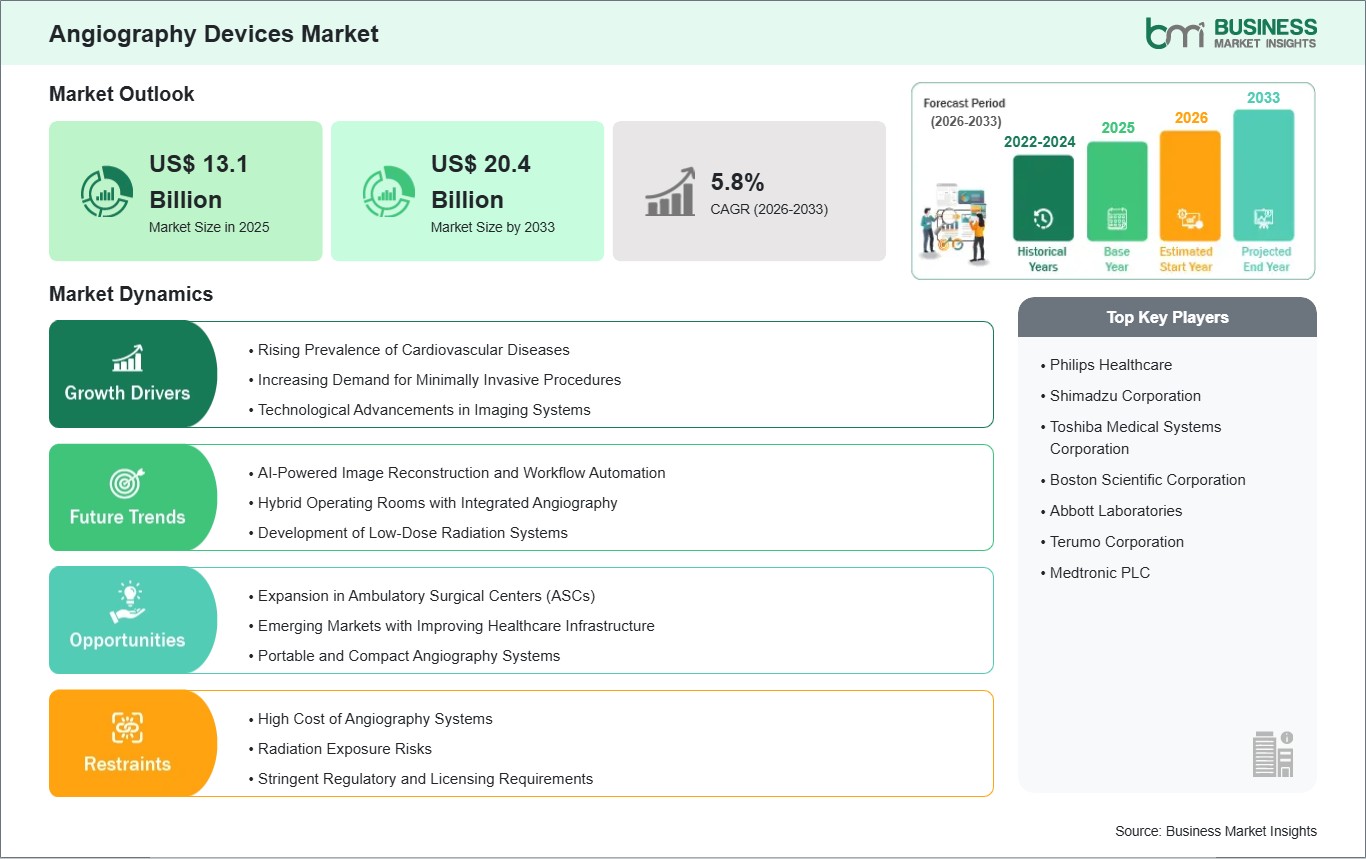
Angiography devices refer to a sophisticated suite of medical imaging instruments used to visualize the internal lumen of blood vessels and organs, with a specific focus on the arteries, veins, and heart chambers. The procedure, known as an angiogram, involves the injection of a radio-opaque contrast agent into the bloodstream via a catheter, followed by imaging using various modalities such as X-ray fluoroscopy, Computed Tomography (CT), or Magnetic Resonance Imaging (MRI). Market expansion is fundamentally propelled by the rising global prevalence of cardiovascular diseases (CVDs) and the increasing demand for minimally invasive procedures, which offer shorter recovery times and reduced patient trauma. Furthermore, the shift toward digital integration and the expansion of hybrid operating rooms, where angiography systems are combined with other surgical tools, are enhancing procedural precision. The global aging population, who are at a higher risk for vascular disorders, continues to serve as a primary catalyst for sustained market demand.
However, several factors may restrain market growth. The high capital cost of advanced angiography suites and the recurring expense of specialized consumables can be prohibitive for healthcare facilities in emerging regions. Stringent regulatory pathways and the necessity for extensive clinical validation for high-risk interventional devices often extend commercialization timelines. Additionally, the industry faces challenges related to radiation safety concerns, necessitating continuous investment in dose-reduction technologies, and a global shortage of highly trained interventional staff capable of operating complex imaging platforms.
Despite these hurdles, the market holds significant opportunities in the integration of artificial intelligence (AI) for automated vessel segmentation and real-time motion correction. The rise of robotic-assisted angiography systems and the development of portable, mobile C-arms for use in diverse clinical settings are expected to support long-term development within the sector. Manufacturers are also finding growth potential in subscription-based service models and modular system upgrades to improve affordability for mid-sized diagnostic centers.
Segment Analysis
Angiography Devices Market Segmentation
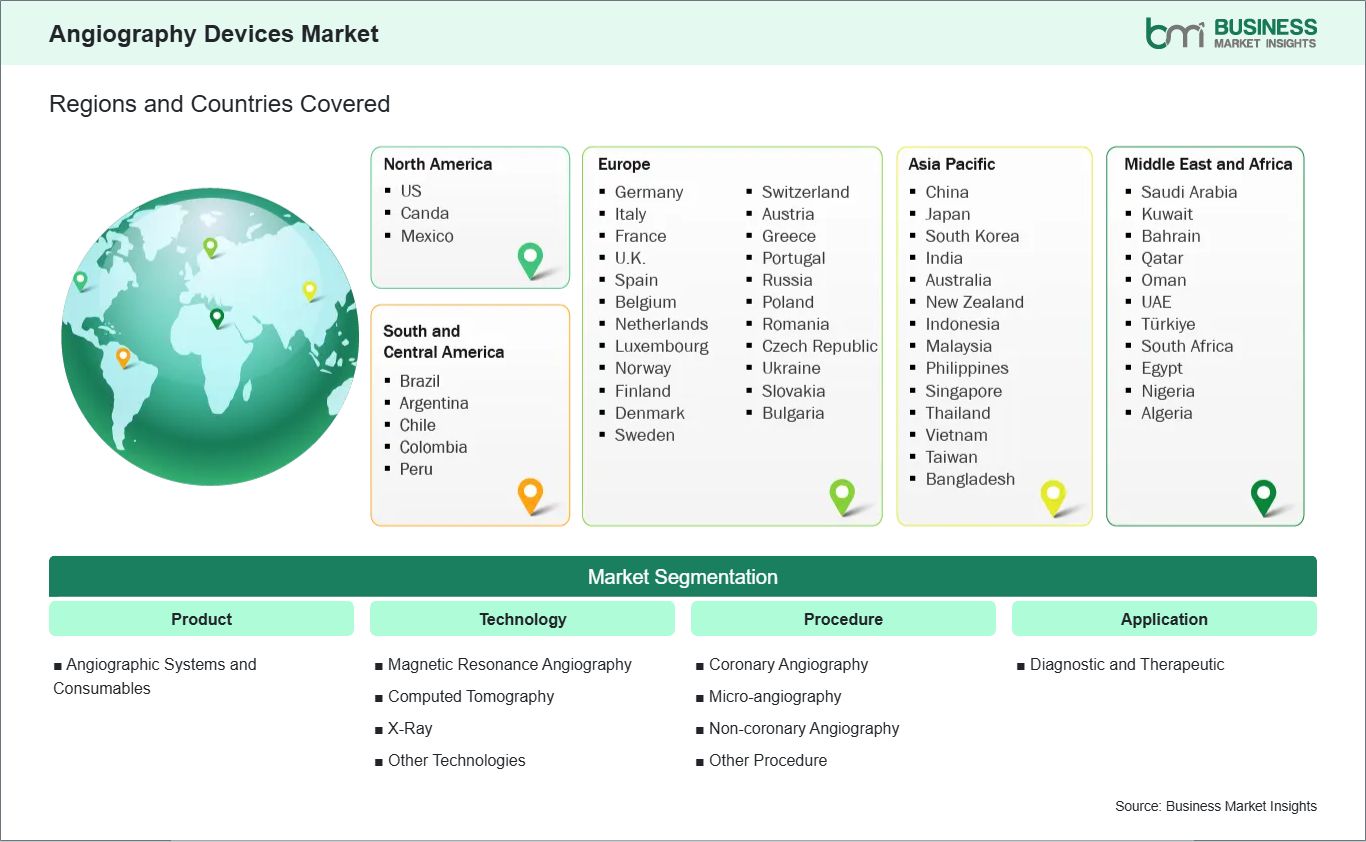
Key segments that contributed to the derivation of the Angiography Devices market analysis are product, technology, procedure, and application.
- By Product, the market is segmented into Angiographic Systems and Consumables.
- By Technology, the market is divided into Magnetic Resonance Angiography, Computed Tomography, X-Ray, and Other Technologies.
- By Procedure, the market is categorized into Coronary Angiography, Micro-angiography, Non-coronary Angiography, and Others.
- By Application, the market is segmented into Diagnostic and Therapeutic
Market Forces
Angiography Devices Market Drivers and Opportunities
Escalating Cardiovascular Burden and the Demand for Radiation-Efficient Imaging
The primary driver for the Angiography Devices Market is the systemic global rise in cardiovascular and neurovascular diseases associated with an aging population and metabolic health trends. The Increasing Prevalence of Coronary Artery Disease, Stroke, and Peripheral Artery Disease acts as a foundational catalyst, as these high-acuity conditions necessitate precise diagnostic mapping before interventional treatment. This momentum is further propelled by the Growing Clinical Preference for Minimally Invasive Image-Guided Therapy; as patients and providers seek shorter hospital stays and reduced complication rates, the demand for sophisticated angiography systems that facilitate catheter-based repairs is intensifying. In the technological sphere, the Rapid Adoption of Flat-Panel Detector (FPD) Technology and Dose-Reduction Software serves as a critical driver, addressing the industry-wide mandate to minimize ionizing radiation for both patients and clinical staff without compromising image fidelity. Furthermore, the Expansion of Specialized Cardiac Centers and Ambulatory Surgical Centers (ASCs) is driving market growth, as these facilities invest in dedicated angiography suites to accommodate higher procedural volumes outside of traditional hospital environments. Together, these factors, disease prevalence, procedural innovation, and safety mandates, ensure a robust and essential growth path for the global Angiography Devices Market.
AI-Native Image Interpretation and Robotic-Assisted Navigation
A significant high-value opportunity lies in the convergence of Angiography Systems with Artificial Intelligence (AI) and Machine Learning. Next-generation software is being developed to utilize AI for real-time image enhancement and automated lesion quantification, which significantly reduces the cognitive load on clinicians and improves the accuracy of diagnostic interpretations. There is also a major growth frontier in the development of Robotic-Assisted Angiography and Catheterization Systems; by providing sub-millimeter precision in catheter placement and allowing physicians to operate from a radiation-shielded cockpit, these systems are revolutionizing complex neurovascular coiling and structural heart procedures. Furthermore, the expansion of Hybrid Imaging Modalities (e.g., Fusion of CT/MR with Live Fluoroscopy) presents a lucrative opportunity, offering a comprehensive multi-dimensional view of the anatomy that enhances decision-making in high-stress surgical scenarios. Beyond the hardware, the rise of Bioresorbable Consumables and Low-Toxicity Contrast Agents offers a unique frontier, particularly for patients with renal impairment or those requiring multiple follow-up procedures. Manufacturers who focus on Miniaturized, Portable Angiography Units for emergency and field use and those pioneering Cloud-Based Remote Procedural Supervision are positioned to lead the global Angiography Devices Market.
Size and Share Analysis
Angiography Devices Market Size and Share Analysis
The Angiography Devices market demonstrates steady growth, with size and share analysis revealing evolving trends and competitive positioning among key players. The report examines subsegments categorized within product, technology, procedure, and application, offering insights into their contribution to overall market performance.
Based on the technology, the X-Ray Angiography subsegment holds the primary market presence, serving as the gold standard for real-time interventional guidance and diagnostic verification. This technology is indispensable for the market, maintaining the largest influence because its high temporal resolution is critical for dynamic coronary and peripheral assessments. A notable trend is the surge in the Magnetic Resonance Angiography (MRA) and Computed Tomography (CT) subsegments, which are registering the fastest expansion. In these technologies, angiography is becoming essential for Pre-Procedural Planning and Non-Invasive Surveillance, where the strategic use of silent MRA and high-speed CT enables the evaluation of aneurysms and stenoses without the requirement for arterial puncture or radiation exposure.
Report Coverage
Angiography Devices Market Report Coverage and Deliverables
The "Angiography Devices Market Size and Forecast (2022–2033)" report provides a detailed analysis of the market covering below areas:
- Angiography Devices market size and forecast at global, regional, and country levels for all market segments covered under the scope
- Angiography Devices market trends, as well as drivers, restraints, and opportunities
- Angiography Devices market analysis covering key trends, global and regional framework, major players, regulations, and recent developments
- Industry landscape and competition analysis covering market concentration, heat map analysis, prominent players, and recent developments for the Angiography Devices market
- Detailed company profiles, including SWOT analysis
Geographic Insights
Angiography Devices Market Geographic Insights
The geographical scope of the Angiography Devices market report is divided into five regions: North America, Asia Pacific, Europe, Middle East & Africa, and South & Central America.
North America maintains the primary market position, supported by a sophisticated healthcare infrastructure, high healthcare expenditure, and the rapid adoption of breakthrough technologies such as artificial intelligence-integrated intravascular imaging and robotic-assisted surgical platforms. Europe represents a mature and highly regulated market where growth is sustained by a robust institutional focus on reducing hospital stay durations and an increasing clinical shift toward transcatheter aortic valve replacement (TAVR) as a standard of care. Asia Pacific is identified as the most rapidly advancing region, propelled by accelerating healthcare modernization, significant investments in specialized cardiac catheterization laboratories, and an expanding middle-class demographic with increasing access to sophisticated cardiovascular interventions.
The Asia-Pacific Angiography Devices Market is segmented into China, Japan, South Korea, India, Australia, and the Rest of Asia Pacific. China serves as a central engine for regional expansion, driven by large-scale government procurement programs for coronary stents and a massive patient volume requiring percutaneous coronary interventions (PCI). India is experiencing a notable transition as private healthcare networks expand their interventional capabilities to address the high prevalence of coronary artery disease and structural heart defects. Japan continues to lead in technological adoption, prioritizing high-precision instrumentation such as drug-eluting balloons and miniaturized catheters tailored for its substantial and aging geriatric population.
Industry Activity
Recent Developments
The Angiography Devices market is evaluated by gathering qualitative and quantitative data post primary and secondary research, which includes important corporate publications, association data, and databases. A few of the key developments in the Angiography Devices market are:
- In Feb 2026, Medtronic announced its acquisition of CathWorks, adding the FFRangio® angiography-derived fractional flow reserve system to its interventional cardiology portfolio. The acquisition strengthens Medtronic`s angiography devices offerings and enables AI-driven, non-invasive assessment of coronary physiology to optimize patient care.
- In December 2025, Philips announced the acquisition of SpectraWAVE Inc., adding AI-powered HyperVue intravascular imaging and X1-FFR angio-derived physiology technologies to its Azurion image-guided therapy platform. The acquisition strengthens Philips’ coronary intervention portfolio and enhances adoption of advanced intravascular imaging and physiological assessment in angiography procedures.
Trust & Transparency
Research Methodology
The market analysis combines proprietary research with secondary data from government agencies, company disclosures, regulatory filings, industry databases and expert interviews. Market estimates are validated through data triangulation, cross-market benchmarking and analyst
review.
View Full Research Methodology
Key Sources Referred:
World Bank – Global Trade IndicatorsWorld Trade Organization (WTO)(International Monetary Fund )IMFInternational Trade Administration (ITA)Company websiteCompany annual reportsCompany investor presentations