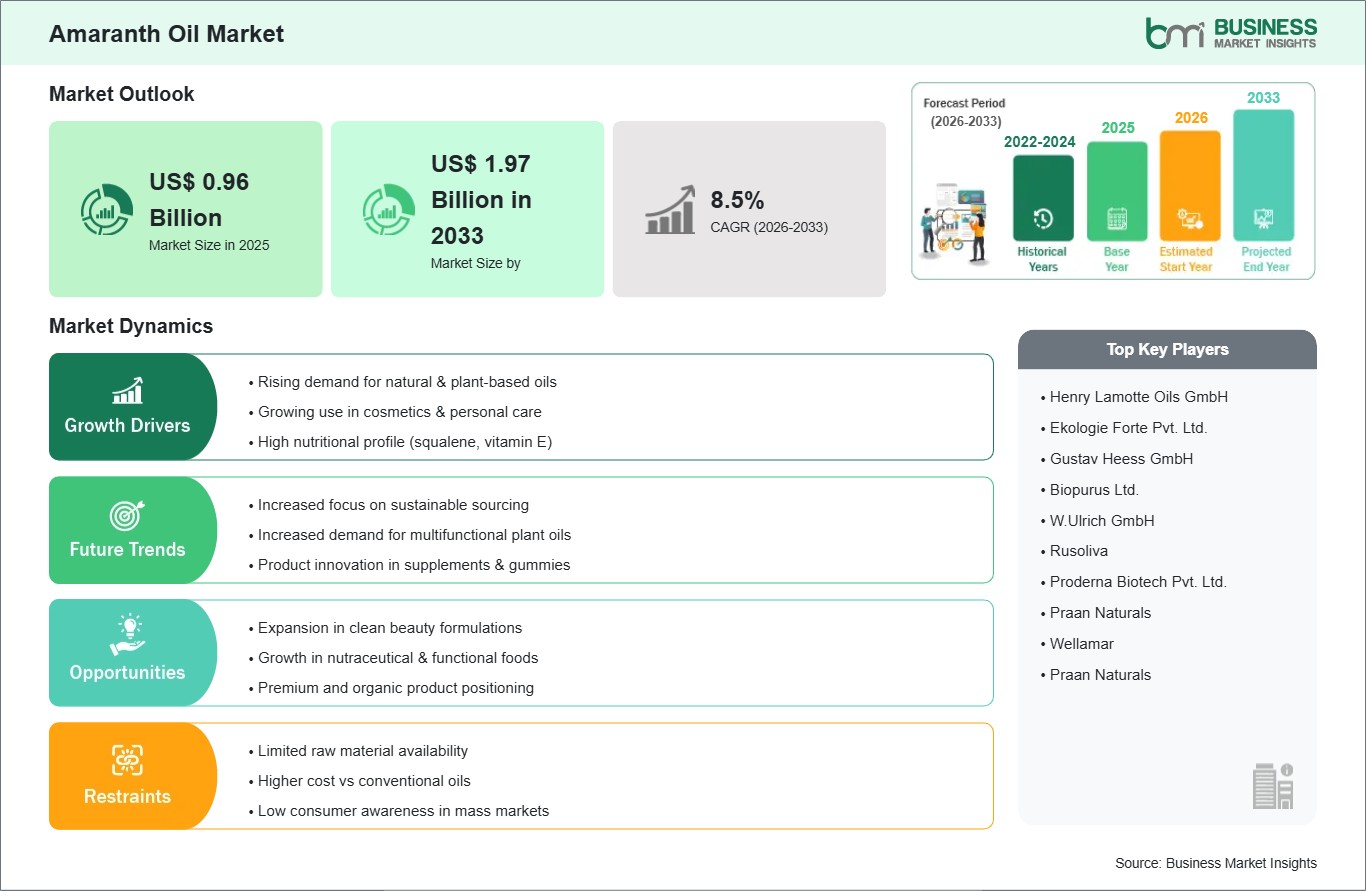
The amaranth oil market size is expected to reach US$ 1.97 billion by 2033 from US$ 0.96 billion in 2025. The market is estimated to record a CAGR of 8.5% from 2026 to 2033.
Executive Summary and Global Market Analysis:
The amaranth oil market represents a niche yet steadily expanding segment within the specialty edible oils and nutraceutical ingredients industry. Growth is primarily driven by rising consumer interest in plant‑based, functional, and health‑centric products. Extracted from amaranth seeds, the oil is valued for its exceptionally high squalene content, alongside rich concentrations of unsaturated fatty acids, tocopherols, and phytosterols. These bioactive components position amaranth oil as a premium ingredient for dietary supplements, functional foods, cosmetics, and pharmaceutical formulations. Market expansion is further supported by increasing global awareness of cardiovascular health, growing demand for natural antioxidants, and the accelerating shift toward clean‑label and vegan product portfolios. The cosmetics and personal care industry also plays a pivotal role, with formulators adopting amaranth oil for its moisturizing, anti‑aging, and skin‑repair properties—attributes that align with the rising preference for high‑quality, natural skincare ingredients. Despite its positive outlook, the industry faces several structural challenges. Limited availability of raw materials, comparatively low seed yields, and higher production and processing costs versus conventional vegetable oils constrain large‑scale adoption. Additionally, restricted consumer awareness and the absence of extensive commercial cultivation infrastructure continue to hinder broader market penetration.
Nevertheless, sustained research into advanced extraction technologies, coupled with renewed interest in ancient grains and premium natural ingredients, is expected to support consistent growth in the upcoming years. As innovation progresses and supply chains mature, amaranth oil is well‑positioned to gain broader traction across both nutraceutical and personal care segments.
Amaranth Oil Market - Strategic Insights:
Get more information on this report
Amaranth Oil Market Segmentation Analysis:
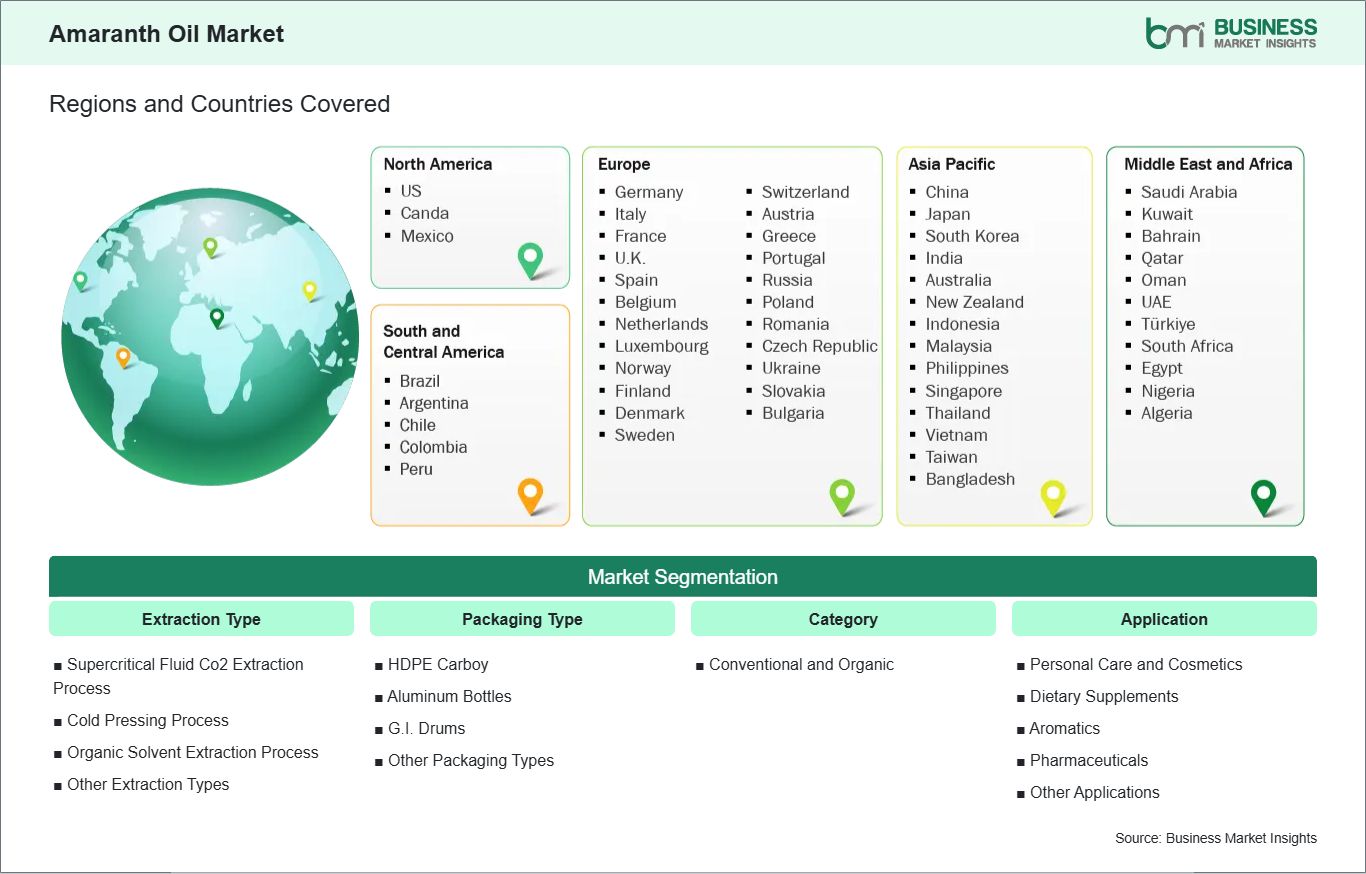
Key segments that contributed to the derivation of the amaranth oil market analysis are extraction type, packaging type, category, and application.
By extraction type, the market is segmented into supercritical fluid CO₂ extraction, cold pressing, organic solvent extraction, and other methods. The supercritical fluid CO₂ extraction segment accounted for a significant share of the market in 2025.
By packaging type, the market is segmented into HDPE carboys, aluminum bottles, G.I. drums, and other packaging formats. HDPE carboys represented a major market share in 2025.
By category, the market is segmented into conventional and organic amaranth oil. The conventional segment dominated the market in 2025.
By application, the market is segmented into personal care and cosmetics, dietary supplements, aromatics, pharmaceuticals, and other applications. The dietary supplements segment held the largest market share in 2025.
Amaranth Oil Market Drivers and Opportunities:
Rising Demand for Natural and Functional Ingredients
The amaranth oil market is mainly driven by the growing global interest in natural, plant-based, and functional ingredients in the food, nutraceutical, and personal care industries. Consumers are becoming more health-conscious. They seek products that provide nutritional benefits beyond basic needs, such as cardiovascular support, antioxidant protection, and anti-inflammatory effects. Amaranth oil contains a high level of squalene, unsaturated fatty acids, and bioactive compounds, which aligns well with these preferences. This makes it a suitable ingredient for dietary supplements and functional food products.
Simultaneously, regulatory support for clean-label products and a decreased reliance on synthetic additives are helping the market propel. The cosmetics and personal care sector also supports this trend, as manufacturers increasingly use naturally derived oils to meet consumer expectations for safer and more sustainable skincare options. This increasing focus on transparency, wellness, and preventive healthcare is broadening the use of amaranth oil, strengthening its position as a valuable specialty oil in global markets.
Expansion of Organic and Premium Product Segments
The demand for certified organic oils continues to rise rapidly, particularly in developed markets where consumers increasingly prioritize sustainably sourced, chemical‑free products and are willing to pay a premium for them. Organic amaranth oil has seen strong market momentum, supported by its association with ancient grains, environmentally responsible cultivation practices, and minimal processing—attributes that strongly appeal to eco‑conscious and health‑oriented buyers. Advancements in extraction technologies, such as supercritical CO₂ processing, are further elevating product quality by enabling the production of cleaner, higher‑purity oils that retain a greater concentration of bioactive compounds. This technological progress enhances product differentiation and strengthens the competitive positioning of premium-grade amaranth oil.
Significant opportunities are also emerging in developing economies, where rising disposable incomes and increased awareness of functional nutrition are driving demand for high‑value health and wellness products. Strategic branding initiatives, improved supply chain integration, and collaborative partnerships with nutraceutical and cosmetic manufacturers can further accelerate market expansion. Collectively, these dynamics position organic and premium amaranth oil as a high‑growth, high‑potential segment in the years ahead.
Amaranth Oil Market Size and Share Analysis:
The amaranth oil market demonstrates steady growth, with size and share analysis revealing evolving trends and competitive positioning among key players. The report examines subsegments categorized within extraction type, packaging type, category, and application, offering insights into their contribution to overall market performance. By application, the dietary supplements segment dominates the market owing to the oil's high squalene content, favorable fatty acid profile, and antioxidant properties, which promote heart health, immunity, and cholesterol management. Amaranth oil is commonly found in capsule and softgel forms, especially in preventive healthcare and wellness products. The rising consumer preference for natural and plant-based supplements, along with increased awareness of lifestyle-related health issues, has boosted demand in this segment. Growth is also driven by aging populations, the expansion of the nutraceutical industry, and greater investment in functional nutrition.
Australia, China, India, Japan, South Korea, Indonesia, Malaysia, Philippines, Singapore, Thailand, Vietnam, Bangladesh, New Zealand, Taiwan
South and Central America
Brazil, Argentina, Peru, Chile, Colombia
Middle East and Africa
Bahrain, Kuwait, Oman, Qatar, Saudi Arabia, United Arab Emirates, Turkiye, South Africa, Egypt, Algeria, Nigeria
Market leaders and key company profiles
Henry Lamotte Oils GmbH
Ekologie Forte Pvt. Ltd.
Gustav Heess GmbH
Biopurus Ltd.
W.Ulrich GmbH
Rusoliva
Proderna Biotech Pvt. Ltd.
Praan Naturals
Wellamar
Praan Naturals
Get more information on this report
Amaranth Oil Market Report Coverage and Deliverables:
The " Amaranth Oil Market Size and Forecast (2022–2033)" report provides a detailed analysis of the market covering below areas:
Amaranth oil market size and forecast at global, regional, and country levels for all the key market segments covered under the scope
Amaranth oil market trends, as well as market dynamics such as drivers, restraints, and key opportunities
Amaranth oil market analysis covering key market trends, global and regional framework, major players, regulations, and recent market developments
Industry landscape and competition analysis covering market concentration, heat map analysis, prominent players, and recent developments for the amaranth oil market
Detailed company profiles, including SWOT analysis
Amaranth Oil Market Geographic Insights:
The geographical scope of the amaranth oil market report is divided into five regions: North America, Asia Pacific, Europe, the Middle East & Africa, and South & Central America. The amaranth oil market in North America is expected to grow significantly during the forecast period due to strong demand from the dietary supplements, functional food, and personal care sectors. Consumers in this region are highly aware of preventive healthcare, heart health, and the benefits of using plant-based and natural ingredients. The established nutraceutical industry, especially in the United States, has greatly influenced the adoption of amaranth oil in capsules, softgels, and functional nutrition products. Furthermore, the presence of reliable extraction technology providers and ingredient manufacturers ensures consistent quality and scalability, reinforcing the region's dominance.
The cosmetics and personal care industry in North America also plays an important role as brands increasingly use premium botanical oils to meet clean-label and sustainability expectations. Supportive regulations for dietary supplements, rising disposable incomes, and strong retail and e-commerce distribution channels contribute to market growth.
Get more information on this report
Amaranth Oil Market Research Report Guidance:
The report includes qualitative and quantitative data in the amaranth oil market across extraction type, packaging type, category, application, and geography.
The report starts with the key takeaways (chapter 2), highlighting the key trends and outlook of the amaranth oil market.
Chapter 3 includes the research methodology of the study.
Chapter 4 further includes ecosystem analysis.
Chapter 5 highlights the major industry dynamics in the amaranth oil market, including factors that are driving the market, prevailing deterrents, potential opportunities, as well as future trends. Impact analysis of these drivers and restraints is also covered in this section.
Chapter 6 discusses the amaranth oil market scenario in terms of historical market revenues and forecast till the year 2033.
Chapters 7 to 10 cover the amaranth oil market segments by extraction type, packaging type, category, application, and geography across North America, Europe, Asia Pacific, the Middle East and Africa, and South and Central America. They cover the market revenue, forecast, and factors driving the market.
Chapter 11 describes the competitive analysis along with the heat map analysis for the key players operating in the market.
Chapter 12 describes the industry landscape analysis. It provides detailed descriptions of business activities such as market initiatives, new developments, mergers, and joint ventures globally, along with a competitive landscape.
Chapter 13 provides detailed profiles of the major companies operating in the amaranth oil market. Companies have been profiled on the basis of their key facts, business descriptions, products and services, financial overview, SWOT analysis, and key developments.
Chapter 14, i.e., the appendix, is inclusive of a brief overview of the company, a list of abbreviations, and a disclaimer.
Amaranth Oil Market News and Key Development:
The amaranth oil market is evaluated by gathering qualitative and quantitative data post primary and secondary research, which includes important corporate publications, association data, and databases. A few of the key developments in the amaranth oil market are:
In August 2023, Wellamar, launched a new wellness brand centered on amaranth oil products, including topical oils, ingestible supplements, and gummies. The brand aims to integrate amaranth oil into daily health and beauty routines, highlighting its natural nutrient profile and potential benefits for skin, overall health, and well-being.
In September 2021, Praan Naturals introduced Organic Virgin Amaranth Oil to its portfolio of certified organic and natural personal care ingredients. Sourced from certified organic amaranth seeds grown in Ukraine, the oil is rich in linoleic acid, squalene, and vitamin E.
Key Sources Referred:
World Bank – Global Trade Indicators
World Trade Organization (WTO)
International Monetary Fund (IMF)
International Trade Administration (ITA)
Company Websites
Company Annual Reports
Company Investor Presentations
Federation of Oils, Seeds and Fats Associations (FOSFA International)
Organic Trade Association (OTA)
Edible Oil Producers Association
American Oil Chemists' Society (AOCS)
The List of Companies - Amaranth Oil Market
Frequently Asked Questions
How big is the Amaranth Oil Market?
The Amaranth Oil Market is valued at US$ 0.96 Billion in 2025, it is projected to reach US$ 1.97 Billion in 2033 by .
What is the CAGR for Amaranth Oil Market by (2026 - 2033)?
As per our report Amaranth Oil Market, the market size is valued at US$ 0.96 Billion in 2025, projecting it to reach US$ 1.97 Billion in 2033 by . This translates to a CAGR of approximately 8.5% during the forecast period.
What segments are covered in this report?
The Amaranth Oil Market report typically cover these key segments-
Extraction Type (Supercritical Fluid Co2 Extraction Process, Cold Pressing Process, Organic Solvent Extraction Process, and Other Extraction Types)
Packaging Type (HDPE Carboy, Aluminum Bottles, G.I. Drums, and Other Packaging Types)
Category (Conventional and Organic)
Application (Personal Care and Cosmetics, Dietary Supplements, Aromatics, Pharmaceuticals, and Other Applications)
What is the historic period, base year, and forecast period taken for Amaranth Oil Market?
The historic period, base year, and forecast period can vary slightly depending on the specific market research report. However, for the Amaranth Oil Market report:
Historic Period : 2022-2024
Base Year : 2025
Forecast Period : 2026-2033
Who are the major players in Amaranth Oil Market?
The Amaranth Oil Market is populated by several key players, each contributing to its growth and innovation. Some of the major players include:
Henry Lamotte Oils GmbH
Ekologie Forte Pvt. Ltd.
Gustav Heess GmbH
Biopurus Ltd.
W.Ulrich GmbH
Rusoliva
Proderna Biotech Pvt. Ltd.
Praan Naturals
Wellamar
Praan Naturals
Who should buy this report?
The Amaranth Oil Market report is valuable for diverse stakeholders, including:
Investors: Provides insights for investment decisions pertaining to market growth, companies, or industry insights. Helps assess market attractiveness and potential returns.
Industry Players: Offers competitive intelligence, market sizing, and trend analysis to inform strategic planning, product development, and sales strategies.
Suppliers and Manufacturers: Helps understand market demand for components, materials, and services related to concerned industry.
Researchers and Consultants: Provides data and analysis for academic research, consulting projects, and market studies.
Financial Institutions: Helps assess risks and opportunities associated with financing or investing in the concerned market.
Essentially, anyone involved in or considering involvement in the Amaranth Oil Market value chain can benefit from the information contained in a comprehensive market report.




 Get Free Sample For Amaranth Oil Market