
AI Agents In Financial Services Market Outlook: Size, Share, Trends, Growth Analysis, Competitive Landscape & Forecast, 2026–2033

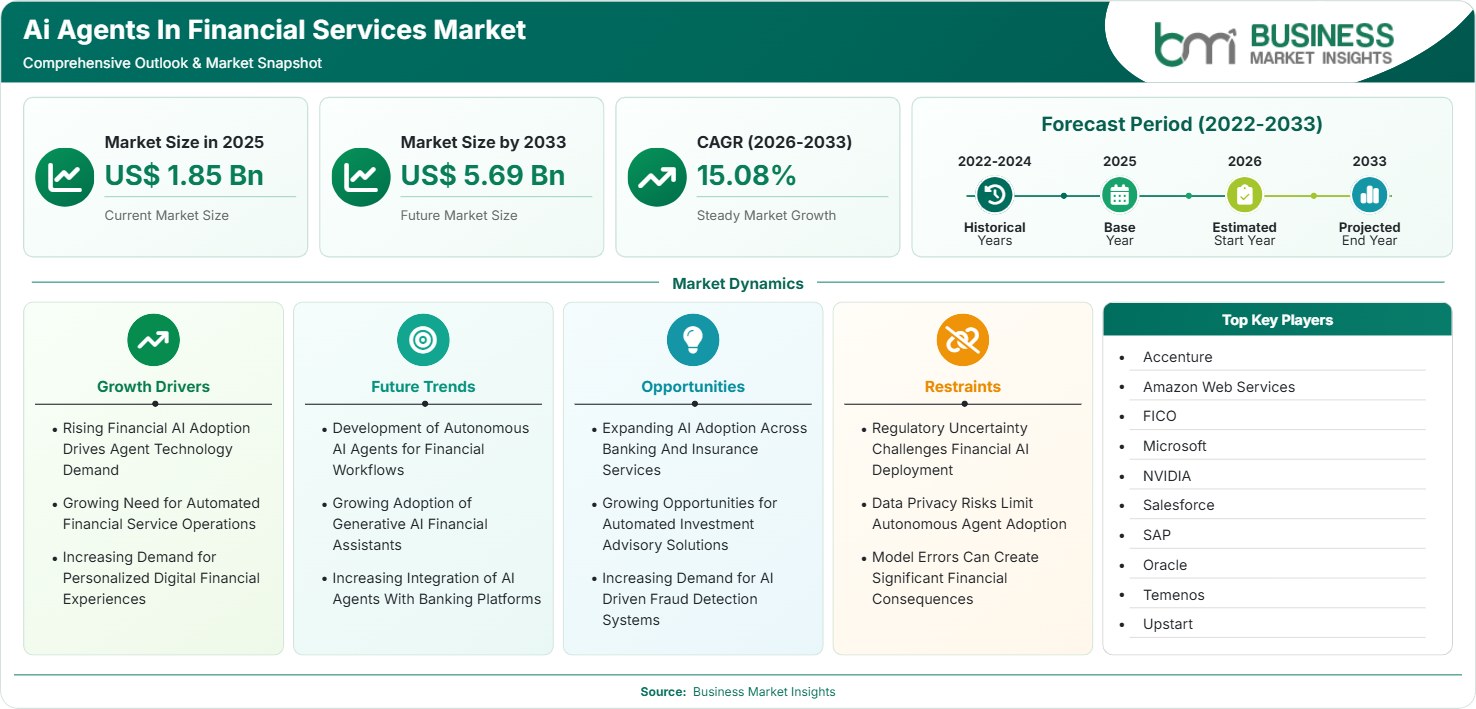
The AI Agents In Financial Services Market size was valued at US$ 1.85 billion in 2025 and is projected to reach US$ 5.69 billion by 2033, growing at a CAGR of 15.08% during 2026–2033, driven by automation, personalized financial services, fraud prevention, intelligent decision-making, and expanding enterprise AI adoption.

Report Coverage
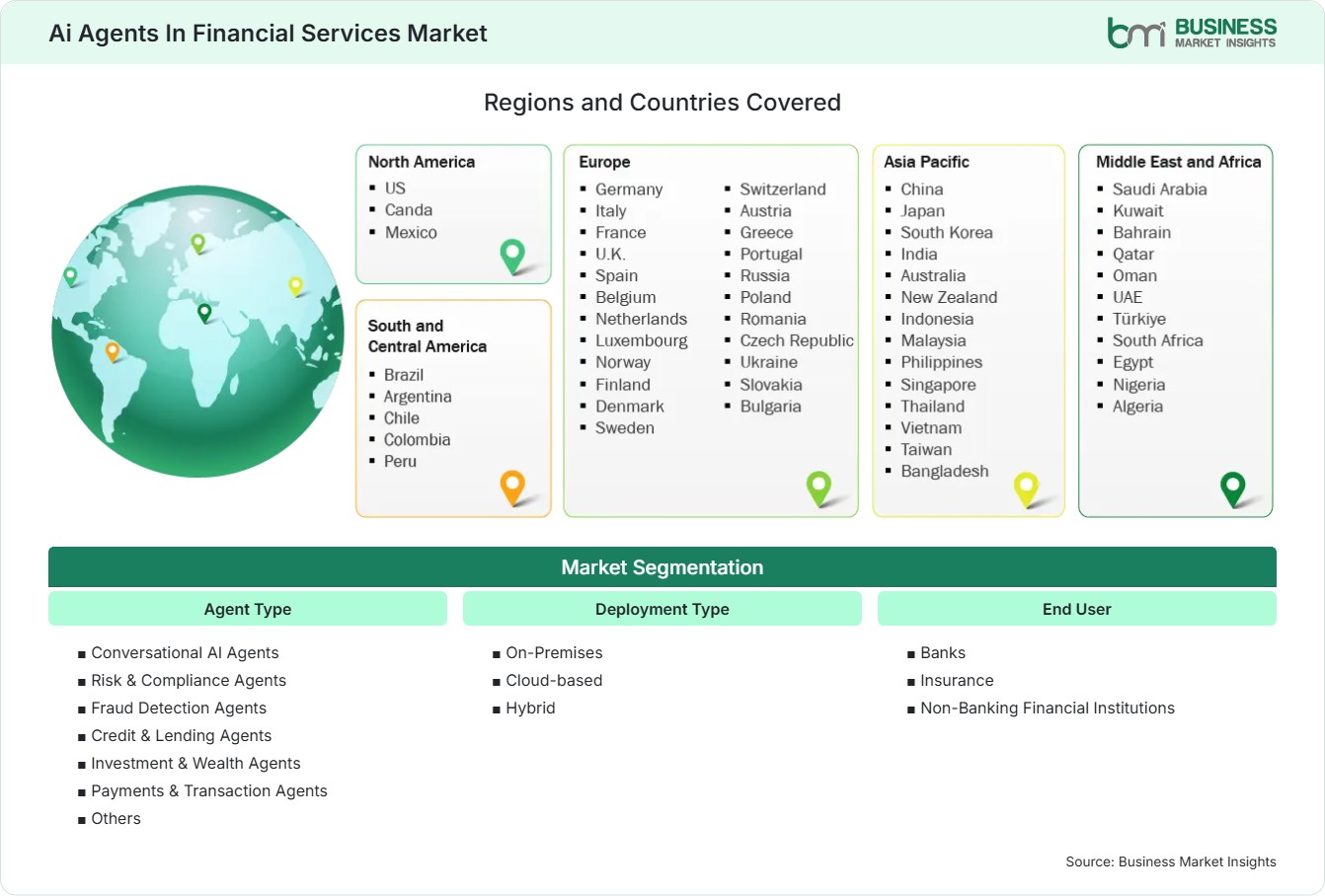
  • Agent Type: Conversational AI Agents, Risk & Compliance Agents, Fraud Detection Agents, Credit & Lending Agents, Investment & Wealth Agents, Payments & Transaction Agents, Others
  • Deployment Type: On-Premises, Cloud-based, Hybrid
  • End User: Banks, Insurance, Non-Banking Financial Institutions
US$ 1.85 Bn Market size in 2025
US$ 5.69 Bn Market Size by 2033
15.08% CAGR, 2026 - 2033
2026-2033 Forecast Period

AI Overview

AI Agents In Financial Services Market Summary

  • North America Region: North America holds a 34%–38% share in 2025, expanding at a 14.5%–16.5% CAGR during 2026–2033, supported by advanced digital banking infrastructure, enterprise AI investment, cloud adoption, financial automation, fraud analytics, and demand for personalized customer engagement.
  • Fastest Growing Region: Asia Pacific holds a 22%–26% share in 2025, advancing at a 17.0%–19.0% CAGR, supported by digital banking expansion, fintech development, mobile financial services, expanding cloud infrastructure, automated risk management, and rising demand for AI-enabled customer experiences.
  • Leading Segment: Conversational AI Agents account for a 27%–31% share in 2025, growing at a 14.0%–16.0% CAGR, supported by automated customer service, financial guidance, multilingual interaction, personalized recommendations, and integration with digital banking channels.
  • High Growth Segment: Fraud Detection Agents represent a 15%–19% share in 2025, advancing at a 17.0%–19.0% CAGR, driven by transaction monitoring, anomaly detection, faster investigation, continuous risk assessment, and increasing sophistication of financial fraud.
  • Key Market Opportunity: Financial institutions can expand agent deployment from customer interaction into lending, compliance, wealth management, payments, fraud prevention, and internal operations, creating broader automation and recurring technology demand.
  • Major Market Players: Accenture, Amazon Web Services, FICO, Microsoft, NVIDIA, Salesforce, SAP, Oracle, Temenos, and Upstart.
Strategic Insights

AI Agents In Financial Services Market: Strategic Insights

AI Agents In Financial Services Market Strategic Framework
FREE PDF
Request your free sample
Request free sample
Stakeholder View

Key Takeaways

  • Agent deployment is moving from isolated customer-service applications toward coordinated workflows spanning front-office, middle-office, risk, compliance, and operational functions.
  • Banks and insurers can capture greater value by prioritizing repetitive, rules-based activities where agents can operate within clearly defined permissions and escalation procedures.
  • Specialized financial agents are gaining relevance because lending, fraud management, investment services, and payments require different datasets, controls, workflows, and decision boundaries.
  • Asia Pacific offers a strong expansion opportunity as digital banking, fintech ecosystems, mobile payments, and cloud infrastructure create favorable conditions for agent-based financial services.
  • Vendor competition is shifting toward secure orchestration, domain-specific models, enterprise integration, governance, and measurable workflow outcomes rather than basic conversational functionality.
  • Institutions that establish reusable AI infrastructure can accelerate deployment across multiple functions, reducing duplication between individual AI projects and improving consistency in governance and monitoring.
Geographic Outlook

AI Agents In Financial Services Market Regional Highlights

North America AI Agents In Financial Services Market

North America holds a 34%–38% share in 2025 and is projected to expand at a 14.5%–16.5% CAGR through 2033. The AI Agents In Financial Services Market share is supported by mature digital banking platforms, extensive cloud infrastructure, strong fintech ecosystems, and high enterprise technology spending.

  • Large financial institutions are developing enterprise AI strategies that connect customer data, internal knowledge, workflow systems, and specialized models.
  • Fintech companies are pushing automation into lending, payments, personal finance, and investment applications, increasing competitive pressure on established financial institutions to modernize customer-facing experiences.
  • Cloud infrastructure supports scalable agent deployment by providing computing capacity, model access, data processing, application programming interfaces, and centralized technology management.
  • Regulatory scrutiny is increasing demand for traceable decision processes, controlled permissions, monitoring, and governance mechanisms within autonomous or semi-autonomous financial workflows.

US AI Agents In Financial Services Market

The US represents a 76%–80% share of North American demand in 2025 and is projected to grow at a 14.8%–16.8% CAGR during 2026–2033. The market benefits from a large concentration of banks, insurers, fintech firms, technology providers, and cloud infrastructure companies.

  • US institutions are expanding AI from employee assistance into customer engagement, fraud prevention, credit workflows, wealth services, and operational automation.
  • Fintech competition is encouraging traditional institutions to improve digital interfaces and provide more personalized financial recommendations without weakening customer trust.
  • Financial firms are placing greater emphasis on governance because autonomous systems can influence sensitive decisions involving credit, payments, investments, and regulatory obligations.

Europe AI Agents In Financial Services Market

Europe accounts for a 26%–30% share in 2025 and is forecast to expand at a 13.5%–15.5% CAGR through 2033. The UK remains a major adoption center, while Germany, France, and the Nordic markets provide additional opportunities.

  • UK banks and fintechs are exploring AI across customer support, financial guidance, fraud detection, and internal operations, supported by a mature digital financial ecosystem.
  • Germany provides opportunities for enterprise-grade AI applications in banking and insurance, particularly where automation can improve processing efficiency while maintaining strong governance.
  • France and Nordic markets offer potential through digital financial services, automated advisory capabilities, and growing demand for efficient technology-enabled customer engagement.
  • European institutions are placing significant emphasis on model oversight, data governance, transparency, and controlled deployment when implementing agentic systems.

Asia Pacific AI Agents In Financial Services Market

Asia Pacific represents a 22%–26% share in 2025 and is projected to grow at a 17.0%–19.0% CAGR through 2033. China, India, Japan, Singapore, and South Korea provide important demand centers. India is projected to expand at an 18.0%–20.0% CAGR, while Singapore could achieve a 17.5%–19.5% CAGR.

  • India offers substantial potential because banks and fintech companies are expanding digital lending, customer service automation, fraud analytics, and personalized financial engagement.
  • Singapore provides a strong environment for financial AI through its concentration of regional banking operations, technology investment, digital finance initiatives, and sophisticated financial infrastructure.
  • Japan and South Korea are adopting AI for customer interaction, operational efficiency, financial analysis, and risk management while emphasizing reliability and enterprise integration.
  • Southeast Asian markets can benefit from agent-based financial services because mobile-first customers and digital financial platforms can support automation without extensive dependence on physical distribution networks.

Rest of World AI Agents In Financial Services Market

Rest of World accounts for a 16%–20% share in 2025 and is expected to expand at a 14.0%–17.0% CAGR through 2033. Latin America is benefiting from fintech expansion and digital payments, while Middle Eastern markets are investing in digital financial infrastructure. Brazil is projected to grow at a 15.0%–17.0% CAGR, while the UAE could reach a 16.0%–18.0% CAGR.

Latin American financial institutions are using digital channels to expand access to banking, lending, payments, and financial services. Middle Eastern markets are developing technology-enabled banking ecosystems supported by digital transformation initiatives and investments in advanced financial infrastructure.

  • Brazil provides opportunities for automated lending, fraud analytics, digital customer engagement, and financial inclusion applications across banks and fintech platforms.
  • The UAE offers strong potential through digital banking modernization, wealth management technology, payments innovation, and sophisticated financial technology ecosystems.
  • Other Middle Eastern markets can deploy specialized agents across customer service, compliance monitoring, financial guidance, and operational workflows as digital financial infrastructure expands.
  • African AI Agents In Financial Services Markets offer longer-term opportunities where mobile financial services and fintech adoption can support AI-enabled customer engagement and automated risk assessment.
Global Market Geography
FREE PDF
Request your free sample
Request free sample
Segment Analysis

AI Agents In Financial Services Market Segmentation

Agent Type

Conversational AI Agents account for a 27%–31% share in 2025 and are projected to grow at a 14.0%–16.0% CAGR through 2033. AI Agents In Financial Services Market scope is broadening as institutions move conversational systems toward task execution.

  • Conversational AI Agents: Automate customer interactions, product explanations, service requests, and financial guidance while supporting continuous digital engagement across banking and insurance channels.
  • Risk & Compliance Agents: Assist with regulatory monitoring, documentation, policy interpretation, investigation workflows, and risk assessment while improving consistency across compliance operations.
  • Fraud Detection Agents: Analyze transactions, behavioral patterns, alerts, and contextual information to identify suspicious activity and accelerate investigation processes.
  • Credit & Lending Agents: Support customer qualification, document review, credit analysis, application processing, and lending workflows while improving responsiveness and operational efficiency.
  • Investment & Wealth Agents: Provide personalized financial information, portfolio insights, investment recommendations, and wealth-management support within defined advisory and governance frameworks.
  • Payments & Transaction Agents: Assist with transaction routing, payment monitoring, reconciliation, exception handling, and customer payment support across digital financial ecosystems.

Deployment Type

Cloud-based deployment represents a 52%–56% share in 2025 and is projected to expand at a 16.0%–18.0% CAGR through 2033. Cloud environments provide scalable computing, model access, centralized updates, and flexible integration with digital applications.

  • On-Premises: Supports institutions requiring greater control over infrastructure, sensitive financial data, security policies, and internal technology environments.
  • Cloud-based: Enables scalable computing, rapid deployment, centralized model management, and integration with digital financial applications and enterprise data platforms.
  • Hybrid: Combines cloud scalability with controlled on-premises infrastructure, supporting organizations that need flexible deployment while retaining selected workloads within internal environments.

End User

Banks represent a 58%–62% share in 2025 and are projected to grow at a 14.5%–16.5% CAGR through 2033. Banks have broad opportunities to deploy agents across servicing, lending, fraud management, compliance, payments, and wealth operations.

  • Banks: Deploy agents across customer service, lending, fraud prevention, compliance, payments, wealth management, and internal operations to improve responsiveness and productivity.
  • Insurance: Use AI agents for customer interaction, claims support, underwriting assistance, policy servicing, fraud assessment, and workflow automation across insurance operations.
  • Non-Banking Financial Institutions: Apply agents to lending, payments, collections, customer engagement, risk assessment, investment services, and other specialized financial workflows.
Market Forces

AI Agents In Financial Services Market Dynamics

Key Market Drivers

Rising Financial AI Adoption Drives Agent Technology Demand

Financial institutions are moving from experimental implementations of AI to operational adoption of this technology, thus laying the groundwork for agents' integration. Early AI applications were centered on customer and employee support, document handling, and analysis, and more recent agents could manage multiple stages of processes. Consequently, AI Agents In Financial Services Market expansion is becoming increasingly linked to enterprise AI readiness, data availability, and cloud migration. Financial institutions have been exploring use cases in which automation is possible for regular activities, while decisions related to those activities would be handled by employees. It will ensure that they can implement their use case gradually and reduce the risk involved in the process. The infrastructure for agents may use enterprise data, APIs, business logic, and security mechanisms.

Growing Need for Automated Financial Service Operations

Activities within financial services are characterized by high volumes of routine work that implies information search, validation, communication, documentation, and decision-making support. Agents can automate these processes through different systems, thus eliminating the need for manual transfer of information. The application is especially useful when the time that employees spend on gathering information is considerable compared to the completion of higher-value tasks. Currently, banks and other financial organizations are considering the use of agent technologies for servicing, loan origination, collection, compliance checks, and internal support. Successful implementation will depend on proper process management, defined permissions, availability of reliable information, and escalation procedures. The AI Agents In Financial Services Market trend is moving towards workflow automation based on multiple specialized agents.

Increasing Demand for Personalized Digital Financial Experiences

Customers are demanding financial services that are available on a round-the-clock basis, fast, and personalized to fit their individual circumstances. Traditional digital interfaces may need customers to move through a number of screens, have knowledge of the terms of products, and make comparisons themselves. AI agents may help by making sense of customer requests, searching for the required information, and assisting in financial activities. Personalization can include product selection, service provision, financial education, investment details, and payment assistance. However, institutions have to take care of the issue of suitability, disclosures, privacy, and authorization, especially when an agent transitions from informing to taking any kind of action. According to the AI Agents In Financial Services Market forecast, there will be growing prospects for financial organizations to rethink their digital interaction methods.

Key Market Opportunities

Expanding AI Adoption Across Banking And Insurance Services

Banks and insurers have numerous workflows where agent technology can produce value beyond customer service. Lending, claims, compliance, collections, underwriting support, financial research, and employee assistance can all benefit from systems that retrieve information and coordinate predefined actions. Opportunity is strongest where workflows are repetitive but still require contextual judgment and interaction with several enterprise systems. Vendors can support adoption by providing domain-specific agents with controlled access to financial data and applications. Integration with core banking, policy administration, customer relationship management, and risk systems can create deeper customer value. As deployment expands, institutions can establish reusable agent frameworks and governance structures that reduce the time and resources required to launch additional use cases.

Growing Opportunities for Automated Investment Advisory Solutions

Investment and wealth management provide an attractive application because customers increasingly seek accessible explanations, portfolio information, market context, and personalized financial guidance. Agents can organize information, answer questions, monitor predefined conditions, and support advisers by preparing relevant research or client summaries. Opportunities are particularly strong for institutions seeking to extend wealth services to customers who may not traditionally receive dedicated advisory support. However, successful deployment depends on appropriate suitability controls, disclosures, data quality, and clear boundaries between education, recommendation, and regulated advice. Providers that combine conversational interfaces with trusted financial information and human adviser escalation can create differentiated digital experiences while maintaining appropriate governance over higher-risk decisions.

Increasing Demand for AI Driven Fraud Detection Systems

Fraud management is well suited to agent-based systems because suspicious activity often requires information to be gathered from multiple transactions, accounts, customer histories, and external signals. Agents can help prioritize alerts, collect relevant evidence, summarize cases, and support investigators during review. This can reduce repetitive investigation work while allowing specialists to concentrate on complex cases. Opportunity also exists for systems that continuously monitor changing fraud patterns and adapt investigation workflows under controlled rules. Financial institutions can improve the value of such solutions by integrating agents with transaction monitoring, customer identity systems, case-management platforms, and risk engines. Strong audit trails and human review remain important where automated outputs could influence account restrictions or customer decisions.

Market Restraints and Challenges

Regulatory Uncertainty Challenges Financial AI Deployment

Factor: Financial services operate under extensive requirements covering consumer protection, suitability, discrimination, explainability, recordkeeping, accountability, and operational resilience. Impact: Uncertainty about how existing requirements apply to autonomous AI behavior can delay deployment or limit agents to narrowly defined tasks. Institutions may require additional validation, human approval, monitoring, and documentation before allowing agents to execute sensitive actions. These controls can increase implementation complexity and reduce the immediate productivity advantage of highly autonomous systems. Vendors can mitigate the challenge by embedding audit trails, permission management, model monitoring, explainability features, and escalation controls into agent platforms. Regulatory clarity and repeatable governance frameworks should gradually support broader deployment across financial workflows.

Data Privacy Risks Limit Autonomous Agent Adoption

Factor: AI agents may need access to customer records, transaction information, financial histories, internal documents, and proprietary institutional data to complete complex workflows. Impact: Greater data access increases the consequences of unauthorized exposure, inappropriate processing, model leakage, or incorrect action. Financial institutions therefore require strong identity management, access controls, encryption, data minimization, monitoring, and clear boundaries around agent permissions. Hybrid deployment can remain attractive where institutions need tighter control over sensitive information. Vendors that demonstrate robust security architectures and granular authorization can reduce adoption barriers. The ability to restrict agents to approved datasets, applications, and actions will remain important as organizations move from informational assistants toward systems capable of executing transactions.

Company Analysis

Competitive Landscape

The AI Agents In Financial Services Market analysis covers technology companies, consulting firms, financial software providers, cloud platforms, enterprise application vendors, and specialized financial technology companies. Vendors with broad enterprise ecosystems can use existing customer relationships and technology stacks to accelerate financial AI deployment.

Company Name

Overview

Products and Services Relevant to This Market

Accenture

Global technology and consulting company supporting financial institutions with AI strategy, transformation, technology implementation, and operational modernization.

AI consulting, agentic AI transformation, financial services technology, data modernization, automation, cloud services, and intelligent workflow solutions.

Amazon Web Services

Cloud computing provider offering infrastructure, AI services, data platforms, and development capabilities for enterprise financial applications.

Cloud AI infrastructure, machine learning services, generative AI development tools, data services, application integration, and scalable computing.

FICO

Analytics and decision technology company with strong capabilities in financial risk, fraud management, and credit decisioning.

Fraud detection, risk analytics, credit decisioning, predictive models, customer decision platforms, and AI-enabled financial workflows.

Microsoft

Technology company providing cloud, AI, productivity, data, and enterprise application capabilities to financial institutions.

Azure AI, AI agents, cloud infrastructure, analytics, enterprise applications, cybersecurity, workflow automation, and financial services solutions.

NVIDIA

Computing technology company providing accelerated computing platforms and AI infrastructure for enterprise and financial applications.

AI computing platforms, accelerated infrastructure, model development technologies, AI software, inference capabilities, and enterprise AI ecosystems.

Salesforce

Enterprise software provider focused on customer relationship management, data, automation, and AI-enabled customer engagement.

Agentic CRM capabilities, customer service automation, data platforms, AI assistants, workflow automation, and financial services applications.

SAP

Enterprise software company providing business applications, data platforms, analytics, and AI capabilities for financial operations.

Enterprise AI, intelligent automation, business applications, analytics, financial management software, data platforms, and workflow solutions.

Oracle

Enterprise technology company providing cloud infrastructure, databases, applications, analytics, and AI capabilities for financial institutions.

Cloud AI infrastructure, financial applications, data management, analytics, automation, enterprise software, and AI-enabled workflows.

Temenos

Financial technology provider specializing in banking software, digital banking, core banking, and financial services technology.

Banking platforms, digital banking, AI capabilities, customer engagement, risk management, payments, lending, and financial workflow solutions.

Upstart

AI-driven lending technology company focused on improving credit access and automating lending decisions.

AI-powered lending platforms, credit decisioning, automated loan processing, risk assessment, and financial institution technology solutions.

Trust & Transparency

Research Methodology

The market analysis combines proprietary research with secondary data from government agencies, company disclosures, regulatory filings, industry databases and expert interviews. Market estimates are validated through data triangulation, cross-market benchmarking and analyst review.

View Full Research Methodology

Questions Answered

Frequently Asked Questions

What does the AI Agents In Financial Services Market Report cover?

The report examines market size, regional development, agent types, deployment models, end-user adoption, technology trends, growth drivers, investment opportunities, restraints, competitive positioning, and strategic areas shaping future industry demand.

What factors will influence future AI agent adoption?

Adoption will depend on regulatory clarity, data quality, security, integration with core systems, model reliability, operating costs, employee acceptance, customer trust, and the ability to demonstrate measurable improvements in productivity or service quality.

How can financial institutions control autonomous AI agents?

Institutions can establish permission boundaries, human approval requirements, audit trails, monitoring systems, identity controls, data restrictions, and escalation procedures. These mechanisms allow agents to automate defined activities while keeping sensitive decisions subject to appropriate oversight.

Which financial functions are most suitable for AI agents?

Customer service, fraud investigation, compliance support, lending workflows, payments, collections, wealth management assistance, and employee productivity are among the most suitable areas because they involve structured processes, recurring tasks, and access to substantial enterprise data.

What is the AI Agents In Financial Services Market?

The market covers technologies that enable software-based AI agents to interpret information, perform tasks, coordinate workflows, provide financial guidance, and support decisions across banking, insurance, lending, payments, investment, compliance, and other financial activities.

Access the Full AI Agents In Financial Services Market Report

Get segment-level forecasts, regional estimates, competitive benchmarking, company profiles and downloadable Excel datasets.

Access the full AI Agents In Financial Services Market Report
350 pages PDF & Excel | 2026-09-03