Market Summary
Executive Summary and Global Market Analysis
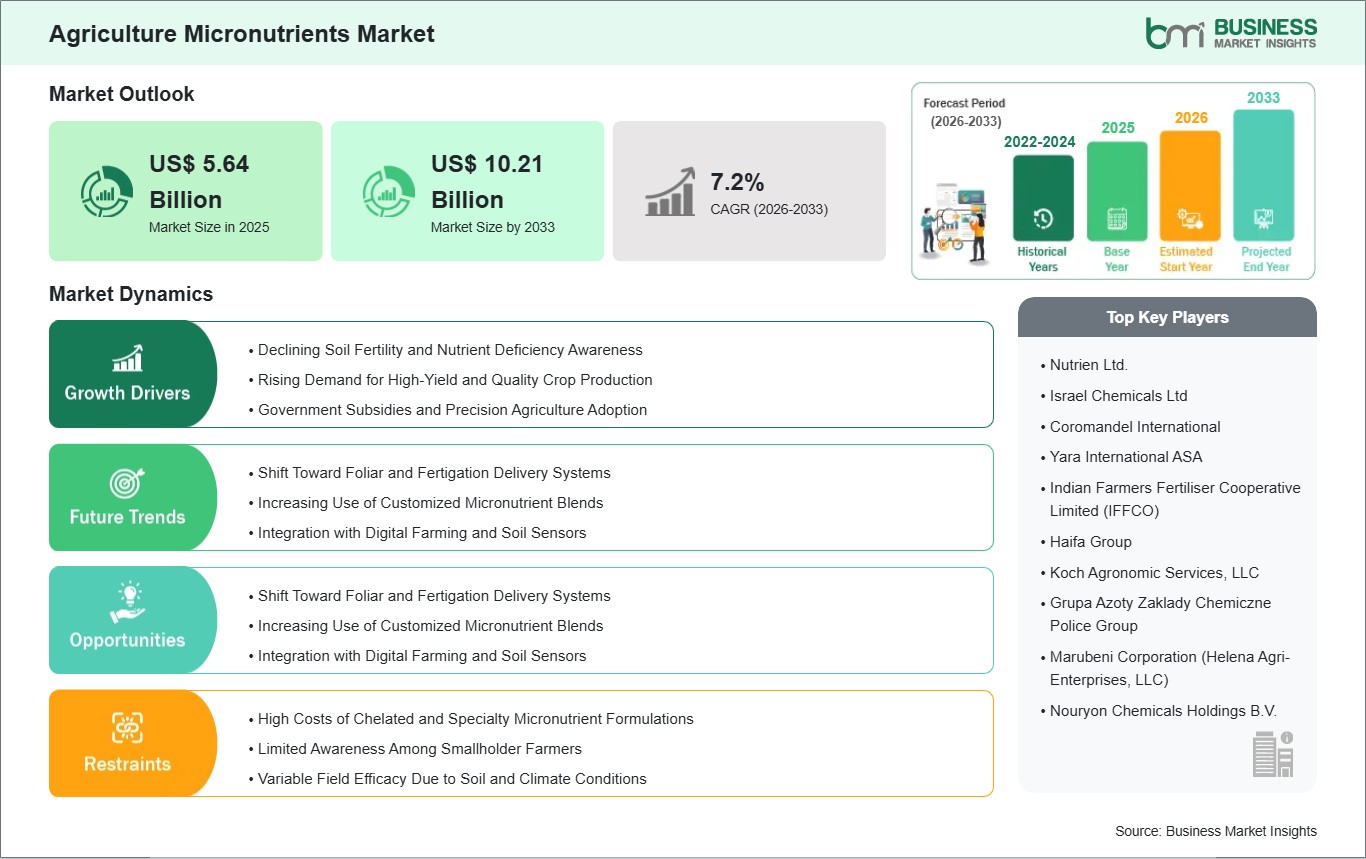
Agricultural micronutrients are essential trace elements, such as zinc, boron, iron, manganese, copper, and molybdenum. They play a critical role in modern crop nutrition and high-productivity farming systems. These nutrients support basic physiological processes like enzyme activation, photosynthesis, and hormone regulation. They can be applied through soil, foliar sprays, fertigation, or seed treatment to various crops. This helps to correct deficiencies, improve yield quality, and enhance stress tolerance. The market is growing steadily due to widespread soil nutrient depletion, rising demand for high-value and nutritious food, and the increasing use of precision agriculture technologies. Supportive government policies and greater farmer awareness of balanced fertilization are also speeding up global adoption.
However, the market faces significant challenges such as the technical difficulties of ensuring correct dosage and application, the sensitivity to soil conditions, and fluctuations in raw material costs. Additional issues are fragmented supply chains, varying regulatory standards, and the ongoing need for farmer education. Nevertheless, the market outlook remains positive due to advancements in chelated and nano-formulations, the integration of micronutrients with digital farming tools, and the focus on biofortification and sustainable practices. These trends highlight the essential role of micronutrients in creating resilient, efficient, and productive agricultural systems to secure future global food supply.
Segment Analysis
Agriculture Micronutrients Market Segmentation
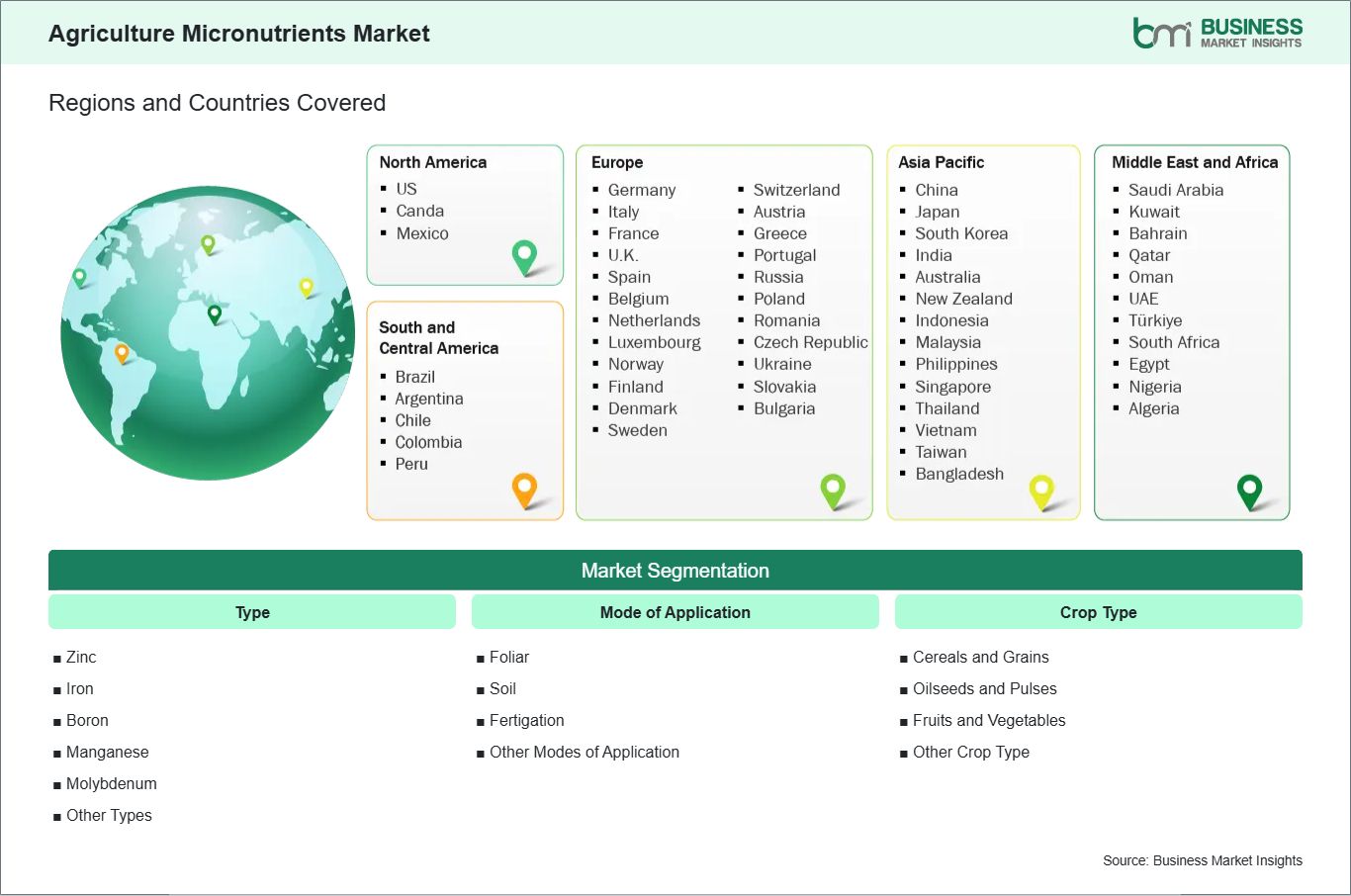
Key segments that contributed to the derivation of the agriculture micronutrients market analysis are type, mode of application, and crop type.
- By type, the agriculture micronutrients market is categorized into zinc, iron, boron, manganese, molybdenum, and other types. The molybdenum segment dominated the market in 2025.
- By mode of application, the market is segmented into foliar, soil, fertigation, and other modes of application. The foliar segment dominated the market in 2025.
- By crop type, the agricultural activator adjuvants market is categorized into cereals and grains, oilseeds and pulses, fruits and vegetables, and Others. The cereals and grains segmented is further sub-segmented into corn, wheat, rice, and others. The oilseeds and pulses segment is further sub-segmented into soybean, cotton, rapeseed/canola, peas and legumes, and others. The fruits and vegetables segment is further sub-segmented into tomatoes, chilies, onions, bananas, citrus fruits, berries, and others. The cereals and grains segment held the largest share of the market in 2025.
Market Forces
Agriculture Micronutrients Market Drivers and Opportunities
Widespread Soil Nutrient Depletion and Degradation
Intensive farming practices and the widespread use of high-yielding crop varieties have caused a significant and ongoing removal of micronutrients from soil without sufficient replenishment. This depletion worsens due to soil erosion, unbalanced fertilization that focuses only on NPK, and the low levels of natural organic matter in many agricultural soils. Consequently, micronutrient deficiencies have become a major limiting factor for crop productivity and quality across many global farmlands. This growing agronomic challenge is driving the demand for targeted micronutrient solutions, as farmers increasingly realize that macronutrients alone cannot maintain yields. Regulatory and educational programs that promote soil health testing and balanced fertilization are encouraging the use of micronutrients in standard farming practice. This makes them a key input for maintaining soil fertility and ensuring reliable harvests.
Integration with Digital Agriculture and Precision Delivery Platforms
The rise of precision farming tools, such as soil sensors, drone-based spectral imaging, and AI-driven analytics, allows for precise mapping of micronutrient deficiencies in fields. This creates a strong opportunity for formulating and applying customized micronutrient blends at variable rates. These technologies support nutrient management that focuses on using the right source, right rate, right time, and right place, which greatly improves efficiency and farm economics. For micronutrient suppliers, this shift opens new paths for creating valuable, data-linked product and service bundles, along with smart formulations that work with modern equipment. This integration enhances crop performance and resource efficiency, positioning micronutrients as a key element of connected, sustainable, and data-driven farm management systems.
Size and Share Analysis
Agriculture Micronutrients Market Size and Share Analysis
The Agriculture Micronutrients market demonstrates steady growth, with size and share analysis revealing evolving trends and competitive positioning among key players. The report further examines subsegments categorized within type, mode of application, and crop type, offering insights into their contribution to overall market performance.
Based on type, the molybdenum subsegment dominates the agriculture micronutrients market. Molybdenum is essential for nitrogen fixation in legumes and for using nitrogen efficiently within plants. Its demand comes from the growing legume cultivation, the need to improve fertilizer efficiency, and the common molybdenum deficiency in acidic soils. This nutrient helps support sustainable nitrogen management practices, making it important for precision crop nutrition.
Report Coverage
Agriculture Micronutrients Market Report Coverage and Deliverables
The " Agriculture Micronutrients Market Size and Forecast (2022–2033)" report provides a detailed analysis of the market covering below areas:
- Agriculture Micronutrients market size and forecast at global, regional, and country levels for all the key market segments covered under the scope
- Agriculture Micronutrients market trends, as well as market dynamics such as drivers, restraints, and key opportunities
- Agriculture Micronutrients market analysis covering key market trends, global and regional framework, major players, regulations, and recent market developments
- Industry landscape and competition analysis covering market concentration, heat map analysis, prominent players, and recent developments for the agriculture micronutrients market
- Detailed company profiles, including SWOT analysis
Geographic Insights
Agriculture Micronutrients Market Geographic Insights
The geographical scope of the Agriculture Micronutrients market report is divided into five regions: North America, Asia Pacific, Europe, the Middle East & Africa, and South & Central America. The Asia Pacific Agriculture Micronutrients Market is segmented into China, Japan, South Korea, India, Australia, New Zealand, Indonesia, Malaysia, the Philippines, Singapore, Thailand, Vietnam, Taiwan, Bangladesh, and the Rest of Asia Pacific. Asia Pacific shows strong growth in the global agricultural micronutrients market. This growth is due to its large arable land, intensive farming practices, and the urgent need to improve soil fertility. The rising population, increased food demand, and the decline of arable land are speeding up the use of micronutrients to fix deficiencies and enhance crop yield and quality.
Major government efforts to promote balanced fertilization, growing awareness among farmers, and the rise of high-value crop farming are boosting production and consumption in the region. Together, these factors make Asia Pacific a significant consumer and a rapidly developing producer of agricultural micronutrients, highlighting its important role in the global market.
Industry Activity
Recent Developments
The Agriculture Micronutrients market is evaluated by gathering qualitative and quantitative data post-primary and secondary research, which includes important corporate publications, association data, and databases. A few of the key developments in the agriculture micronutrients market are:
- In December 2024, US-based Sound Agriculture secured a $25 million extension of its Series D raise, enabling the expansion of its plant epigenetics platform and bio-inspired nutrient efficiency solutions, aimed at promoting healthier soils, higher crop yields, and climate-friendly farming practices.
- In July 2024, Syngenta Biologicals and Intrinsyx Bio partnered to introduce innovative endophyte formulations aimed at enhancing sustainability and crop yields through seed treatment and foliar applications. This collaboration will provide farmers with access to Intrinsyx Bio's endophyte formulations, which fix atmospheric nitrogen and improve nutrient uptake, thereby reducing reliance on synthetic fertilizers. Syngenta's investment in biological solutions emphasizes its commitment to sustainable farming and environmental management.
Trust & Transparency
Research Methodology
The market analysis combines proprietary research with secondary data from government agencies, company disclosures, regulatory filings, industry databases and expert interviews. Market estimates are validated through data triangulation, cross-market benchmarking and analyst
review.
View Full Research Methodology
Key Sources Referred:
World Bank – Global Trade IndicatorsEuropean Chemicals AgencyInternational Council of Chemical AssociationsInternational Monetary Fund (IMF)World Trade Organization (WTO)International Trade Administration (ITA)Company WebsitesCompany Annual ReportsCompany Investor Presentations