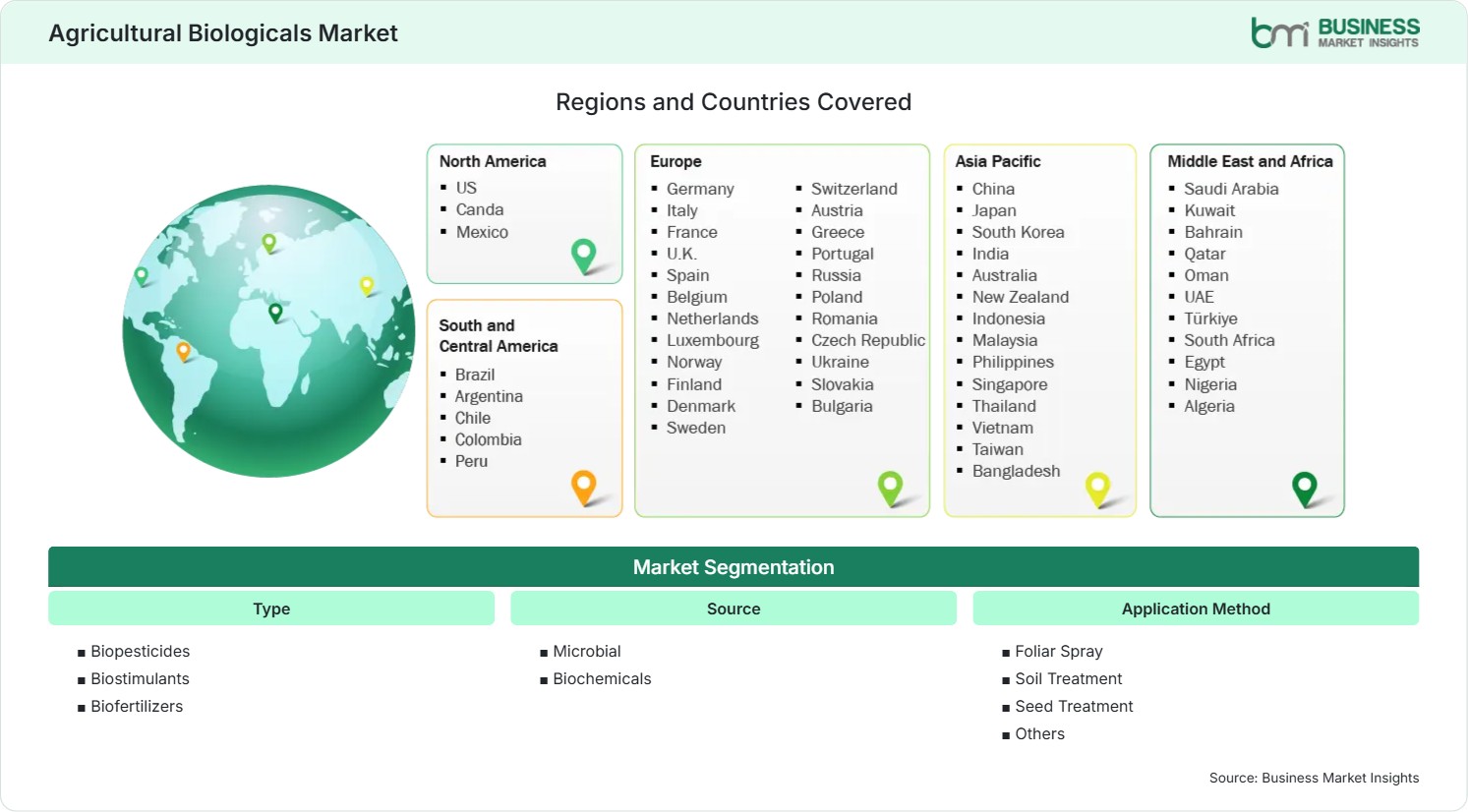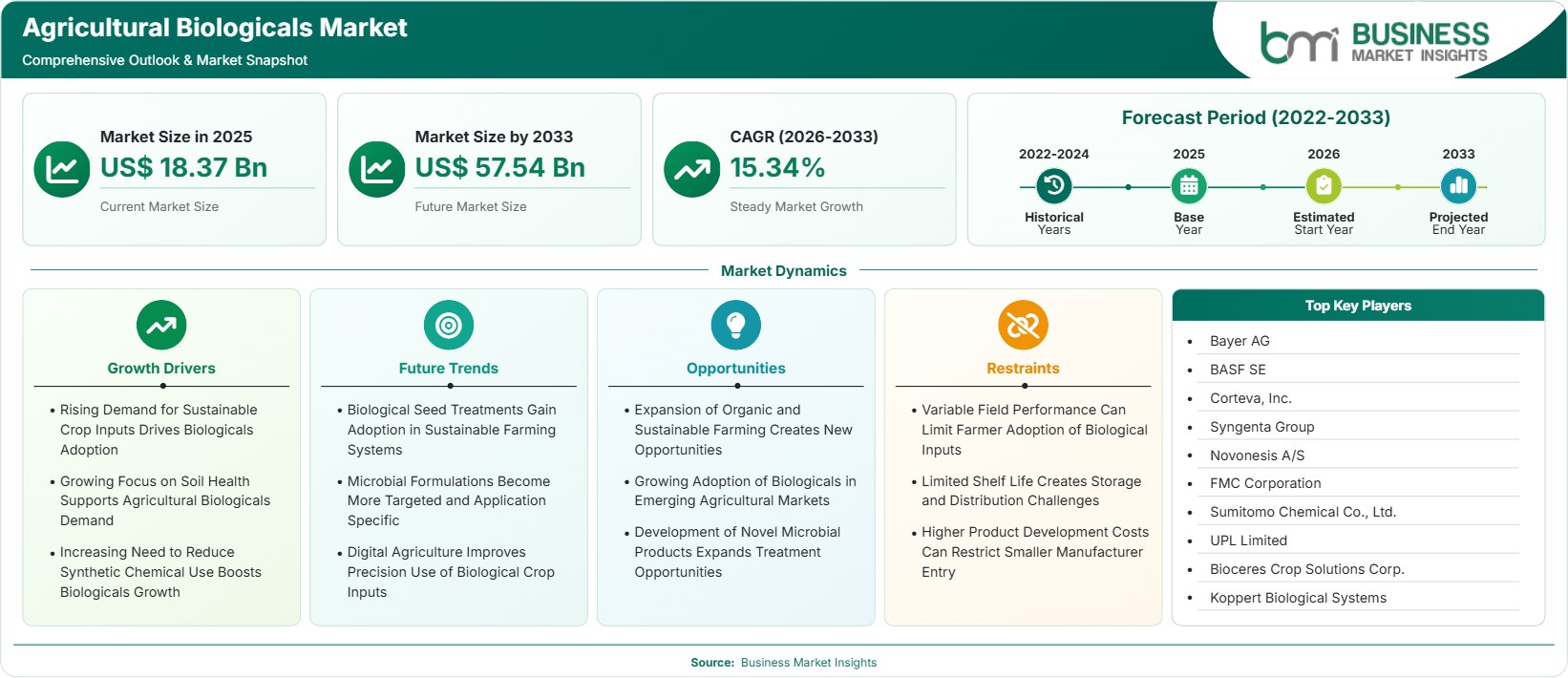
Agricultural Biologicals Market Regional Highlights
North America Agricultural Biologicals Market
North America accounted for a 28%–31% share in 2025 and North America Agricultural Biologicals Market forecast to grow at a 14%–16% CAGR through 2033. This area has advantages in terms of an already established agricultural supply chain, developed crop protection distribution network, increased consciousness about soil health, and increased interest in the application of integrated pest management. The USA is still the main country, while Canada acts as a supplementary market through the use of sustainable crop production and biological inputs.
- Biological crop protection is becoming increasingly significant in integrated strategies since farmers are looking for products that may complement their traditional chemical practices.
- Soil health initiatives are increasing demand for biological products that support nutrient cycling, plant vigor, root development, and crop performance under variable growing conditions.
- Product registration and performance validation remain important commercial considerations because growers require predictable results before incorporating biological products into established crop protection programs.
- Established agricultural distribution networks provide manufacturers with access to growers, agronomists, retailers, and farm advisers, supporting wider commercialization of differentiated biological formulations.
US Agricultural Biologicals Market
The U.S. Agricultural Biologicals Market accounted for 82%–86% of North America's share in 2025 and is projected to grow at a 14.5%–16.5% CAGR through 2033. Demand is supported by established crop protection infrastructure, increasing interest in soil health, biological pest management, and integrated farming. Product developers are focusing on efficacy, formulation stability, and compatibility with existing agricultural programs to improve adoption across major crop categories.
- Biological products are increasingly positioned as complementary inputs rather than direct replacements for conventional crop protection, allowing growers to integrate them within broader agronomic programs.
- Demand for soil and plant health solutions is encouraging product development around nutrient utilization, stress management, microbial activity, and crop establishment.
- Regulatory requirements remain a key commercialization factor, making product registration, performance documentation, formulation consistency, and application guidance important competitive capabilities.
Europe Agricultural Biologicals Market
Europe Agricultural Biologicals Market held a 22%–25% share in 2025 and is projected to grow at a 13%–15% CAGR through 2033. France, Germany, Spain, Italy, and the Netherlands represent leading markets, while Spain and Italy provide strong growth potential. Restrictions on selected conventional inputs, sustainability objectives, integrated pest management, and consumer expectations are supporting biological adoption across agricultural production systems.
- France and Germany provide established markets for biological crop protection and plant health products, supported by strong agricultural research, distribution capabilities, and sustainability-oriented farming practices.
- Spain and Italy offer higher growth potential as horticulture, specialty crops, water management, and residue considerations increase demand for biological crop inputs.
- European growers increasingly require products that fit integrated programs, placing greater emphasis on efficacy, application timing, compatibility, and documented agronomic performance.
- Regulatory requirements continue to influence product development because biological products must satisfy defined safety, efficacy, labeling, and environmental criteria before commercialization.
Asia Pacific Agricultural Biologicals Market
Asia Pacific Agricultural Biologicals Market represented a 24%–27% share in 2025 and is projected to expand at a 17%–20% CAGR through 2033. China, India, Japan, and Australia lead regional adoption, while India and Southeast Asia provide higher growth potential. Agricultural intensification, input efficiency requirements, changing soil conditions, and government support for sustainable farming are broadening the addressable market.
- China is expanding biological input adoption alongside agricultural modernization, crop productivity initiatives, and efforts to improve soil and resource efficiency.
- India offers substantial growth potential as growers, distributors, and agricultural institutions increase attention toward biological crop protection, microbial products, and sustainable nutrient management.
- Japan and Australia are relatively mature markets where quality, formulation efficacy, crop specificity, and agronomic efficacy affect purchasing decisions.
- The agriculture of Southeast Asia presents an opportunity to apply biologicals to intensive cropping systems where pest pressure, input efficiency, residues, and environmental factors necessitate a more specific solution.
Rest of World Agricultural Biologicals Market
South and Central America accounted for part of the 18%–21% Rest of World share in 2025 and are projected to grow at a 15%–18% CAGR. Brazil and Argentina lead demand, supported by extensive agricultural production, biological crop protection use, and increasing interest in integrated farming. Mexico provides additional growth through crop diversification and expanding sustainable agriculture practices.
The Middle East and Africa also fall within the 18%–21% regional share range and are projected to grow at a 14%–17% CAGR. Brazil, Argentina, South Africa, and selected Gulf agricultural markets provide leading opportunities as growers address soil constraints, water limitations, pest pressure, and input efficiency.
- Brazil and Argentina provide strong commercial potential because large-scale agricultural production creates demand for biological crop protection, soil management, and products supporting input efficiency.
- Mexico offers opportunities across commercial agriculture as growers seek improved crop protection and biological products suited to diversified production systems.
- South Africa provides a developed agricultural base for biological products, while broader African adoption depends on distribution networks, agronomic awareness, product affordability, and local registration.
- Middle Eastern markets create demand for biological solutions that support crop productivity under water stress, high temperatures, soil constraints, and intensive agricultural production.