
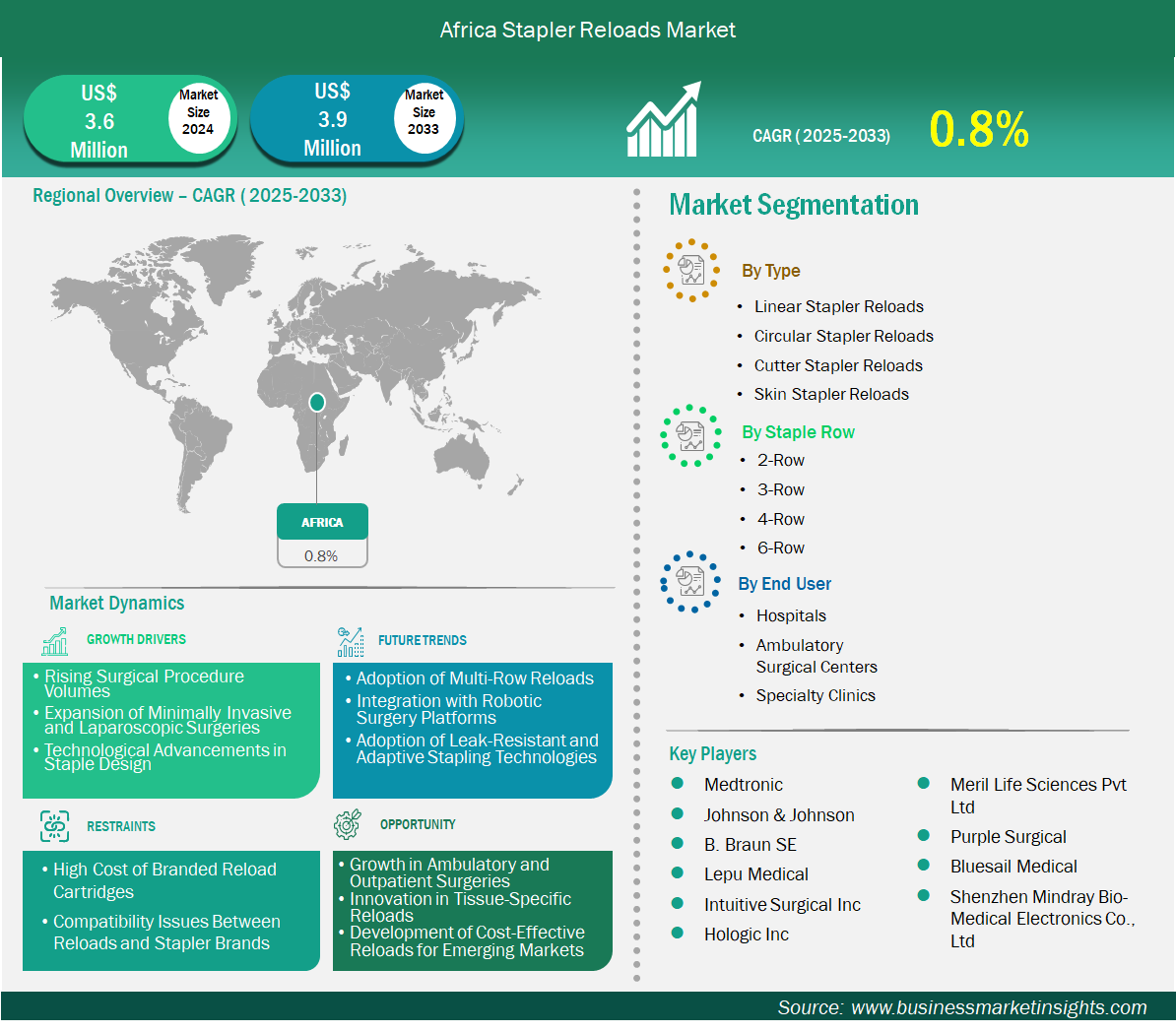
The Africa stapler reloads market size is expected to reach US$ 3.9 million by 2033 from US$ 3.6 million in 2024. The market is estimated to record a CAGR of 0.8% from 2025 to 2033.
Executive Summary and Africa Stapler Reloads Market Analysis:
The Africa stapler reloads market is developing steadily, supported by gradual improvements in surgical infrastructure and increasing adoption of standardized wound-closure techniques. Demand is closely linked to the rising use of surgical staplers in general surgery, trauma care, and obstetric procedures, particularly in urban hospitals. Stapler reloads are gaining preference due to their role in improving procedural consistency, reducing operating time, and supporting better post-operative outcomes. Expansion of private healthcare facilities and growing awareness of infection control practices further support market growth. However, the market faces restraints such as limited availability of advanced surgical tools in rural regions and strong dependence on imported stapler systems and reload cartridges. Cost sensitivity within public healthcare systems and complex procurement processes also restrict widespread adoption. Despite these challenges, Africa represents a promising emerging market for stapler reload manufacturers focused on long-term penetration.
Africa Stapler Reloads Market Segmentation Analysis:
Key segments that contributed to the derivation of the stapler reloads market analysis are type, staple row, and end user.
- By type, the stapler reloads market is segmented into linear stapler reloads, circular stapler reloads, cutter stapler reloads, and skin stapler reloads. The linear stapler reloads segment dominated the market in 2024. Their dominance stemmed from versatility in gastrointestinal and thoracic surgeries, precision in cutting and stapling, and strong adoption in minimally invasive procedures, making them the most reliable choice for surgeons globally.
- By staple row, the stapler reloads market is segmented into 2-row, 3-row, 4-row, and 6-row. The 4-row segment dominated the market in 2024. This leadership was driven by superior tissue security and hemostasis, reducing leakage risks during complex surgeries, enhancing patient safety, and ensuring better surgical outcomes compared to fewer-row alternatives.
- By end user, the market is segmented into hospitals, ambulatory surgical centers, and specialty clinics. The hospitals segment held the largest share of the market in 2024. Hospitals perform the vast majority of complex and high-volume surgical procedures across diverse specialties, making them the largest consumers of stapler reload.
Africa Stapler Reloads Market Outlook
The Africa stapler reloads market functions primarily as a consumables-driven segment, with demand dependent on the installed base of surgical staplers and overall surgical procedure volumes. Reload usage is recurrent, making hospitals consistent buyers once stapling devices are integrated into routine practice. A major driver for the market is the increasing volume of trauma and emergency surgeries across metropolitan areas. Road accidents, workplace injuries, and urban population growth contribute to higher surgical caseloads where speed and reliability are critical. Stapler reloads allow surgeons to perform rapid wound closure while maintaining uniform staple formation, supporting operating room efficiency. As hospitals aim to reduce procedure duration and manage patient throughput more effectively, reload utilization increases. This driver is reinforced by surgeon familiarity with stapling techniques, ensuring continued reliance on reload cartridges across multiple surgical specialties.
Africa Stapler Reloads Market Country Insights
Based on country, the Africa stapler reloads market is further segmented into Nigeria, Egypt, South Africa, and Algeria. South Africa held the largest share in 2024.
South Africa dominates the African stapler reloads market due to its comparatively advanced healthcare ecosystem and strong penetration of private hospital groups. The country has higher adoption of modern surgical staplers, which directly drives consistent demand for compatible reload cartridges. Private hospitals prioritize efficiency, patient safety, and standardized surgical outcomes, making stapler reloads a routine consumable in general, colorectal, and bariatric procedures. South Africa also benefits from better access to international medical device manufacturers and distributors, ensuring stable product availability. Additionally, the country acts as a regional training and referral hub, increasing exposure to advanced surgical techniques that rely on stapling systems. While public hospitals remain cost-constrained, procurement activity in the private sector and growing medical tourism continue to support South Africa’s leading position in the African stapler reloads market.
Africa Stapler Reloads Market Company Profiles
Africa Stapler Reloads Market Research Methodology:
The following methodology has been followed for the collection and analysis of data presented in this report:
Secondary Research
The research process begins with comprehensive secondary research, utilizing both internal and external sources to gather qualitative and quantitative data for each market. Commonly referenced secondary research sources include, but are not limited to:
- Company websites, annual reports, financial statements, broker analyses, and investor presentations
- -Industry trade journals and other relevant publications
- Government documents, statistical databases, and market reports
- News articles, press releases, and webcasts specific to companies operating in the market
Note: All financial data included in the Company Profiles section has been standardized to US$. For companies reporting in other currencies, figures have been converted to US$ using the relevant exchange rates for the corresponding year.
Primary Research
Business Market Insights conducts a significant number of primary interviews each year with industry stakeholders and experts to validate and analyze the data and gain valuable insights. These research interviews are designed to:
- Refine findings from secondary research
- Enhance the expertise and market understanding of the analysis team
- Gain insights into market size, trends, growth patterns, competitive dynamics, and future prospects
Primary research is conducted via email interactions and telephone interviews with industry experts across various markets, categories, segments, and sub-segments in different regions. Participants typically include:
- Industry stakeholders: Vice Presidents, business development managers, market intelligence managers, and national sales managers
- External experts: Valuation specialists, research analysts, and key opinion leaders with industry-specific expertise
Key Sources Referred:
- The World Bank
- World Health Organization (WHO)
- Center for Disease Control and Prevention (CDC)
- American Society for Metabolic and Bariatric Surgery
- International Federation for the Surgery of Obesity
- British Obesity & Metabolic Specialist Society
- Company website
- Company annual reports
- Company investor presentations
Africa Stapler Reloads Market Strategic Insights
Africa Stapler ReloadsMarket Report Highlights
| Report Attribute | Details |
| Market size in 2024 | US$ 3.6 Million |
| Market Size by 2033 | US$ 3.9 Million |
| CAGR (2025 - 2033) | 0.8% |
| Historical Data | 2022-2023 |
| Forecast period | 2025-2033 |
| Segments Covered |
By Type
|
|
Regions and Countries Covered
|
|
| Africa | Egypt, South Africa, Nigeria, Algeria |
| Market leaders and key company profiles |
|
Africa Stapler Reloads Market Country and Regional Insights
