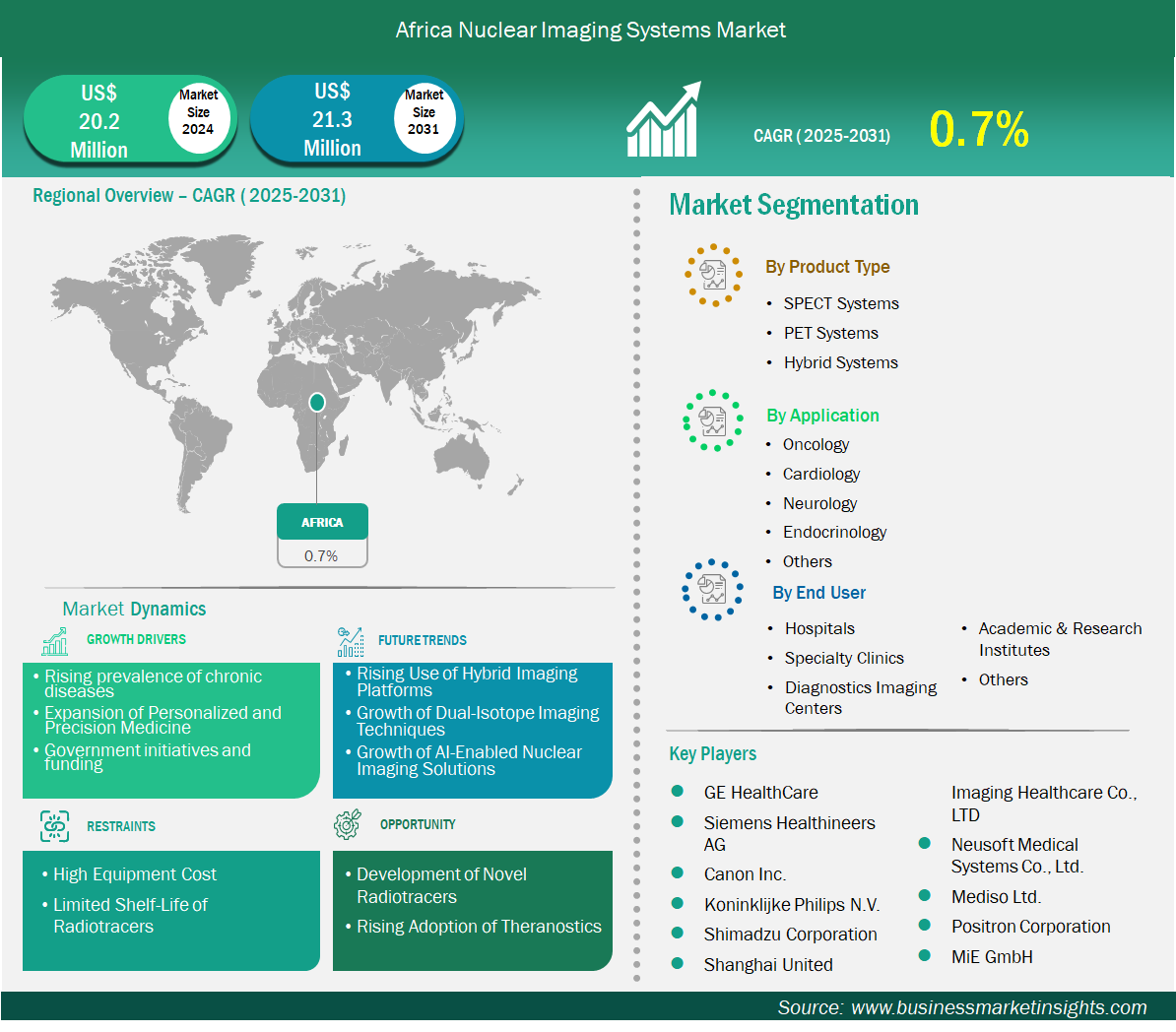
The Africa nuclear imaging systems market size is expected to reach US$ 21.3 million by 2031 from US$ 20.2 million in 2024. The market is estimated to record a CAGR of 0.7% from 2025 to 2031.
Executive Summary and Africa Nuclear Imaging Systems Market Analysis:
The nuclear imaging market in Africa is underdeveloped and faces many restraints. Advanced medical diagnostics system are concentrated in major countries such as South Africa. These major countries have most of the advance facilities for diagnosis of diseases such as cancer, cardiovascular diseases and others. Outside of these hubs, many communities still depend on basic diagnostic tools, and in rural areas, advanced imaging is often out of reach. Progress is slowed by expensive equipment, a shortage of trained specialists, and poor supply chains for radiopharmaceuticals. However, demand is building as more cases of cancer and cardiovascular disease are diagnosed and as awareness of better diagnostic options grows. International suppliers view the region as a long-term opportunity, with joint ventures and government partnerships already under discussion. Over time, regional imaging hubs and selective investments could start to close the gap, bringing services to people who have had very limited access until now.
Africa Nuclear Imaging Systems Market Segmentation Analysis:
Key segments that contributed to the derivation of the nuclear imaging systems market analysis are product type, application, and end user.
- By product type, the nuclear imaging systems market is segmented into SPECT systems, PET systems and hybrid systems. The PET systems segment dominated the market in 2024.
- By application, the nuclear imaging systems market is segmented into oncology, cardiology, neurology, endocrinology and others. The oncology segment dominated the market in 2024.
- By end user, the market is segmented into hospitals, specialty clinics, diagnostics imaging centers, academic & research Institutes and others. The hospitals segment held the largest share of the market in 2024.
Africa Nuclear Imaging Systems Market Outlook
The nuclear imaging sector in Africa is still developing, as most of the interest stems from large hospital networks or private diagnostic centers. The PET/CT and SPECT systems are mainly used cancer and cardiovascular conditions diagnosis. However, access is restricted by supply chain limitations for radiotracers, inadequate infrastructure for storage and transport, and a limited number of trained nuclear medicine specialists. These challenges slow down adoption in many countries outside the major healthcare hubs. One of the main forces driving the market is the rising cancer burden across Africa. Hospitals are steadily expanding their oncology units, and nuclear imaging is becoming an important tool for earlier detection and more precise treatment planning. The technology also helps cut down diagnostic delays, a challenge that many facilities in the region still face. Cost is a hurdle, but healthcare budgets are improving in some countries, and private providers are stepping in. Together, these factors are giving the market a slow but steady growth.
Africa Nuclear Imaging Systems Market Country Insights
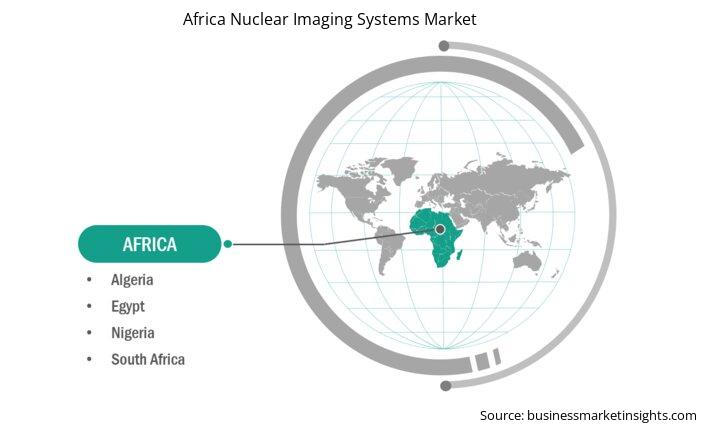
Based on country, the Africa nuclear imaging systems Market is further segmented into Nigeria, Egypt, South Africa, and Algeria. South Africa held the largest share in 2024.
South Africa is the biggest nuclear imaging market in Africa, mainly because it has a stronger healthcare system than most of its neighbors. Both public and private hospitals have advanced facilities, and radiopharmacies are better organized, which increases the availability of radiotracers. Streamlined regulations have made it easier for hospitals to implement PET/CT and SPECT imaging systems, particularly for diagnosing cancer and cardiovascular conditions. With a growing number of neurological cases, demand for these technologies is now expanding beyond oncology. In addition, many universities in this country has begun theranostics project even strengthening its position in nuclear medicine. Patients from neighboring countries frequently travel to Johannesburg and Cape Town for advanced diagnostic scans unavailable in their home nations. With robust infrastructure, a skilled healthcare workforce, and strong cross-border demand, South Africa has emerged as a pivotal hub for medical imaging suppliers across the region.
Africa Nuclear Imaging Systems Market Company Profiles
GE HealthCare, Siemens Healthineers AG, Canon Inc., Koninklijke Philips N.V., SHIMADZU CORPORATION, United Imaging Healthcare Co., Ltd., Neusoft Medical Systems Co., Ltd., Mediso Ltd., Positron Corporation, and MiE GmbH are among the key players operating in the market. These players adopt strategies such as expansion, product innovation, and mergers and acquisitions to stay competitive in the market and offer innovative products to their consumers.
Africa Nuclear Imaging Systems Market Research Methodology:
The following methodology has been followed for the collection and analysis of data presented in this report:
Secondary Research
The research process begins with comprehensive secondary research, utilizing both internal and external sources to gather qualitative and quantitative data for each market. Commonly referenced secondary research sources include, but are not limited to:
- Company websites, annual reports, financial statements, broker analyses, and investor presentations
- Industry trade journals and other relevant publications
- Government documents, statistical databases, and market reports
- News articles, press releases, and webcasts specific to companies operating in the market
Note: All financial data included in the Company Profiles section has been standardized to US$. For companies reporting in other currencies, figures have been converted to US$ using the relevant exchange rates for the corresponding year.
Primary Research
Business Market Insights conducts a significant number of primary interviews each year with industry stakeholders and experts to validate and analyze the data and gain valuable insights. These research interviews are designed to:
- Refine findings from secondary research
- Enhance the expertise and market understanding of the analysis team
- Gain insights into market size, trends, growth patterns, competitive dynamics, and future prospects
Primary research is conducted via email interactions and telephone interviews with industry experts across various markets, categories, segments, and sub-segments in different regions. Participants typically include:
- Industry stakeholders: Vice Presidents, business development managers, market intelligence managers, and national sales managers
- External experts: Valuation specialists, research analysts, and key opinion leaders with industry-specific expertise
Key Sources Referred:
- The World Bank
- World Health Organization (WHO)
- Center for Disease Control and Prevention (CDC)
- Society of Nuclear Medicine and Molecular Imaging (SNMMI)
- European Association of Nuclear Medicine (EANM)
- American College of Nuclear Medicine (ACNM)
- American Society of Nuclear Cardiology (ASNC)
- Global Cancer Observatory
- Company website
- Company annual reports
- Company investor presentations
Africa Nuclear Imaging Systems Market Strategic Insights
Africa Nuclear Imaging SystemsMarket Report Highlights
| Report Attribute | Details |
| Market size in 2024 | US$ 20.2 Million |
| Market Size by 2031 | US$ 21.3 Million |
| CAGR (2025 - 2031) | 0.7% |
| Historical Data | 2021-2023 |
| Forecast period | 2025-2031 |
| Segments Covered |
By Product Type
|
|
Regions and Countries Covered
|
|
| Africa | Egypt, South Africa, Nigeria, Algeria |
| Market leaders and key company profiles |
|
Africa Nuclear Imaging Systems Market Country and Regional Insights