
The Africa last mile delivery market was worth US$ 5,145.15 million in 2024 and is projected to reach US$ 8,932.50 million by 2031; it is expected to register a CAGR of 8.2% from 2025 to 2031.
Executive Summary and Africa Last Mile Delivery Market Analysis:
The booming e-commerce industry increased mobile internet penetration, urbanization, and a rising middle class steadily drive the demand for last-mile delivery in Africa. However, despite its potential, the sector faces a variety of challenges due to infrastructure limitations, security concerns, and operational inefficiencies. Nigeria has one of the largest internet user bases in Africa, with over 150 million internet users and a mobile penetration rate of over 90%. A high mobile and internet penetration has led to a surge in online shopping and digital transactions, both of which directly propel the demand for efficient last-mile delivery services. Mobile apps and websites for ordering products have made it easier for Nigerians to access e-commerce platforms, which, in turn, drives the need for fast and reliable delivery services.
The rise of hyperlocal delivery models is a prominent trend in Nigeria's last-mile delivery sector. Hyperlocal delivery services involve quick delivery from local retailers to consumers within a few hours; these services are gaining popularity, particularly in urban areas such as Lagos. These services cater to the growing demand for faster fulfillment and aid in convenience for consumers. Food delivery services such as Jumia Food, Uber Eats, and Bolt Food are leading the charge in hyperlocal delivery. Other sectors, such as pharmaceuticals, groceries, and electronics, are also adopting the trend.
Environmental sustainability has become an important consideration for many logistics providers. Electric vehicles (EVs) are starting to make an appearance in Nigeria's last-mile delivery market, especially in urban areas. These vehicles offer a sustainable alternative to traditional delivery vans, reducing carbon emissions and noise pollution. Additionally, some delivery companies are exploring the use of motorcycles or bicycles for smaller packages in congested urban areas. While the adoption of EVs is still limited due to the high initial investment, the growing focus on green logistics represents a significant trend in the sector.
Africa Last Mile Delivery Market Outlook:
One of the primary drivers of the market is the increasing e-commerce sector globally. The demand for efficient, cost-effective, and timely last-mile delivery solutions has grown in countries such as Algeria, South Africa, Egypt, and Nigeria. Despite facing several challenges, including infrastructure issues and relatively low internet penetration, the last-mile delivery market in Algeria is experiencing gradual growth, driven by an expanding middle class, ongoing urbanization, and increasing mobile access. The rapid growth of e-commerce in Algeria is one of the primary factors fueling the development of the last-mile delivery market.
The Algerian government has recognized the importance of developing its logistics and e-commerce infrastructure to enhance economic growth. It has made efforts to improve transportation networks, particularly in urban centers, by investing in roads, ports, and railways. This focus on infrastructure development provides a foundation for more efficient last-mile delivery services. Additionally, the government has introduced measures to support local e-commerce initiatives, such as incentivizing digital payments and improving postal services, which can be leveraged to boost last-mile delivery capabilities.
The rise of hyperlocal delivery models is a prominent trend in Nigeria's last-mile delivery sector. Hyperlocal delivery services involve quick delivery from local retailers to consumers within a few hours; these services are gaining popularity, particularly in urban areas such as Lagos. These services cater to the growing demand for faster fulfillment and aid in convenience for consumers.
The last-mile delivery market in Nigeria is positioned for significant growth, driven by the expansion of e-commerce, urbanization, and the increasing demand for fast and reliable delivery services. However, challenges such as infrastructure deficiencies, traffic congestion, high operational costs, and security concerns continue to impact the efficiency of the sector. Nevertheless, technological innovation, rural market expansion, and digital payment solutions are likely to serve as opportunities for the market players, enabling them to overcome these challenges.
Africa Last Mile Delivery Market Strategic Insights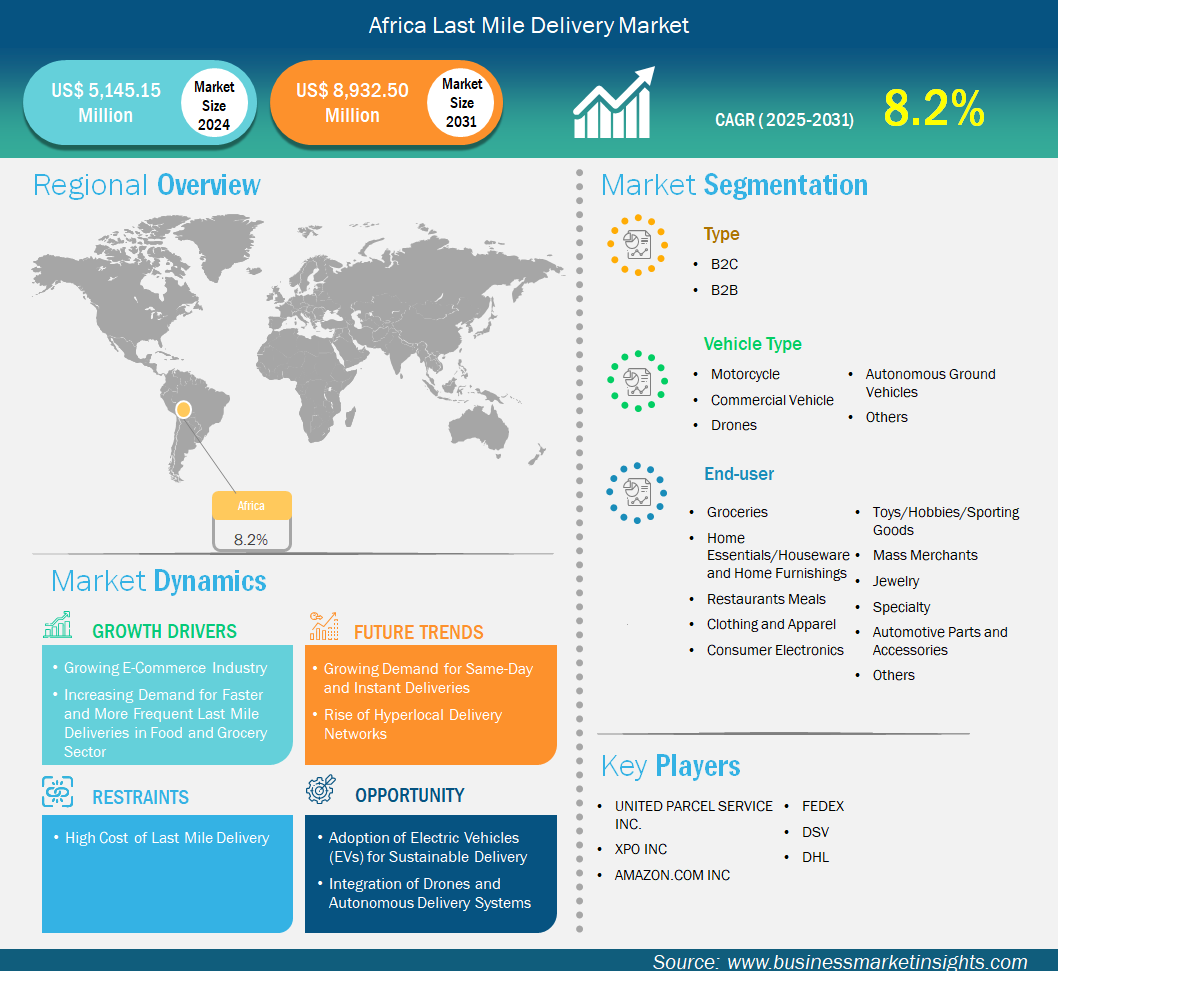
Key segments that contributed to the derivation of the last mile delivery market analysis are type, vehicle type, and end-use.
- Based on type, the market is segmented into B2C and B2B.
- Based on vehicle type, the market is segmented into Motorcycles, Commercial Vehicle, Drones, Autonomous Ground Vehicle, and Others.
- Depending upon the end-use, the market is divided into groceries, home essentials/houseware and home furnishings, restaurant meals, clothing and apparel, consumer electronics, toys/hobbies/sporting goods, mass merchants, jewelry, specialty, automotive parts and accessories, and others.
| Report Attribute | Details |
| Market size in 2024 | US$ 5,145.15 Million |
| Market Size by 2031 | US$ 8,932.50 Million |
| CAGR (2025 - 2031) | 8.2% |
| Historical Data | 2021-2023 |
| Forecast period | 2025-2031 |
| Segments Covered |
By Type
|
|
Regions and Countries Covered
|
|
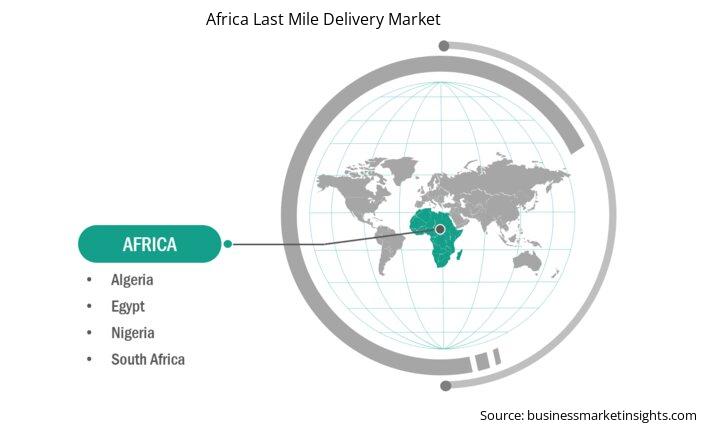
| Africa | Egypt, South Africa, Algeria, and Nigeria |
| Market leaders and key company profiles |
|
Africa Last Mile Delivery Market Company Profiles
Some of the key players operating in the market include Kerry Logistics Network Ltd., FedEx Corp., United Parcel Service Inc., DHL Group, WumDrop, Picup Technologies, Pargo, SENDR, RUSH, Fastvan, and Kobo360, among others. These players are adopting various strategies such as expansion, product innovation, and mergers and acquisitions to provide innovative products to their consumers and increase their market share.
Africa Last Mile Delivery Market Research Methodology:
The following methodology has been followed for the collection and analysis of data presented in this report:
- Secondary Research
The research process begins with comprehensive secondary research, utilizing both internal and external sources to gather qualitative and quantitative data for each market. Commonly referenced secondary research sources include, but are not limited to:
- Company websites, annual reports, financial statements, broker analyses, and investor presentations.
- Industry trade journals and other relevant publications.
- Government documents, statistical databases, and market reports.
- News articles, press releases, and webcasts specific to companies operating in the market.
Note: All financial data included in the Company Profiles section has been standardized to USD. For companies reporting in other currencies, figures have been converted to USD using the relevant exchange rates for the corresponding year.
- Primary Research
The Insight Partners conducts a significant number of primary interviews each year with industry stakeholders and experts to validate its data analysis and gain valuable insights. These research interviews are designed to:
- Validate and refine findings from secondary research.
- Enhance the expertise and market understanding of the analysis team.
- Gain insights into market size, trends, growth patterns, competitive dynamics, and prospects.
Primary research is conducted via email interactions and telephone interviews, encompassing various markets, categories, segments, and sub-segments across different regions. Participants typically include:
- Industry stakeholders: Vice Presidents, business development managers, market intelligence managers, and national sales managers
- External experts: Valuation specialists, research analysts, and key opinion leaders with industry-specific expertise
Africa Last Mile Delivery Key Sources Referred:
- Federation of East African Freight
- Forwarders Associations
- The African Logistics & Material Handling Association
- Africa Transport and Logistics Solutions
- International Air Transport Association (IATA)
- World Bank Group


