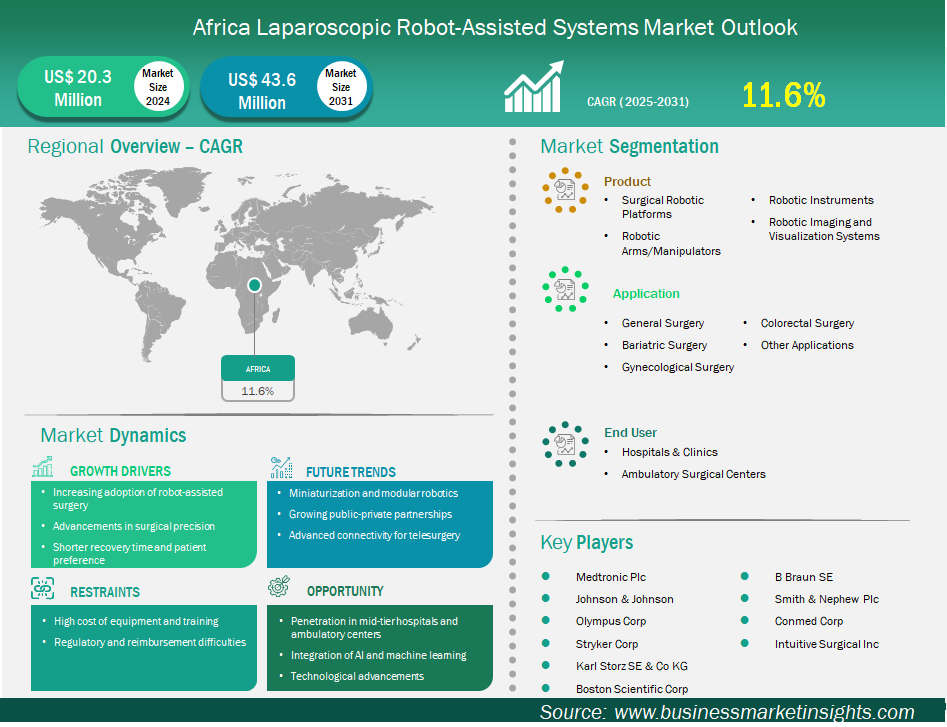
The Africa laparoscopic robot-assisted systems market size is expected to reach US$ 43.6 million by 2031 from US$ 20.3 million in 2024. The market is estimated to record a CAGR of 11.6% from 2025 to 2031.
Executive Summary and Africa Laparoscopic Robot-Assisted Systems Market Analysis:
The laparoscopic robot-assisted systems market in Africa is experiencing significant growth, driven by the increasing adoption of robot-assisted surgery, advancements in surgical precision, shorter recovery times, and patient preference. The African laparoscopic robot-assisted systems market is undergoing a structural transition, driven by the convergence of healthcare modernization and surgical innovation, as well as the expansion of investments in minimally invasive technology. Historically, it had been limited by infrastructure and capital constraints; however, these historical limitations are now being lifted in favour of value-based surgical pathways, with robotic platforms being embraced as a means of achieving clinical efficiencies and a long-term cost containment approach. The key market drivers are the increasing need for precision surgery in oncological and urological procedures, heightened awareness of postoperative recovery benefits in the surgical culture, and the initiation of public-private partnerships to digitize surgical workflows.
The competitive environment remains fragmented. Major global OEM companies, such as Intuitive Surgical, Medtronic, and Stryker, have entered the market through distributor-led business models with limited integration of medical robotic technologies. However, regional OEM integrators focused on modular visualization and instrument solutions will continue to grow. The procurement process is also changing from full capital purchases to hybrid leases that include service, making it more accessible for distribution to regional hospital networks and mid-tier hospitals. There are some adoption bottlenecks in training due to limited access to simulation labs and credentialed robotic surgeons. Academic institutions in South Africa and Egypt, which are currently transitioning and integrating robotic modules into postgraduate surgical programs, will leverage these productivity bottlenecks as a stable human capital solution to address the need for surgical robotic skills. In summary, a transitional shift in the African laparoscopic robotic-assisted systems market from an exploratory distribution of robotic technology acceptance will be a key trend.
Africa Laparoscopic Robot Assisted Systems Market Segmentation Analysis:
Key segments that contributed to the derivation of the laparoscopic robot-assisted systems market analysis are product, application, and end user.
- By product, the laparoscopic robot-assisted systems market is segmented into surgical robotic platforms, robotic arms/manipulators, robotic instruments, and robotic imaging and visualization systems. The surgical robotic platforms segment dominated the market in 2024. Surgical robotic platforms are the largest product segment due to the high initial cost and foundational necessity of the robotic system (the capital equipment) itself for performing robotic-assisted laparoscopic procedures.
- In terms of application, the market is segmented into general surgery, bariatric surgery, gynecological surgery, colorectal surgery, and other applications. The general surgery segment held the largest market share in 2024. General Surgery is the largest application segment due to the versatility of robotic systems across a wide range of common abdominal procedures and the growing prevalence of conditions requiring general surgical intervention.
- By end user, the market is segmented into hospitals and clinics, and ambulatory surgical centers. The hospitals and clinics segment held the largest market share in 2024. Hospitals and clinics are the largest end-user segment due to their substantial financial capability for the high initial investment in robotic systems and the ability to justify the cost through a high volume of complex procedures.
Africa Laparoscopic Robot-Assisted Systems Market Outlook
The Africa laparoscopic robot-assisted systems market is segmented into Egypt, South Africa, Nigeria, and Algeria. The future of the laparoscopic robot-assisted systems market in Africa is becoming increasingly positive as countries stabilize their macroeconomic conditions, digitize their healthcare systems, and align policies around surgical innovation. African nations have adopted minimally invasive surgery as part of their national health plans, particularly for oncology, gynecology, and hepatobiliary interventions. The evolving policy environment will support the growth of procurement frameworks, accelerate regulatory development, and facilitate knowledge transfer across borders. Technological convergence is also changing the landscape for robot-assisted surgery, with artificial intelligence-assisted imaging, cloud-based surgical analytics, and modular robotic platforms receiving attention at urban tertiary facilities.
In addition, pan-African surgical networks and tele-mentoring programs are expected to democratize access to robotic surgical expertise, particularly in areas with limited access to robotic surgical support. Private sector investment is growing, with hospital chains and diagnostic groups investing capital in robotic surgical infrastructure to support the local differentiation of service offerings and develop a scope of practice that attracts medical tourism. The original equipment manufacturers are reconsidering their go-to-market strategies to address the idiosyncratic demand curve in Africa, including a focus on economically scalable systems, those with a small clinical footprint, or those based on outcome pricing. Maintenance logistics, surgeon retention, and reimbursement challenges persist, although the overall market direction suggests a trend of rapid uptake. Robotic-assisted laparoscopy is projected to become embedded in the surgical pathways of recognized African health systems, supported by regional training centers and outcome-based criteria.
Africa Laparoscopic Robot-Assisted Systems Market Country Insights
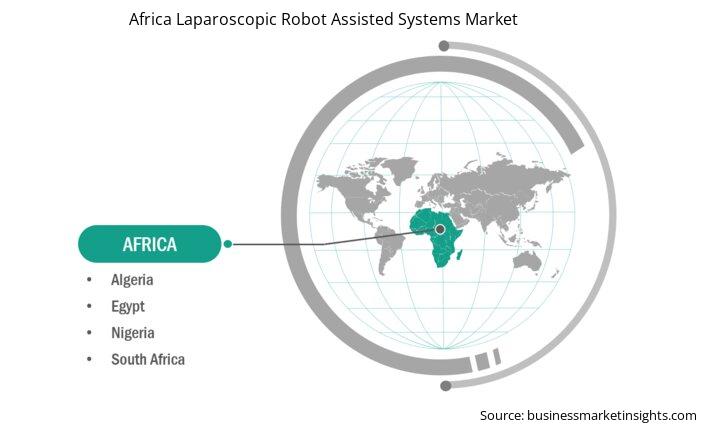
Based on country, the Africa laparoscopic robot-assisted systems market is segmented into Egypt, South Africa, Nigeria, and Algeria. Egypt held the largest share in 2024.
Dynamics between countries in Africa’s laparoscopic robot-assisted systems market showcase a disparate and evolving landscape. Egypt is establishing itself as a regional hub for innovation, with Cairo-based institutions integrating robotic platforms for hepatobiliary and gynecologic ,oncology pathways, and supported by digitization initiatives from the government. South Africa is a leader in deployment maturity, with da Vinci systems in practice in Johannesburg and Cape Town, alongside practice-supported structured training programs and oncology-driven use cases. Nigeria, despite its limited infrastructure, is witnessing some pilot deployments in private surgical centers, particularly in Lagos, where robotic systems are being utilized for urology and general surgery. While each country has its own path for regulatory, financial, and clinical adoption, similar themes are playing out with respect to public-private partnerships, regional training alliances, and outcome-based procurement.
Africa Laparoscopic Robot Assisted Systems Market Company Profiles
Medtronic Plc; Johnson & Johnson; Olympus Corp; Stryker Corp; Karl Storz SE & Co KG, Boston Scientific Corp, B Braun SE, Smith & Nephew Plc, Conmed Corp, and Intuitive Surgical Inc., are among the key players operating in the market. These players adopt strategies such as expansion, product innovation, and mergers and acquisitions to stay competitive in the market and offer innovative products to their consumers.
Africa Laparoscopic Robot-Assisted Systems Market Research Methodology:
The following methodology has been followed for the collection and analysis of data presented in this report:
Secondary Research
The research process begins with comprehensive secondary research, utilizing both internal and external sources to gather qualitative and quantitative data for each market. Commonly referenced secondary research sources include, but are not limited to:
- Company websites, annual reports, financial statements, broker analyses, and investor presentations
- Industry trade journals and other relevant publications
- Government documents, statistical databases, and market reports
- News articles, press releases, and webcasts specific to companies operating in the market
Note: All financial data included in the Company Profiles section has been standardized to US$. For companies reporting in other currencies, figures have been converted to US$ using the relevant exchange rates for the corresponding year.
Primary Research
Business Market Insights conducts a significant number of primary interviews each year with industry stakeholders and experts to validate and analyze the data and gain valuable insights. These research interviews are designed to:
- Refine findings from secondary research
- Enhance the expertise and market understanding of the analysis team
- Gain insights into market size, trends, growth patterns, competitive dynamics, and future prospects
Primary research is conducted via email interactions and telephone interviews with industry experts across various markets, categories, segments, and sub-segments in different regions. Participants typically include:
- Industry stakeholders: Vice Presidents, business development managers, market intelligence managers, and national sales managers
- External experts: Valuation specialists, research analysts, and key opinion leaders with industry-specific expertise
Key Sources Referred:
- World Health Organization (WHO)
- The World Bank Group
- Worldometer
- The Lancet
- BMC Medical Education
- Eurostat
Africa Laparoscopic Robot Assisted Systems Market Strategic Insights
Africa Laparoscopic Robot Assisted SystemsMarket Report Highlights
| Report Attribute | Details |
| Market size in 2024 | US$ 20.3 Million |
| Market Size by 2031 | US$ 43.6 Million |
| CAGR (2025 - 2031) | 11.6% |
| Historical Data | 2021-2023 |
| Forecast period | 2025-2031 |
| Segments Covered |
By Product
|
|
Regions and Countries Covered
|
|
| Africa | Egypt, South Africa, Nigeria, Algeria |
| Market leaders and key company profiles |
|
Africa Laparoscopic Robot Assisted Systems Market Country and Regional Insights