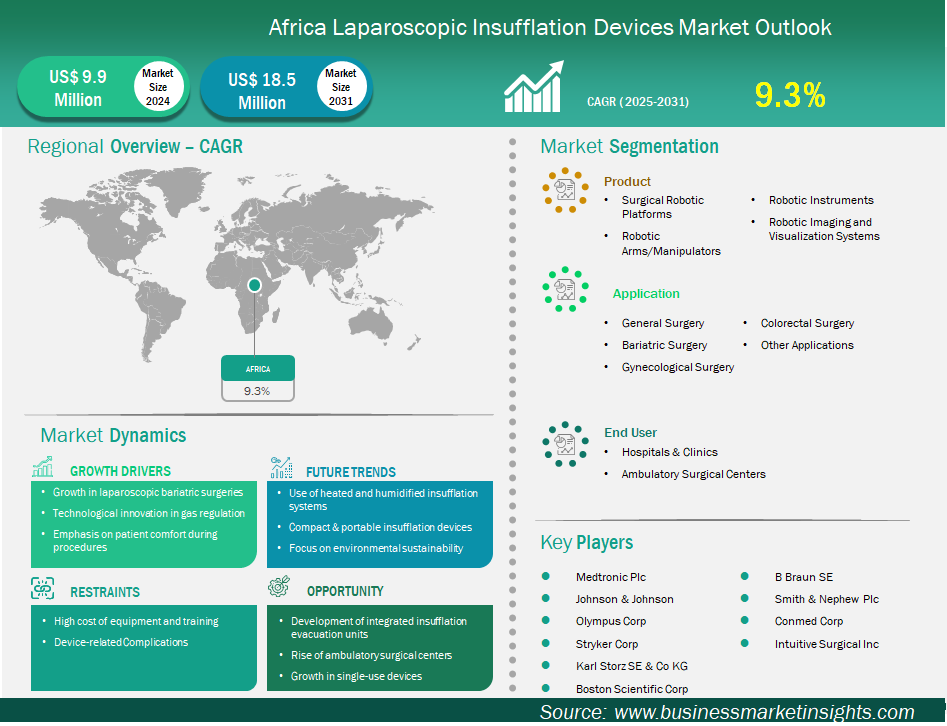
The Africa laparoscopic insufflation devices market size is expected to reach US$ 18.5 million by 2031 from US$ 9.9 million in 2024. The market is estimated to record a CAGR of 9.3% from 2025 to 2031.
Executive Summary and Africa Laparoscopic Insufflation Devices Market Analysis:
The laparoscopic insufflation devices market in Africa is experiencing significant growth, driven by growth in laparoscopic bariatric surgeries, technological innovation in gas regulation, and emphasis on patient comfort during procedures. The Africa laparoscopic insufflation devices market is being reshaped in a major way owing to surgical modernization, healthcare infrastructure upgrading, and awareness of minimally invasive procedures mature in the region. The region, which has been traditionally underpenetrated, is now witnessing the widespread adoption of laparoscopic methods, especially in urban tertiary care centers. CO₂ insufflators are leading the way in terms of product choices because they are reliable, affordable, and compatible with standard laparoscopic setups. There is a fragmented supplier base that characterizes the market with players from around the world who are entering through distribution partnerships and local firms that offer cost-effective alternatives. The demand is mainly driven by bariatric, gynecological, and gastrointestinal surgeries, thus reflecting the lifestyle changes and the increase in the prevalence of chronic diseases. Device durability, ease of sterilization, and integration with existing surgical platforms are the main factors that influence procurement decisions. Harmonization of regulations across African countries is still a problem; thus, product approvals and market entry are often delayed. However, public-private partnerships, which aim to equip hospitals with advanced laparoscopic tools, are giving the market a boost.
Africa Laparoscopic Insufflation Devices Market Segmentation Analysis:
Key segments that contributed to the derivation of the laparoscopic insufflation devices market analysis are product, application, and end user.
- By product, the laparoscopic insufflation devices market is segmented into CO₂ Insufflators, Warm Gas Insufflators, and Insufflation Tubing and Accessories. The CO₂ Insufflators segment dominated the market in 2024. This is the largest segment due to their widespread clinical acceptance, cost-effectiveness, and compatibility with standard laparoscopic procedures.
- In terms of application, the market is segmented into general surgery, bariatric surgery, gynecological surgery, colorectal surgery, and other applications. The bariatric surgery segment held the largest market share in 2024. This is the largest segment due to rising obesity rates across urban African populations and increasing demand for minimally invasive weight-loss interventions.
- By end user, the market is segmented into hospitals and clinics, and ambulatory surgical centers. The hospitals and clinics segment held the largest market share in 2024. This is the largest segment due to concentrated surgical infrastructure, skilled personnel, and higher patient throughput compared to standalone centers.
Africa Laparoscopic Insufflation Devices Market Outlook
The future for laparoscopic insufflation devices in Africa looks optimistic and is mainly supported by the gradual move towards value-based healthcare and surgical efficiency. As governments commit to universal health coverage, laparoscopic procedures are being added to the benefits of national insurance schemes, thus accessibility is increasing. Innovations like integrated flow control, real-time pressure monitoring, and AI-assisted insufflation systems are anticipated to set new standards of operations.
The development of outpatient surgical centers and mobile clinics is stimulating the need for small, portable insufflation units that are suitable for low-resource settings. Programmes initiated by international surgical societies are improving the skills of African surgeons; thus, more procedures can be performed. Besides that, the widespread use of telemedicine and remote surgical mentoring is making it easier to transfer knowledge and use of devices in extensive areas. Green environmental issues are becoming an important factor in the decision of purchasing as hospitals are choosing energy-efficient and recyclable device components. Though urban centers will be the front runners in adoption, it is expected that secondary cities will become the new growth hotspots because of the rising healthcare investments and demographic changes. Thus, the market is strongly expected to expand slowly but steadily, influenced by innovation and policy reform.
Africa Laparoscopic Insufflation Devices Market Country Insights
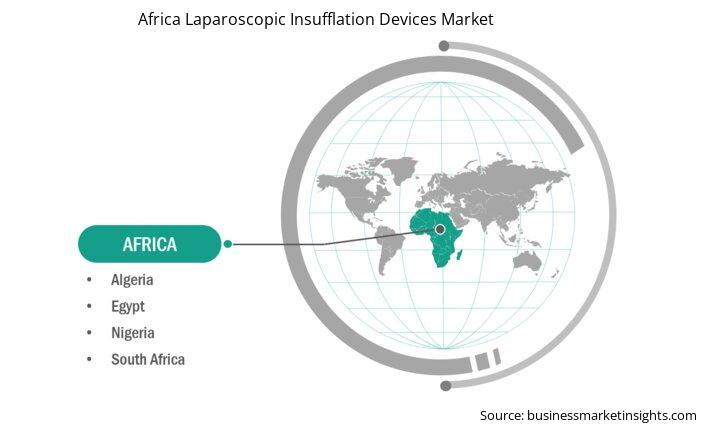
Based on country, the Africa laparoscopic insufflation devices market is segmented into Egypt, South Africa, Nigeria, and Algeria. Egypt held the largest share in 2024.
The differences in African countries show that the market for laparoscopic insufflation devices is really varied in each of those countries. Egypt, with its surgical infrastructure, is a regional leader and actively participating in clinical trials worldwide. South Africa, through government-supported modernization programs and foreign direct investment in medical technology, is rapidly increasing its laparoscopic capacity. Nigeria, in spite of the power situation and bad road conditions, is going to be a very profitable market for private hospitals in Lagos and Abuja, where the demand for minimally invasive procedures is increasing. While Algeria’s health-tech ecosystem continues to support the development of low-cost surgical tools and to be attractive to global MedTech start-ups. The direction of each country’s market depends on the local regulatory environment, the healthcare funding model, and the level of public-private collaboration. Although there are disparities in access and affordability, the combined flow of these countries gives rise to the development of laparoscopic insufflation technologies in Africa.
Africa Laparoscopic Insufflation Devices Market Company Profiles
Medtronic Plc; Johnson & Johnson; Olympus Corp; Stryker Corp; Karl Storz SE & Co KG, Boston Scientific Corp, B Braun SE, Smith & Nephew Plc, Conmed Corp, and Intuitive Surgical Inc., are among the key players operating in the market. These players adopt strategies such as expansion, product innovation, and mergers and acquisitions to stay competitive in the market and offer innovative products to their consumers.
Africa Laparoscopic Insufflation Devices Market Research Methodology:
The following methodology has been followed for the collection and analysis of data presented in this report:
Secondary Research
The research process begins with comprehensive secondary research, utilizing both internal and external sources to gather qualitative and quantitative data for each market. Commonly referenced secondary research sources include, but are not limited to:
- Company websites, annual reports, financial statements, broker analyses, and investor presentations
- Industry trade journals and other relevant publications
- Government documents, statistical databases, and market reports
- News articles, press releases, and webcasts specific to companies operating in the market
Note: All financial data included in the Company Profiles section has been standardized to US$. For companies reporting in other currencies, figures have been converted to US$ using the relevant exchange rates for the corresponding year.
Primary Research
Business Market Insights conducts a significant number of primary interviews each year with industry stakeholders and experts to validate and analyze the data and gain valuable insights. These research interviews are designed to:
- Refine findings from secondary research
- Enhance the expertise and market understanding of the analysis team
- Gain insights into market size, trends, growth patterns, competitive dynamics, and future prospects
Primary research is conducted via email interactions and telephone interviews with industry experts across various markets, categories, segments, and sub-segments in different regions. Participants typically include:
- Industry stakeholders: Vice Presidents, business development managers, market intelligence managers, and national sales managers
- External experts: Valuation specialists, research analysts, and key opinion leaders with industry-specific expertise
Key Sources Referred:
- World Health Organization (WHO)
- The World Bank Group
- Worldometer
- The Lancet
- BMC Medical Education
- Eurostat
Africa Laparoscopic Insufflation Devices Market Strategic Insights
Africa Laparoscopic Insufflation DevicesMarket Report Highlights
| Report Attribute | Details |
| Market size in 2024 | US$ 9.9 Million |
| Market Size by 2031 | US$ 18.5 Million |
| CAGR (2025 - 2031) | 9.3% |
| Historical Data | 2021-2023 |
| Forecast period | 2025-2031 |
| Segments Covered |
By Product
|
|
Regions and Countries Covered
|
|
| Africa | Egypt, South Africa, Nigeria, Algeria |
| Market leaders and key company profiles |
|
Africa Laparoscopic Insufflation Devices Market Country and Regional Insights