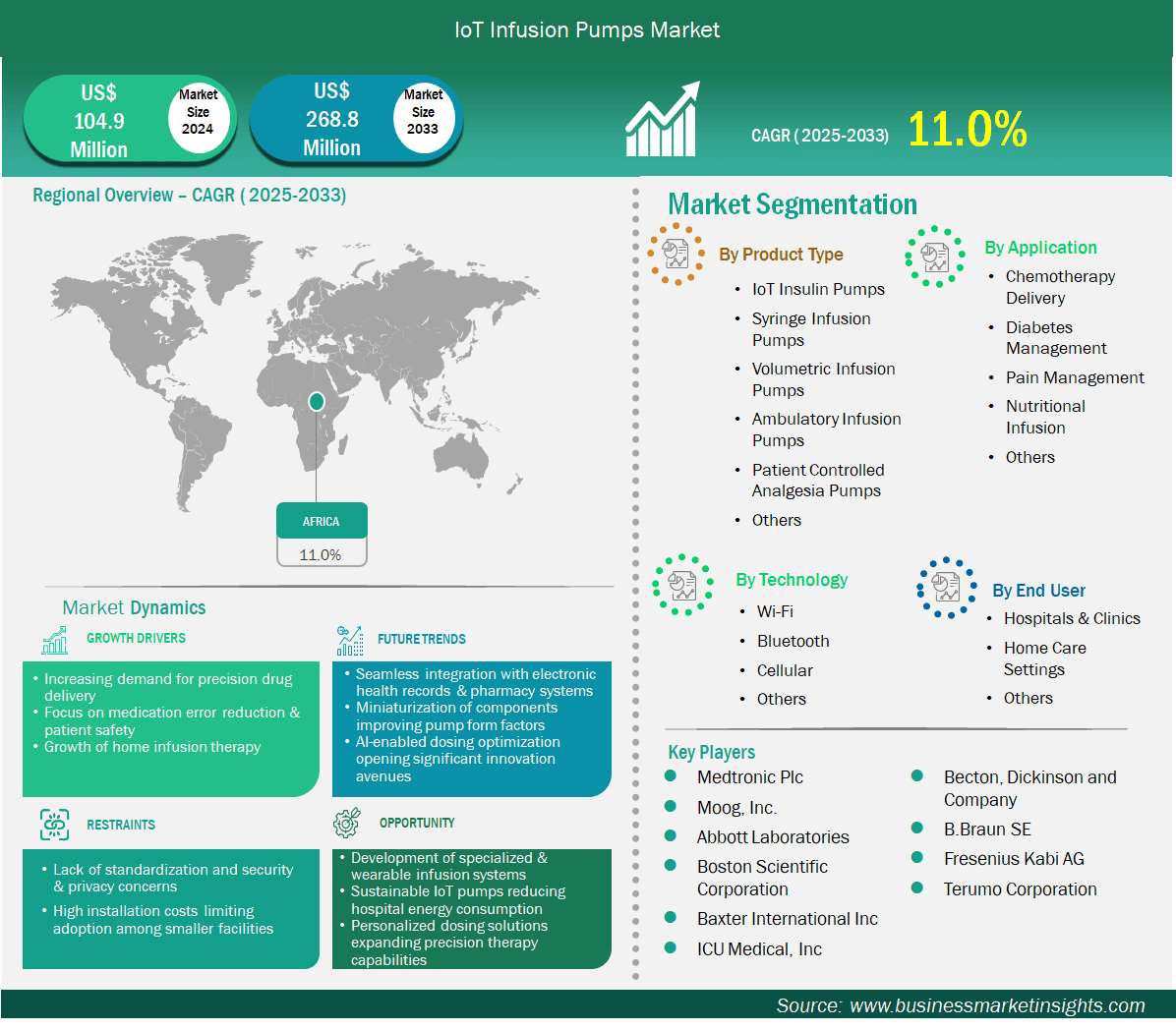
The Africa IoT infusion pumps market size is expected to reach US$ 268.8 million by 2033 from US$ 104.9 million in 2024. The market is estimated to record a CAGR of 11.0% from 2025 to 2033.
Executive Summary and Africa IoT Infusion Pumps Market Analysis:
The IoT infusion pumps market in Africa is experiencing significant growth driven by the increasing demand for precision drug delivery, focus on medication error reduction & patient safety, growth of home infusion therapy. The Africa IoT infusion pumps market is entering a transformative phase as healthcare systems across the continent embrace digital health solutions to address chronic disease burdens and infrastructure gaps. Infusion pumps equipped with IoT capabilities are increasingly being deployed in hospitals, clinics, and home-care settings to enable real-time monitoring, remote diagnostics, and predictive analytics. The market is characterized by strong demand for insulin pumps, chemotherapy delivery systems, and pain management devices, reflecting the rising incidence of diabetes, cancer, and lifestyle-related conditions. Hospitals remain the dominant end users, leveraging IoT-enabled pumps to improve treatment precision, reduce monitoring costs, and streamline workflows. However, home-based adoption is gaining momentum in urban centers, driven by patient demand for convenience and mobility. Competitive dynamics are shaped by multinational corporations introducing advanced smart infusion systems and local firms focusing on affordability and accessibility. Partnerships between device manufacturers, telecom operators, and healthcare institutions are creating integrated ecosystems that enhance patient outcomes while improving operational efficiency. Regulatory frameworks are evolving, with governments increasingly embedding digital health into national strategies, though challenges around standardization, cybersecurity, and affordability persist. Overall, the market is balancing innovation with accessibility, positioning IoT infusion pumps as a cornerstone of Africa’s healthcare modernization.
Africa IoT Infusion Pumps Market Segmentation Analysis:
Key segments that contributed to the derivation of the IoT infusion pumps market analysis are product, technology, application, and end user.
- By product, the IoT infusion pumps market is segmented into IoT insulin pumps, syringe infusion pumps, volumetric infusion pumps, ambulatory infusion pumps, patient-controlled analgesia pumps, and others. IoT insulin pumps dominated the market in 2024, driven by high diabetes prevalence across Africa and strong demand for connected glucose management solutions.
- By technology, the IoT infusion pumps market is segmented into Wi-Fi, Bluetooth, cellular, and others. Wi-Fi dominated the market in 2024, driven by stable urban connectivity that supports hospital integration and seamless real‑time monitoring.
- In terms of application, the market is segmented into chemotherapy delivery, diabetes management, pain management, nutritional infusion, and others. Chemotherapy delivery dominated the market in 2024, driven by rising cancer incidence and the need for precise, IoT‑enabled drug infusion in oncology care.
- By end user, the market is segmented into hospitals & clinics, home care settings, and others. Hospitals & clinics dominated the market in 2024, driven by its dominant role in providing advanced diagnostics and centralized patient monitoring infrastructure.
Africa IoT Infusion Pumps Market Outlook
The Africa IoT infusion pumps market is segmented into Egypt, South Africa, Nigeria, and Algeria. Looking ahead, the Africa IoT infusion pumps market is expected to witness rapid expansion fuelled by demographic shifts, technological innovation, and policy support. The growing prevalence of lifestyle diseases such as diabetes and hypertension are driving demand for connected insulin pumps, while oncology care continues to rely heavily on IoT-enabled chemotherapy infusion systems. Advances in connectivity—particularly Wi-Fi in urban centers and mobile/satellite solutions in rural regions—will accelerate adoption, bridging infrastructure gaps and enabling broader access. Artificial intelligence and machine learning are expected to play a pivotal role, powering predictive analytics that allow early detection of complications and personalized therapy pathways. Governments are prioritizing preventive healthcare and digital transformation, with e-health investments and telemedicine integration creating fertile ground for IoT adoption. Private healthcare providers are also emerging as key drivers, investing in advanced IoT technologies to differentiate services and attract patients seeking higher standards of care. Despite these opportunities, challenges remain around fragmented regulatory environments, uneven distribution of healthcare resources, and affordability constraints. Cybersecurity and interoperability will be critical as devices become more interconnected. Nevertheless, the long-term outlook is highly positive, with IoT infusion pumps positioned to reduce hospital admissions, improve patient outcomes, and support universal healthcare access across Africa.
Africa IoT Infusion Pumps Market Country Insights
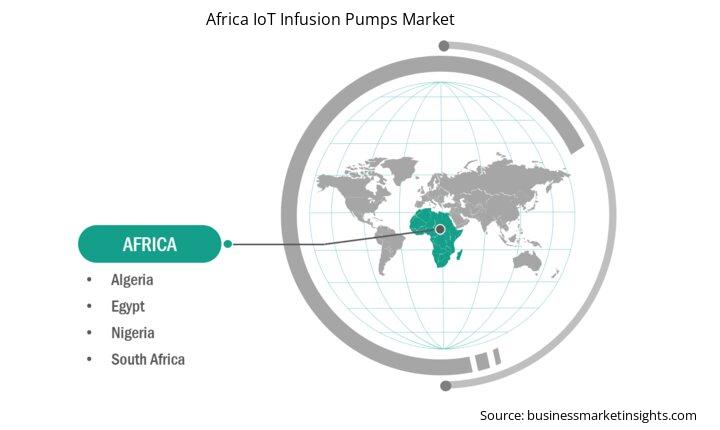
Based on region, the Africa IoT infusion pumps market is further segmented into Egypt, South Africa, Nigeria, and Algeria. Egypt held the largest share in 2024.
Country-level dynamics reveal significant variation in adoption across Africa. Egypt leads the region, supported by advanced healthcare infrastructure, strong private sector involvement, and well-established digital health policies. Nigeria demonstrates substantial uptake, driven by its large population, escalating burden of hypertension and diabetes, and growing investments in telemedicine platforms. In South Africa, adoption is being accelerated by private healthcare providers and government initiatives aimed at integrating IoT into national health strategies. Emerging markets are leveraging public-private partnerships to deploy IoT infusion pumps in hospital networks and rural health programs, particularly for universal healthcare coverage. French-speaking Africa is progressing at a slower pace due to infrastructure limitations and affordability challenges, though donor-funded projects are beginning to introduce IoT monitoring in community health programs. Cultural acceptance also varies, with urban populations more receptive to digital health solutions compared to rural communities that continue to rely on traditional practices. These variations underscore the heterogeneity of Africa’s healthcare landscape, requiring market players to tailor strategies to local conditions. Affordability, connectivity, and regulatory compliance are critical factors for success, and companies that adapt to these dynamics will be best positioned to capture growth opportunities. Collectively, country insights highlight a continent moving steadily toward deeper integration of IoT infusion pumps into national healthcare systems, albeit at different speeds and scales.
Africa IoT Infusion Pumps Market Company Profiles
Medtronic Plc, Moog, Inc., Abbott Laboratories, Boston Scientific Corporation, Baxter International Inc, Becton, Dickinson and Company, B. Braun SE, ICU Medical Inc., Fresenius Kabi AG, Terumo Corporation, are among the key players operating in the market. These players adopt strategies such as expansion, product innovation, and mergers and acquisitions to stay competitive in the market and offer innovative products to their consumers.
Africa IoT Infusion Pumps Market Research Methodology:
The following methodology has been followed for the collection and analysis of data presented in this report:
Secondary Research
The research process begins with comprehensive secondary research, utilizing both internal and external sources to gather qualitative and quantitative data for each market. Commonly referenced secondary research sources include, but are not limited to:
- Company websites, annual reports, financial statements, broker analyses, and investor presentations
- Industry trade journals and other relevant publications
- Government documents, statistical databases, and market reports
- News articles, press releases, and webcasts specific to companies operating in the market
Note: All financial data included in the Company Profiles section has been standardized to US$. For companies reporting in other currencies, figures have been converted to US$ using the relevant exchange rates for the corresponding year.
Primary Research
Business Market Insights conducts a significant number of primary interviews each year with industry stakeholders and experts to validate and analyze the data and gain valuable insights. These research interviews are designed to:
- Refine findings from secondary research
- Enhance the expertise and market understanding of the analysis team
- Gain insights into market size, trends, growth patterns, competitive dynamics, and future prospects
Primary research is conducted via email interactions and telephone interviews with industry experts across various markets, categories, segments, and sub-segments in different regions. Participants typically include:
- Industry stakeholders: Vice Presidents, business development managers, market intelligence managers, and national sales managers
- External experts: Valuation specialists, research analysts, and key opinion leaders with industry-specific expertise
Key Sources Referred:
- World Health Organization (WHO)
- Organisation for Economic Cooperation and Development (OECD)
- The World Bank Group
- Worldometer
- The Lancet
- International Bar Association
- International Trade Administration
- Eurostat
Africa IoT Infusion Pumps Market Strategic Insights
Africa IoT Infusion PumpsMarket Report Highlights
| Report Attribute | Details |
| Market size in 2024 | US$ 104.9 Million |
| Market Size by 2033 | US$ 268.8 Million |
| CAGR (2025 - 2033) | 11.0% |
| Historical Data | 2022-2023 |
| Forecast period | 2025-2033 |
| Segments Covered |
By Product
|
|
Regions and Countries Covered
|
|
| Africa | Egypt, South Africa, Nigeria, Algeria |
| Market leaders and key company profiles |
|
Africa IoT Infusion Pumps Market Country and Regional Insights