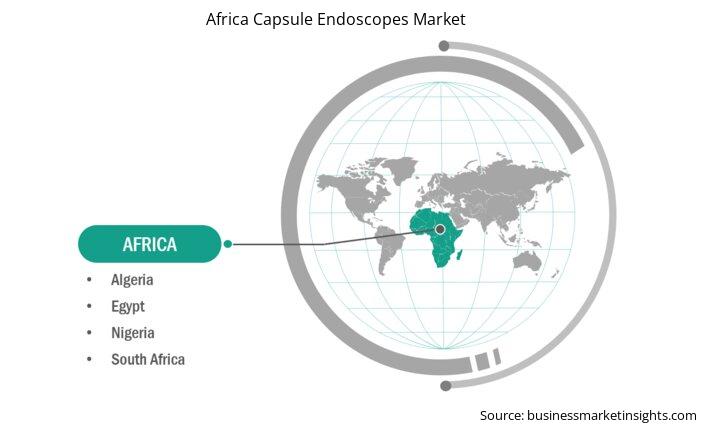
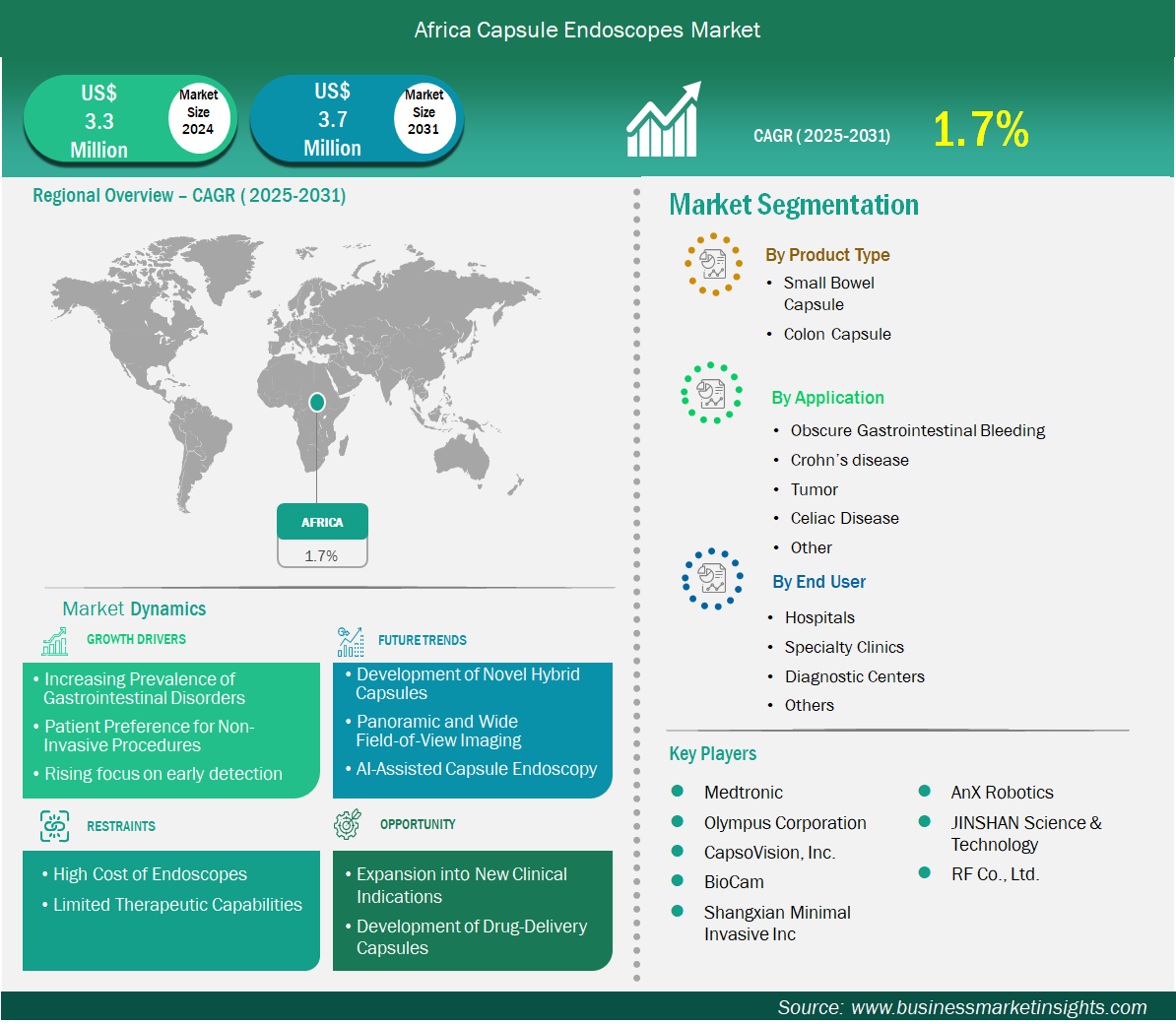
The Africa capsule endoscopes market size is expected to reach US$ 3.7 million by 2031 from US$ 3.3 million in 2024. The market is estimated to record a CAGR of 1.7% from 2025 to 2031.
Executive Summary and Africa Capsule Endoscopes Market Analysis:
The Africa capsule endoscopy market is still in its early stages of development, with adoption mostly limited to large urban hospitals that can afford the high cost of devices, have the health care infrastructure in place, and low awareness of advanced gastrointestinal diagnostics. Working toward higher penetration, the market is still valuable, as healthcare systems are slowly evolving, leading to a shift toward priorities focused around non-invasive measures to diagnose illness. The combination of government and other private initiatives trying to increase diagnostic capacity is slowly creating an environment conducive to adoption. As patients become more aware of these modalities and medical training and systems develops, the use of capsule endoscopy diagnostic technology is expected to increase across the continent over the next several years.
Africa Capsule Endoscopes Market Segmentation Analysis:
Key segments that contributed to the derivation of the capsule endoscopes market analysis are product type, application, and end user.
- By product type, the capsule endoscopes market is segmented into small bowel capsule and colon capsule. The small bowel capsule segment dominated the market in 2024.
- By application, the capsule endoscopes market is segmented into obscure gastrointestinal bleeding, Crohn's disease, tumor, celiac disease and others. The obscure gastrointestinal bleeding segment dominated the market in 2024.
- By end user, the market is segmented into hospitals, specialty clinics, diagnostic centers and others. The hospitals segment held the largest share of the market in 2024.
Africa Capsule Endoscopes Market Outlook
Capsule endoscopy remains a niche procedure, largely limited to major urban hospitals. The main roadblock is affordability—both for hospitals and patients. Still, the need is real. However, the rising incidence of GI disorders such as Crohn’s disease, ulcers, and intestinal bleeding is creating awareness about the importance of accurate, patient-friendly diagnostic options. Capsule endoscopy meets that demand well. Private hospitals are the early adopters, typically bringing on new services for those patients seeking premium care. Support from international healthcare organizations and medical device suppliers has helped with training and conducting pilots. While widespread use is still distant, the early signs are encouraging, and the shift toward modernization in diagnostics is gradually gaining strength.
Africa Capsule Endoscopes Market Country Insights
Based on country, the Africa capsule endoscopes market is further segmented into Nigeria, Egypt, South Africa, and Algeria. South Africa held the largest share in 2024.
South Africa dominates the African market. Adoption is mostly concentrated in major urban hospitals in Johannesburg, Cape Town, and Durban, where private healthcare providers are willing to invest in newer, patient-friendly technologies. Doctors are becoming more familiar with capsule endoscopy and see its advantages over traditional procedures, especially for diagnosing small bowel and other GI disorders. International manufacturers arrange training programs and collaborate with universities to build capacity. The price remains a limitation for many public hospitals, and is the key reason for a slow uptake of such devices. Awareness from the patient population and government funds to assist in modernizing diagnostics are creating opportunities. South African experience often sets the pace for the rest of the region and is the main facility for the advancement of capsule endoscopy in Africa.
Africa Capsule Endoscopes Market Company Profiles
Medtronic, Olympus Corporation, CapsoVision, Inc., BioCam, Shangxian Minimal Invasive Inc., AnX Robotics, JINSHAN Science & Technology and RF Co., Ltd. are among the key players operating in the market. These players adopt strategies such as expansion, product innovation, and mergers and acquisitions to stay competitive in the market and offer innovative products to their consumers.
Africa Capsule Endoscopes Market Research Methodology:
The following methodology has been followed for the collection and analysis of data presented in this report:
-
Secondary Research
The research process begins with comprehensive secondary research, utilizing both internal and external sources to gather qualitative and quantitative data for each market. Commonly referenced secondary research sources include, but are not limited to:
- Company websites, annual reports, financial statements, broker analyses, and investor presentations
- Industry trade journals and other relevant publications
- Government documents, statistical databases, and market reports
- News articles, press releases, and webcasts specific to companies operating in the market
Note: All financial data included in the Company Profiles section has been standardized to US$. For companies reporting in other currencies, figures have been converted to US$ using the relevant exchange rates for the corresponding year.
-
Primary Research
Business Market Insights conducts a significant number of primary interviews each year with industry stakeholders and experts to validate and analyze the data and gain valuable insights. These research interviews are designed to:
- Refine findings from secondary research
- Enhance the expertise and market understanding of the analysis team
- Gain insights into market size, trends, growth patterns, competitive dynamics, and future prospects
Primary research is conducted via email interactions and telephone interviews with industry experts across various markets, categories, segments, and sub-segments in different regions. Participants typically include:
- Industry stakeholders: Vice Presidents, business development managers, market intelligence managers, and national sales managers
- External experts: Valuation specialists, research analysts, and key opinion leaders with industry-specific expertise
Key Sources Referred:
- The World Bank
- World Health Organization (WHO)
- Center for Disease Control and Prevention (CDC)
- American Society for Gastrointestinal Endoscopy
- European Society of Gastrointestinal Endoscopy
- World Endoscopy Organization
- Society of American Gastrointestinal and Endoscopic Surgeons
- Global Cancer Observatory
- Company website
- Company annual reports
- Company investor presentations
Africa Capsule Endoscopes Market Strategic Insights
Africa Capsule EndoscopesMarket Report Highlights
| Report Attribute | Details |
| Market size in 2024 | US$ 3.3 Million |
| Market Size by 2031 | US$ 3.7 Million |
| CAGR (2025 - 2031) | 1.7% |
| Historical Data | 2021-2023 |
| Forecast period | 2025-2031 |
| Segments Covered |
By Product Type
|
|
Regions and Countries Covered
|
|
| Africa | Egypt, South Africa, Nigeria, Algeria |
| Market leaders and key company profiles |
|
Africa Capsule Endoscopes Market Country and Regional Insights