
Aerostructures Market Outlook: Size, Share, Trends, Growth Analysis, Competitive Landscape & Forecast, 2026–2033

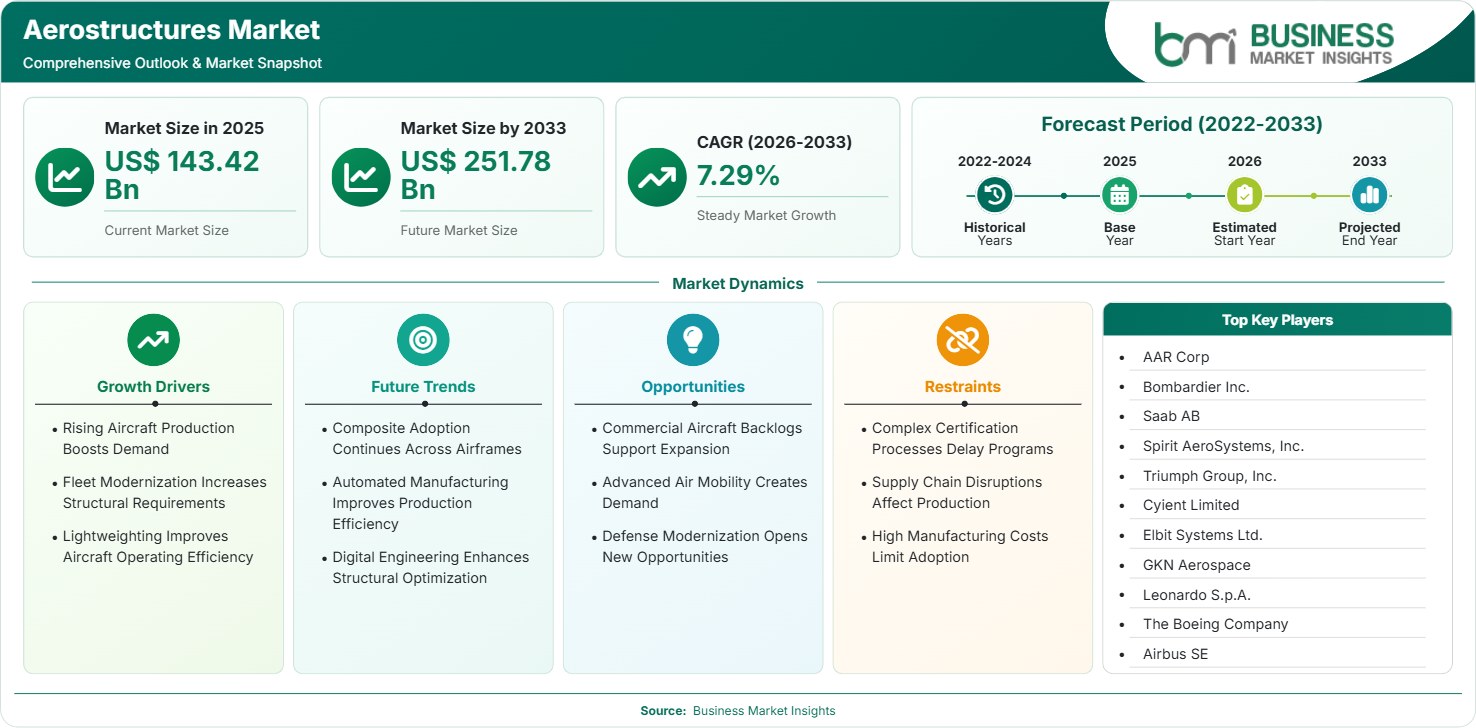
The Aerostructures Market size was valued at US$ 143.42 Billion in 2025 and is projected to reach US$ 251.78 Billion by 2033, growing at a CAGR of 7.29% during 2026–2033, supported by aircraft production recovery, fleet modernization, lightweight composites, defense procurement, aftermarket demand, and expanding aerospace manufacturing capacity.

Report Coverage
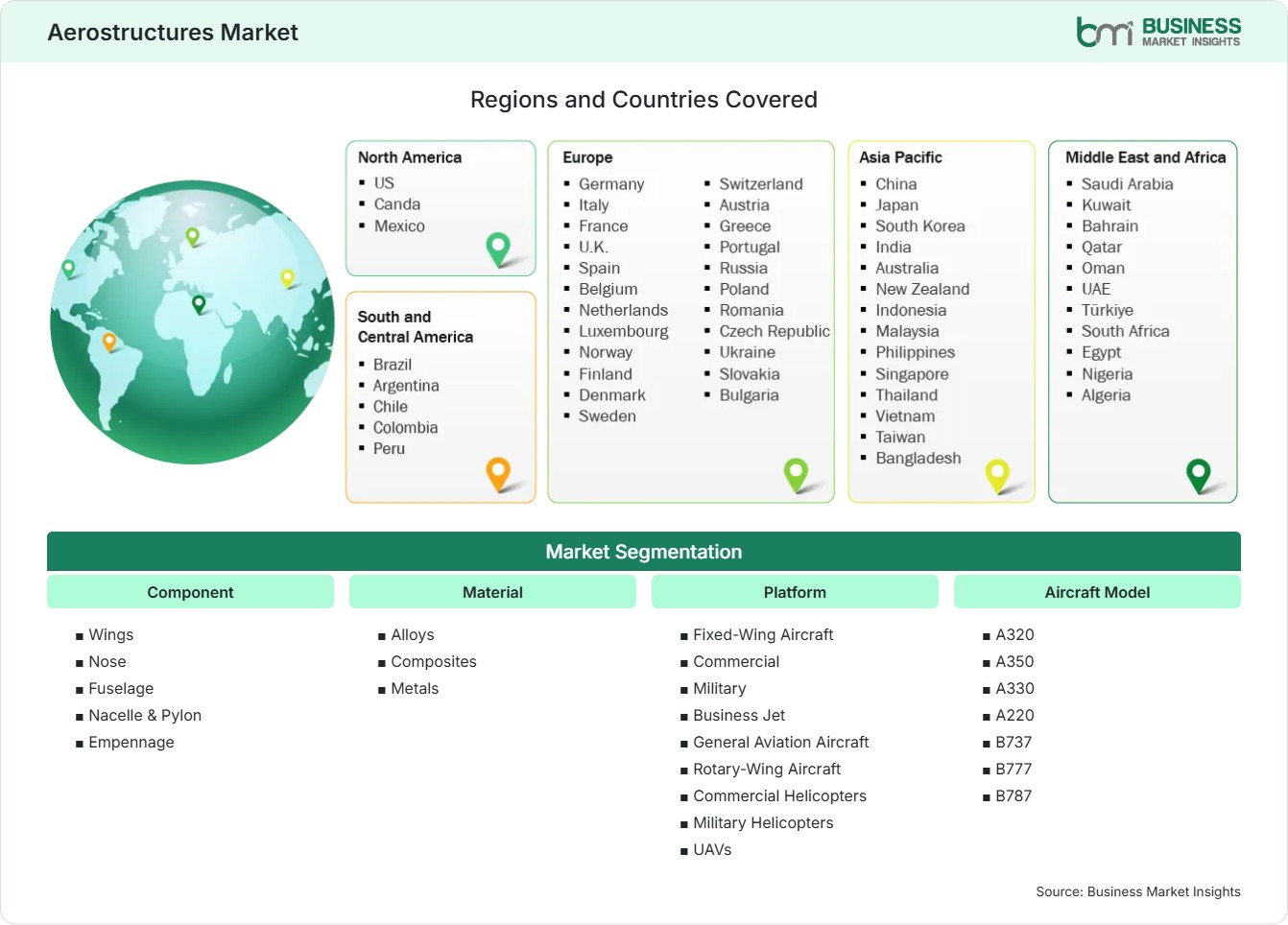
  • Component: Wings, Nose, Fuselage, Nacelle & Pylon, Empennage
  • Material: Alloys, Composites, Metals
  • Platform: Fixed-Wing Aircraft, Commercial, Military, Business Jet, General Aviation Aircraft, Rotary-Wing Aircraft, Commercial Helicopters, Military Helicopters, UAVs
  • Aircraft Model: A320, A350, A330, A220, B737, B777, B787
US$ 143.42 Bn Market size in 2025
US$ 251.78 Bn Market Size by 2033
7.29% CAGR, 2026 - 2033
2026-2033 Forecast Period

AI Overview

Aerostructures Market Summary

  • North America Region: North America holds a modeled 31%–34% Aerostructures Market share in 2025, growing at a 6.4%–6.9% CAGR during 2026–2033, supported by aircraft production, defense programs, supplier localization, composite manufacturing, aftermarket activity, and substantial commercial aerospace investment. The US benefits from Boeing production recovery, defense procurement, supplier consolidation, and demand for lightweight structures across commercial and military platforms.
  • Fastest Growing Region: Asia Pacific accounts for a modeled 25%–29% share in 2025, with the fastest regional CAGR of 8.2%–8.8% during 2026–2033, driven by fleet expansion, rising passenger traffic, aerospace localization, aircraft assembly programs, defense modernization, and investments in composite structures and precision manufacturing across India, China, Japan, and Southeast Asia.
  • Leading Segment: Fuselage within Component represents a modeled 34%–38% Aerostructures Market share in 2025, advancing at 7.0%–7.5% CAGR during 2026–2033, supported by high structural content, commercial aircraft production, replacement demand, modular manufacturing, composite adoption, supplier integration, and increasing requirements for lighter, stronger, more manufacturable fuselage assemblies.
  • High Growth Segment: Composites within Material represent a modeled 30%–34% share in 2025, expanding at 8.0%–8.7% CAGR during 2026–2033, supported by weight reduction, fuel efficiency, corrosion resistance, advanced automated manufacturing, lower lifecycle costs, and growing use in next-generation wings, fuselages, nacelles, empennages, and UAV platforms.
  • Key Market Opportunity: Increasing aircraft backlogs, fleet aging, defense modernization, composite penetration, and supply-chain localization create opportunities for vertically integrated suppliers offering engineering, manufacturing, certification, digital production, repair, and lifecycle support capabilities.
  • Major Market Players: AAR Corp, Bombardier Inc., Saab AB, Spirit AeroSystems, Inc., Triumph Group, Inc., Cyient Limited, Elbit Systems Ltd., GKN Aerospace, Leonardo S.p.A., The Boeing Company, and Airbus SE.
Strategic Insights

Aerostructures Market: Strategic Insights

Aerostructures Market Strategic Framework
FREE PDF
Request your free sample
Request free sample
Stakeholder View

Key Takeaways

  • The manufacture of aerostructures is becoming more reliant on OEM-supplier collaboration, which includes coordination with respect to engineering, tooling, certification, materials, and quality assurance.
  • Growth areas include fuselages, wings, composite tails, nacelles, pylons, and UAV structures since the aircraft design focuses on reducing weight, increasing performance, repeatability, and lifecycle cost efficiency.
  • Automated fiber placement, resin transfer, additive manufacturing, digital twin, robotic inspection, and advanced machining enhance the structural integrity and production process efficiency.
  • Asia Pacific offers strong investment potential as passenger traffic, aircraft procurement, aerospace localization, and government-backed manufacturing initiatives expand the regional supplier base.
  • Vertical integration is becoming increasingly significant with Boeing acquiring Spirit AeroSystems and controlling the manufacturing of major structural components.
  • Suppliers combining composite expertise, engineering, digital manufacturing, certification, and aftermarket services can capture greater value across the aircraft lifecycle.
Geographic Outlook

Aerostructures Market Regional Highlights

North America Aerostructures Market

North America represented a modeled 31%–34% Aerostructures Market share in 2025 and is projected to expand at 6.4%–6.9% CAGR during 2026–2033. The region benefits from concentrated commercial aircraft manufacturing, extensive defense programs, established Tier 1 suppliers, advanced materials capability, and large aftermarket requirements.

  • Recovery in production at Boeing is providing impetus to fuselage, wing, nacelle, and pylon orders; supplier integration is becoming more production-based, emphasizing production stability, quality, and reliability across major aircraft programs.
  • Defense spending in the United States and aircraft modernization are providing an impetus to the demand for metallic and composite structures, especially those of fighters, tankers, helicopters, surveillance, and unmanned aircraft needing specialized engineering and low-rate production.
  • Aerospace suppliers are automating their operations, inspections, machining, and composite operations to cope with the labor shortage as well as to enhance the repeatability and reduce manufacturing variability in structurally critical assemblies.
  • Aftermarket demand is crucial, as aircraft delivery delays and aging fleets require repairs, modifications, and replacement parts from aerospace suppliers.

US Aerostructures Market

The US represented a modeled 74%–78% Aerostructures Market share of North American revenue in 2025, with 6.2%–6.7% CAGR during 2026–2033. The country's position reflects Boeing's commercial programs, extensive defense procurement, advanced supplier infrastructure, and strong aerospace engineering capabilities.

  • Commercial aircraft production remains the principal demand driver, supporting continued demand for structural components across major aircraft programs.
  • Defense manufacturing supports specialized structures for fighters, tankers, helicopters, surveillance aircraft, and unmanned systems, creating opportunities for suppliers with rapid prototyping and certified low-volume manufacturing capabilities.
  • Supply-chain consolidation is reshaping procurement dynamics as OEMs seek greater control over critical structural production, demonstrated by Boeing’s acquisition of Spirit AeroSystems.

Europe Aerostructures Market

Europe held a modeled 27%–30% Aerostructures Market share in 2025, with a 6.8%–7.3% CAGR through 2033. France, Germany, the UK, Italy, and Spain remain core aerospace manufacturing locations, while Italy and the UK provide strong opportunities in structures and advanced materials.

  • France and Germany benefit from Airbus production networks and major single-aisle and widebody programs, creating sustained demand for fuselage sections, wings, empennages, nacelles, and advanced composite assemblies.
  • The UK offers strong growth potential in composite wing technologies, with aerospace manufacturers investing in next-generation composite wingtip and flap structures.
  • Italy combines commercial and defense structural manufacturing, with Leonardo supplying large structural components for Boeing and Airbus programs using aluminum alloys, composites, and hybrid materials.
  • Spain remains strategically relevant to European aerospace structures through Airbus-linked production and advanced composite capabilities, supporting demand for high-value structural assemblies and precision manufacturing.

Asia Pacific Aerostructures Market

Asia Pacific represented a modeled 25%–29% Aerostructures Market share in 2025 and is forecast to record 8.2%–8.8% CAGR during 2026–2033. China, Japan, India, South Korea, and Southeast Asia are expanding aerospace production and supplier ecosystems.

  • India is emerging as an important sourcing center in aerospace manufacturing owing to the substantial sourcing by Airbus from the country, including intricate aerostructures and systems, helping in localization of suppliers as well as export manufacturing.
  • China benefits from domestic airline requirements and its own indigenous aircraft development program to facilitate sourcing of metallic structure, composite structure, tooling, precision machining, and component manufacture through its emerging aircraft programs.
  • Japan has highly developed expertise in composites and precision manufacturing, and the existing supply chain within its aerospace industry provides high-quality parts for commercial aircraft programs.
  • South Korea and South East Asia are emerging in terms of aerospace manufacturing capabilities through defense programs, aircraft component exports and partnerships and high precision manufacturing and maintenance facilities.

Rest of World Aerostructures Market

Rest of World represented a modeled 9%–13% Aerostructures Market share in 2025, with a 6.0%–6.6% CAGR during 2026–2033. South and Central America benefit from expanding air connectivity and fleet modernization, while the Middle East combines strong airline growth with major widebody fleets and defense procurement. Africa provides longer-term opportunity as fleet renewal and regional connectivity improve.

Brazil remains the leading South American aerospace manufacturing location, supported by established aircraft production and a developed supplier base. Mexico also offers structural manufacturing opportunities because of its proximity to North American OEMs and aerospace clusters.

  • Brazil provides structural manufacturing opportunities in the areas of commercial aviation, regional aviation, machining, and aerospace exports, allowing a platform for manufacturers looking to diversify into Latin American production.
  • In Mexico, the aerospace cluster, export-led manufacturing, skill development, and proximity to US original equipment manufacturers enable the manufacture of nacelles, fuselages, machined parts, and composite parts.
  • UAE and Saudi Arabia provide high-value opportunities due to fleet growth, defense spending, maintenance localization, and the building of aerospace industrial ecosystems.
  • Africa has limited structural manufacturing capabilities but has future opportunities in the areas of fleet renewal, regional aviation growth, MRO development, and technical support localization.
Global Market Geography
FREE PDF
Request your free sample
Request free sample
Segment Analysis

Aerostructures Market Segmentation

Component

Component represented the largest structural value pool in 2025, with a modeled 48%–52% share and 7.0%–7.5% CAGR during 2026–2033. Demand is anchored by fuselages and wings, while nacelles, pylons, empennages, and nose structures benefit from rising aircraft production and lightweighting requirements.

  • Wings: Wing structures command high engineering value because aerodynamic efficiency, composite integration, load management, and automated manufacturing directly influence aircraft range, fuel consumption, and structural weight.
  • Nose: Nose assemblies require high dimensional accuracy and systems integration, supporting demand for advanced machining, composites, radome-compatible structures, and precision assembly across commercial and defense aircraft.
  • Fuselage: Fuselages remain structurally intensive assemblies, with demand supported by aircraft production recovery, modular manufacturing, composite penetration, supplier integration, and growing requirements for lightweight pressure-resistant structures.
  • Nacelle & Pylon: Nacelles and pylons benefit from engine modernization, aerodynamic optimization, noise reduction, and lightweight structures, creating opportunities for suppliers combining metallic fabrication, composites, and systems integration.
  • Empennage: Empennage structures increasingly incorporate lightweight composites and advanced manufacturing, improving weight efficiency while meeting demanding stiffness, fatigue, aerodynamic, and certification requirements across aircraft platforms.

Material

Material represented a critical value driver, with alloys, composites, and metals collectively supporting a modeled 7.2%–7.8% CAGR during 2026–2033. Composite penetration is increasing as manufacturers prioritize weight reduction, corrosion resistance, fuel efficiency, and lifecycle performance.

  • Alloys: Aluminum and advanced aerospace alloys remain important because they provide established certification pathways, predictable manufacturing characteristics, reparability, and competitive cost performance across high-volume commercial aircraft structures.
  • Composites: Composite adoption is accelerating because lower structural weight, corrosion resistance, high strength-to-weight ratios, and automated manufacturing support more efficient aircraft designs and next-generation wing and fuselage architectures.
  • Metals: Titanium, steel, and specialized metals remain essential for highly loaded structural areas, attachment points, engine interfaces, and applications requiring elevated temperature resistance, fatigue performance, or dimensional stability.

Platform

Platform demand is diversified across fixed-wing and rotary-wing aircraft, with a modeled 7.3%–8.0% CAGR during 2026–2033. Commercial aircraft provide volume, while military aircraft, helicopters, business jets, general aviation, and UAVs broaden structural applications.

  • Fixed-Wing Aircraft: Fixed-wing platforms remain the largest structural demand center because commercial, military, business, and general aviation aircraft require extensive primary and secondary structures across wings, fuselages, empennages, nacelles, and pylons.
  • Commercial: Commercial aircraft dominate volume requirements, supported by fleet expansion, passenger demand, large OEM backlogs, replacement cycles, and airline efforts to improve operating efficiency through newer lightweight aircraft.
  • Military: Military aircraft demand benefits from modernization programs, geopolitical tensions, fleet replacement, and increased investment in survivability, low observability, advanced composites, and specialized structural configurations.
  • Business Jet: Business jets require lightweight, high-quality structures supporting range, cabin comfort, speed, and fuel efficiency, with composite materials increasingly important for premium aircraft design and manufacturing.
  • General Aviation Aircraft: General aviation supports diversified structural demand across training, private, utility, and specialty aircraft, with opportunities for lightweight components, cost-efficient manufacturing, and replacement structures.
  • Rotary-Wing Aircraft: Rotary-wing platforms create specialized structural requirements around vibration resistance, fatigue performance, lightweight materials, and high-strength assemblies used in commercial, military, and unmanned helicopter applications.
  • Commercial Helicopters: Commercial helicopters require lightweight fuselages, rotor-supporting structures, cabins, and tail assemblies, with demand influenced by offshore energy, emergency services, tourism, utility operations, and passenger transport.
  • Military Helicopters: Military helicopter structures emphasize survivability, fatigue life, modularity, payload capacity, and repairability, supporting demand for advanced materials and structurally optimized assemblies.
  • UAVs: UAV structures are a high-growth application because lightweight airframes, endurance requirements, rapid design cycles, and scalable production favor composites, additive manufacturing, and integrated structural-electronic architectures.

Aircraft Model

Aircraft-model demand is concentrated among high-volume narrowbody and widebody programs, with a modeled 7.1%–7.8% CAGR during 2026–2033. Program longevity creates recurring structural demand for OEM production, replacements, modifications, and aftermarket support.

  • A320: The A320 family provides a substantial recurring structural opportunity because of its large installed base, continuing production, supplier ecosystem, and broad global airline adoption.
  • A350: The A350 drives advanced composite and lightweight structural demand, particularly for wings, fuselage sections, empennages, and other assemblies requiring high strength-to-weight performance.
  • A330: The A330 supports continuing structural demand through fleet operation, freighter applications, passenger conversions, maintenance requirements, and long-term aftermarket activity.
  • A220: The A220 offers growth potential through rising production and expanding airline adoption, increasing demand for lightweight structures and specialized composite and metallic assemblies.
  • B737: The B737 family remains a major structural volume driver because of its large backlog, production recovery, global installed base, and extensive aftermarket requirements.
  • B777: The B777 platform sustains structural demand through passenger and freighter operations, modernization, maintenance, and the transition toward the next-generation 777X program.
  • B787: The B787 supports advanced composite demand because of its extensive composite airframe architecture, increasing production rates, and long-term widebody fleet expansion.
Market Forces

Aerostructures Market Dynamics

Commercial Aircraft Production Recovery

Commercial aircraft production recovery is a primary demand catalyst. Improving aircraft production demonstrates strengthening output despite persistent supply constraints. High backlogs of large aircraft result in continuous demand for structural assemblies such as wings, fuselages, nacelles, pylons, and empennages. Increasing passenger traffic also means increased airline demands for replacements and expansion of fleets. As the production rate increases in OEMs, certified suppliers capable of handling these requirements are poised to benefit from steady orders.

Growing Adoption of Lightweight Composite Structures

Lightweighting is increasing the strategic value of advanced composites across wings, fuselages, empennages, nacelles, and UAV structures, supporting Aerostructures Market growth. Composite structures have the potential to lower weight and improve corrosion resistance, along with the ability to shape intricate airframes. Aerospace companies are moving towards advanced composites for wing and control surfaces, along with automation and sustainability features. The move to integrated manufacturing, automated placement, digital inspection, and repairability capabilities is also enhancing the growth prospects in the aerostructures segment.

Defense Modernization and Unmanned Aircraft Demand

Defense modernization is broadening structural demand beyond commercial aviation. Governments are procuring new fighters, helicopters, tankers, surveillance aircraft, and unmanned platforms while upgrading existing fleets. The Aerostructures Market scope covers commercial aviation, defense aircraft, unmanned platforms, and advanced structural applications, including wings, fuselages, empennages, nacelles, pylons, and composite assemblies. Strong defense activity across aeronautics, surveillance, and naval programs illustrates continued structural requirements across military platforms. UAVs further expand the market scope because endurance and payload performance depend heavily on lightweight airframe design.

Key Market Opportunities

Localization of Aerospace Manufacturing in Asia

Asia Pacific presents a major investment opportunity as aircraft demand increasingly aligns with government-supported aerospace localization. India is expanding its position as a global supplier, including in complex aerostructures and systems. The country is developing capabilities across engineering, machining, composites, assembly, maintenance, and defense manufacturing. China, Japan, South Korea, and Southeast Asia similarly offer opportunities through domestic aviation programs and international supplier relationships. For investors, localized production can reduce logistics exposure, expand access to skilled technical labor, and improve proximity to rapidly growing airline markets.

Digital Manufacturing and Automated Structural Production

Digital manufacturing is emerging as a key Aerostructures Market trend, offering opportunities to improve throughput and reduce production variability as aircraft programs increase output. Automated fiber placement, robotic drilling, digital twins, machine vision, additive tooling, and automated inspection can reduce repetitive labor requirements while improving traceability. These technologies are particularly relevant for composite wings, fuselage sections, and complex secondary structures where dimensional accuracy and process consistency are critical. The trend is gaining importance as suppliers deploy automation across multiple aircraft programs to improve productivity, quality, and manufacturing flexibility.

Aftermarket Structural Repair and Lifecycle Services

The aging global fleet creates a durable opportunity for structural repair, modification, replacement parts, and lifecycle engineering. The Aerostructures Market Forecast highlights growing opportunities in aftermarket structural services as older aircraft remain operational for longer. Supply-chain disruptions can also delay new aircraft deliveries, increasing requirements for structural inspection, fatigue assessment, corrosion repair, component replacement, and cabin or mission modifications. Suppliers with both original-equipment manufacturing and aftermarket capabilities can use production expertise to improve repair turnaround and parts availability.

Market Restraints and Challenges

Supply-Chain Constraints and Production Bottlenecks

Factor: Aerospace manufacturing remains exposed to shortages of engines, castings, forgings, specialized materials, electronics, and skilled labor, creating dependencies across highly interconnected production programs. Persistent aircraft delivery shortfalls and large industry backlogs continue to place pressure on the aerospace supply chain.

Impact: Suppliers for structural parts may experience irregular production processes, stock pressure, faster demand requirements, and increased need for working capital when the upstream parts are not available. The inconsistent production rate may also decrease efficiency in manufacturing as tooling and labor cannot always be utilized effectively.

High Certification Costs and Material Complexity

Factor: Aerostructure suppliers must meet stringent airworthiness, traceability, fatigue, fire, damage-tolerance, and process-control requirements, while advanced composites introduce specialized qualification and inspection needs.

Impact: Certification can lengthen the time required to develop an aircraft component, raise the cost of non-recurring engineering and pose barriers to entry for smaller manufacturers who wish to enter the market of primary structure production. Modification of materials or process will require further validation, modification of tools, testing and customer approvals.

Company Analysis

Competitive Landscape

The Aerostructures Market analysis indicates a competitive structure combining aircraft OEMs, Tier 1 structural manufacturers, defense specialists, engineering providers, and diversified aerospace suppliers. Competitive differentiation increasingly depends on certified production capacity, composite expertise, program longevity, engineering depth, geographic footprint, and the ability to support customers through both manufacturing and aftermarket requirements.

Company Name

Overview

Products and Services relevant to this market

AAR Corp

Diversified aviation services provider with capabilities spanning commercial and defense aftermarket support and aircraft component services.

Aircraft component support, structural repair, parts distribution, maintenance, repair, overhaul, and lifecycle aviation services.

Bombardier Inc.

Canadian aerospace manufacturer focused on business aircraft and related engineering, manufacturing, and aftermarket capabilities.

Business aircraft structures, aircraft engineering, component support, maintenance, modifications, and lifecycle services.

Saab AB

Swedish aerospace and defense company with strong capabilities in advanced aircraft and military structural systems.

Military aircraft structures, aerospace engineering, components, systems integration, and defense lifecycle support.

Spirit AeroSystems, Inc.

Major aerostructure manufacturer specializing in large structural assemblies for commercial and defense aircraft.

Fuselages, pylons, nacelles, wing components, composite structures, metallic structures, and engineering services.

Triumph Group, Inc.

Aerospace supplier providing structures, components, systems, and aftermarket support across commercial and defense programs.

Aircraft structures, assemblies, components, precision manufacturing, engineering, repair, and aftermarket services.

Cyient Limited

Engineering and technology company supporting aerospace customers through design, manufacturing engineering, and digital capabilities.

Aerostructure engineering, product design, manufacturing engineering, digital engineering, and lifecycle support.

Elbit Systems Ltd.

Israeli defense technology company with aerospace manufacturing and advanced composite structural capabilities through its subsidiaries.

Composite aircraft structures, assemblies, build-to-print manufacturing, defense components, and aerospace engineering.

GKN Aerospace

Global aerospace supplier specializing in lightweight structures, composite technologies, and advanced manufacturing.

Wings, fuselage structures, empennages, composite components, metallic structures, machining, and advanced manufacturing.

Leonardo S.p.A.

Italian aerospace and defense group with major aerostructure capabilities supporting Boeing, Airbus, and other programs.

Fuselage sections, wings, structural assemblies, aluminum structures, composites, hybrids, and aircraft manufacturing.

The Boeing Company

Major aircraft OEM with extensive commercial and defense aircraft manufacturing and vertically integrated structural capabilities.

Commercial and military aircraft structures, fuselages, wings, pylons, nacelles, engineering, manufacturing, and aftermarket services.

Airbus SE

Global aircraft manufacturer with extensive commercial aircraft production and a broad international aerostructure supply chain.

Aircraft structures, wings, fuselages, composite assemblies, engineering, manufacturing, systems integration, and lifecycle support.

Trust & Transparency

Research Methodology

The market analysis combines proprietary research with secondary data from government agencies, company disclosures, regulatory filings, industry databases and expert interviews. Market estimates are validated through data triangulation, cross-market benchmarking and analyst review.

View Full Research Methodology

Questions Answered

Frequently Asked Questions

Which technologies will influence future structural manufacturing?

Automation, digital twins, additive manufacturing, automated composite placement, machine vision, robotic drilling, advanced non-destructive inspection, and AI-supported analytics are expected to improve repeatability, traceability, productivity, and manufacturing flexibility.

How does aircraft backlog influence suppliers?

Large backlogs provide visibility for structural procurement, tooling, capacity planning, and engineering investments. However, engine shortages, labor constraints, certification delays, and supply-chain disruptions can delay deliveries and revenue realization. These dynamics are important factors considered in the Aerostructures Market Report.

Why are fuselages strategically important?

Fuselages contain significant structural content and require advanced manufacturing, joining, pressure management, fatigue validation, systems integration, and certification. They also create long-term aftermarket opportunities through repair and maintenance.

How are composites changing aircraft structures?

Composites provide high strength-to-weight ratios, corrosion resistance, aerodynamic flexibility, and lower structural weight. Their adoption is driving investment in automated fiber placement, resin processes, robotic inspection, digital quality systems, and specialized repair.

What factors determine aerostructure supplier selection?

OEMs assess suppliers based on certification, capacity, quality, cost, engineering expertise, delivery reliability, financial strength, geographic presence, and ramp-up capabilities. Composite expertise and digital manufacturing are also increasingly important.

Access the Full Aerostructures Market Report

Get segment-level forecasts, regional estimates, competitive benchmarking, company profiles and downloadable Excel datasets.

Access the full Aerostructures Market Report
350 pages PDF & Excel | 2026-09-01