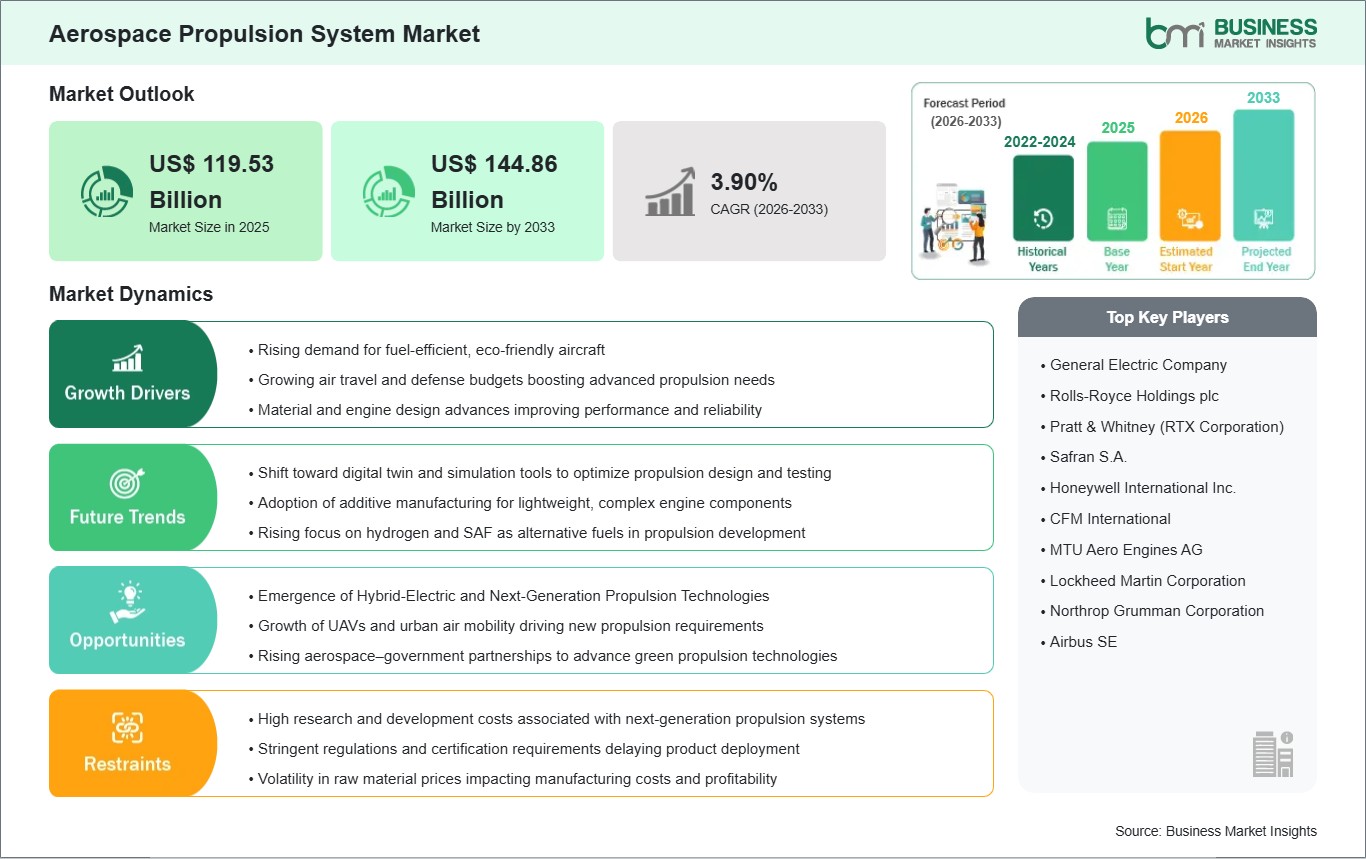
The Aerospace Propulsion System market size is expected to reach US$ 144.86 billion by 2033 from US$ 119.53 billion in 2025. The market is estimated to record a CAGR of 3.9% from 2026 to 2033.
The Aerospace Propulsion System market is a foundational pillar of the global aerospace and defense industry, enabling the development of efficient, reliable, and high-performance aircraft and space platforms. Propulsion systems are central to determining aircraft range, speed, fuel efficiency, payload capacity, and environmental performance across commercial aviation, military aircraft, unmanned systems, and space launch vehicles. Continuous innovation in propulsion technologies supports the industry’s objectives of improving operational efficiency, reducing emissions, and meeting increasingly stringent safety and regulatory requirements. Advanced propulsion solutions, supported by digital engineering, simulation, and testing capabilities, allow manufacturers to optimize performance while reducing development cycles and lifecycle costs. Aerospace propulsion systems are at the core of managing the growing complexity of next-generation platforms, including wide-body and narrow-body commercial aircraft, advanced fighter jets, helicopters, and space systems. These solutions enable critical capabilities such as higher thrust-to-weight ratios, improved thermal efficiency, reduced noise levels, and enhanced reliability. As aerospace platforms evolve to support longer ranges, higher payloads, and more demanding mission profiles, robust and efficient propulsion technologies play a decisive role in maintaining competitiveness and operational readiness across civil and defense markets.
Several factors are driving the growth of the aerospace propulsion system market, including the recovery and expansion of global air travel, rising defense spending, and increasing demand for fuel-efficient and low-emission aircraft. Additionally, the emergence of sustainable aviation fuels (SAF), hybrid-electric propulsion concepts, and advanced materials is accelerating innovation and investment across the value chain. Ongoing modernization programs, fleet renewals, and growing interest in space exploration and satellite deployment further contribute to sustained market expansion. Despite strong long-term prospects, the market faces challenges such as high development and manufacturing costs, lengthy certification cycles, and complex supply chains. Stringent environmental regulations, technical risks associated with new propulsion architectures, and a shortage of highly skilled engineering talent also pose constraints. Nevertheless, continued R&D investment, strategic partnerships, and advancements in digital design and manufacturing are expected to support scalable growth and long-term competitiveness in the aerospace propulsion system market.

Key segments that contributed to the derivation of the Aerospace Propulsion System market analysis are equipment type, and end user.
The increasing global emphasis on fuel efficiency and environmental sustainability is a key driver of the aerospace propulsion system market. Airlines, defense agencies, and aircraft manufacturers are under mounting pressure to reduce operating costs, carbon emissions, and noise levels while maintaining high performance and safety standards. Fuel expenses represent a significant portion of airline operating costs, making propulsion efficiency a critical competitive factor. As a result, there is strong demand for next-generation propulsion systems that deliver higher thrust-to-weight ratios, improved thermal efficiency, and lower fuel consumption.
Regulatory bodies across North America, Europe, and Asia-Pacific are implementing increasingly stringent emissions and noise regulations, compelling manufacturers to invest in advanced propulsion technologies. Innovations such as high-bypass turbofan engines, geared turbofan architectures, advanced materials, and improved aerodynamics are gaining rapid traction. In parallel, military programs are also prioritizing efficient propulsion systems to extend operational range, improve mission endurance, and reduce logistical complexity. These combined commercial and defense requirements are driving sustained investment in propulsion system research, development, and fleet modernization, making fuel efficiency and sustainability a fundamental growth driver for the aerospace propulsion system market.
The development of hybrid-electric and next-generation propulsion technologies presents a significant long-term opportunity for the aerospace propulsion system market. As the industry explores alternatives to conventional gas turbine engines, hybrid-electric, fully electric, and hydrogen-based propulsion concepts are gaining increasing attention from aircraft manufacturers, governments, and investors. These technologies offer the potential to significantly reduce emissions, operating costs, and noise, particularly for regional aircraft, urban air mobility (UAM) platforms, and short-haul operations.
Governments and regulatory authorities are actively supporting innovation through funding programs, research initiatives, and public–private partnerships aimed at accelerating the commercialization of sustainable propulsion solutions. Aerospace OEMs and engine manufacturers are investing heavily in electric motors, power electronics, energy storage systems, and advanced thermal management solutions to enable scalable deployment. Additionally, advancements in digital engineering, additive manufacturing, and materials science are lowering development barriers and enabling rapid prototyping of new propulsion architectures.
By propulsion type, the Aerospace Propulsion System market is divided into Gas Turbine Engines, Ramjet and Scramjet Engines, Rocket Engines, and Others. The Gas Turbine Engines segment dominated the market in 2024. Gas turbine engines including turbofan, turboprop, turbojet, and turboshaft variants offer an optimal balance of thrust, fuel efficiency, and reliability, making them the propulsion system of choice for the majority of aircraft and rotorcraft
By platform type, the market is divided into Fixed-Wing Aircraft, Rotary-Wing Aircraft, Space Launch Vehicles and Others. The Fixed-Wing Aircraft held the larger share in 2024. Fixed-wing aircraft, including commercial airliners, regional jets, and business aircraft, demand highly reliable and fuel-efficient propulsion systems to ensure performance across long-haul and short-haul routes.
By application, the market is divided into Passenger Transport, Cargo and Logistics, Defense and Military, Others. The Passenger Transport held the larger share in 2024. The dominance of passenger transport reflects the global expansion of commercial aviation, rising air travel demand, and fleet modernization initiatives, which require high-efficiency, low-emission propulsion systems.
| Report Attribute | Details |
|---|---|
| Market size in 2025 | US$ 119.53 Billion |
| Market Size by 2033 | US$ 144.86 Billion |
| Global CAGR (2026 - 2033) | 3.90% |
| Historical Data | 2022-2024 |
| Forecast period | 2026-2033 |
| Segments Covered | By Propulsion Type
|
|
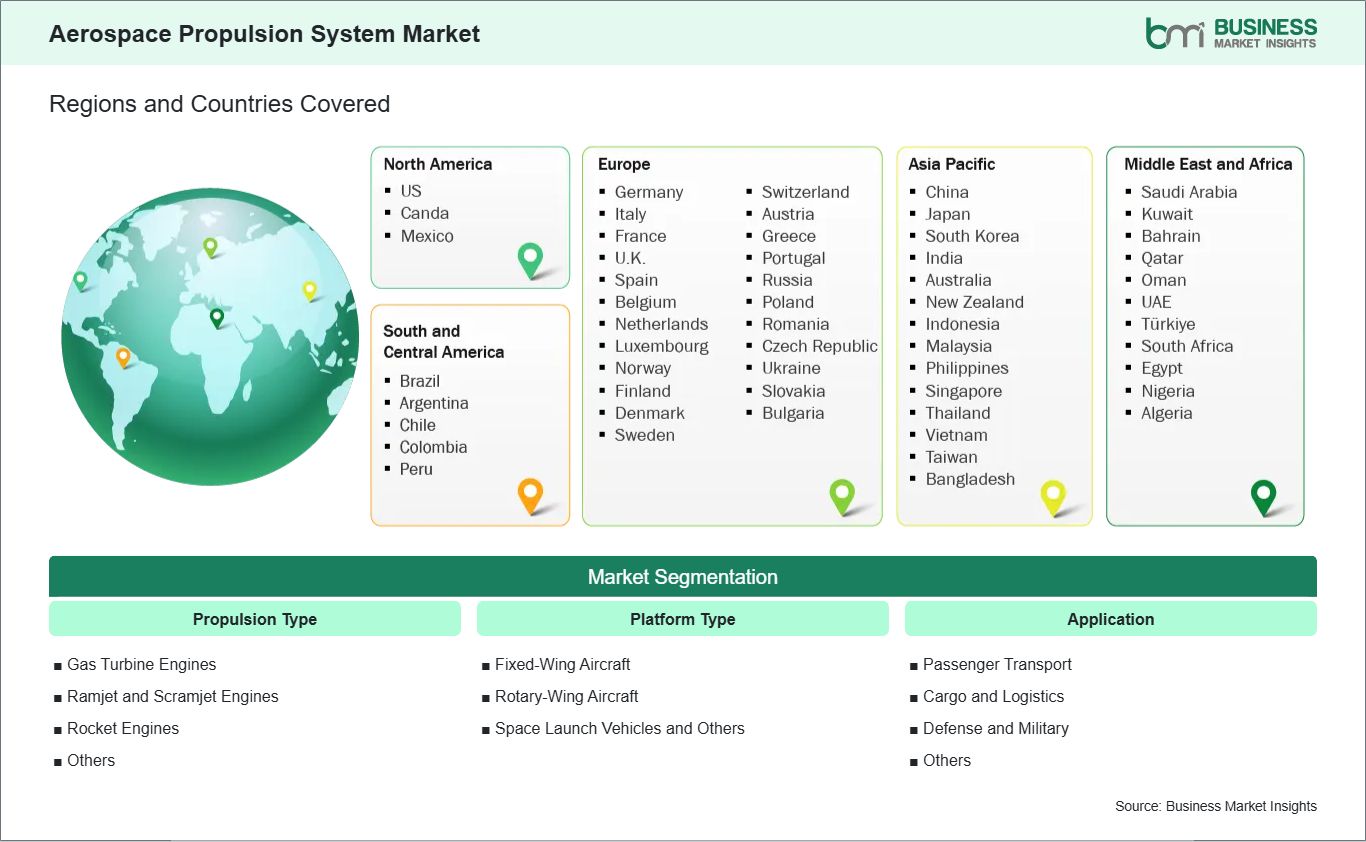
Regions and Countries Covered
| |
| North America | US, Canada, Mexico |
| Europe | Belgium, Austria, Finland, Denmark, Greece, Poland, Romania, Russia, Ukraine, Czech Republic, Slovakia, Bulgaria, Italy, Luxembourg, Germany, Switzerland, France, Netherlands, Norway, Portugal, Spain, Sweden, United Kingdom |
| Asia-Pacific | Australia, China, India, Japan, South Korea, Indonesia, Malaysia, Philippines, Singapore, Thailand, Vietnam, Bangladesh, New Zealand, Taiwan |
| South and Central America | Brazil, Argentina, Peru, Chile, Colombia |
| Middle East and Africa | Bahrain, Kuwait, Oman, Qatar, Saudi Arabia, United Arab Emirates, Turkiye, South Africa, Egypt, Algeria, Nigeria |
| Market leaders and key company profiles |
|
The "Aerospace Propulsion System Market Size and Forecast (2022–2033)" report provides a detailed analysis of the market covering below areas:
The Aerospace Propulsion System market is geographically segmented into North America, Asia Pacific, Europe, the Middle East & Africa, and South & Central America. Among these regions, Asia Pacific is expected to witness the strongest growth and remain a leading market throughout the forecast period, driven by rapid industrialization, expanding commercial and defense aviation sectors, and increasing investments in aerospace infrastructure. The region benefits from large-scale aircraft manufacturing capabilities, growing airline fleets, and government-backed aerospace programs, positioning it as a key hub for propulsion system development and adoption.
Within Asia Pacific, the market encompasses China, Japan, South Korea, India, Australia, New Zealand, Indonesia, Malaysia, the Philippines, Singapore, Thailand, Vietnam, Taiwan, Bangladesh, and the Rest of Asia. Growth in this region is supported by robust aircraft production, rising demand for commercial and regional air transport, and strong defense modernization programs. Leading economies such as China, Japan, South Korea, and India are driving adoption of advanced propulsion technologies, including high-bypass turbofan engines, turboprops, and next-generation hybrid-electric and sustainable fuel systems. These countries are also leveraging digital engineering, additive manufacturing, and predictive maintenance technologies to enhance efficiency, reliability, and performance in propulsion systems.
Demand for aerospace propulsion systems in Asia Pacific is further fueled by commercial aviation, defense, space launch programs, and emerging urban air mobility applications. Significant investments in engine manufacturing facilities, R&D centers, testing laboratories, and compliance certification infrastructure are accelerating market expansion. Additionally, public–private partnerships, government-led aerospace initiatives, and workforce development programs aimed at technical and engineering expertise are strengthening the regional ecosystem.
Despite challenges such as high capital expenditure, complex regulatory frameworks, and integration of new propulsion technologies with legacy aircraft platforms, Asia Pacific remains strategically positioned as a global hub for aerospace propulsion systems, supported by efficient supply chains, cost-competitive manufacturing, and strong domestic demand.

The Aerospace Propulsion System market is evaluated by gathering qualitative and quantitative data post primary and secondary research, which includes important corporate publications, association data, and databases. A few of the key developments in the Aerospace Propulsion System market are:
The Aerospace Propulsion System Market is valued at US$ 119.53 Billion in 2025, it is projected to reach US$ 144.86 Billion by 2033.
As per our report Aerospace Propulsion System Market, the market size is valued at US$ 119.53 Billion in 2025, projecting it to reach US$ 144.86 Billion by 2033. This translates to a CAGR of approximately 3.90% during the forecast period.
The Aerospace Propulsion System Market report typically cover these key segments-
The historic period, base year, and forecast period can vary slightly depending on the specific market research report. However, for the Aerospace Propulsion System Market report:
The Aerospace Propulsion System Market is populated by several key players, each contributing to its growth and innovation. Some of the major players include:
The Aerospace Propulsion System Market report is valuable for diverse stakeholders, including:
Essentially, anyone involved in or considering involvement in the Aerospace Propulsion System Market value chain can benefit from the information contained in a comprehensive market report.
Please tell us your area of interest
(Market Segments/ Regions and Countries/ Companies)