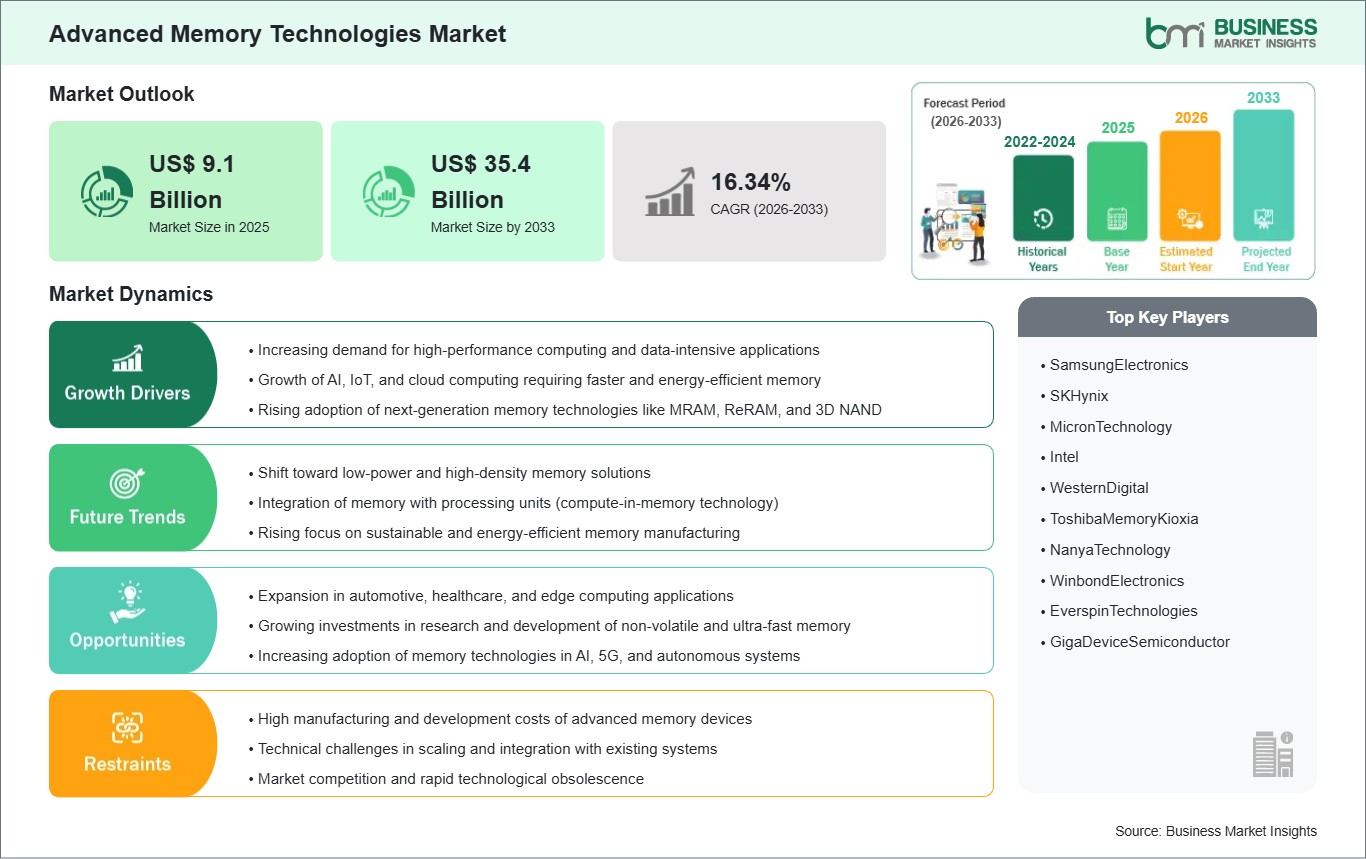
The Advanced Memory Technologies market size is expected to reach US$ 35.4 billion by 2033 from US$ 9.1 billion in 2024. The market is estimated to record a CAGR of 16.34% from 2025 to 2033.
The Advanced Memory Technologies market is a significant part of the worldwide semiconductor industry, primarily propelled by the ever, growing demand for fast, low, latency, energy, efficient, and scalable memory devices. These memory techniques go far beyond the standard DRAM and NAND and comprise High, Bandwidth Memory (HBM), DDR5/LPDDR5, 3D NAND, MRAM, ReRAM, Phase, Change Memory (PCM), as well as in, memory and neuromorphic computing architectures that are still in the early stages. Advanced memory products are the main actors in data, heavy applications from data centers and consumer electronics to automotive, industrial automation, telecommunications, and artificial intelligence (AI) environments.Worldwide, the market is experiencing robust growth as a result of the incredible surge in data production and the need for data processing. The steep increase in cloud computing, AI and machine learning, big data analytics, and high, performance computing (HPC) usage is fueling the need for memory hardware capable of delivering higher bandwidth and faster access speeds, all the while reducing power consumption. The deployment of 5G networks, the rise of edge computing, as well as the growth of the Internet of Things (IoT) are playing a pivotal role in increasing the demand for advanced memory solutions, especially the low, power and high, density ones.The automotive industry is turning into a major beneficiary, where the incorporation of advanced memory technologies is significantly contributing to the development of advanced driver, assistance systems (ADAS), autonomous driving, infotainment, and connected car platforms.

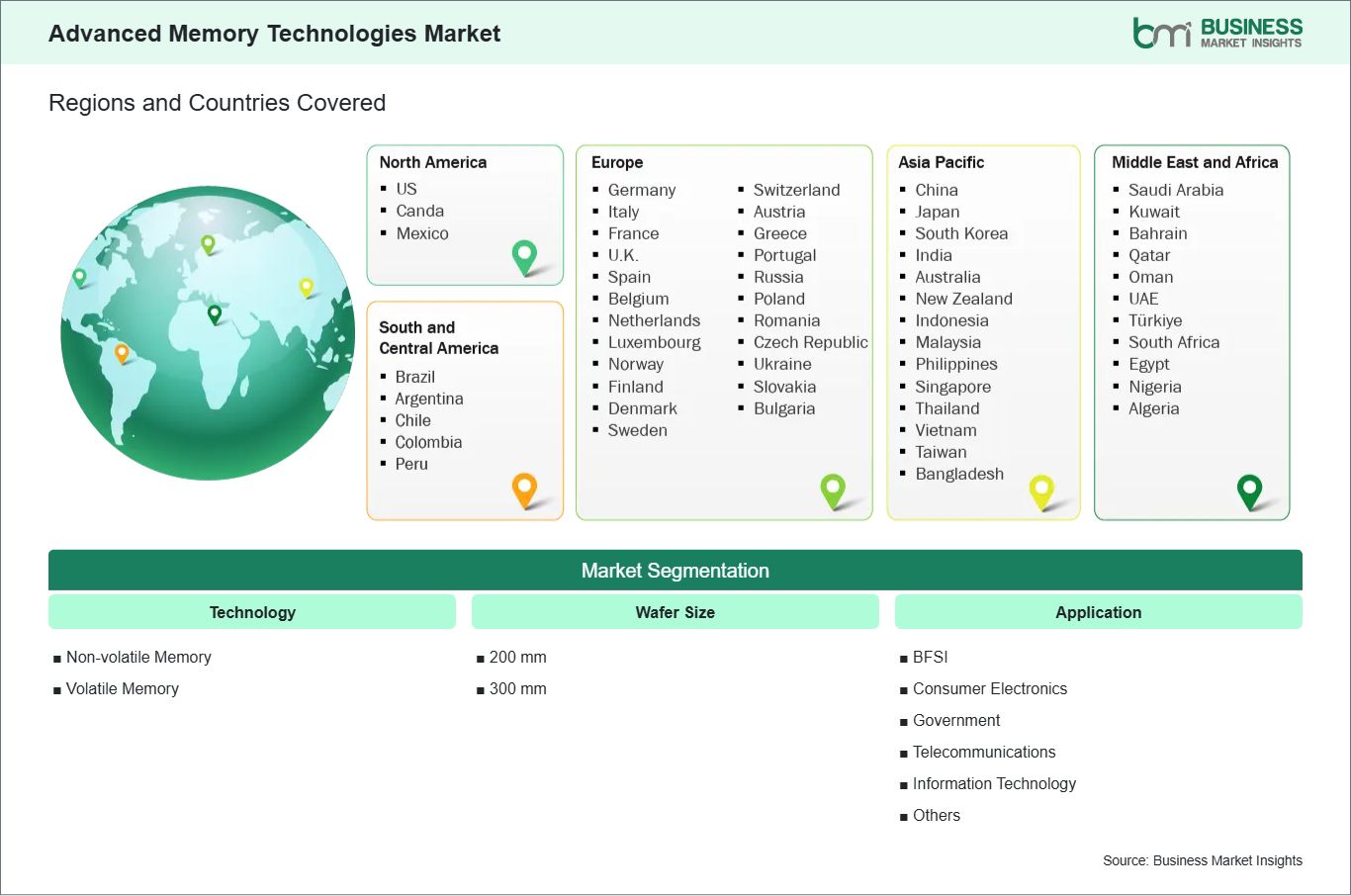
Key segments that contributed to the derivation of the Advanced Memory Technologies Market analysis are technology, wafer size, and application.
One of the key factors propelling the growth of the Advanced Memory Technologies market is the fast development of artificial intelligence (AI), machine learning (ML), and data, centric computing workloads. Deep learning and generative AI, a category of AI models, are extremely data, intensive and require the processing of huge volumes of data in real time. These demands have a significant impact on memory bandwidth, latency, and power efficiency. With the storage architectures that are in use today, only a few of such requirements can be fulfilled. This is why there is a strong push towards advanced memory solutions like High, Bandwidth Memory (HBM), DDR5/LPDDR5, and innovative in, memory computing technologies.The data centre and high, performance computing (HPC) fields are deploying advanced memory technologies so that the processor, memory bottlenecks can be broken, the system throughput can be raised, and the total energy consumption can be reduced. AI accelerators, GPUs, and custom silicon that are being increasingly adopted, are creating even more necessity for intimately linked, high, speed memory architectures. Apart from that, cloud service providers are constantly upgrading their infrastructure to stay capable of offering AI, driven services, big data analytics, and real, time decision, making applications. With AI actively entering the realms of healthcare, finance, autonomous systems, and smart manufacturing, the supply of advanced, scalable, and energy, efficient memory technologies will be a principal and persistent factor in the demand growth of the market.
The increasing use of sophisticated memory technologies in car electronics and edge computing is a considerable market opportunity. A modern car is becoming a data, centric platform pretty fast. It is equipped with advanced driver, assistance systems (ADAS), autonomous driving, entertainment systems, and vehicle, to, everything (V2X) communication. These applications need memory solutions that can provide high performance, low latency, and high reliability even at extreme temperatures and vibrations. Next, generation memory technologies like MRAM, LPDDR5, and high, density NAND are in a great position to meet these needs, thus creating new revenue streams for memory suppliers.On the other hand, growth in edge computing is also bringing opportunities for memory technologies that are designed for low power consumption and real, time processing. Edge devices deployed in smart cities, industrial automation, healthcare monitoring, and IoT networks have to locally process the data to minimize latency and bandwidth usage. This trend is increasing the demand for small, energy, saving, and durable memory components. With the worldwide growth of automotive electrification and edge intelligence, advanced memory technologies will be adopted rapidly not only in traditional data center and consumer electronics markets but also in other markets.

By technology, the Advanced Memory Technologies (AVAS) market is segmented into non-volatile memory, and volatile memory. The volatile memory segment dominates the Advanced Memory Technologies market. This dominance is primarily driven by the widespread adoption of advanced DRAM-based solutions such as DDR5, LPDDR5, and High-Bandwidth Memory (HBM) across data centers, high-performance computing (HPC), artificial intelligence (AI), and cloud infrastructure. One of the key features that make volatile memory so attractive for real, time data processing is its lightning, fast speed, low access time, and high bandwidth, these characteristics are very important for compute, intensive workloads.
By wafer size, the Advanced Memory Technologies (AVAS) market is segmented into 200 mm and 300 mm. 300 mm wafers dominate the advanced memory technologies market. One of the key reasons behind the strong position of the 300 mm wafer segment is their extensive use in leading, edge memory production, notably for DRAM, NAND, and High, Bandwidth Memory (HBM) manufacturing. 300 mm wafers offer several advantages over 200 mm wafers, such as significantly increased chip output per wafer, improved economies of scale, and reduced cost per bit. Consequently, 300 mm wafers have become the preferred option for high, volume, state, of, the, art memory fabrication.
By Application, the Advanced Memory Technologies (AVAS) market is segmented into BFSI, consumer electronics, government, telecommunications, information technology, others. The IT (Information Technology) segment leads both adoption and revenue in Advanced Memory Technologies market. Most of the advanced memory solutions in data centers, cloud computing infrastructure, high, performance computing (HPC), artificial intelligence (AI), and machine learning workloads are used in the IT sector. Therefore, the IT segment accounts for the largest share in the market.
| Report Attribute | Details |
|---|---|
| Market size in 2025 | US$ 9.1 Billion |
| Market Size by 2033 | US$ 35.4 Billion |
| Global CAGR (2026 - 2033) | 16.34% |
| Historical Data | 2022-2024 |
| Forecast period | 2026-2033 |
| Segments Covered | By Technology
|
|
Regions and Countries Covered
| |
| North America | US, Canada, Mexico |
| Europe | Belgium, Austria, Finland, Denmark, Greece, Poland, Romania, Russia, Ukraine, Czech Republic, Slovakia, Bulgaria, Italy, Luxembourg, Germany, Switzerland, France, Netherlands, Norway, Portugal, Spain, Sweden, United Kingdom |
| Asia-Pacific | Australia, China, India, Japan, South Korea, Indonesia, Malaysia, Philippines, Singapore, Thailand, Vietnam, Bangladesh, New Zealand, Taiwan |
| South and Central America | Brazil, Argentina, Peru, Chile, Colombia |
| Middle East and Africa | Bahrain, Kuwait, Oman, Qatar, Saudi Arabia, United Arab Emirates, Turkiye, South Africa, Egypt, Algeria, Nigeria |
| Market leaders and key company profiles |
|
The "Advanced Memory Technologies Market Size and Forecast (2022–2033)" report provides a detailed analysis of the market covering below areas:
The geographical scope of the Advanced Memory Technologies market report is divided into five regions: North America, Asia Pacific, Europe, Middle East & Africa, and South & Central America. The Advanced Memory Technologies market in Asia Pacific is expected to grow significantly during the forecast period.
Asia Pacific Advanced Memory Technologies market is divided into major countries, such as China, Japan, South Korea, India, Australia, New Zealand, Taiwan, Malaysia, Singapore, Thailand, Vietnam, Indonesia, and the Rest of Asia. These markets account for the largest share of the global advanced memory market as the region is home to strong semiconductor manufacturing capabilities, heavy investments in research & development, and rising demand for high performance computing, data center, and consumer electronics applications. Major contributors of this growth are China, Japan, South Korea, and Taiwan. As one of the largest global consumers and producers of memory solutions, China keeps its semiconductor ecosystem growing, and with a loud government backing and strategic investments, local memory production becomes an aim. South Korea and Japan are still the leaders in memory technology globally, especially when it comes to DRAM, NAND and High, Bandwidth Memory (HBM). They provide advanced fabrication processes, 3D stacking, and high, performance memory solutions. Taiwan, which has major foundries and memory manufacturing companies, keeps on supplying memory chips worldwide, backing both consumer and enterprise markets.

The Advanced Memory Technologies market is evaluated by gathering qualitative and quantitative data post primary and secondary research, which includes important corporate publications, association data, and databases. A few of the key developments in the Advanced Memory Technologies market are:
The Advanced Memory Technologies Market is valued at US$ 9.1 Billion in 2025, it is projected to reach US$ 35.4 Billion by 2033.
As per our report Advanced Memory Technologies Market, the market size is valued at US$ 9.1 Billion in 2025, projecting it to reach US$ 35.4 Billion by 2033. This translates to a CAGR of approximately 16.34% during the forecast period.
The Advanced Memory Technologies Market report typically cover these key segments-
The historic period, base year, and forecast period can vary slightly depending on the specific market research report. However, for the Advanced Memory Technologies Market report:
The Advanced Memory Technologies Market is populated by several key players, each contributing to its growth and innovation. Some of the major players include:
The Advanced Memory Technologies Market report is valuable for diverse stakeholders, including:
Essentially, anyone involved in or considering involvement in the Advanced Memory Technologies Market value chain can benefit from the information contained in a comprehensive market report.
Please tell us your area of interest
(Market Segments/ Regions and Countries/ Companies)