
Advanced Carbon Materials Market Outlook: Size, Share, Trends, Growth Analysis, Competitive Landscape & Forecast, 2026–2033

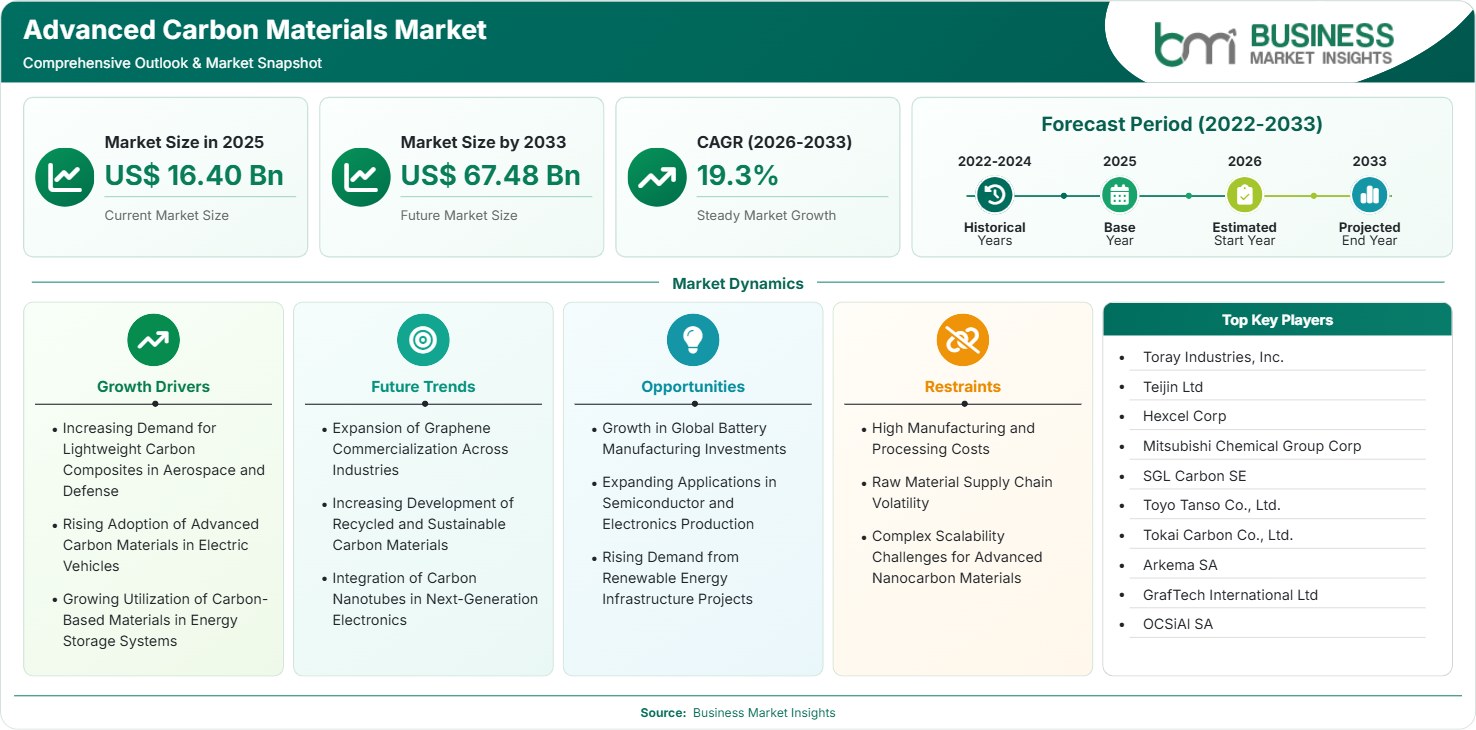
The Advanced Carbon Materials Market size was valued at US$ 16.40 billion in 2025 and is projected to reach US$ 67.48 billion by 2033, growing at a CAGR of 19.3% during 2026–2033. Growth is supported by rising aerospace lightweighting requirements, battery manufacturing expansion, semiconductor investments, renewable energy deployment, and increasing adoption of high-performance carbon materials across transportation, industrial, and electronics applications.

Report Coverage
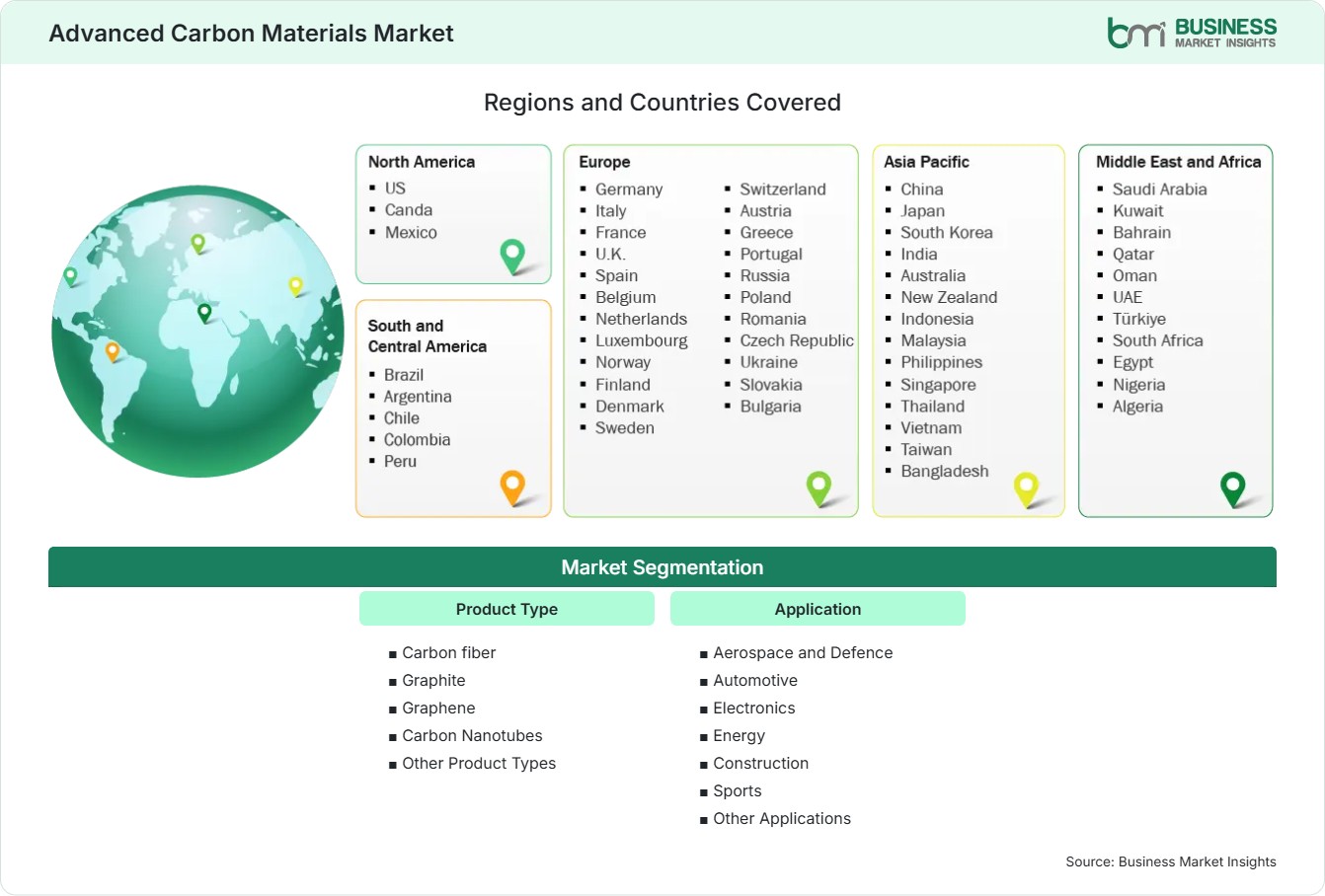
  • Product Type: Carbon fiber, Graphite, Graphene, Carbon Nanotubes (CNTs), Other Product Types
  • Application: Aerospace and Defence, Automotive, Electronics, Energy, Construction, Sports, Other Applications
US$ 16.40 Bn Market size in 2025
US$ 67.48 Bn Market Size by 2033
19.3% CAGR, 2026 - 2033
2026-2033 Forecast Period

AI Overview

Advanced Carbon Materials Market Summary

  • North America Region: North America holds a market share of 24.8% in 2025, growing with a CAGR of 22.2% during 2026–2033, supported by aerospace production, EV investments, defense modernization, battery manufacturing expansion, and advanced manufacturing incentives creating strong commercial opportunities across multiple industries. The U.S. benefits from aerospace manufacturing leadership, battery investments, and defense programs, supporting a CAGR of 21.9% through 2033.
  • Fastest Growing Region: North America is the fastest growing region and holds a market share of 24.8% in 2025, growing with a CAGR of 22.2% during 2026–2033, driven by expanding aerospace production, battery manufacturing investments, defense modernization programs, semiconductor capacity additions, and increasing adoption of advanced lightweight materials across transportation and energy sectors.
  • Leading Product Type: Carbon Fiber accounts for a 40.4% share in 2025 and is expected to expand at a 19.5% CAGR, supported by aircraft production, automotive lightweighting initiatives, renewable energy deployment, and growing demand for high-strength composite components.
  • High Growth Application: Electronics applications account for a 13.2% share in 2025 and are projected to grow at a 22.7% CAGR during 2026–2033, supported by semiconductor fabrication expansion, AI computing infrastructure, advanced thermal-management requirements, high-performance consumer electronics, and increasing adoption of graphene, graphite, and carbon nanotube-based materials.
  • Key Market Opportunity: Expanding battery anode materials, advanced conductive additives, hydrogen infrastructure components, and next-generation semiconductor manufacturing create substantial opportunities for suppliers developing high-purity, high-performance carbon-based materials and solutions.
  • Major Market Players: Toray Industries, Inc., Teijin Limited, Hexcel Corporation, Mitsubishi Chemical Group Corporation, SGL Carbon SE, Toyo Tanso Co., Ltd., Tokai Carbon Co., Ltd., Arkema S.A., GrafTech International Ltd., OCSiAl SA.
Strategic Insights

Advanced Carbon Materials Market: Strategic Insights

Advanced Carbon Materials Market Strategic Framework
FREE PDF
Request your free sample
Request free sample
Stakeholder View

Key Takeaways

  • There will be a more and more integrated value chain due to the desire of manufacturers to gain control over precursor materials, graphite raw material, processing techniques, and composite manufacturing.
  • The areas that have the most promise from a business perspective would be energy storage, battery anode materials, conductive additives, and hydrogen-based applications because of increasing electrification and decarbonization spending around the world.
  • Innovation is focused on recycled carbon fibers, cheaper graphene, high-purity synthetic graphite, and single-wall carbon nanotubes for energy and electronics applications.
  • China, India, South Korea, and manufacturing centers of Southeast Asia offer attractive investment prospects owing to the growth in battery production, semiconductor investments, and favorable industrial policies.
  • The rise in strategic alliances, technology licensing arrangements, and capacity-based acquisitions is expected, as firms gain better access to manufacturing technologies and material supply chains.
  • Sustainable practices are fast emerging as a crucial competitive edge, with customers preferring to work with providers of more sustainable manufacturing processes and materials.
Geographic Outlook

Advanced Carbon Materials Market Regional Highlights

North America Advanced Carbon Materials Market

North America represented 24.8% of global revenue in 2025 and is forecast to expand at a 22.2% CAGR through 2033. Regional demand is supported by aerospace manufacturing, defense modernization programs, electric vehicle investments, and battery supply chain localization initiatives. Strong R&D intensity, advanced manufacturing capabilities, and favorable industrial policies continue supporting adoption across transportation, electronics, and energy sectors. The region maintains strong positions in engineered composites, specialty graphite products, and high-value carbon material innovations. The Advanced Carbon Materials Market share remains among the highest globally.

  • Aerospace manufacturers continue increasing carbon composite utilization to improve fuel efficiency and operational performance while reducing lifecycle emissions and maintenance requirements.
  • Federal and state-level incentives encourage battery manufacturing investments, strengthening domestic consumption of graphite, nanotubes, and conductive carbon materials.
  • Defense modernization programs support demand for lightweight structural materials, thermal management solutions, and advanced electronic components across military platforms.
  • Semiconductor and data-center expansion increases requirements for specialty carbon products used in manufacturing equipment and thermal management applications.

US Advanced Carbon Materials Market

The United States accounts for 83.4% of regional revenue and is expected to expand at a 21.9% CAGR during 2026–2033. Strong aerospace production, growing battery manufacturing investments, and increasing renewable energy deployment support demand. Government-backed industrial development programs continue encouraging domestic production of strategic materials. Advanced research ecosystems and commercialization capabilities strengthen innovation across carbon fiber, graphite, graphene, and nanotube technologies while supporting long-term competitiveness in high-value industrial markets.

  • The development of large battery gigafactories keeps increasing the use of synthetic graphite, conductive carbon additives, and engineered carbons.
  • Manufacturers of aircraft and the defense industry keep focusing on the need for light parts, creating the consistent demand for composite solutions.
  • R&D facilities and private companies fast-track the commercialization of graphene and nanotube uses in the energy and electronics sectors.
  • Efforts to ensure domestic supply chain security foster investments into local manufacturing of advanced materials.

Europe Advanced Carbon Materials Market

Europe held 21.5% of Advanced Carbon Materials Market revenue in 2025 and is expected to grow at a 15.4% CAGR through 2033. Stringent emissions targets, automotive electrification programs, and renewable energy investments underpin demand. Germany remains the leading national market, while Eastern European manufacturing hubs exhibit higher growth rates. Regional producers increasingly focus on sustainable manufacturing technologies, recycled carbon fibers, and energy-efficient production methods. Strong industrial engineering expertise supports continued innovation and commercialization across multiple end-use sectors.

  • Germany leads regional demand due to automotive, industrial equipment, and advanced manufacturing strength, growing around 18.0%–19.0% annually.
  • Poland and Hungary emerge as high-growth locations supported by battery manufacturing investments and expanding industrial infrastructure.
  • Offshore wind deployments increase consumption of lightweight structural components and composite materials with enhanced performance characteristics.
  • Sustainability regulations encourage adoption of recycled content, lower-emission production technologies, and circular economy initiatives.

Asia Pacific Advanced Carbon Materials Market

Asia Pacific accounted for 46.4% of global revenue in 2025 and is projected to achieve the fastest expansion at a 20.3% CAGR through 2033. China remains the largest market, while India and Southeast Asia display accelerating demand growth. Extensive battery manufacturing ecosystems, electronics production leadership, industrial expansion, and infrastructure development support widespread adoption. The region continues benefiting from large-scale capacity additions, competitive production costs, and strong government support for advanced materials industries.

  • China dominates regional consumption through leadership in battery production, electric vehicles, and advanced manufacturing industries.
  • India represents one of the fastest-growing opportunities, supported by industrialization, renewable energy deployment, and manufacturing investment programs.
  • Semiconductor investments across South Korea, Taiwan, and Japan increase demand for high-purity specialty carbon products.
  • Expanding energy storage deployments support substantial consumption of graphite and advanced conductive materials.
  • The region contributes significantly to overall Advanced Carbon Materials Market growth through large-scale manufacturing expansion.

Rest of World Advanced Carbon Materials Market

The Rest of World accounts for 7.4% of the Advanced Carbon Materials Market share in 2025 and is expected to grow at an 11.1% CAGR during the forecast period. South and Central America recorded a 4.2% global share in 2025 and is forecast to grow at an 11.9% CAGR through 2033, while the Middle East and Africa recorded 3.1% and 10.3% CAGR, respectively. Expanding renewable energy investments, industrial diversification strategies, and infrastructure modernization support demand. South & Central America benefits from energy transition investments and growing industrial activity. The Middle East and Africa increasingly invest in advanced manufacturing, transportation, and energy infrastructure projects requiring high-performance material solutions.

  • Brazil leads regional demand through industrial manufacturing activities, renewable energy projects, and transportation infrastructure investments.
  • Saudi Arabia and the UAE continue diversifying industrial economies through advanced manufacturing and technology-focused development initiatives.
  • Hydrogen and renewable energy projects create opportunities for specialized carbon materials used in energy infrastructure applications.
  • Increasing industrial automation and modernization efforts support adoption of advanced engineered materials across multiple sectors.
Global Market Geography
FREE PDF
Request your free sample
Request free sample
Segment Analysis

Advanced Carbon Materials Market Segmentation

Product Type

Carbon Fiber dominated the segment with an estimated share of 40.4% in 2025 and is anticipated to register a CAGR of 19.5% during 2026–2033. High strength-to-weight characteristics, fatigue resistance, corrosion resistance, and design flexibility continue driving demand across advanced manufacturing applications. The Advanced Carbon Materials Market scope is expanding further as technological advancements improve production efficiency and application diversity.

  • Carbon Fiber: Carbon fiber remains the dominant material category, supported by extensive use in aerospace structures, wind energy components, pressure vessels, automotive lightweighting programs, and high-performance industrial composite applications.
  • Graphite: Graphite benefits from expanding lithium-ion battery production, semiconductor manufacturing requirements, metallurgy processes, and thermal management applications requiring superior conductivity, heat resistance, and chemical stability characteristics.
  • Graphene: Graphene adoption continues increasing across advanced electronics, coatings, sensors, energy storage devices, and conductive materials where exceptional electrical, thermal, and mechanical properties create differentiation.
  • Carbon Nanotubes (CNTs): Carbon nanotubes gain traction in batteries, conductive polymers, advanced composites, electronics, and next-generation materials requiring enhanced conductivity, strength, durability, and lightweight characteristics.

Application

Aerospace and Defense dominated the segment with an estimated share of 34.3% in 2025 and is forecast to expand at a CAGR of 18.2% during 2026–2033. Rising commercial aircraft production, defense modernization programs, space exploration activities, and growing demand for lightweight structural components continue supporting segment leadership. The Advanced Carbon Materials Market trends increasingly reflect the strategic importance of advanced composites in next-generation transportation and defense systems.

  • Aerospace and Defense: Aerospace and defense organizations utilize advanced materials to reduce structural weight, improve fuel efficiency, enhance durability, and support next-generation military and commercial platform development.
  • Automotive: Automotive manufacturers increasingly deploy lightweight composite and conductive carbon solutions to improve vehicle efficiency, extend electric vehicle range, and meet emissions-reduction objectives.
  • Electronics: Electronics applications benefit from superior thermal management, electrical conductivity, miniaturization capabilities, and performance improvements required for advanced semiconductor and device manufacturing.
  • Energy: Energy-related deployments expand through battery production, grid-scale storage systems, hydrogen technologies, fuel cells, and renewable energy infrastructure supporting long-term decarbonization objectives.
  • Construction: Construction applications leverage enhanced strength-to-weight ratios, durability advantages, corrosion resistance, and structural performance benefits in specialized infrastructure and engineering projects.
  • Sports: Sports equipment manufacturers adopt advanced carbon materials to improve strength, reduce weight, enhance performance, and increase durability across premium recreational products.
Market Forces

Advanced Carbon Materials Market Dynamics

Key Market Drivers

Expansion of Global Battery Manufacturing Capacity

Global battery manufacturing investments continue accelerating as electric vehicle adoption expands worldwide. According to reports from the International Energy Agency, the growth in demand for batteries continues to be significantly dependent on the rise in the penetration rate of electric vehicles and energy storage facilities. Synthetic graphite, conductive additives, and nanotubes form important components of batteries, thereby maintaining high levels of demand. The growth in the construction of battery gigafactories across Asia, North America, and Europe supports long-term material consumption and strengthens Advanced Carbon Materials Market growth. This results in procurement commitments that encourage capacity expansion, processing technology improvements, and vertical integration strategies across the value chain.

Increasing Demand for Lightweight Transportation Solutions

Commercial aviation, defense modernization, and automotive electrification continue prioritizing lightweight materials capable of enhancing efficiency without compromising structural performance. The carbon fiber composite material reduces the weight of structures significantly while ensuring good mechanical properties. The aircraft industries have started making use of advanced composite materials in their primary and secondary structures. In the automobile industry, the electric vehicles have started using such lightweight material to make batteries more efficient and to increase driving range. The Advanced Carbon Materials Market trends are driven enabling innovation in the material, production, and commercialization.

Technology Advancements in Electronics and Semiconductor Manufacturing

Semiconductor fabrication, data-center infrastructure, advanced computing systems, and high-performance electronics increasingly require materials capable of managing heat and improving conductivity. Products such as specialty graphite, graphene, and nanotubes solve problems of thermal management and electrical performance. Increased investments in semiconductor fabrication plants in Asia Pacific, North America, and Europe are generating more consumption opportunities. Miniaturization tendencies within the field of electronics increase the need for superior materials. Innovation within digital infrastructure, artificial intelligence devices, and computer platforms increases visibility of the demand.

Key Market Opportunities

Commercialization of Single-Wall Carbon Nanotube Technologies

Single-wall carbon nanotubes represent one of the most promising opportunities due to superior conductivity, lightweight characteristics, and multifunctional performance benefits. These are increasingly being used in applications ranging from batteries to conductive coatings, composite materials, and flexible electronics. There is also an ongoing effort on the part of producers to invest in mass-production processes that can bring down costs. Suppliers of these materials that possess proprietary technology and manufacturing platforms will have an advantage in the future. The industry offers good investment opportunities in terms of transportation, energy storage, electronics, and industry.

Growth of Hydrogen Economy Infrastructure

Global hydrogen investments are creating demand for specialty carbon materials utilized in fuel cells, storage systems, electrolyzers, and supporting infrastructure. Governments in Europe, Asia, and the Middle East are continuously investing significant funds in the development of hydrogen projects. Carbon materials possess properties like conductivity, durability, and light weight that are necessary for hydrogen technologies. As these pilot projects scale toward commercialization, material providers have an ever-growing market to tap into. This is different from the current battery market and represents yet another stream of income. Early adoption in the hydrogen value chain will give competitive advantage.

Emerging Market Industrialization and Localization Strategies

Industrial expansion in India, Southeast Asia, the Middle East, and Latin America is strengthening demand for advanced manufacturing inputs. The trend towards strategic material self-sufficiency is gaining importance in the government sector and is driving investments in domestic capability building and localization of supply chains. Such efforts help build regional ecosystems for sectors like transportation, electronics, renewable energy, and industries. Suppliers who have the ability to create local connections and production base can definitely take advantage of improved access and proximity to customers. There are plenty of opportunities to grow capacity and implement customer strategies due to the increasing demand for technological material in developing countries. Advanced Carbon Materials Market Forecasts indicate particularly strong potential in these emerging manufacturing hubs.

Market Restraints and Challenges

High Production Costs and Capital Requirements

Factor: Manufacturing advanced graphite, carbon fiber, graphene, and nanotube products requires sophisticated processing technologies, specialized equipment, energy-intensive operations, and significant research investment.

Impact: Increased capital needs create high barriers to entry, slowing capacity building when there are uncertainties in demand. The cost issue could also be a limitation among price-conscious consumers even though the technology performs better. Companies have to work on efficiencies constantly in order to remain competitive and meet the changing quality demands. This is even more critical for developing technologies that are reliant on cost factors for their commercial viability.

Raw Material Availability and Supply Chain Concentration

Factor: Supply chains for precursor materials, specialty feedstocks, and advanced processing inputs remain concentrated within specific geographic regions.

Impact: Disturbances that may arise due to trade barriers, geopolitical uncertainties, logistical challenges, or resource limitations can have implications on price and production. Manufacturers are becoming more and more conscious about adopting diversified sources of supplies to avoid such risks. However, setting up an alternate channel of supplies can involve considerable investments. Dependence on a restricted set of suppliers can impact the efficiency of operations as well as the consumer trust.

Company Analysis

Competitive Landscape

The competitive environment remains characterized by material innovation, capacity expansion, strategic partnerships, and vertical integration initiatives. Advanced Carbon Materials Market analysis indicates that leading participants are focusing on battery materials, aerospace composites, specialty graphite solutions, graphene commercialization, and nanotube technologies to strengthen their market positions.

Company Name

Overview

Products and Services Relevant to this Market

Toray Industries, Inc.

Global leader in advanced materials with strong expertise in carbon fiber manufacturing and high-performance composite technologies serving aerospace, automotive, and industrial sectors.

Carbon fiber, thermoplastic composites, prepregs, composite materials, advanced industrial materials, and engineered solutions for transportation and energy applications.

Teijin Limited

Major advanced materials producer with diversified operations across composites, fibers, healthcare, and high-performance industrial solutions.

Carbon fibers, composite materials, aramid fibers, thermoplastic composites, aerospace-grade materials, and mobility-focused lightweighting solutions.

Hexcel Corporation

Specialized composites manufacturer serving commercial aerospace, defense, space, and industrial markets through advanced engineering capabilities.

Carbon fiber, prepregs, honeycomb structures, engineered composites, aerospace materials, and lightweight structural solutions.

Mitsubishi Chemical Group Corporation

Diversified chemical and advanced materials company with significant investments in carbon fiber and performance materials technologies.

Carbon fiber composites, specialty materials, advanced polymers, battery-related materials, and industrial carbon-based solutions.

SGL Carbon SE

Leading supplier of carbon-based products focused on industrial applications, mobility solutions, and semiconductor markets.

Specialty graphite, carbon fibers, composite materials, graphite components, and industrial carbon solutions.

Toyo Tanso Co., Ltd.

Specialist manufacturer recognized for high-purity graphite products supporting semiconductor and industrial applications worldwide.

Isostatic graphite, semiconductor graphite components, carbon products, specialty graphite materials, and engineered solutions.

Tokai Carbon Co., Ltd.

Global carbon materials supplier with extensive product portfolio serving industrial, energy, and manufacturing sectors.

Graphite electrodes, fine carbon products, specialty carbon materials, battery-related materials, and industrial carbon solutions.

Arkema S.A.

Specialty materials producer expanding advanced composite capabilities through innovative materials and technology development.

Composite materials, advanced polymers, specialty additives, lightweighting solutions, and industrial performance materials.

GrafTech International Ltd.

Significant manufacturer of graphite products and engineered carbon solutions serving industrial and energy-intensive applications.

Graphite electrodes, petroleum needle coke products, engineered graphite materials, and specialty carbon solutions.

OCSiAl SA

Technology-focused company specializing in large-scale production and commercialization of single-wall carbon nanotubes.

Single-wall carbon nanotubes, conductive additives, nanomaterial solutions, battery materials, and advanced performance enhancers.

Trust & Transparency

Research Methodology

The market analysis combines proprietary research with secondary data from government agencies, company disclosures, regulatory filings, industry databases and expert interviews. Market estimates are validated through data triangulation, cross-market benchmarking and analyst review.

View Full Research Methodology

Questions Answered

Frequently Asked Questions

What does the Advanced Carbon Materials Market Report emphasize for investors?

The Market Report highlights battery materials, hydrogen technologies, aerospace composites, semiconductor applications, and nanotube commercialization as major investment themes, alongside opportunities created by supply-chain localization and sustainability-driven innovation.

Which region is expected to witness the fastest expansion during the forecast period?

Asia Pacific is projected to achieve the highest growth rate due to large-scale battery manufacturing investments, semiconductor capacity expansion, industrial development initiatives, growing electric vehicle production, and strong government support for advanced manufacturing technologies.

How do carbon nanotubes contribute to next-generation technologies?

Carbon nanotubes improve electrical conductivity, mechanical strength, and material efficiency. Their adoption is increasing in batteries, conductive coatings, electronics, composite materials, sensors, and advanced manufacturing applications requiring enhanced performance.

Why is carbon fiber the leading product category?

Carbon fiber delivers a unique combination of strength, lightweight performance, corrosion resistance, and durability. These characteristics make it highly suitable for aircraft structures, defense systems, automotive components, wind energy equipment, and advanced industrial applications.

What are the primary end-use industries driving demand for the Advanced Carbon Materials Market?

Aerospace and defense, automotive, electronics, energy storage, semiconductor manufacturing, renewable energy, and industrial engineering applications represent the principal demand centers. These sectors prioritize lightweighting, conductivity, durability, thermal management, and high-performance functionality.

Access the Full Advanced Carbon Materials Market Report

Get segment-level forecasts, regional estimates, competitive benchmarking, company profiles and downloadable Excel datasets.

Access the full Advanced Carbon Materials Market Report
350 pages PDF & Excel | 2026-11-20
Similar Research

Related Market Reports