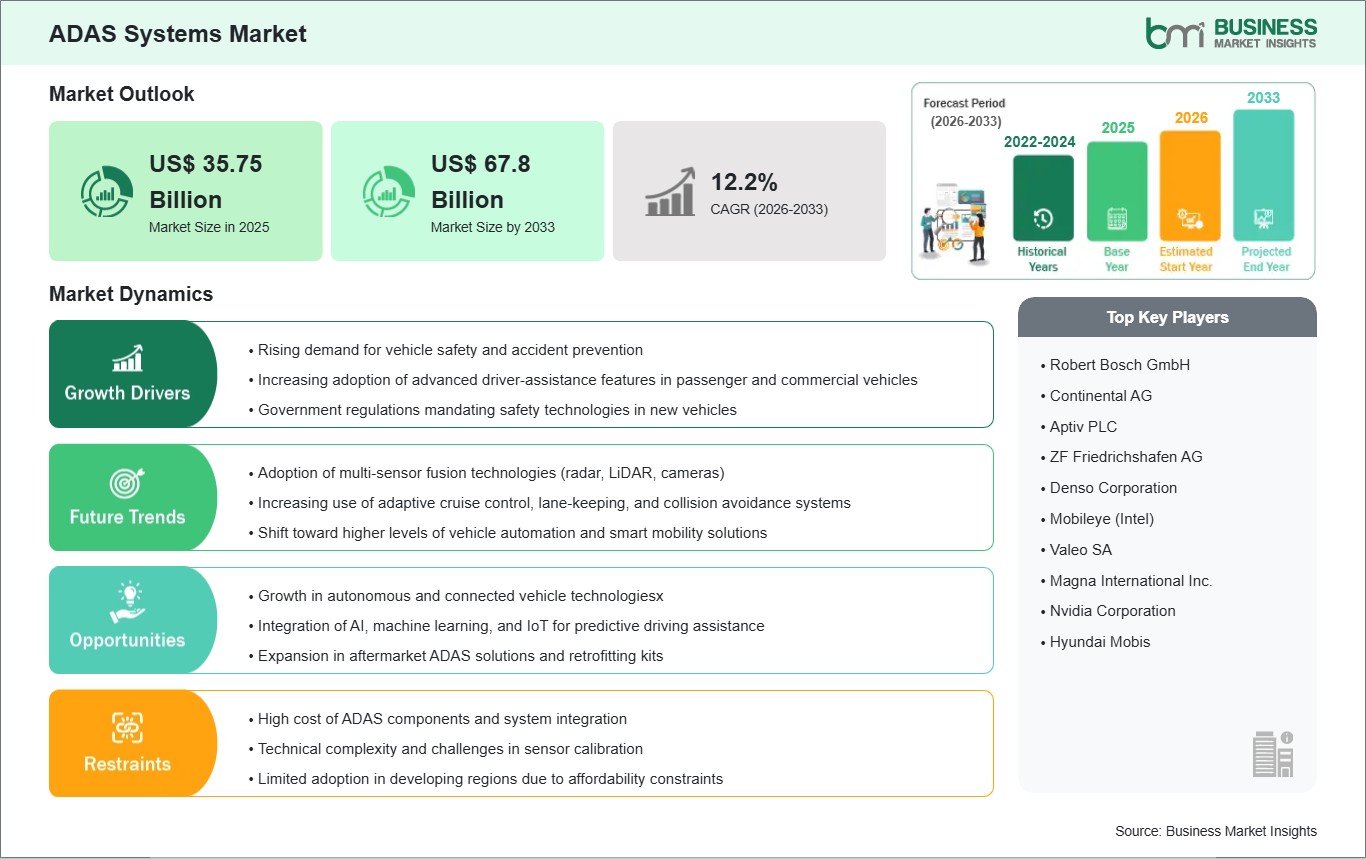
The ADAS Systems market size is expected to reach US$ 67.80 billion by 2033 from US$ 35.75 billion in 2025. The market is estimated to record a CAGR of 12.2% from 2026 to 2033.
ADAS is the short form for Advanced Driver Assistance Systems and it is a collection of electronic systems in a vehicle that are meant to help the driver during the driving process, safety the driver, and lower the chances of a traffic accident. To deliver these functions, the systems incorporate technologies such as sensors, cameras, radar, and AI to keep a check on the environment around the vehicle, give instant alerts, and, if it is the case, perform the necessary actions like slowing down the car, helping in making the vehicle stay in the right lane, or driving at the same speed as the vehicle in front.The ADAS Market (Advanced Driver Assistance Systems) is experiencing explosive growth. There are several factors that are driving this market, including increased safety regulation requirements, the continued growth in consumer interest in better vehicle safety, and the ongoing growth of electric and autonomous vehicles. Additionally, the rapid advancement of technology in areas such as artificial intelligence (AI), sensors, and connectivity provides an avenue for innovation in new ADAS solutions, including lane-keeping assist, adaptive cruise control, and collision avoidance systems, among others. As a consequence, these factors set the ADAS Market up for continued strong growth as both automotive manufacturers and technology companies invest heavily in developing more intelligent, safer, and better-connected vehicles.

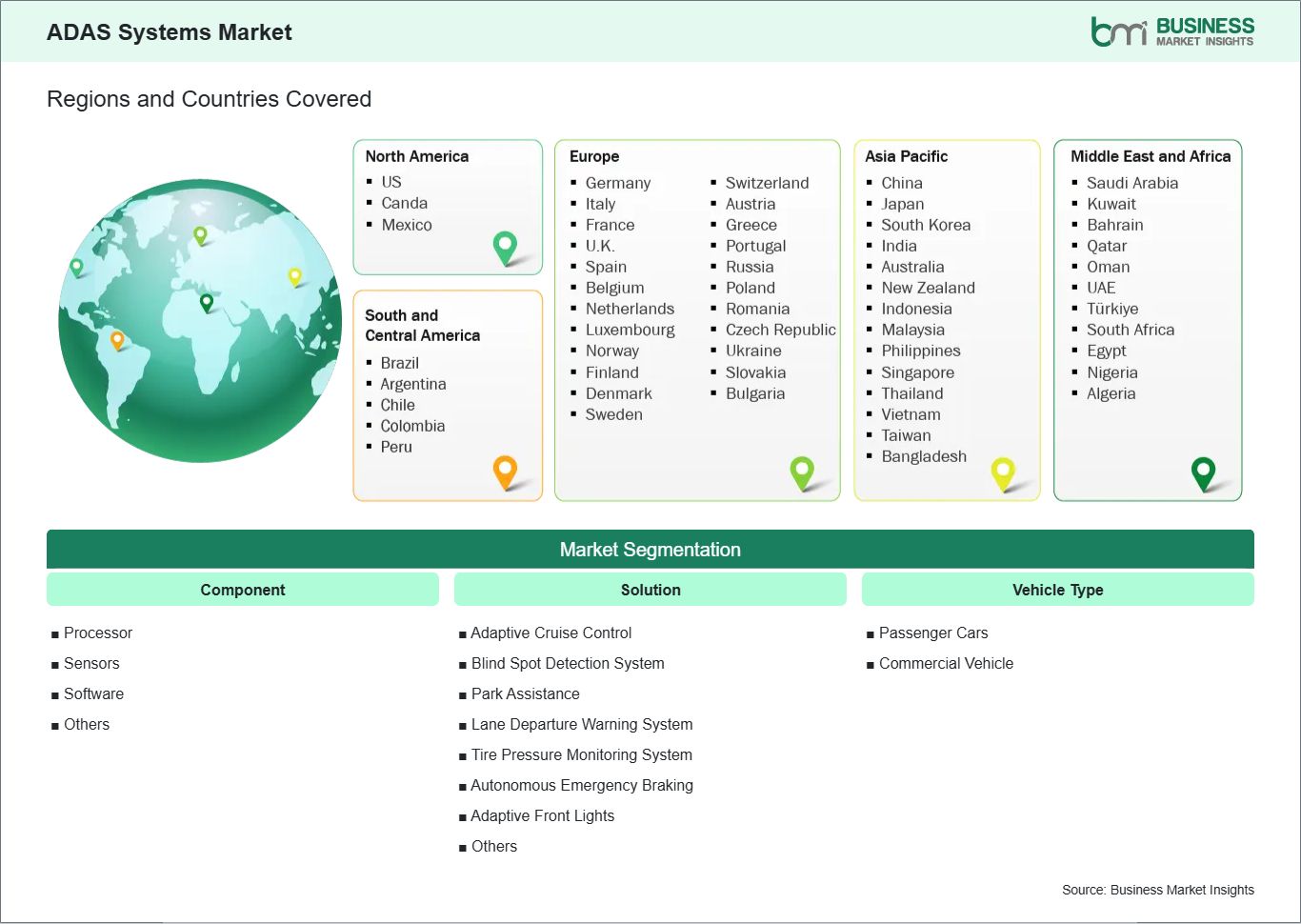
Key segments that contributed to the derivation of the ADAS Systems market analysis are component , solution, and vehicle type.
One of the key drivers supporting the growth of the ADAS Systems market is the increasing global emphasis on vehicle safety and stricter regulatory standards. Governments and safety organizations across major automotive markets are mandating the integration of advanced safety features such as automatic emergency braking, lane departure warning, adaptive cruise control, and blind-spot detection to reduce road accidents and fatalities. As road safety becomes a priority, automakers are accelerating the adoption of ADAS technologies to comply with regulations while meeting consumer expectations for safer vehicles.
ADAS systems play a crucial role in enhancing driver awareness and reducing human error, which remains one of the leading causes of road accidents. By using sensors, cameras, radar, and lidar technologies, these systems continuously monitor the vehicle’s surroundings and assist drivers in real time. Features such as collision avoidance, pedestrian detection, and driver monitoring not only improve safety but also boost consumer confidence in modern vehicles. As a result, ADAS is increasingly becoming a standard offering rather than a premium feature, especially in passenger cars.
Rapid advancements in sensor technologies, artificial intelligence, and vehicle connectivity are significantly contributing to the expansion of the ADAS Systems market. Modern ADAS solutions leverage high-resolution cameras, radar, ultrasonic sensors, and increasingly lidar systems to provide accurate and reliable environmental perception. These hardware advancements, combined with AI-driven algorithms, enable vehicles to process vast amounts of data in real time, improving decision-making accuracy and system responsiveness.
In addition, the integration of AI and machine learning allows ADAS systems to continuously learn from driving patterns and real-world scenarios, enhancing performance over time. Connectivity technologies such as vehicle-to-vehicle (V2V) and vehicle-to-infrastructure (V2I) communication further strengthen ADAS capabilities by enabling vehicles to receive external data related to traffic conditions, hazards, and road infrastructure. Together, these innovations support smoother driving experiences, enable semi-autonomous functions, and lay the foundation for fully autonomous vehicles, positioning ADAS systems as a critical component of the future automotive ecosystem.
By component, the ADAS Systems market is segmented into processors, sensors, software, and others. The processors segment dominated the market in 2024, as ADAS functionalities rely heavily on high-performance computing to process large volumes of data generated by cameras, radar, lidar, and ultrasonic sensors in real time. Advanced processors enable faster decision-making, improved system accuracy, and seamless integration of multiple safety features such as collision avoidance, lane keeping, and adaptive cruise control. Continuous innovation in automotive-grade semiconductors, including AI-enabled and energy-efficient chipsets, further strengthened the dominance of this segment.
By solution, the market is divided into Adaptive Cruise Control (ACC), Blind Spot Detection System (BSD), Park Assistance, Lane Departure Warning System (LDWS), Tire Pressure Monitoring System (TPMS), Autonomous Emergency Braking (AEB), Adaptive Front Lights (AFL), and others. Adaptive Cruise Control (ACC) held the largest market share in 2024 due to its widespread adoption across mid-range and premium vehicles. ACC enhances driving comfort and safety by automatically maintaining a safe distance from the vehicle ahead, reducing driver fatigue and the risk of rear-end collisions. Growing consumer preference for convenience features, along with regulatory support for advanced safety systems, has accelerated the integration of ACC, while other solutions such as AEB and LDWS are also witnessing strong growth as they become standard safety offerings.
By vehicle type, the ADAS Systems market is bifurcated into passenger cars and commercial vehicles. Passenger cars dominated the market in 2024, driven by rising consumer awareness of vehicle safety, increasing disposable incomes, and stricter safety regulations across major automotive markets. Automakers are increasingly offering ADAS features as standard or optional equipment in passenger vehicles to enhance brand differentiation and meet regulatory requirements. Although commercial vehicles currently hold a smaller share, adoption is steadily increasing as fleet operators recognize the benefits of ADAS in reducing accidents, lowering insurance costs, and improving overall fleet efficiency.
| Report Attribute | Details |
|---|---|
| Market size in 2025 | US$ 35.75 Billion |
| Market Size by 2033 | US$ 67.8 Billion |
| Global CAGR (2026 - 2033) | 12.2% |
| Historical Data | 2022-2024 |
| Forecast period | 2026-2033 |
| Segments Covered | By Component
|
| Regions and Countries Covered | North America
|
| Market leaders and key company profiles |
|
The ADAS Systems Market Size and Forecast (2022–2033) report provides a detailed analysis of the market covering below areas:
The geographical scope of the ADAS Systems market report is segmented into five major regions: North America, Asia Pacific, Europe, Middle East & Africa, and South & Central America. Among these regions, Asia Pacific is expected to witness significant growth during the forecast period, driven by strong automotive production volumes and the rapid adoption of advanced vehicle safety technologies.
The ADAS Systems market in the Asia-Pacific region is segmented into China, Japan, South Korea, India, Australia, New Zealand, Indonesia, Malaysia, the Philippines, Singapore, Thailand, Vietnam, Taiwan, Bangladesh, and the Rest of Asia. The region’s growth is supported by expanding automotive manufacturing bases, rising vehicle ownership, and increasing regulatory emphasis on road safety. Major economies such as China, Japan, South Korea, and India are leading the adoption of ADAS solutions by integrating advanced technologies including artificial intelligence, sensors, radar, cameras, and connectivity systems to enhance vehicle safety, driving assistance, and compliance with global safety standards.
In addition, strong demand from passenger cars and commercial vehicles is accelerating the deployment of ADAS Systems across the region. Investments in smart automotive manufacturing facilities, semiconductor production, and software development platforms are further strengthening the market outlook. Government-led road safety initiatives, along with collaborations between automakers, technology providers, and suppliers, are fostering innovation and supporting the development of a robust ADAS ecosystem in Asia Pacific, positioning the region as a key growth hub for the global ADAS Systems market.

The ADAS Systems market is evaluated by gathering qualitative and quantitative data post primary and secondary research, which includes important corporate publications, association data, and databases. A few of the key developments in the ADAS Systems market are:
The ADAS Systems Market is valued at US$ 35.75 Billion in 2025, it is projected to reach US$ 67.8 Billion by 2033.
As per our report ADAS Systems Market, the market size is valued at US$ 35.75 Billion in 2025, projecting it to reach US$ 67.8 Billion by 2033. This translates to a CAGR of approximately 12.2% during the forecast period.
The ADAS Systems Market report typically cover these key segments-
The historic period, base year, and forecast period can vary slightly depending on the specific market research report. However, for the ADAS Systems Market report:
The ADAS Systems Market is populated by several key players, each contributing to its growth and innovation. Some of the major players include:
The ADAS Systems Market report is valuable for diverse stakeholders, including:
Essentially, anyone involved in or considering involvement in the ADAS Systems Market value chain can benefit from the information contained in a comprehensive market report.
Please tell us your area of interest
(Market Segments/ Regions and Countries/ Companies)