Market Summary
Executive Summary and Global Market Analysis
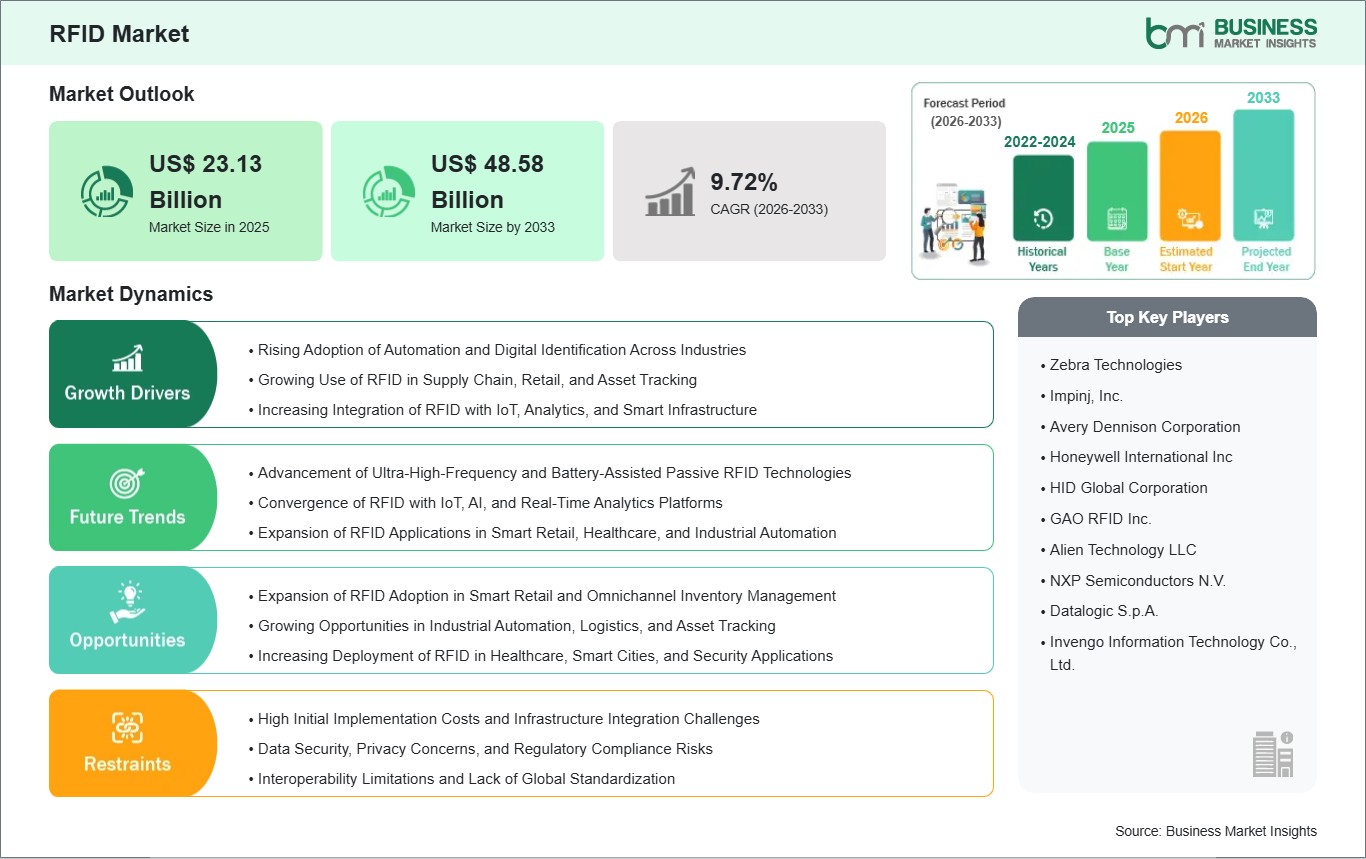
Radio Frequency Identification (RFID) technology plays a critical role in the automated identification and tracking of assets globally, offering high-speed data capture without the need for a direct line of sight. It is essential for industries such as retail, logistics, healthcare, automotive, and manufacturing. RFID has several advantages, including real-time inventory visibility, reduced human error in data entry, and enhanced security for high-value assets. Increasing demand for supply chain transparency, the rise of omnichannel retail, and the growing adoption of IoT-enabled devices are fueling the market. Additionally, innovations in printed electronics, miniaturized tags, and cloud-integrated middleware are enhancing system efficiency and affordability.
However, several challenges can restrain market growth, such as high initial implementation costs, technical complexities related to metal and liquid interference, and data privacy concerns. The industry is also sensitive to standardization issues across different frequency bands and global regions. Despite these hurdles, the market holds significant opportunities driven by the rising demand for smart labels in e-commerce, expansion of Industry 4.0 in developing economies, and increased adoption of RFID in the pharmaceutical sector for drug traceability. Investment in sustainable, plastic-free RFID tags and eco-friendly manufacturing processes is also expected to open new avenues for market expansion.
Segment Analysis
RFID Market Segmentation
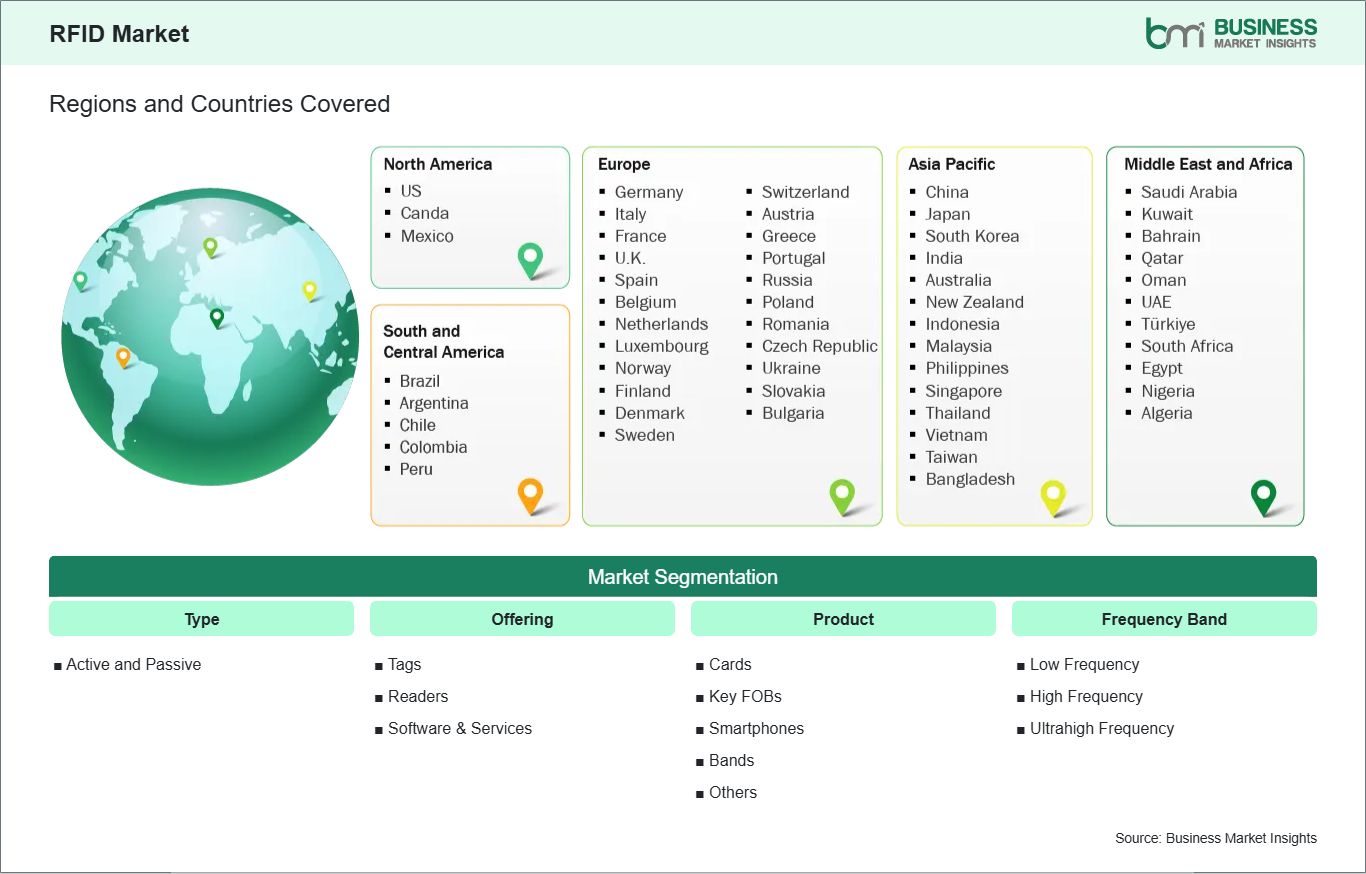
Key segments that contributed to the derivation of the RFID market analysis are type, offering, product, frequency band, and application.
- By Type, the market is segmented into Active and Passive.
- By Offering, the market is divided into Tags, Readers, and Software & Services.
- By Product, the market is categorized into Cards, Key FOBs, Smartphones, Bands, and Others.
- By Frequency Band, the market is segmented into Low Frequency, High Frequency, and Ultrahigh Frequency.
- By Application, the market is divided into Parcel & Mailboxes, Lockers, Ticketing, and Others.
Market Forces
RFID Market Drivers and Opportunities
Supply Chain Management
The automation of supply chains is one of the major motivators fueling the growth of RFID technology, with its demand for real-time tracking and optimization across several supply chains operating worldwide. With the increase in e-commerce and just-in-time inventory management, RFID technology ensures accurate and automated capture, with minimal room for error and faster processing. For example, UHF RFID allows for long-distance tracking at a pallet level in warehouses handling high quantities. Companies in sectors such as retail and logistics apply this technology to gain above 99% inventory accuracy, thus lowering both stockout and overstocking.
IoT and AI Integration
Integration with IoT and AI offers a massive opportunity for growth in the RFID industry. With the advent of Industry 4.0, RFID sensors provide constant input to AI systems for predictive analytics and inventory management. For logistics, this maximizes route optimization and saves 20–30% of cost, while for the medical industry, it maintains the cold chain requirement for vaccinations. With the cost of RFID tags going below $0.10, the scale has finally shifted to mass implementation, and edge computing has resolved latency concerns. The government supports this with smart cities, which foresees double growth by 2030.
Size and Share Analysis
RFID Market Size and Share Analysis
The RFID market demonstrates steady growth, with size and share analysis revealing evolving trends and competitive positioning among key players. The report further examines subsegments categorized within type, offering, product, frequency band, and application, offering insights into their contribution to overall market performance.
For instance, the Passive RFID subsegment holds a significant market share, due to cost-effectiveness and high volume of use in retail. Ultrahigh Frequency (UHF) systems are typically used for logistics and supply chain management due to their long read range and ability to read multiple tags simultaneously. Smart cards and ticketing applications utilize High Frequency (HF) RFID for secure, contactless interactions in transportation and access control, where reliability and security are paramount.
Report Coverage
RFID Market Report Coverage and Deliverables
The "RFID Market Size and Forecast (2022–2033)" report provides a detailed analysis of the market covering below areas:
- RFID market size and forecast at global, regional, and country levels for all the key market segments covered under the scope.
- RFID market trends, as well as market dynamics such as drivers, restraints, and key opportunities.
- RFID market analysis covering key market trends, global and regional framework, major players, regulations, and recent market developments.
- Industry landscape and competition analysis covering market concentration, heat map analysis, prominent players, and recent developments for the RFID market.
- Detailed company profiles, including SWOT analysis.
Geographic Insights
RFID Market Geographic Insights
The geographical scope of the RFID market report is divided into five regions: North America, Asia Pacific, Europe, Middle East & Africa, and South & Central America.
Asia Pacific is experiencing robust growth, driven by the rapid expansion of manufacturing hubs in China and India, and the rising demand for automated logistics. The region is witnessing increased adoption of advanced technologies, including AI-based inventory analytics and smart manufacturing. The surge in e-commerce penetration and the development of smart city infrastructure further solidifies the region’s position as the fastest-growing market.
Industry Activity
Recent Developments
The RFID market is evaluated by gathering qualitative and quantitative data post primary and secondary research, which includes important corporate publications, association data, and databases. A few of the key developments in the RFID market are:
- In October 2025, Walmart and Avery Dennison announced a breakthrough to advance the use of radio-frequency identification (RFID) technology in fresh food categories. The solution specifically addresses bakery, meat, and deli departments, areas where RFID adoption was previously difficult due to technical limitations in high-moisture and cold environments. By providing each item with a unique digital identity and real-time freshness data, the technology helps associates manage inventory more accurately, rotate products efficiently, and make better markdown decisions to reduce food waste.
- In November 2025, Impinj, Inc., a leading RAIN RFID provider and Internet of Things pioneer, unveiled new Gen2X innovations at its Gen2X Solutions Developers Conference 2025, the company’s exclusive event for IoT solution developers and partners. The key innovations inhibit fraudulent items and tags, reduce stray tag reads, and help readers find and focus on tags of interest in retail and industrial environments.
- In July 2025, Zebra Ventures, the corporate venture capital investment arm of Zebra Technologies, announced a strategic investment in Xemelgo, a leader in cloud-based RFID software solutions. Xemelgo leverages AI, cloud, and RFID technologies to create seamless, automated manufacturing environments, bringing unprecedented real-time visibility and control to factory operations. Its platform enables manufacturers, retailers, and other industrial sectors to effortlessly track inventory, work orders, and assets, minimizing delays and errors while maximizing efficiency and traceability.
Trust & Transparency
Research Methodology
The market analysis combines proprietary research with secondary data from government agencies, company disclosures, regulatory filings, industry databases and expert interviews. Market estimates are validated through data triangulation, cross-market benchmarking and analyst
review.
View Full Research Methodology
Key Sources Referred:
World Bank – Global Trade IndicatorsWorld Trade Organization (WTO)International Monetary Fund (IMF)International Trade Administration (ITA)Company WebsitesCompany Annual ReportsCompany Investor Presentations