Market Summary
Executive Summary and Global Market Analysis
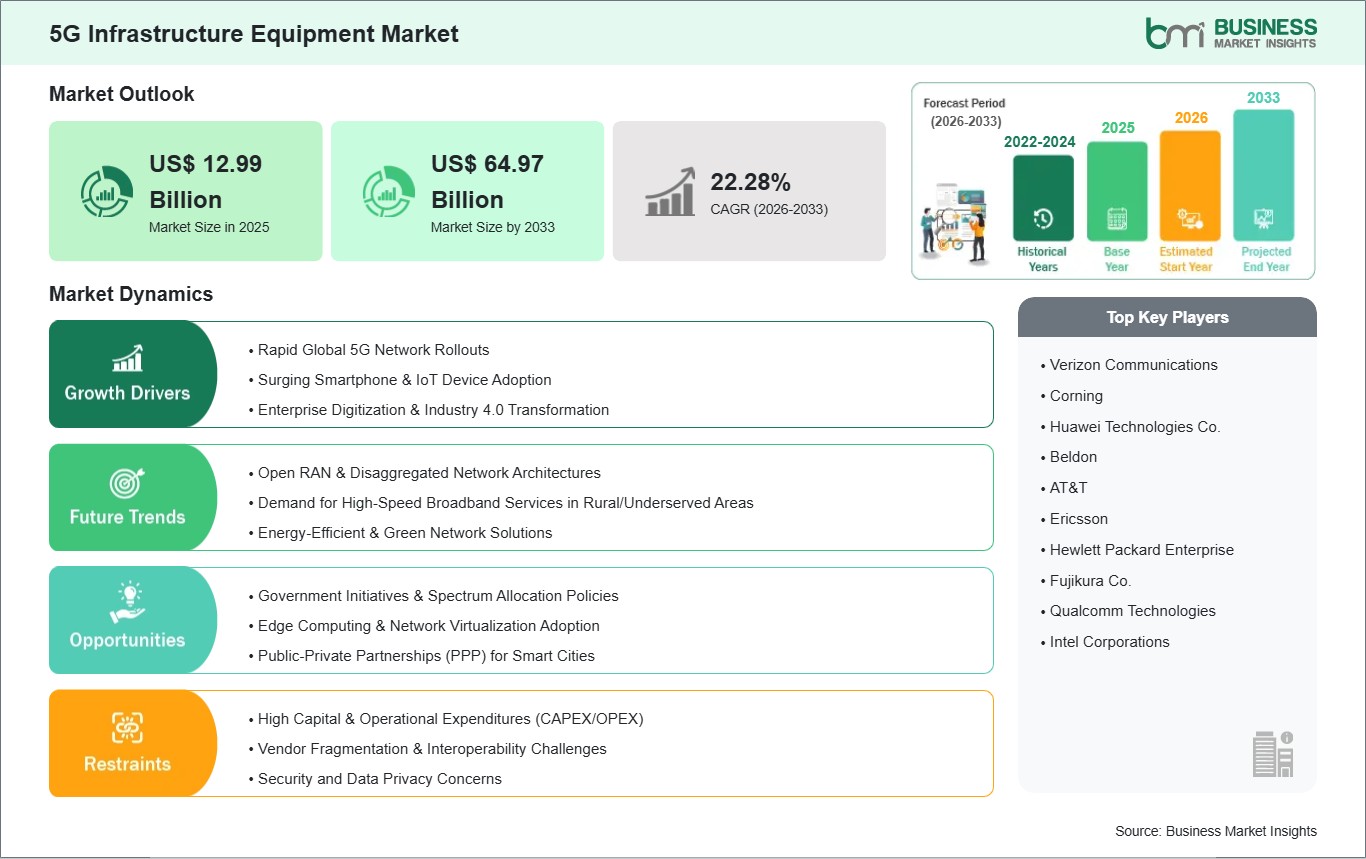
The worldwide 5G infrastructure equipment market for 5G is largely influenced by the increasing need for fast and low-latency connectivity that is required by mobile broadband, enterprise networks, smart cities, and industrial applications. The exponential growth in data usage, the large number of IoT devices, and the rapid adoption of the cloud, edge computing, and AI, enable services are some of the major factors that are contributing to the increase in investments in 5G radio access networks (RAN), core networks, and small cells.
The ongoing digital transformation of various sectors such as manufacturing, healthcare, transportation, and utilities is, therefore, necessitating the provision of a reliable and scalable 5G infrastructure. Besides, the introduction of new technologies like network virtualization, Massive MIMO, and millimeter wave spectrum is helping to increase the performance and capacity of the network.
Though the market has a bright future, it is still confronted with some challenges, such as high costs of deployment and spectrum acquisition, difficulties in network integration, security issues, and uncertain monetization timelines for telecom operators. Moreover, differences in regulations, dependencies in the supply chain, and a shortage of skilled personnel may also cause delays in the rollout of new networks. However, the increasing government support for 5G deployment, the rising enterprise adoption of private 5G networks, the growth of the developing markets, and the innovations in Open RAN, energy, efficient networks, and edge-enabled architectures are some of the factors that will contribute to a steady global market growth during the forecast period.
Segment Analysis
5G Infrastructure Equipment Market Segmentation
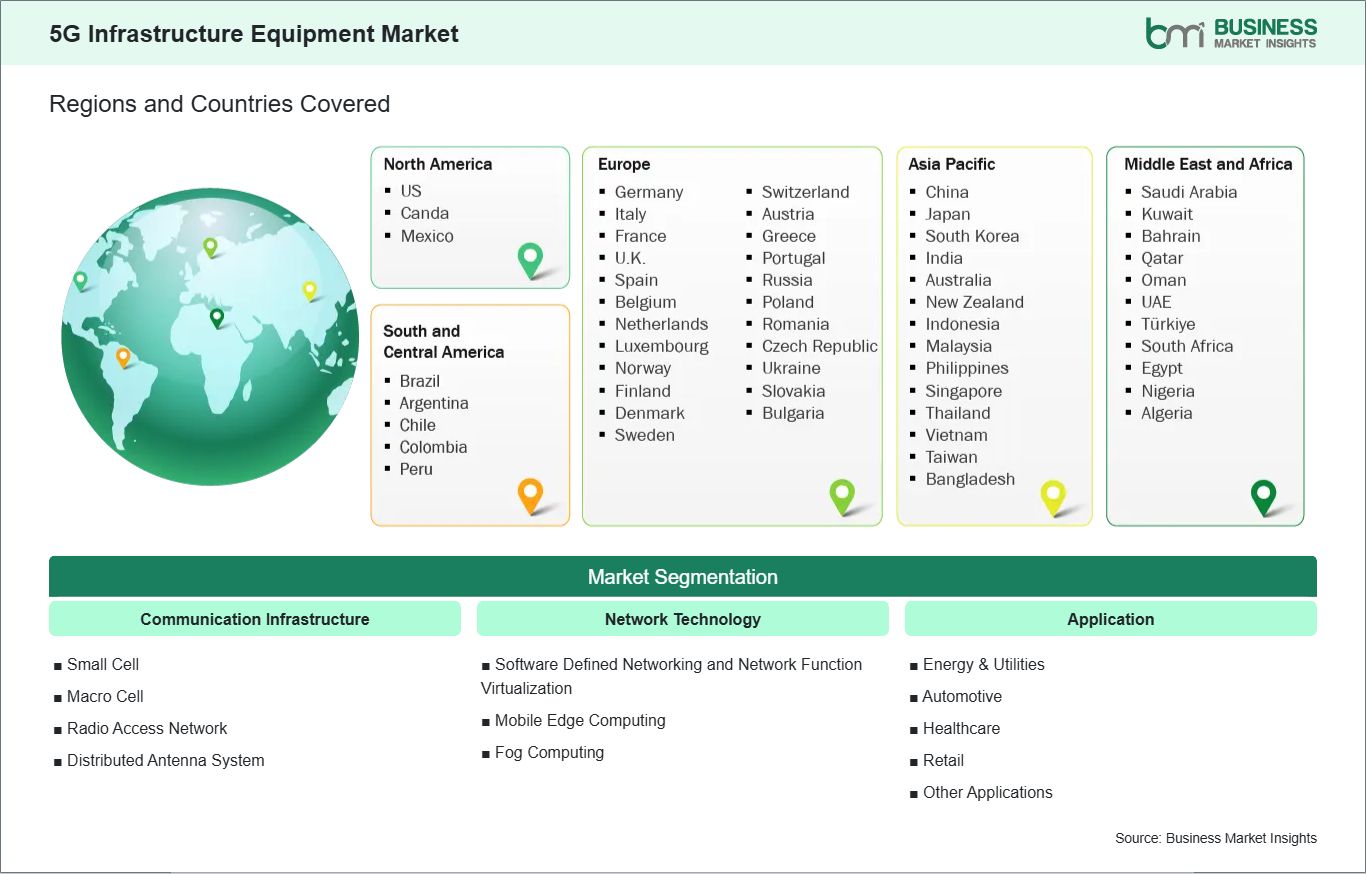
Key segments that contributed to the derivation of the 5G infrastructure equipment market analysis are communication infrastructure, network technology, and application.
- By communication infrastructure, the market is segmented into small cells, macro cells, radio access network (RAN), and distributed antenna systems (DAS). RAN and macro cells segment dominated the market in 2024.
- By network technology, the market is categorized into software-defined networking (SDN) and network function virtualization (NFV), mobile edge computing (MEC), and fog computing (FC). The SDN and NFV segment held the largest share in the 5G infrastructure equipment market in 2024.
- By application, the market is segmented into energy & utilities, automotive, healthcare, retail, and other applications. The automotive and healthcare segment held the largest share in the 5G infrastructure equipment market in 2024.
Market Forces
5G Infrastructure Equipment Market Drivers and Opportunities
Growing Demand for High-Speed and Low-Latency Memory in AI Workloads
The rollout of 5G technology across the globe has emerged as a major factor propelling the demand for 5G infrastructure equipment. Telecommunications firms are stepping up investments in wireless base stations, small cells, and core networks to support rising demand for high-speed connectivity. The growing volume of mobile data traffic, the development of the Internet of Things, and business use cases are further triggering mass-scale deployment of 5G infrastructure across various geographic zones.
Integration of Advanced Memory in AI Accelerators and Neuromorphic Systems
Favorable government interventions and well-organized spectrum allocation strategies are promising growth factors for the 5G infrastructure equipment industry. The national 5G agenda and public investments in 5G have made way for faster 5G deployments, private 5G network adoption, and rural 5G network development on a wider scale.
Size and Share Analysis
5G Infrastructure Equipment Market Size and Share Analysis
The 5G infrastructure equipment market is segmented into small cells, macro cells, radio access network (RAN), and distributed antenna systems (DAS). RAN and macro cells hold a dominant share due to large-scale nationwide 5G rollouts, while small cells and DAS are gaining traction to enhance indoor coverage, urban densification, and network capacity.
Based on network technology, the market includes software-defined networking (SDN) and network function virtualization (NFV), mobile edge computing (MEC), and fog computing (FC). SDN and NFV lead adoption by enabling flexible, scalable, and cost-efficient network management, while MEC and fog computing are expanding rapidly to support ultra-low latency and real-time data processing.
By application, the market is segmented into energy & utilities, automotive, healthcare, retail, and other applications. Automotive and healthcare represent high-growth segments due to demand for connected vehicles, autonomous driving, remote diagnostics, and telemedicine, while energy & utilities increasingly adopt 5G for smart grids and real-time monitoring.
Report Coverage
5G Infrastructure Equipment Market Report Coverage and Deliverables
The "5G Infrastructure Equipment Market Size and Forecast (2022–2033)" report provides a detailed analysis of the market covering below areas:
- 5G Infrastructure Equipment Market size and forecast at global, regional, and country levels for all the key market segments covered under the scope
- 5G Infrastructure Equipment Market trends, as well as market dynamics such as drivers, restraints, and key opportunities
- 5G Infrastructure Equipment Market analysis covering key market trends, global and regional framework, major players, regulations, and recent market developments
- Industry landscape and competition analysis covering market concentration, heat map analysis, prominent players, and recent developments for the 5G infrastructure equipment market
- Detailed company profiles, including SWOT analysis
Geographic Insights
5G Infrastructure Equipment Market Geographic Insights
The global 5G infrastructure equipment market is divided into North America, Asia-Pacific, Europe, the Middle East & Africa, and South & Central America. Asia-Pacific is anticipated to record the fastest growth over the forecast period. This factor can be attributed to aggressive 5G rollouts, solid government backing, and substantial investments by telecom operators. Along with China, South Korea, Japan, India, and Southeast Asian countries are extensively deploying macro cells, small cells, and RAN equipment to support rising mobile data traffic, smart city initiatives, and industrial digitization.
North America continues to be a major market because of the early 5G adoption, the strong presence of the leading telecom operators, and the high demand for advanced network technologies such as SDN, NFV, and MEC. The U.S. and Canada are on their way to network densification and private 5G for enterprise applications through continuous investments. Europe is showing a stable increase, which is mainly supported by the harmonization of regulations, the automotive and industrial 5G use cases, and the rising focus on Open RAN and energy-efficient infrastructure. In contrast, the Middle East & Africa and South & Central America are slowly extending 5G coverage through the initiatives led by the government and urban connectivity projects.
Industry Activity
Recent Developments
The 5G Infrastructure Equipment Market is evaluated by gathering qualitative and quantitative data post primary and secondary research, which includes important corporate publications, association data, and databases. A few of the key developments in the 5G infrastructure equipment market are:
- In December 2025, SoftBank Corp. ("SoftBank") and Ericsson Japan K.K. ("Ericsson"), in collaboration with Qualcomm Technologies, Inc. ("Qualcomm Technologies"), have successfully conducted a field trial of low-latency communications using several 5G and 5G Advanced technologies – including Low Latency, Low Loss, and Scalable Throughput (L4S) – on SoftBank’s 5G Standalone (5G SA) commercial network in Tokyo. The results showed an approximately 90% reduction in wireless link latency compared to scenarios that did not utilize 5G and 5G Advanced technologies such as L4S, successfully achieving continuous low-latency and stable communications.
- In December 2025, du, a leading telecom and digital services provider, entered into a three-year agreement with Huawei following a successful deployment of the world’s first 25Gbps E-band microwave link in a 5G-Advanced (5G-A) site rollout. Spanning three years, the strategic partnership is not just a procurement arrangement, but a comprehensive framework for joint innovation to support increasing demand for data transmission. It also marks a critical step in du’s efforts to enhance its 5G-A network infrastructure, enabling faster, more reliable and scalable 5G-A connectivity across the UAE.
Trust & Transparency
Research Methodology
The market analysis combines proprietary research with secondary data from government agencies, company disclosures, regulatory filings, industry databases and expert interviews. Market estimates are validated through data triangulation, cross-market benchmarking and analyst
review.
View Full Research Methodology
Key Sources Referred:
World Bank – Global Trade IndicatorsWorld Trade Organization (WTO)(International Monetary Fund )IMFInternational Trade Administration (ITA)Company websiteCompany annual reportsCompany investor presentations