Market Summary
Executive Summary and Global Market Analysis
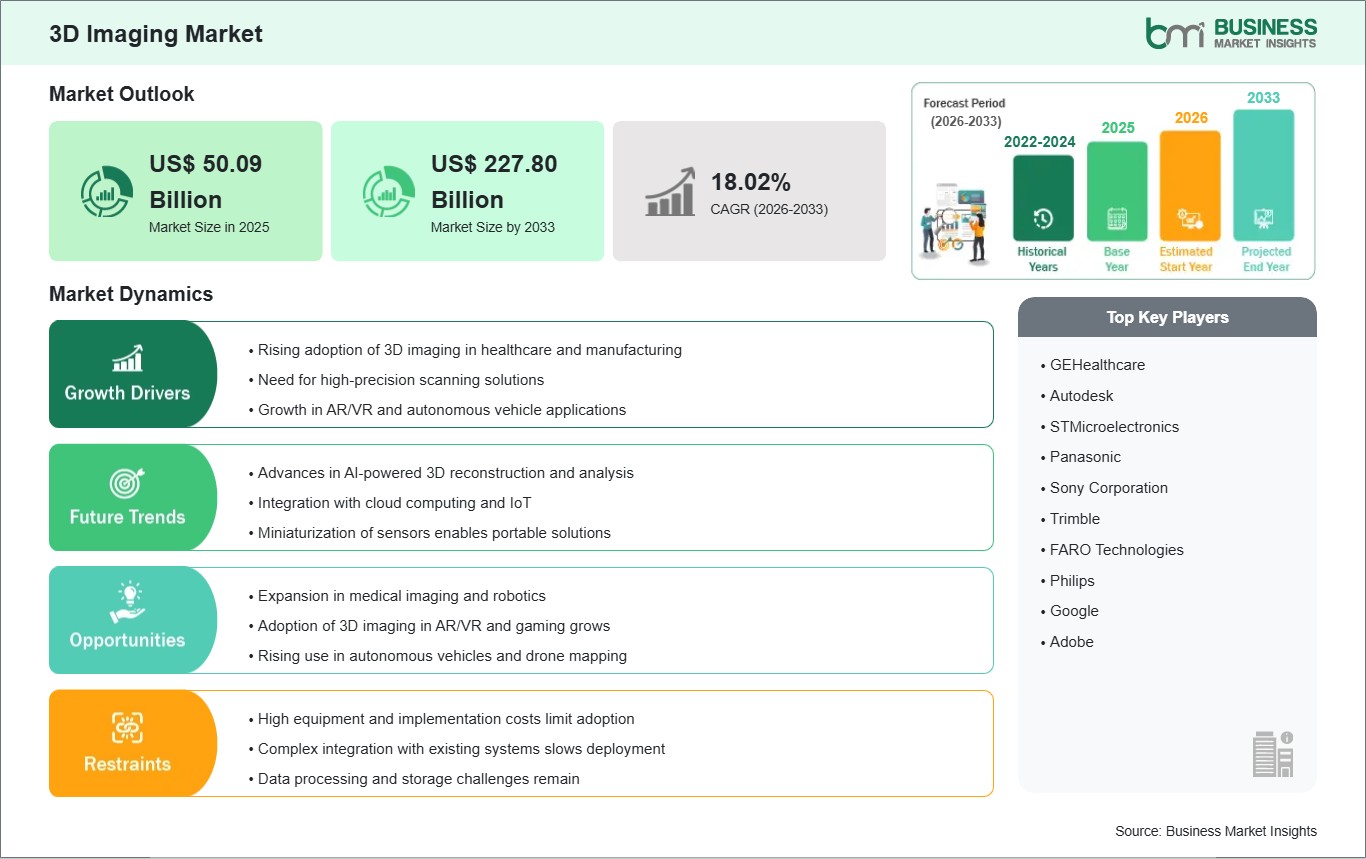
3D imaging is the technical process of capturing the shape, texture, and spatial volume of real-world objects or environments to create a three-dimensional digital representation covering key product categories such as 3D sensors, image reconstruction software, 3D scanners, and cloud-based rendering platforms. These technologies deliver significant clinical and economic value by enabling millimeter-level precision in surgical planning, offering efficient non-invasive solutions for defect detection in smart manufacturing, and ensuring immersive, high-definition experiences in the global gaming and cinema industries. Market expansion is primarily attributed to the rising global demand for minimally invasive medical procedures, the rapid integration of 3D sensing in smartphones, and the escalating need for vision-guided robotics in Industry 4.0. Furthermore, the integration of AI-driven auto-segmentation and edge computing, which allows for instantaneous processing of complex spatial data without heavy cloud reliance, is substantially improving procedural efficiency.
However, several challenges can restrain market growth: high initial procurement and integration costs, particularly for high-end industrial laser scanners and specialized medical hardware, can limit adoption among small-to-medium enterprises (SMEs) and rural healthcare providers. Stringent regulatory hurdles and evolving data privacy laws regarding 3D biometric capture in public spaces lengthen the time-to-market for security applications and increase compliance overhead. Additionally, the industry faces constraints due to technical complexity and a lack of digital literacy, where a shortage of skilled technicians capable of managing and post-processing "heavy" 3D datasets can result in the sub-optimal use of these high-performance solutions.
Despite these hurdles, the market holds immense opportunities in the universal mandate for digital twins and the accelerating deployment of AR-based retail "try-on" experiences. The expansion of 5G-enabled remote diagnostics, which allows for real-time 3D streaming between global specialists, and the development of 4D imaging (adding the dimension of time to observe anatomical motion) are expected to create significant opportunities for market growth.
Segment Analysis
3D Imaging Market Segmentation
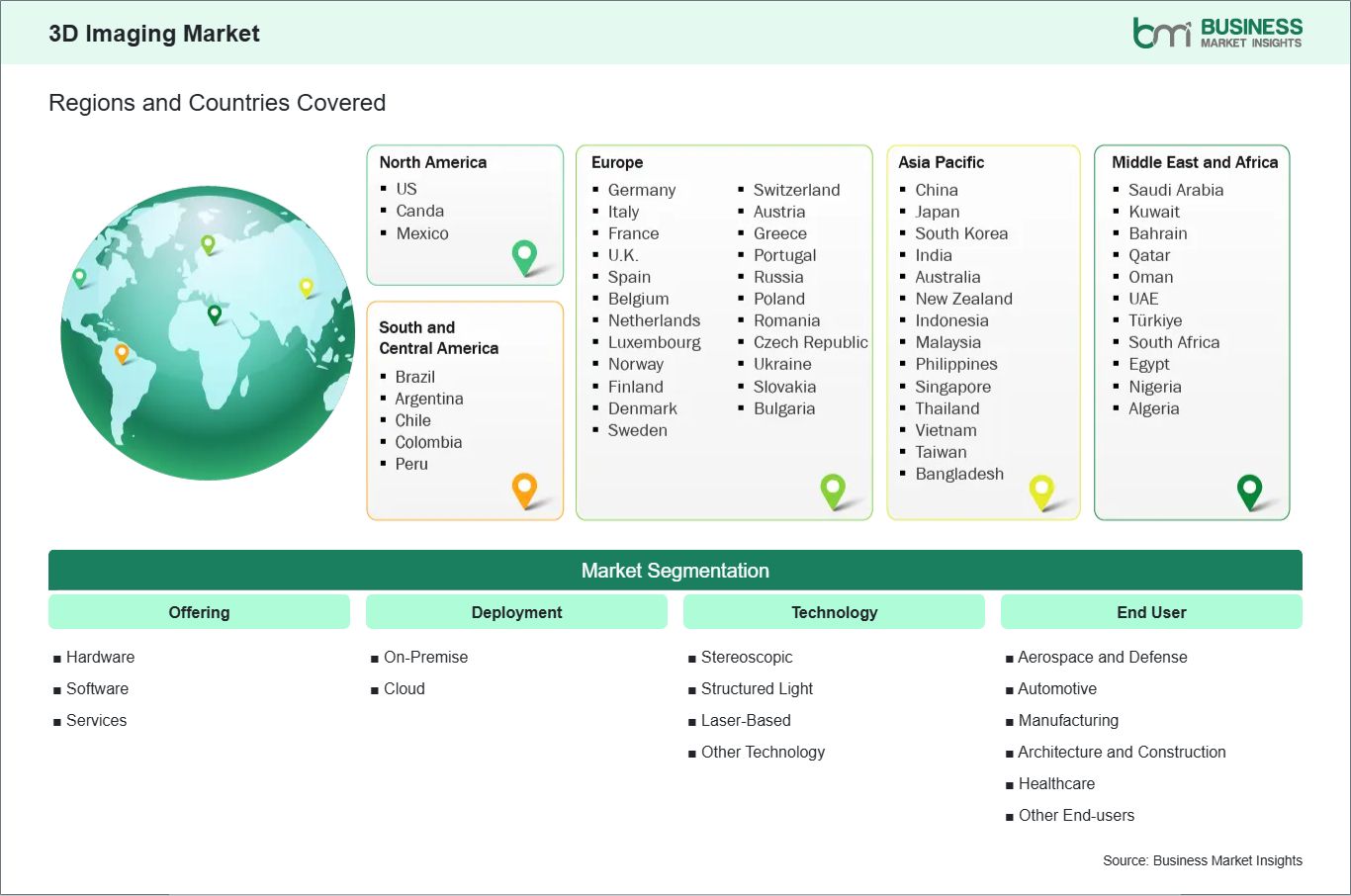
Key segments that contributed to the derivation of the 3D Imaging market analysis are offering, deployment, technology and end user.
- By Offering, the market is segmented into Hardware, Software, and Services.
- By Deployment, the market is divided into On-Premise and Cloud.
- By Technology, the market is categorized into Stereoscopic, Structured Light, Laser-Based, and Others.
- By End User, the market is segmented into Aerospace and Defense, Automotive, Manufacturing, Architecture and Construction, Healthcare, and Others.
Market Forces
3D Imaging Market Drivers and Opportunities
Advancing Digital Transformation and Precision Diagnostic Mandates
The primary driver for the 3D Imaging Market is the intensifying global demand for high-definition spatial visualization across the healthcare, automotive, and consumer electronics sectors. In the medical field, the shift toward minimally invasive surgeries and personalized treatment has made 3D diagnostic tools, such as volume-rendered CT and MRI scans, essential for accurate surgical planning and oncology staging. This biological requirement is mirrored in the automotive industry, where the race toward fully autonomous driving has turned LiDAR and 3D Time-of-Flight (ToF) sensors into non-discretionary safety components.
Furthermore, the relentless "smartphone evolution" continues to push 3D sensing into the mainstream, with facial recognition and depth-sensing cameras becoming standard features in mid-tier and premium devices. As global industries prioritize precision, automation, and real-time data capture to enhance operational accuracy and consumer safety, 3D imaging has transitioned from a specialized luxury to a foundational utility for the modern digital economy.
Immersive Ecosystems and AI-Driven Reconstruction
A significant high-value opportunity lies in the convergence of 3D Imaging with Augmented Reality (AR) and Virtual Reality (VR) ecosystems. As the "metaverse" and industrial digital twins gain traction, there is a burgeoning market for real-time 3D reconstruction tools that can seamlessly bridge the gap between physical objects and their virtual replicas. There is also a major growth frontier in the integration of Artificial Intelligence (AI) for automated image interpretation and upscaling. AI algorithms can now process massive 3D point clouds in seconds, identifying structural defects in infrastructure or early-stage anomalies in medical scans with far greater speed than human operators. Furthermore, the expansion of the 3D printing and additive manufacturing sector presents a lucrative opportunity; as industries move toward on-demand, patient-specific implants and aerospace parts, the need for high-precision 3D scanning and modeling is expected to surge. Manufacturers who focus on "Cloud-as-a-Service" 3D platforms, allowing for remote collaboration and data sharing- are positioned to lead in an increasingly connected global landscape.
Size and Share Analysis
3D Imaging Market Size and Share Analysis
The 3D Imaging market demonstrates steady growth, with size and share analysis revealing evolving trends and competitive positioning among key players. The report further examines subsegments categorized within offering, deployment, technology and end user, offering insights into their contribution to overall market performance.
Based on offering, the Hardware subsegment holds a significant market share. 3D sensors, LiDAR units, and high-resolution cameras are indispensable for Automotive and Aerospace and Defense applications, where they provide the spatial awareness necessary for self-driving vehicles and advanced surveillance drones. A notable trend in 2026 is the miniaturization of VCSEL (Vertical-Cavity Surface-Emitting Laser) components, which has lowered the cost of integration for mass-market consumer devices. These hardware innovations are particularly vital in Healthcare, where specialized 3D CT and MRI scanners allow for sub-millimeter diagnostic precision, potentially improving early-stage disease detection rates. The Cloud subsegment is experiencing the fastest expansion, as organizations shift away from the high capital costs of On-Premise infrastructure. Cloud-based 3D imaging is essential for Architecture and Construction, as it enables global teams to collaborate on massive "BIM" (Building Information Modeling) files in real-time.
Report Coverage
3D Imaging Market Report Coverage and Deliverables
The "3D Imaging Market Size and Forecast (2022 - 2033)" report provides a detailed analysis of the market covering below areas:
- 3D Imaging market size and forecast at global, regional, and country levels for all the key market segments covered under the scope
- 3D Imaging market trends, as well as market dynamics such as drivers, restraints, and key opportunities
- 3D Imaging market analysis covering key market trends, global and regional framework, major players, regulations, and recent market developments
- Industry landscape and competition analysis covering market concentration, heat map analysis, prominent players, and recent developments for the 3D Imaging market
- Detailed company profiles, including SWOT analysis
Geographic Insights
3D Imaging Market Geographic Insights
The geographical scope of the 3D Imaging market report is divided into five regions: North America, Asia Pacific, Europe, Middle East &Africa, and South &Central America.
The Asia-Pacific 3D Imaging Market is segmented into China, Japan, South Korea, India, Australia, New Zealand, Indonesia, Malaysia, the Philippines, Singapore, Thailand, Vietnam, Taiwan, Bangladesh, and the Rest of Asia. This region is emerging as the fastest-growing market globally. The expansion is primarily fueled by rapid industrialization and the proliferation of consumer electronics that integrate 3D sensors and camera modules. China and Japan lead the regional growth, supported by a burgeoning semiconductor industry and the widespread adoption of automation in manufacturing, which necessitates precise 3D scanning and inspection solutions.
Growth is further bolstered by a significant shift toward AI-integrated imaging models among healthcare facilities looking to improve diagnostic accuracy and surgical planning. The integration of 3D depth-sensing and real-time rendering into mobile devices, alongside the rising demand for autonomous vehicle navigation in the urbanized areas of the East, solidifies Asia-Pacific as a critical hub for innovation and the future scaling of the 3D imaging industry.
Industry Activity
Recent Developments
The 3D Imaging market is evaluated by gathering qualitative and quantitative data post primary and secondary research, which includes important corporate publications, association data, and databases. A few of the key developments in the 3D Imaging market are:
- In July 2025, Carl Zeiss Microscopy GmbH acquired all equity shares of Pi Imaging Technology SA, based in Lausanne, Switzerland. The acquisition enhances 3D imaging capabilities by improving low-light sensitivity, image quality, and throughput, enabling new applications in life sciences and research. This strategic move reinforces ZEISS's leadership in high-end imaging and represents a positive development for the 3D imaging technology.
- In January 2026, Artec 3D partnered with InnovMetric to strengthen inspection offering. This collaboration enhances industrial inspection workflows, enabling faster, more precise 3D measurement, CAD comparison, and quality control. The partnership is expected to strengthen Artec 3D's metrology capabilities, improve operational efficiency for customers, and support broader adoption of advanced 3D imaging solutions in manufacturing and other precision industries.
Trust & Transparency
Research Methodology
The market analysis combines proprietary research with secondary data from government agencies, company disclosures, regulatory filings, industry databases and expert interviews. Market estimates are validated through data triangulation, cross-market benchmarking and analyst
review.
View Full Research Methodology
Key Sources Referred:
World Bank - Global Trade IndicatorsWorld Trade Organization (WTO)International Monetary Fund (IMF)International Trade Administration (ITA)Company websiteCompany annual reportsCompany investor presentations