1,4-Butanediol Market Outlook (2022 - 2033)

Historic Data: 2022-2024   |   Base Year: 2025   |   Forecast Period: 2026-2033
Report Content: Market Scope, Market Segmentation, Market Dynamics, and Competitive Analysis

Report Coverage:
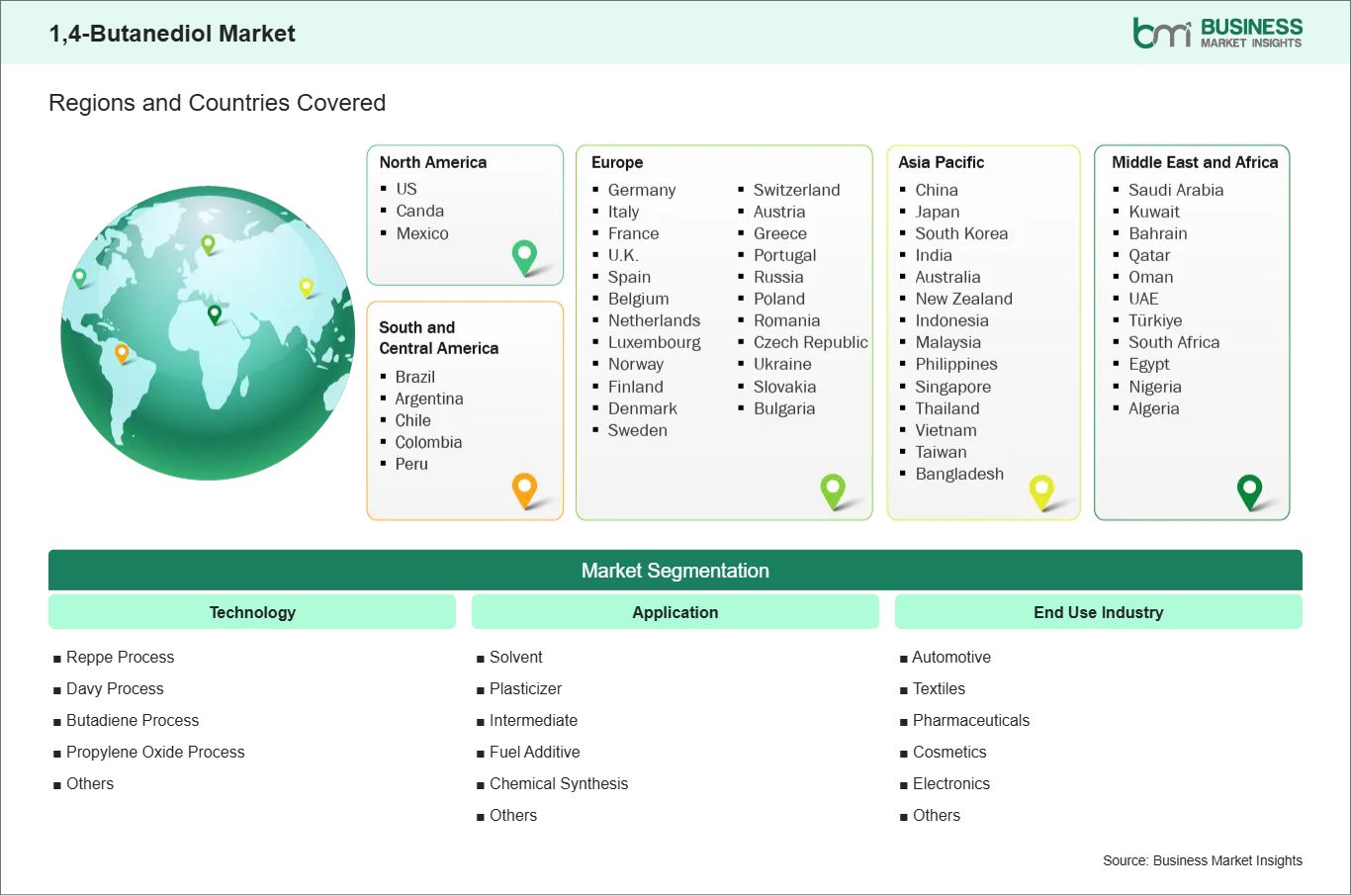
  • Technology (Reppe Process, Davy Process, Butadiene Process, Propylene Oxide Process, and Others)
  • Application (Solvent, Plasticizer, Intermediate, Fuel Additive, Chemical Synthesis, and Others)
  • End Use Industry (Automotive, Textiles, Pharmaceuticals, Cosmetics, Electronics, and Others)

No. of Pages: 400
Report Code: BMIPUB00033222
Category: Chemicals and Materials
1,4-Butanediol Market

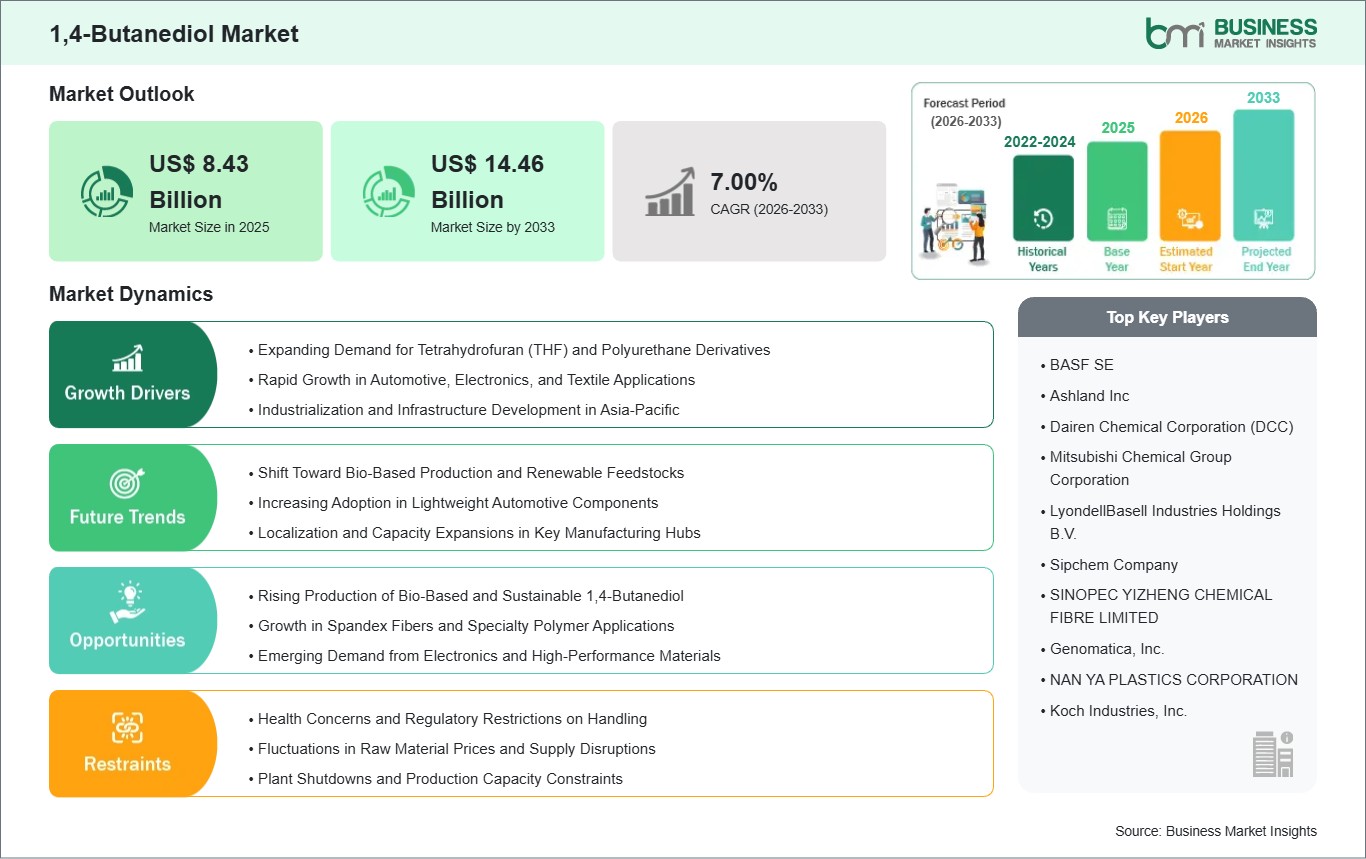
The 1,4-Butanediol market size is expected to reach US$ 14.46 billion by 2033 from US$ 8.43 billion in 2025. The market is estimated to record a CAGR of 7.0% from 2026 to 2033.

Executive Summary and Global Market Analysis:

The 1,4-Butanediol (BDO) market contributes to a number of end use products, which are in the chemical, pharmaceutical, textile, automotive, electronic, construction, and consumer goods sectors, as it is a major intermediate in the synthesis of diverse downstream products. 1,4-Butanediol is utilized in downstream product synthesis through tetrahydrofuran (THF), polybutylene terephthalate (PBT), gamma-butyrolactone (GBL), and polyurethane resins. The benefits of 1,4-Butanediol are that it is versatile, highly stable to chemicals, has good mechanical and thermal properties in final products, and increases durability, flexibility, and performance in applications. The 1,4-Butanediol market is witnessing significant growth due to the rapid industrialization, greater use of lightweight and high-performance structures, and rising use of 1,4-Butanediol in the automotive, electrical, and other textile sectors. Technological progress in manufacturing technology, the growing use of bio-based BDO, and the growing emphasis on sustainable and environmentally friendly chemical solutions in the world promote demand.

Market growth is constrained by the changing price of the raw materials, the large amounts of capital that will be invested, and the stringent environmental and safety laws concerning the production and emission of chemicals. Adherence to the regulatory requirements, safe handling procedures, and waste management is an issue that still faces manufacturers. With all these shortcomings, it is projected that the market would enjoy rising investments in process optimization, bio-based alternatives development, and automation in factories. Increased demand by the rising economies, development of new downstream applications, and change of production processes towards sustainability are expected to present profitable opportunities. The 1,4-Butanediol market is poised to witness steady growth with constant research and development, friendly industrial policies, and the world in search of cost-effective and high-performance chemical intermediates.

1,4-Butanediol Market - Strategic Insights:

global-market-strategic-framework
Get more information on this report

1,4-Butanediol Market Segmentation Analysis:

Key segments that contributed to the derivation of the 1,4-butanediol market analysis are technology, application, and end use industry.

  • By technology, the 1,4-butanediol market is segmented into Reppe process, Davy process, butadiene process, propylene oxide process, and others. The Reppe process segment dominated the market in 2025.
  • By application, the market is segmented into solvent, plasticizer, intermediate, fuel additive, chemical synthesis, and others. The intermediate segment held the largest share of the market in 2025.
  • By end use industry, the market is segmented into automotive, textiles, pharmaceuticals, cosmetics, electronics, and others. The automotive segment held the largest share of the market in 2025.

1,4-Butanediol Market Drivers and Opportunities:

Rising Demand from Automotive, Textile, and Chemical Industries

The primary consumers of 1,4-Butanediol include automotive, textile, chemical, and electronics industries since it is a vital raw material in the production of engineering plastics, elastic fibers, solvents, and polyurethane resins. There is a rising demand in these industries because of the need for lightweight, durable, and high-performance materials. Its modification in the manufacturing of tetrahydrofuran (THF), polybutylene terephthalate (PBT), and gamma-butyrolactone (GBL) to strength, flexibility, and thermal stability is vital in contemporary industrial applications. The efficient use of 1,4-Butanediol enhances the consistency of products, decreases wastage of materials, and facilitates cost-effective production.

The growth of investment in auto manufacturing industries, textile production units, and chemical processing facilities has greatly added to the demand for 1,4-Butanediol. It is in the best interest of sectors to have a steady flow of high-quality intermediates. The adoption of standardized and high-grade 1,4-Butanediol is driven by the strict quality and safety measures in regions such as Asia Pacific, North America, and Europe. Also, the improvement in production technologies and efficient management of the supply chain is increasing the efficiency of production.

Expanding Applications and Focus on Sustainable Production

1,4-butanediol is finding a wide range of applications in manufacturing and processing processes to enhance the efficiency of operations, the performance of products, and the reliability of processes. It is crucial in maintaining consistency, chemical stability, and improving the mechanical properties of downstream products like plastics, fibers, coatings, and adhesives. The application of 1,4-Butanediol facilitates energy-efficient manufacturing, reduces the generation of waste, and enhances product durability and performance, which aims at industrial sustainability.

Manufacturers are looking at sustainable feedstocks and processes that are more environmentally friendly and do not involve a reduction in product quality to comply with the strict environmental rules. BDO solutions are more eco-friendly and are experiencing rapid development due to government policies and technological innovation, and pressure toward eliminating carbon footprints. Long-term advantages of the 1,4-Butanediol include operational effectiveness, low environmental impact, and adherence to international safety requirements.

1,4-Butanediol Market Size and Share Analysis:

The 1,4-Butanediol market demonstrates steady growth, with size and share analysis revealing evolving trends and competitive positioning among key players. The report further examines subsegments categorized within technology, application, and end use industry, offering insights into their contribution to overall market performance.

By technology, the Reppe process segment had the largest share of the 1,4-butanediol market . The Reppe process has high reliability and can produce a consistent product quality. The high usage rate is supported by well-developed industrial infrastructure, economical synthesis pathways, and high demand for the product in its downstream usages such as THF, PBT, and polyurethane resins.

1,4-Butanediol Market Report Highlights:

Report Attribute Details
Market size in 2025 US$ 8.43 Billion
Market Size by 2033 US$ 14.46 Billion
Global CAGR (2026 - 2033)7.00%
Historical Data 2022-2024
Forecast period 2026-2033
Segments Covered By Technology
  • Reppe Process
  • Davy Process
  • Butadiene Process
  • Propylene Oxide Process
  • Others
By Application
  • Solvent
  • Plasticizer
  • Intermediate
  • Fuel Additive
  • Chemical Synthesis
  • Others
By End Use Industry
  • Automotive
  • Textiles
  • Pharmaceuticals
  • Cosmetics
  • Electronics
  • Others
Regions and Countries Covered
North America US, Canada, Mexico
Europe Belgium, Austria, Finland, Denmark, Greece, Poland, Romania, Russia, Ukraine, Czech Republic, Slovakia, Bulgaria, Italy, Luxembourg, Germany, Switzerland, France, Netherlands, Norway, Portugal, Spain, Sweden, United Kingdom
Asia-Pacific Australia, China, India, Japan, South Korea, Indonesia, Malaysia, Philippines, Singapore, Thailand, Vietnam, Bangladesh, New Zealand, Taiwan
South and Central America Brazil, Argentina, Peru, Chile, Colombia
Middle East and Africa Bahrain, Kuwait, Oman, Qatar, Saudi Arabia, United Arab Emirates, Turkiye, South Africa, Egypt, Algeria, Nigeria
Market leaders and key company profiles
  • BASF SE
  • Ashland Inc
  • Dairen Chemical Corporation (DCC)
  • Mitsubishi Chemical Group Corporation
  • LyondellBasell Industries Holdings B.V.
  • Sipchem Company
  • SINOPEC YIZHENG CHEMICAL FIBRE LIMITED
  • Genomatica, Inc.
  • NAN YA PLASTICS CORPORATION
  • Koch Industries, Inc.
Get more information on this report

1,4-Butanediol Market Report Coverage and Deliverables:

The " 1,4-Butanediol Market Size and Forecast (2022–2033)" report provides a detailed analysis of the market covering below areas:

  • 1,4-Butanediol market size and forecast at global, regional, and country levels for all the key market segments covered under the scope
  • 1,4-Butanediol market trends, as well as market dynamics such as drivers, restraints, and key opportunities
  • 1,4-Butanediol market analysis covering key market trends, global and regional framework, major players, regulations, and recent market developments
  • Industry landscape and competition analysis covering market concentration, heat map analysis, prominent players, and recent developments for the 1,4-butanediol market
  • Detailed company profiles, including SWOT analysis

1,4-Butanediol Market Geographic Insights:

The geographical scope of the 1,4-Butanediol market report is divided into five regions: North America, Asia Pacific, Europe, the Middle East & Africa, and South & Central America.

The Asia-Pacific 1,4-Butanediol market is segmented into China, Japan, South Korea, India, Australia, New Zealand, Indonesia, Malaysia, the Philippines, Singapore, Thailand, Vietnam, Taiwan, Bangladesh, and the Rest of Asia Pacific. APAC is one of the fastest-expanding markets, owing to increasing industrialization, car manufacturing, textile manufacturing, and chemical processing. Due to the high rate of urbanization, a fast-growing population, increased industrial production, and increasing demand for high-performance intermediates. China and India have become the major markets. The 1,4-Butanediol supply chain and production chain are developed in the region due to the low production costs, access to skilled employees, and the concentrated industrial demand. The governments of the region are implementing favorable policies, development infrastructure, and encouraging the local production and distribution of chemical intermediates.

They have introduced initiatives to promote the automotive, textile, chemical processing industries, and the manufacturing of high-quality and sustainable, and safe chemical solutions. Japan and South Korea have come up with programs that enhance the use of advanced and environmental friendly technologies for producing chemicals. The increase in the usage of 1,4-Butanediol in end use industries is influenced by the fast industrialization process, attention to the efficiency of the operations, sustainability, favorable government policy, crucial performance of the applications, and adherence to industry standards.

global-market-geography
Get more information on this report

1,4-Butanediol Market Research Report Guidance:

  • The report includes qualitative and quantitative data in the 1,4-Butanediol market across technology, application, end use industry, and geography.
  • The report starts with the key takeaways (chapter 2), highlighting the key trends and outlook of the 1,4-Butanediol market.
  • Chapter 3 includes the research methodology of the study.
  • Chapter 4 further includes ecosystem analysis.
  • Chapter 5 highlights the major industry dynamics in the 1,4-Butanediol market, including factors that are driving the market, prevailing deterrents, potential opportunities, as well as future trends. Impact analysis of these drivers and restraints is also covered in this section.
  • Chapter 6 discusses the 1,4-Butanediol market scenario in terms of historical market revenues and forecasts till the year 2033.
  • Chapters 7 to 10 cover the 1,4-Butanediol market segments by technology, application, end use industry, and geography across North America, Europe, Asia Pacific, the Middle East and Africa, and South and Central America. They cover the market revenue, forecast, and factors driving the market.
  • Chapter 11 describes the competitive analysis along with the heat map analysis for the key players operating in the market.
  • Chapter 12 describes the industry landscape analysis. It provides detailed descriptions of business activities such as market initiatives, new developments, mergers, and joint ventures globally, along with a competitive landscape.
  • Chapter 13 provides detailed profiles of the major companies operating in the 1,4-Butanediol market. Companies have been profiled on the basis of their key facts, business descriptions, products and services, financial overview, SWOT analysis, and key developments.
  • Chapter 14, i.e., the appendix, is inclusive of a brief overview of the company, a list of abbreviations, and a disclaimer.

1,4-Butanediol Market News and Key Development:

The 1,4-Butanediol market is evaluated by gathering qualitative and quantitative data post-primary and secondary research, which includes important corporate publications, association data, and databases. A few of the key developments in the 1,4-Butanediol market are:

  • In November 2025, Geno launched the world's largest GENO Bio-BDO manufacturing plant in Eddyville, Iowa, utilizing its proprietary biocatalyst and process technology to produce 1,4-butanediol (BDO) from plant-based sugars through a single-step fermentation. The facility, operated by Qore—a joint venture between Cargill and HELM—aims to assist brands in transitioning from fossil-based chemistries to sustainable alternatives.
  • In July 2025, Qore inaugurated a US$ 300 million facility in Eddyville, Iowa, capable of producing 66,000 tonnes/year of biobased 1,4-butanediol (BDO) under the Qira brand, using dent corn from local farms. Qira serves as a sustainable alternative to fossil-derived BDO, being applicable across industries such as personal care, fashion, automotive, and packaging. A long-term supply agreement with BASF and adoption by the Lycra Company highlight its market integration, with projections showing a potential 44% reduction in carbon footprint compared to fossil-based counterparts.

Key Sources Referred:

  • World Bank – Global Trade Indicators
  • European Chemicals Agency
  • International Council of Chemical Associations
  • International Monetary Fund (IMF)
  • World Trade Organization (WTO)
  • International Trade Administration (ITA)
  • Company Websites
  • Company Annual Reports
  • Company Investor Presentations
The List of Companies - 1,4-Butanediol Market
  • BASF SE
  • Ashland Inc
  • Dairen Chemical Corporation (DCC)
  • Mitsubishi Chemical Group Corporation
  • LyondellBasell Industries Holdings B.V.
  • Sipchem Company
  • SINOPEC YIZHENG CHEMICAL FIBRE LIMITED
  • Genomatica, Inc.
  • NAN YA PLASTICS CORPORATION
  • Koch Industries, Inc.
Frequently Asked Questions
How big is the 1,4-Butanediol Market?

The 1,4-Butanediol Market is valued at US$ 8.43 Billion in 2025, it is projected to reach US$ 14.46 Billion by 2033.

What is the CAGR for 1,4-Butanediol Market by (2026 - 2033)?

As per our report 1,4-Butanediol Market, the market size is valued at US$ 8.43 Billion in 2025, projecting it to reach US$ 14.46 Billion by 2033. This translates to a CAGR of approximately 7.00% during the forecast period.

What segments are covered in this report?

The 1,4-Butanediol Market report typically cover these key segments-

  • Technology (Reppe Process, Davy Process, Butadiene Process, Propylene Oxide Process, and Others)
  • Application (Solvent, Plasticizer, Intermediate, Fuel Additive, Chemical Synthesis, and Others)
  • End Use Industry (Automotive, Textiles, Pharmaceuticals, Cosmetics, Electronics, and Others)

What is the historic period, base year, and forecast period taken for 1,4-Butanediol Market?

The historic period, base year, and forecast period can vary slightly depending on the specific market research report. However, for the 1,4-Butanediol Market report:

  • Historic Period : 2022-2024
  • Base Year : 2025
  • Forecast Period : 2026-2033
  • Who are the major players in 1,4-Butanediol Market?

    The 1,4-Butanediol Market is populated by several key players, each contributing to its growth and innovation. Some of the major players include:

  • BASF SE
  • Ashland Inc
  • Dairen Chemical Corporation (DCC)
  • Mitsubishi Chemical Group Corporation
  • LyondellBasell Industries Holdings B.V.
  • Sipchem Company
  • SINOPEC YIZHENG CHEMICAL FIBRE LIMITED
  • Genomatica, Inc.
  • NAN YA PLASTICS CORPORATION
  • Koch Industries, Inc.
  • Who should buy this report?

    The 1,4-Butanediol Market report is valuable for diverse stakeholders, including:

    • Investors: Provides insights for investment decisions pertaining to market growth, companies, or industry insights. Helps assess market attractiveness and potential returns.
    • Industry Players: Offers competitive intelligence, market sizing, and trend analysis to inform strategic planning, product development, and sales strategies.
    • Suppliers and Manufacturers: Helps understand market demand for components, materials, and services related to concerned industry.
    • Researchers and Consultants: Provides data and analysis for academic research, consulting projects, and market studies.
    • Financial Institutions: Helps assess risks and opportunities associated with financing or investing in the concerned market.

    Essentially, anyone involved in or considering involvement in the 1,4-Butanediol Market value chain can benefit from the information contained in a comprehensive market report.

    Available Report Formats

    pdf-format excel-format pptx-format
    Buy Now
    Sales Assistance
    +1 646 791 7070 (US & UK)
    Customization Form

    Please tell us your area of interest
    (Market Segments/ Regions and Countries/ Companies)