Market Summary
Executive Summary and Market Analysis
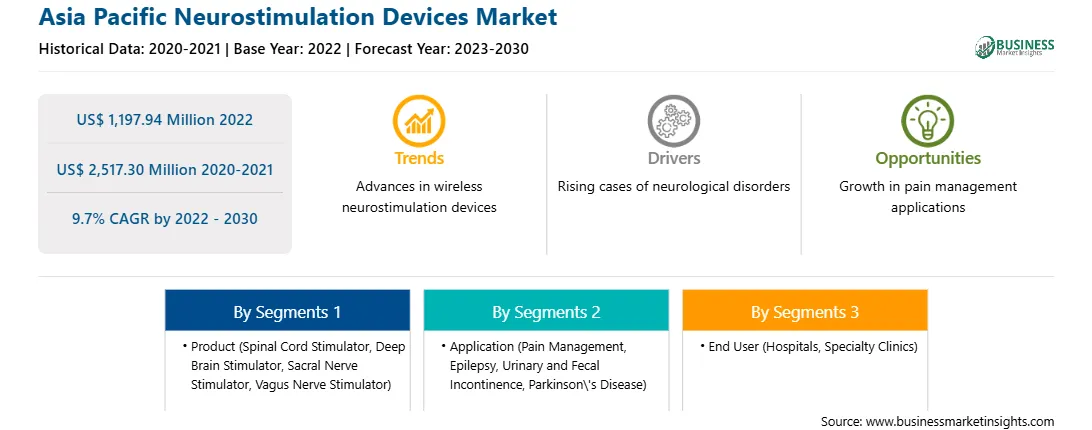
The Asia Pacific neurostimulation devices market is developing into a highly active market segment throughout the world because of rising neurological disorder prevalence and growing acceptance of new neuromodulation treatment. The patient population from chronic pain conditions, epilepsy, Parkinson's disease and movement disorders has expanded in China, Japan and India, which has led to increased demand for non-drug treatment methods. The region is seeing higher acceptance of both implantable and minimally invasive neurostimulation technologies because of advancing healthcare system capabilities and better clinical results. The region experiences strong growth because healthcare infrastructure develops rapidly in urban areas, while developing countries increase their health spending and expand insurance access. Advanced neurostimulation techniques are being adopted throughout India and Thailand because medical tourism brings patients to these countries. The ongoing development of new technologies, which include rechargeable implantable devices and miniaturized stimulators and precise targeting systems, has resulted in better treatment outcomes and more medical applications. The market encounters limitations because it depends on two factors, which include the shortage of trained neurospecialists and the complexity of medical procedures in rural and semi-urban regions. The advanced neurostimulation therapies face accessibility problems because emerging economies show high cost sensitivity, which restricts their availability to patients. The current regulatory approvals, together with increased awareness among doctors and patients, will create sustained regional development throughout the next several years.
Segment Analysis
Asia Pacific Neurostimulation Devices Market Segmentation
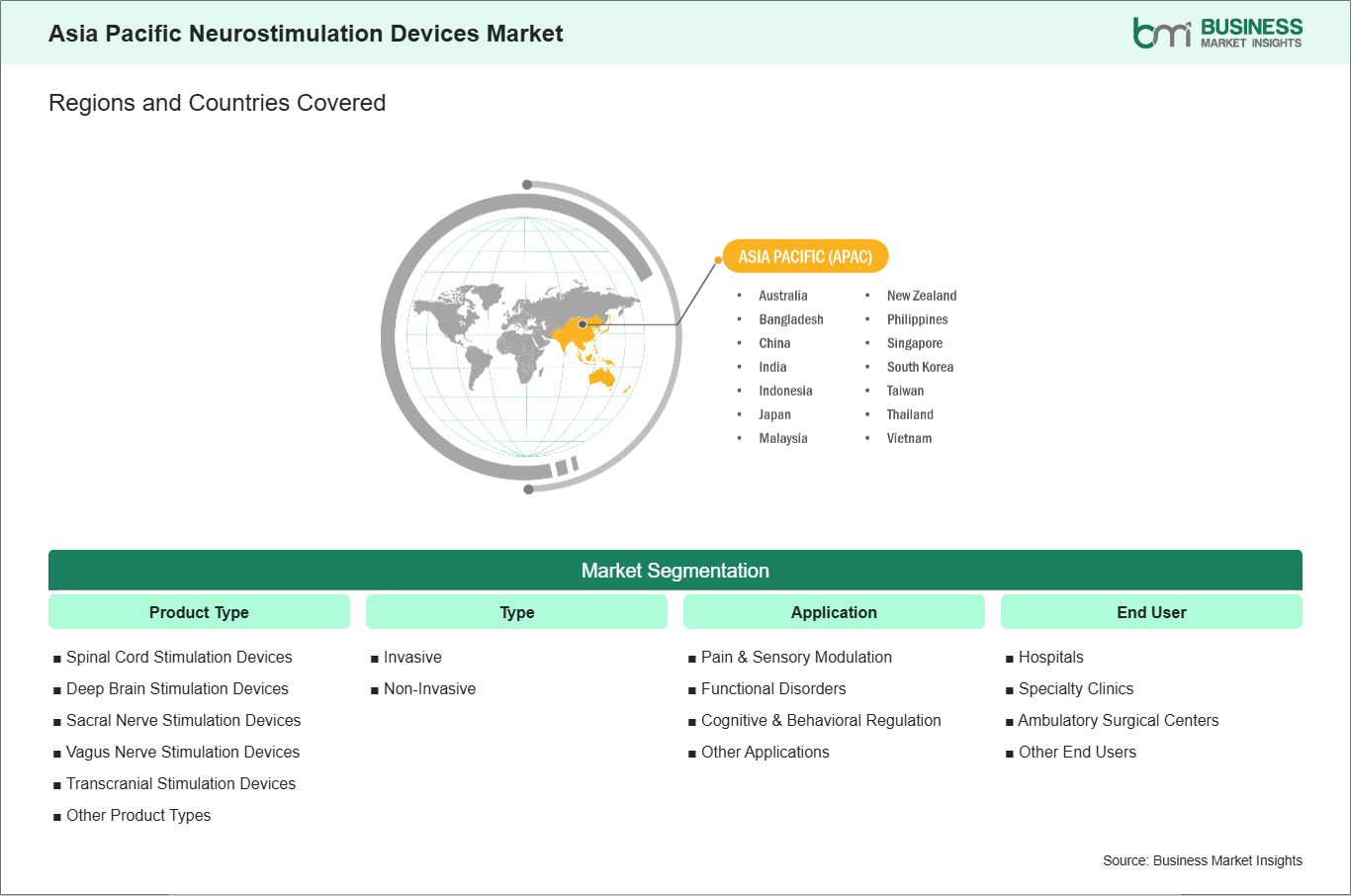
Key segments that contributed to the derivation of the Asia Pacific neurostimulation devices market analysis are product type, type, application, and end user.
- By product type, the neurostimulation devices market is segmented into spinal cord stimulation devices, deep brain stimulation devices, sacral nerve stimulation devices, vagus nerve stimulation devices, transcranial stimulation devices, and other product types. The spinal cord stimulation devices segment dominated the market in 2025.
- Based on type, the neurostimulation devices market is categorized into invasive and non-invasive. The invasive segment dominated the market in 2025.
- On the basis of application, the neurostimulation devices market is categorized into pain and sensory modulation, functional disorders, cognitive and behavioral regulation, and other applications. The pain and sensory modulation segment dominated the market in 2025.
- In terms of end user, the neurostimulation devices market is categorized into hospitals, specialty clinics, ambulatory surgical centers, and other end users. The hospitals segment dominated the market in 2025.
Market Forces
Asia Pacific Neurostimulation Devices Market Drivers and Opportunities
Rising Global Neurological Disease Burden
The Asia Pacific region currently shows increasing cases of neurological disorders because its elderly population base expands and more people develop chronic diseases like epilepsy, Parkinson's disease and neuropathic pain, which now affect both urban and rural areas in India, China and Southeast Asia. The combination of better diagnostic tools and improved healthcare accessibility leads to increased detection of cases, which now occurs in major urban areas.
The rising incidence of stroke complications and traumatic brain injuries, which occur in fast-growing urban centers, creates a higher need for neurostimulation therapies that include spinal cord stimulation and deep brain stimulation systems, which treat both pain and motor disorders. The hospitals throughout Japan, South Korea and Australia are building their neurology departments to enable their medical staff to implement cutting-edge implantable medical technologies.
Patients receive better access to advanced therapies because government programs that improve neurology infrastructure across Asia Pacific healthcare systems work together with rising public knowledge about non-drug treatment methods, which lead to earlier neurological treatment in the region. The market in the region experiences growth because private healthcare systems expand and medical tourism increases in India and Thailand.
Advancement in Brain-Computer Interface Solutions
Advancement in brain computer interface and neurostimulation technologies is accelerating across Asia Pacific supported by strong research activity in China Japan South Korea and India where universities and medical institutions are collaborating on neural signal processing and adaptive stimulation systems These innovations are improving precision in neurological treatment outcomes and device responsiveness significantly regionally deployed
Next-generation neurostimulation devices are increasingly incorporating closed loop feedback mechanisms that adjust electrical stimulation in real time based on neural activity improving treatment accuracy for conditions such as epilepsy and movement disorders Engineering teams in Japan and China are also focusing on miniaturized implantable systems with wireless connectivity enabling less invasive procedures and faster recovery
The growing integration of brain computer interfaces into rehabilitation programs is expanding therapeutic applications for stroke recovery spinal cord injury and neuro motor rehabilitation across advanced hospitals in the region Private sector investment and cross border technology partnerships are further driving commercialization of intelligent neurostimulation platforms designed to deliver personalized neurological care solutions regionally adopted.
Size and Share Analysis
Asia Pacific Neurostimulation Devices Market Size and Share Analysis
The Asia Pacific neurostimulation devices market is experiencing steady growth, with market size and share analysis reflecting evolving treatment preferences and competitive dynamics among key players. The report evaluates important subsegments categorized within product type, type, application, and end user, highlighting their respective contributions to market performance.
By product type, the spinal cord stimulation devices subsegment dominated the market in 2025, driven by its widespread adoption for chronic pain management and strong clinical efficacy.
Based on type, the invasive subsegment dominated the market in 2025, driven by higher precision, long-term effectiveness, and increasing preference for implantable solutions in severe neurological conditions.
On the basis of application, the pain and sensory modulation subsegment dominated the market in 2025, driven by the rising prevalence of chronic pain disorders and growing demand for non-opioid treatment alternatives.
In terms of end user, the hospitals subsegment dominated the market in 2025, driven by advanced healthcare infrastructure, availability of skilled professionals, and higher volume of neurostimulation procedures.
Report Coverage
Asia Pacific Neurostimulation Devices Market Report Coverage and Deliverables
The "Asia Pacific Neurostimulation Devices Market Size and Forecast (2022-2033)" report provides a detailed analysis of the market covering below areas:
- Market size and forecast at regional and country levels for all market segments covered under the scope
- Market trends, as well as drivers, restraints, and opportunities
- Market analysis covering key trends, regional framework, major players, regulations, and recent developments
- Market concentration, heat map analysis, prominent players, and recent developments for the Market
- Detailed company profiles, including SWOT analysis
Geographic Insights
Asia Pacific Neurostimulation Devices Market Geographic Insights
The geographical scope of the Asia Pacific Neurostimulation Devices Market report is divided into China, Japan, South Korea, India, Australia, New Zealand, Indonesia, Malaysia, Philippines, Singapore, Thailand, Vietnam, Taiwan, Bangladesh. China held the largest share in 2025.
The Asia Pacific neurostimulation devices market shows strong heterogeneity, with China as the dominant and fastest-growing hub, which develops through its large patient base, expanding hospital facilities, increasing neurological disorder rates and its active implementation of spinal cord and deep brain stimulators that benefit from rising healthcare spending and local manufacturing growth. Japan operates as a mature high-value market that uses advanced reimbursement systems to enable quick adoption of implantable neuromodulation therapies that address the strong demand of elderly patients who experience pain and movement disorders. South Korea and Taiwan achieve consistent market growth because their hospitals use advanced technology, and they bring AI-based neurostimulation systems with minimal invasiveness to their patients. India operates as a rapidly developing emerging market because its chronic pain patient numbers increase while its neurology treatment facilities expand and its private healthcare system develops. The healthcare systems of Australia and New Zealand create stable demand because they maintain established medical procedures, and their population demonstrates high knowledge about pain management solutions, which they actively implement. The Southeast Asian countries of Indonesia, Malaysia, the Philippines, Thailand and Vietnam currently experience initial market growth because their healthcare spending increases, their neurology diagnostics improve, and their medical tourism industry expands, while Singapore emerges as a center for regional innovation and technology adoption. Bangladesh remains nascent but is gradually increasing adoption through urban hospital expansion. China forms the core of regional control, while India and Southeast Asia produce gradual development, and developed markets deliver technological advancement and premium device distribution throughout the Asia Pacific.
Industry Activity
Recent Developments
The Asia Pacific Neurostimulation Devices Market is evaluated by gathering qualitative and quantitative data post primary and secondary research, which includes important corporate publications, association data, and databases. A few of the key developments in the Asia Pacific neurostimulation devices market are:
- In April 2026, Medtronic announced that it had launched its Adaptive Deep Brain Stimulation (aDBS) system in India, an advanced version of conventional DBS designed to improve symptom control in patients with Parkinson's disease by automatically adjusting stimulation in real time based on brain activity.
- In August 2023, BrainsWay announced the expanded availability of its Deep Transcranial Magnetic Stimulation (Deep TMS™) systems in Taiwan, with additional system installations through its partnership with local healthcare providers.
Trust & Transparency
Research Methodology
The market analysis combines proprietary research with secondary data from government agencies, company disclosures, regulatory filings, industry databases and expert interviews. Market estimates are validated through data triangulation, cross-market benchmarking and analyst
review.
View Full Research Methodology
Key Sources Referred:
U.S. Food and Drug Administration (FDA)European Medicines Agency (EMA)National Institutes of Health (NIH)World Health Organization (WHO)International Neuromodulation SocietyNorth American Neuromodulation SocietyAmerican Academy of NeurologyEuropean Academy of NeurologyCongress of Neurological SurgeonsCompany WebsitesCompany Annual ReportsCompany Investor Presentations