
Zinc Sulphate Market Outlook: Size, Share, Trends, Growth Analysis, Competitive Landscape & Forecast, 2026–2033

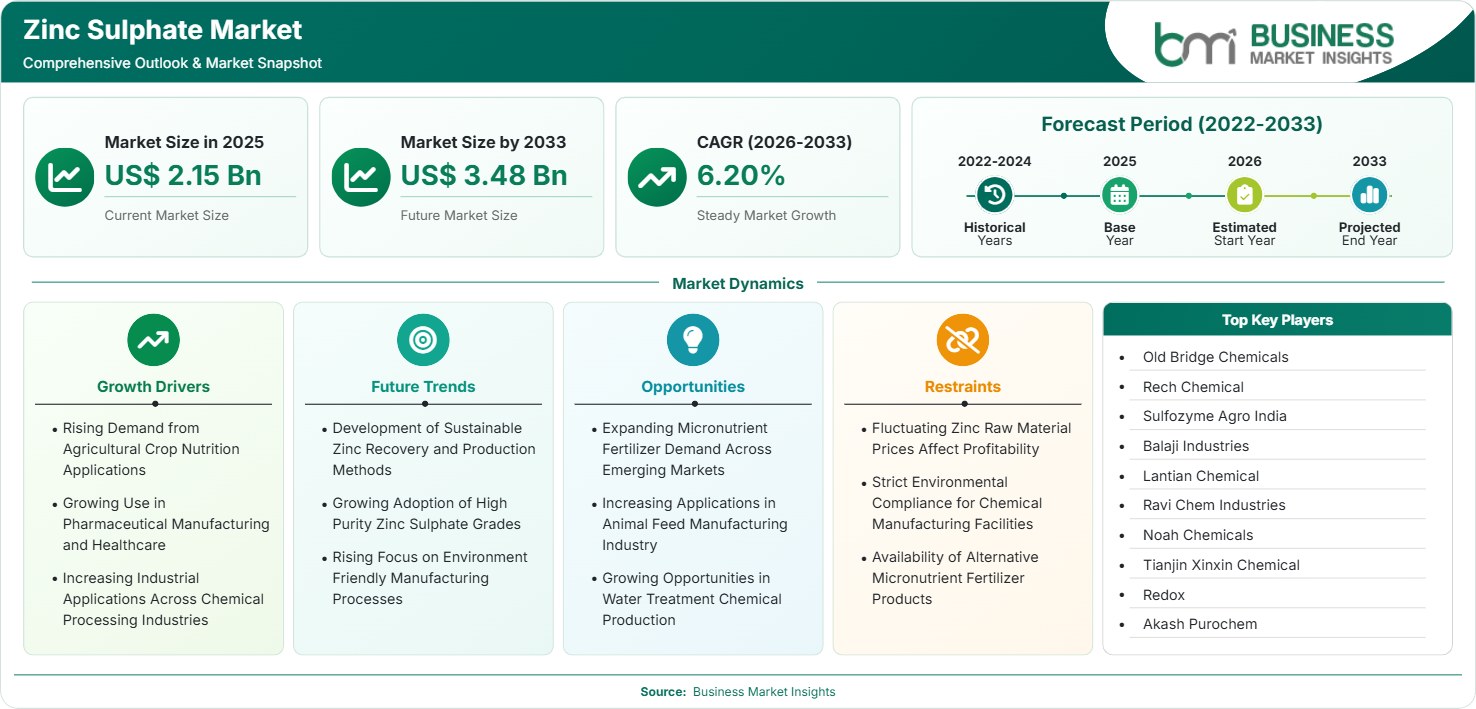
The Zinc Sulphate Market size was valued at US$ 2.15 billion in 2025 and is projected to reach US$ 3.48 billion by 2033, growing at a CAGR of 6.20% during 2026–2033. Growth is driven by increasing micronutrient fertilizer demand, pharmaceutical applications, chemical processing expansion, and rising water treatment requirements across developing and developed economies.

Report Coverage
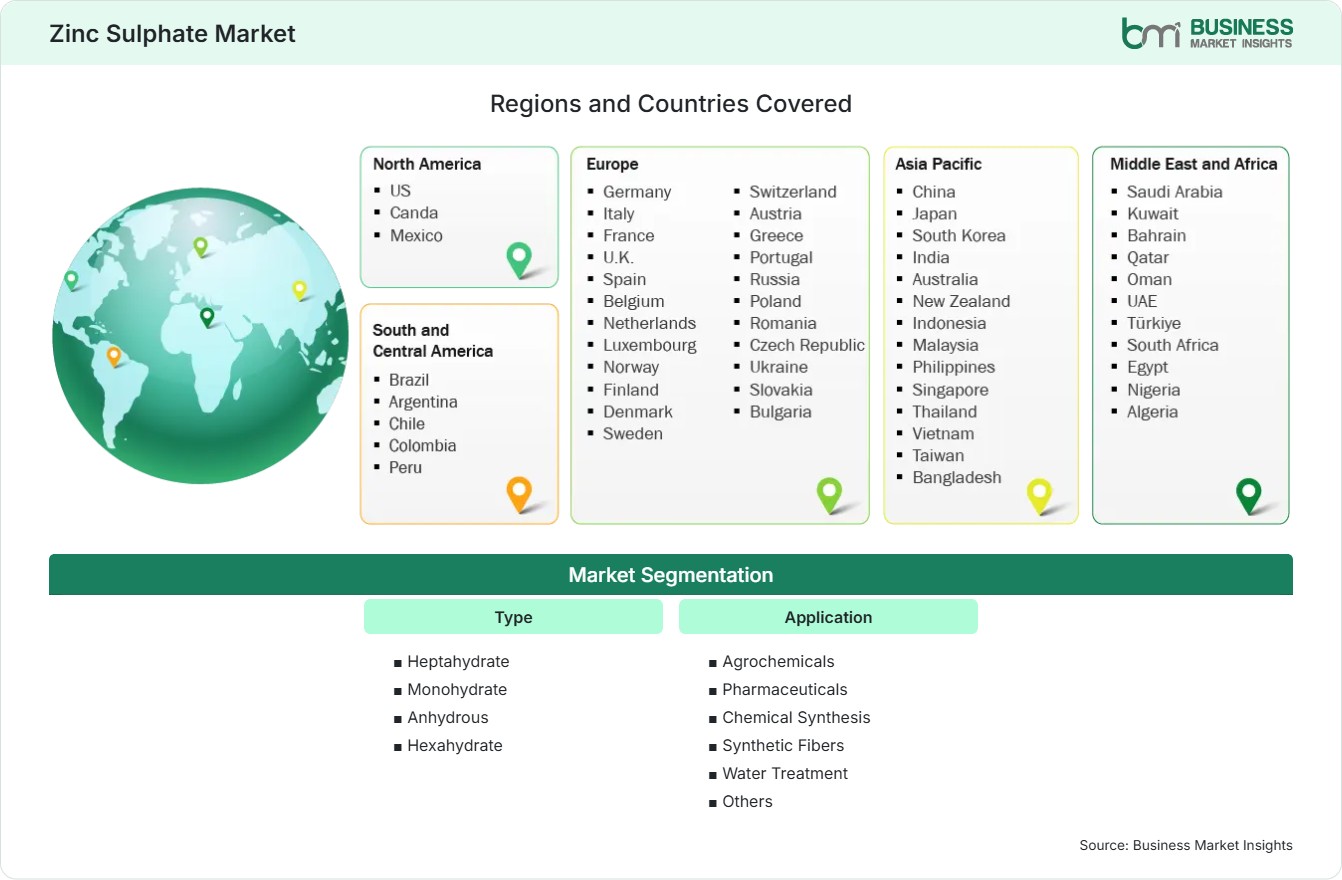
  • Type: Heptahydrate, Monohydrate, Anhydrous, Hexahydrate
  • Application: Agrochemicals, Pharmaceuticals, Chemical Synthesis, Synthetic Fibers, Water Treatment, Others
US$ 2.15 Bn Market size in 2025
US$ 3.48 Bn Market Size by 2033
6.20% CAGR, 2026 - 2033
2026-2033 Forecast Period

01 AI Overview

Zinc Sulphate Market Summary

  • North America Region: North America holds a 24%–28% share in 2025 and is projected to grow at a 5.8%–6.3% CAGR during 2026–2033. Growth is supported by advanced agricultural practices, specialty chemical manufacturing, pharmaceutical production, and wastewater treatment investments. The U.S. market benefits from established chemical infrastructure, precision farming adoption, and demand for high-quality zinc-based compounds in agriculture, healthcare, and industrial applications.
  • Fastest Growing Region: Asia Pacific represents a 42%–46% share in 2025 and is expected to expand at a 6.8%–7.3% CAGR during 2026–2033. Growth is driven by increasing fertilizer consumption, agricultural productivity improvement programs, industrial chemical manufacturing expansion, and rising environmental treatment investments across China, India, and Southeast Asian economies.
  • Leading Segment: Heptahydrate Type accounts for a 45%–49% share in 2025 and is projected to grow at a 6.0%–6.5% CAGR during 2026–2033. Adoption is supported by broad utilization in agricultural fertilizers, animal nutrition products, chemical formulations, and industrial processing applications requiring stable zinc supplementation.
  • High Growth Segment: Water Treatment Application represents a 12%–16% share in 2025 and is expected to grow at a 7.0%–7.5% CAGR during 2026–2033. Expansion is supported by increasing wastewater management requirements, industrial water purification needs, environmental regulations, and demand for effective chemical treatment solutions.
  • Key Market Opportunity: Increasing demand for micronutrient fertilizers, expansion of pharmaceutical manufacturing, growing animal nutrition requirements, and investments in water treatment infrastructure are creating opportunities for zinc sulphate manufacturers.
  • Major Market Players: Old Bridge Chemicals, Rech Chemical, Sulfozyme Agro India, Balaji Industries, Lantian Chemical, Ravi Chem Industries, Noah Chemicals, Tianjin Xinxin Chemical, Redox, and Akash Purochem.
02 Strategic Insights

Zinc Sulphate Market: Strategic Insights

Zinc Sulphate Market Strategic Framework
FREE PDF
Request your free sample
Request free sample
03 Stakeholder View

Key Takeaways

  • The market ecosystem involves zinc raw material suppliers, chemical processors, fertilizer manufacturers, pharmaceutical companies, and industrial consumers, creating interconnected opportunities across agricultural and industrial value chains.
  • Agricultural applications remain the strongest demand contributor as governments and farmers increasingly focus on correcting zinc deficiencies in soil and improving crop productivity through micronutrient-based solutions.
  • Product development is shifting toward higher purity grades, customized formulations, and efficient production methods to serve pharmaceutical, chemical processing, and specialized industrial applications.
  • Asia Pacific provides a strong investment landscape due to expanding fertilizer consumption, rising chemical manufacturing capacity, and increasing environmental infrastructure development across emerging economies.
  • Companies are strengthening competitiveness through capacity expansion, regional distribution partnerships, technology improvements, and supply chain optimization to manage changing raw material conditions.
  • Sustainability-focused chemical production is becoming a strategic priority as manufacturers invest in cleaner processes, regulatory compliance, and environmentally responsible manufacturing practices.
04 Geographic Outlook

Zinc Sulphate Market Regional Highlights

North America Zinc Sulphate Market

North America accounted for a 24%–28% share in 2025 and is expected to grow at a 5.8%–6.3% CAGR during 2026–2033. The region benefits from developed agricultural systems, advanced chemical manufacturing capabilities, and increasing demand from healthcare and environmental applications. Strong fertilizer management practices, industrial processing activities, and wastewater treatment investments are supporting regional expansion. The Zinc Sulphate Market share continues to strengthen through demand for reliable zinc compounds across multiple end-use industries.

  • The United States remains the dominant regional contributor due to advanced agricultural practices, established chemical manufacturing infrastructure, and demand for micronutrient fertilizer solutions.
  • Precision agriculture adoption is increasing the requirement for zinc-based crop nutrition products designed to improve soil quality and enhance agricultural productivity.
  • Pharmaceutical manufacturers are supporting demand through increased utilization of zinc compounds in healthcare formulations and nutritional products.
  • Environmental compliance requirements are encouraging investment in wastewater treatment systems using specialized chemical treatment solutions.
  • Companies are focusing on improving supply reliability and developing customized products for diverse industrial applications.

US Zinc Sulphate Market

The United States represented a 78%–82% share of North America in 2025 and is projected to grow at a 5.9%–6.4% CAGR during 2026–2033. The market is supported by strong agricultural output, pharmaceutical production, and industrial chemical demand. Increasing focus on sustainable farming practices and efficient nutrient management is encouraging the use of zinc sulphate-based products. Expanding water treatment requirements and chemical processing activities are further contributing to market opportunities.

  • Increasing adoption of precision farming technologies is supporting demand for targeted micronutrient fertilizer applications.
  • Pharmaceutical and healthcare industries are creating demand for high-quality zinc compounds used in specialized formulations.
  • Industrial users are increasing consumption through chemical processing, manufacturing, and treatment applications.
  • Domestic manufacturers are improving production capabilities to meet quality and regulatory requirements.

Europe Zinc Sulphate Market

Europe represented a 22%–26% share in 2025 and is expected to expand at a 5.5%–6.0% CAGR during 2026–2033. The region benefits from advanced agricultural practices, strict environmental standards, and established chemical manufacturing industries. Germany, France, and the United Kingdom are important contributors due to strong industrial capabilities and demand for sustainable agricultural inputs. The Zinc Sulphate Market trend in Europe is influenced by nutrient management initiatives, healthcare applications, and environmental treatment requirements.

  • Germany is supporting regional demand through advanced chemical manufacturing and agricultural technology adoption.
  • France is experiencing increasing use of micronutrient fertilizers to improve crop performance and soil management.
  • The United Kingdom is investing in sustainable agricultural practices and industrial water management solutions.
  • Regulatory standards are encouraging manufacturers to adopt cleaner production technologies and improve operational efficiency.
  • Pharmaceutical applications continue supporting demand for high-quality zinc-based compounds.

Asia Pacific Zinc Sulphate Market

Asia Pacific accounted for a 42%–46% share in 2025 and is projected to achieve the highest growth rate of 6.8%–7.3% CAGR during 2026–2033. The region benefits from agricultural expansion, growing fertilizer consumption, industrialization, and increasing environmental infrastructure investments. China, India, and Southeast Asian countries represent major growth centers due to rising crop production requirements, chemical manufacturing activities, and government initiatives supporting agricultural productivity.

  • China remains a major producer and consumer due to extensive agricultural activities and chemical manufacturing capabilities.
  • India is witnessing increased adoption of zinc-based fertilizers to address soil nutrient deficiencies and improve crop yields.
  • Southeast Asian countries are expanding fertilizer consumption through agricultural modernization programs.
  • Industrial chemical production growth is supporting regional demand across manufacturing sectors.
  • Water treatment investments are increasing due to rising environmental management requirements.

Rest of World Zinc Sulphate Market

Rest of World accounted for a 7%–11% share in 2025 and is expected to grow at a 6.0%–6.5% CAGR during 2026–2033. Latin America, the Middle East, and Africa are developing markets supported by agricultural expansion, industrial growth, and increasing environmental infrastructure investments. Growing demand for crop nutrition solutions and chemical treatment products is creating opportunities for suppliers. The Zinc Sulphate Market scope is expanding through new applications in agriculture, water management, and industrial processing.

  • Latin American countries are increasing fertilizer usage to support agricultural productivity and export-oriented farming activities.
  • Brazil and neighboring markets are creating opportunities through large-scale agricultural operations requiring micronutrient solutions.
  • Middle Eastern countries are investing in water treatment infrastructure due to increasing water management challenges.
  • African markets are adopting zinc-based agricultural inputs to improve crop yields and address nutrient deficiencies.
  • Regional distributors are expanding supply networks to improve accessibility for industrial and agricultural users.
Global Market Geography
FREE PDF
Request your free sample
Request free sample
05 Segment Analysis

Zinc Sulphate Market Segmentation

Type

The Type segment represents a fundamental part of the market as different zinc sulphate formulations serve diverse agricultural, pharmaceutical, and industrial requirements. The segment accounted for approximately 45%–49% share in 2025 and is expected to grow at a 6.0%–6.5% CAGR during 2026–2033. Product selection is influenced by application efficiency, solubility requirements, and manufacturing preferences across end-use industries.

  • Heptahydrate: Heptahydrate zinc sulphate remains widely utilized due to its high solubility, suitability for fertilizer production, and extensive application in crop nutrition and industrial formulations.
  • Monohydrate: Monohydrate formulations are gaining adoption due to concentrated zinc content, efficient transportation advantages, and increasing usage in agricultural and animal nutrition applications.
  • Anhydrous: Anhydrous zinc sulphate supports specialized industrial applications where moisture control and higher concentration requirements are important for processing efficiency.
  • Hexahydrate: Hexahydrate formulations serve niche chemical applications where specific hydration properties and controlled zinc delivery characteristics are required.

Application

The Application segment demonstrates broad market potential due to increasing utilization of zinc sulphate across agriculture, healthcare, chemical processing, and environmental management sectors. The segment represented approximately 51%–55% share in 2025 and is projected to grow at a 6.2%–6.7% CAGR during 2026–2033. Expanding industrial activities and rising demand for specialized chemical inputs are influencing adoption patterns. The Zinc Sulphate Market forecast indicates continued opportunities through agricultural modernization, pharmaceutical expansion, and increasing water treatment investments.

  • Agrochemicals: Agrochemical applications represent a major demand area due to increasing fertilizer requirements, soil nutrient correction practices, and focus on improving agricultural productivity.
  • Pharmaceuticals: Pharmaceutical applications are expanding through demand for zinc-based supplements, healthcare formulations, and nutritional products supporting human wellness requirements.
  • Chemical Synthesis: Chemical synthesis applications are supported by zinc sulphate utilization in industrial processes, specialty chemical production, and manufacturing operations requiring zinc compounds.
  • Synthetic Fibers: Synthetic fiber applications utilize zinc sulphate in specialized processing activities where chemical performance and formulation consistency are required.
  • Water Treatment: Water treatment applications are growing due to increasing wastewater management requirements, industrial purification activities, and environmental compliance initiatives.
06 Market Forces

Zinc Sulphate Market Dynamics

Key Market Drivers

Rising Demand from Agricultural Crop Nutrition Applications

Crop nutrition in agriculture remains the key driver, owing to zinc deficiency in the soil, which affects crop production across various farming areas. The application of zinc Sulphate as an ingredient in micronutrient fertilizers is based on its ability to enhance plant growth and support balanced soil nutrition. The rise in food production and precision agriculture is increasing demand for fertilizer producers. The Zinc Sulphate Market growth will be boosted by government efforts aimed at soil health management and better agricultural production. The farmers have increased their use of micronutrients to improve crop production and quality.

Growing Use in Pharmaceutical Manufacturing and Healthcare

Growing applications in healthcare will drive demand for zinc Sulphate, given its use in nutritional supplements, pharmaceuticals, and healthcare products. Zinc is used for various purposes, including boosting immunity, supporting nutrition, and therapeutic applications, resulting in stable demand from the pharmaceutical industry. Health-conscious consumers will drive the growing trend toward developing zinc-containing products. Pharmaceutical manufacturers are emphasizing the need to ensure that zinc compounds are high-quality and sourced from reliable sources. The growing healthcare expenditure in developing countries will create opportunities, driven by increased consumption of healthcare and nutritional products containing zinc compounds.

Increasing Industrial Applications Across Chemical Processing Industries

The chemical processing industry is driving new demand for zinc Sulphate through its use in specific manufacturing processes and chemical formulations. The growing capacity for chemical production in developing countries is boosting the use of zinc compounds. Industries use zinc Sulphate in processes that require controlled chemical characteristics and product consistency. Growth in industries such as synthetic fibers, specialty chemicals, and processing industries is helping expand the market. Companies are working to increase their production capacity and logistics networks to meet industrial demand. The zinc Sulphate market trend indicates diversification from the agriculture sector.

Key Market Opportunities

Expanding Micronutrient Fertilizer Demand Across Emerging Markets

The advent of agricultural economies is generating several business opportunities owing to growing awareness of micronutrient deficiencies and increased crop productivity. Countries engaged in extensive agriculture are using zinc-based fertilizers to improve soil quality and boost agricultural production. Growing demand for food, agricultural developments, and government initiatives for fertilizers are driving market growth. Businesses can capitalize on these opportunities by improving their distribution channels and manufacturing cost-effective products in accordance with regional agricultural demand.

Increasing Applications in Animal Feed Manufacturing Industry

Animal Feed Production
Animal feed production is emerging as a new business opportunity as livestock farmers become more concerned about the nutritional value of their livestock products and the health of their livestock. Zinc Sulphate is used to provide zinc in animal feed formulations, and it improves growth and immunity in animals. Consumption of meat and dairy products is increasing rapidly in developing countries,, leading to increased demand for quality feed supplements. Companies that can provide reliable solutions to feed producers will benefit from this opportunity.

Growing Opportunities in Water Treatment Chemical Production

Growing demand for water treatment is opening up markets for zinc Sulphate manufacturers, owing to efforts by businesses and cities to improve water management systems. Increased environmental regulations and awareness of water quality are driving the use of advanced chemicals in treatment. Businesses are improving their water purification capacity to achieve sustainability goals and comply with regulations. Businesses that focus on making their production processes efficient and have strong supply chains could see growth driven by increased demand for environmental uses. The Zinc Sulphate Market Analysis reveals that water treatment is an emerging use for zinc Sulphate.

Market Restraints and Challenges

Fluctuating Zinc Raw Material Prices Affect Profitability

Factor: There may be a situation in which there could be a shortage of zinc ore, increased mining costs, and global commodity price changes, which would result in higher raw material prices for zinc Sulphate producers. Impact: Higher production costs will reduce profit margins and affect producers' pricing policies. The companies need to look into improving their procurement policies and production processes, and maintaining good relationships with suppliers to cope with volatile costs.

Strict Environmental Compliance for Chemical Manufacturing Facilities

Factor: There are increasing regulations on chemical manufacturing plants regarding emissions, waste management, and production safety. Impact: Compliance can lead to higher operational costs, additional investment, and difficulties for small manufacturing firms. Manufacturers need to develop more environmentally friendly, efficient technologies and systems to manage waste and maintain regulatory compliance in manufacturing processes. Environmental standards push players in the industry to invest in sustainability and effective management of facilities. Although compliance is costly, sustainable production is crucial to future market viability.

07 Company Analysis

Competitive Landscape

The Zinc Sulphate Market analysis indicates a competitive environment involving chemical manufacturers, agricultural input suppliers, and specialty chemical producers. Companies are focusing on production capacity expansion, product quality improvement, regional distribution development, and application-specific formulations to strengthen their market positions.

Company Name

Overview

Products and Services relevant to this market

Old Bridge Chemicals

Old Bridge Chemicals specializes in inorganic chemical manufacturing and specialty compounds.

Provides zinc sulphate products for industrial, agricultural, and chemical applications.

Rech Chemical

Rech Chemical focuses on chemical production and supply solutions.

Manufactures zinc sulphate products for agricultural and industrial requirements.

Sulfozyme Agro India

Sulfozyme Agro India develops agricultural chemical solutions.

Supplies zinc sulphate fertilizers and micronutrient products for crop nutrition.

Balaji Industries

Balaji Industries manufactures chemical products for industrial applications.

Provides zinc-based compounds supporting agriculture and chemical industries.

Lantian Chemical

Lantian Chemical produces specialty chemical products for various markets.

Supplies zinc sulphate materials for industrial and agricultural applications.

Ravi Chem Industries

Ravi Chem Industries focuses on chemical manufacturing and distribution.

Offers zinc sulphate products for multiple industrial uses.

Noah Chemicals

Noah Chemicals supplies specialty chemicals for research and industrial markets.

Provides zinc sulphate and related chemical compounds.

Tianjin Xinxin Chemical

Tianjin Xinxin Chemical manufactures chemical materials for global markets.

Produces zinc sulphate products for industrial applications.

Redox

Redox distributes chemicals and raw materials across international markets.

Supplies zinc sulphate for industrial and commercial applications.

Akash Purochem

Akash Purochem manufactures chemical products and specialty compounds.

Provides zinc sulphate solutions for agriculture and industrial sectors.

10 Trust & Transparency

Research Methodology

The market analysis combines proprietary research with secondary data from government agencies, company disclosures, regulatory filings, industry databases and expert interviews. Market estimates are validated through data triangulation, cross-market benchmarking and analyst review.

View Full Research Methodology

11 Questions Answered

Frequently Asked Questions

What does the Zinc Sulphate Market report indicate about future competition?

The report indicates that competition will focus on production efficiency, supply chain reliability, product quality, sustainability practices, and application-specific solutions. Companies expanding manufacturing capabilities and strengthening distribution networks are expected to improve their competitive positioning across agricultural, industrial, and healthcare markets.

Why are emerging economies creating new opportunities for zinc sulphate suppliers?

Emerging economies are creating opportunities through agricultural modernization, increasing fertilizer consumption, expanding pharmaceutical manufacturing, and infrastructure development. Rising crop production requirements and growing industrial activities are encouraging demand for zinc sulphate products across agriculture, healthcare, and environmental management applications.

How are sustainable chemical manufacturing practices influencing zinc sulphate production?

Sustainable chemical manufacturing practices are influencing production through improved resource efficiency, waste reduction, cleaner processing methods, and regulatory compliance improvements. Manufacturers are adopting operational improvements to reduce environmental impact while maintaining product quality and meeting increasing expectations from industrial and agricultural customers.

Which applications present the strongest opportunity in the market?

Agriculture, water treatment, pharmaceuticals, animal feed manufacturing, and specialty chemical processing represent strong opportunities. Agricultural applications remain important due to increasing soil nutrient management requirements, while water treatment and healthcare applications are gaining attention due to environmental priorities and rising demand for zinc-based solutions.

What factors are improving Zinc Sulphate Market return on investment?

Increasing demand from agricultural micronutrient applications, pharmaceutical manufacturing, industrial chemical processing, and water treatment solutions is improving return on investment. Zinc sulphate producers are benefiting from diversified applications, expanding regional demand, and growing adoption of zinc-based products across agriculture and industrial sectors requiring reliable chemical inputs.

Access the Full Zinc Sulphate Market Report

Get segment-level forecasts, regional estimates, competitive benchmarking, company profiles and downloadable Excel datasets.

Access the full Zinc Sulphate Market Report
350 pages PDF & Excel | 2026-08-25
Similar Research

Related Market Reports