
White Inorganic Pigments Market Outlook: Size, Share, Trends, Growth Analysis, Competitive Landscape & Forecast, 2026–2033

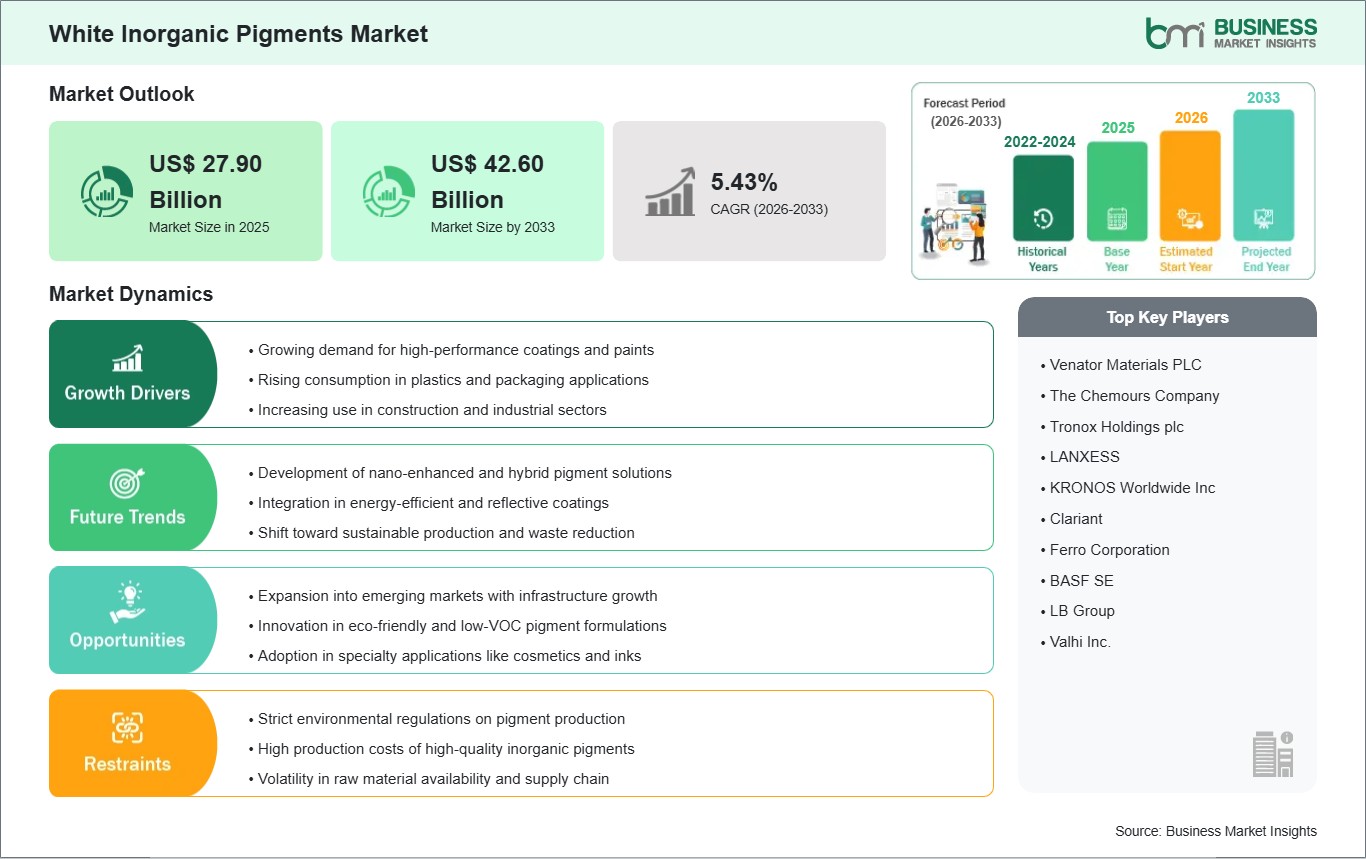
The White Inorganic Pigments Market size was valued at US$ 26.70 Billion in 2025 and is projected to reach US$ 39.76 Billion by 2033, growing at a CAGR of 5.10% during 2026–2033. Rising demand from paints and coatings, increasing construction activity, expanding plastics production, and growing adoption of high-performance pigments in consumer products continue creating significant market opportunities globally.

Report Coverage
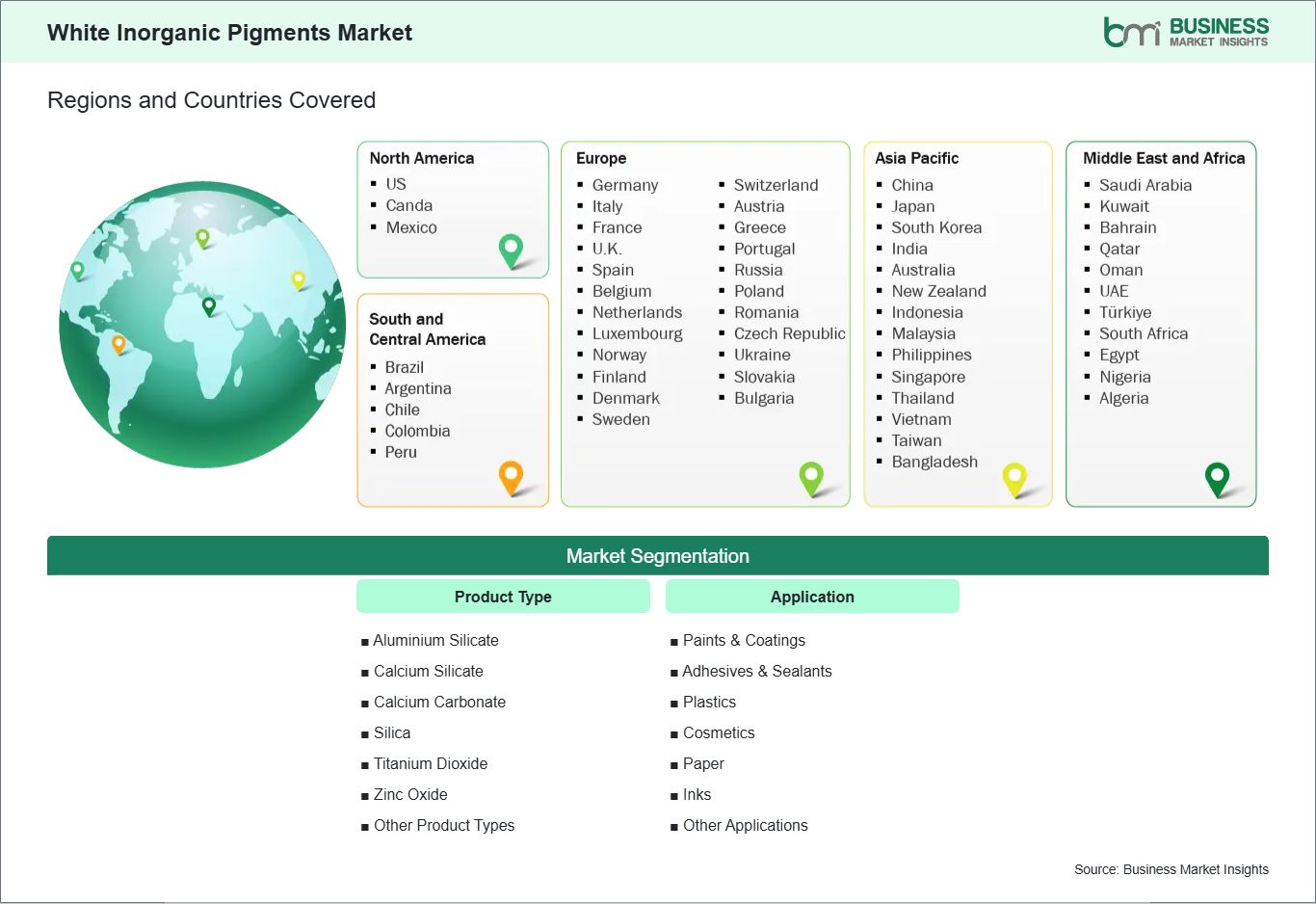
  • Type: Titanium Dioxide (TiO₂), Zinc Oxide, Lithopone, Antimony Oxide
  • Applications: Paints & Coatings, Plastics, Paper, Inks, Cosmetics & Personal Care
  • End-Use Industry: Construction, Packaging, Automotive, Consumer Goods
  • Product Grade: Rutile Grade Titanium Dioxide, Anatase Grade Titanium Dioxide, Surface-Treated Pigments, Functional White Pigments
US$ 26.70 Bn Market size in 2025
US$ 39.76 Bn Market Size by 2033
5.10% CAGR, 2026 - 2033
2026-2033 Forecast Period

01 AI Overview

White Inorganic Pigments  Market Summary

  • North America Region: North America holds 18.40% share in 2025, growing at a CAGR of 5.2% during 2026–2033. Strong coatings demand, infrastructure investments, automotive production, packaging applications, and increasing preference for high-opacity pigments support regional expansion across multiple industrial sectors. The U.S. market benefits from construction and manufacturing activities, advancing at a 5.6% CAGR through 2033.
  • Fastest Growing Region: Asia Pacific accounts for 47.60% share in 2025 and is projected to expand at a CAGR of 5.0% during 2026–2033. Rapid industrialization, construction development, plastics manufacturing growth, consumer goods production, and rising coatings consumption continue driving strong regional demand.
  • Leading Segment: Titanium Dioxide (TiO₂) represents 70.90% share in 2025 and is anticipated to grow at a CAGR of 5.0% through 2033. Superior opacity, brightness, UV resistance, versatility, and widespread application across paints, plastics, paper, and coatings sustain segment leadership.
  • High Growth Segment: Paints & Coatings accounts for 41.20% share in 2025 and is forecast to grow at a CAGR of 4.0% during 2026–2033. Infrastructure development, architectural coatings demand, industrial finishing applications, and growing protective coatings consumption continue accelerating pigment utilization.
  • Key Market Opportunity: Demand for sustainable coatings, advanced plastics, premium construction materials, and functional pigment technologies creates opportunities for manufacturers developing high-performance, environmentally compliant white pigment solutions worldwide.
  • Major Market Players: The Chemours Company, Tronox Holdings plc, LB Group Co., Ltd., Venator Materials PLC, Kronos Worldwide, Inc., INEOS Pigments, Ishihara Sangyo Kaisha, Ltd. (ISK), TAYCA Corporation, Cinkarna Celje d.d., Fengbai Group.
02 Strategic Insights

White Inorganic Pigments  Market: Strategic Insights

White Inorganic Pigments  Market Strategic Framework
FREE PDF
Request your free sample
Request free sample
03 Stakeholder View

Key Takeaways

  • Value chain integration still persists as all suppliers of raw materials, manufacturers of pigments, coatings, plastics and manufacturers of end products are tightly inter-related in terms of long-term supply contracts.
  • The highest growth potential is associated with paints & coatings since investments in infrastructure, urbanization, and demand for decorative and protective coatings are rising.
  • The area of innovation includes development of more sophisticated surface technologies, better dispersion, UV protection and environmentally friendly pigment technology.
  • Asia-Pacific is the region with the highest investment potential due to the manufacturing hub there, high construction industry activity and growing packaging and plastic industry sectors.
  • Capacity expansions, strategic partnerships, and supply chain optimization initiatives continue reshaping competitive dynamics among major pigment producers.
  • Demand is increasingly shifting toward high-performance pigment grades that combine opacity, durability, weather resistance, and regulatory compliance across diverse industrial applications.
04 Geographic Outlook

White Inorganic Pigments  Market Regional Highlights

North America White Inorganic Pigments Market

North America accounts for approximately 18.40% White Inorganic Pigments Market share in 2025 and is projected to grow at a CAGR of 5.2% during 2026–2033. Demand is supported by strong paints and coatings consumption, packaging production, construction activity, and automotive manufacturing. High-quality pigment requirements, sustainability initiatives, and growing adoption of premium coating formulations continue supporting market development. Investments in infrastructure upgrades and industrial manufacturing further strengthen regional demand for titanium dioxide and specialty white inorganic pigment products.

  • Architectural coating is another important category of consumption, driven by home improvement programs, commercial building activities, and need for good exterior coating that is highly opaque and weather-resistant.
  • Packaging industries are becoming a major consumer of white pigments for improving the appearance, UV-protection, brightness, and overall appearance of packaging products.
  • Auto manufacturing industry drives the consumption of performance coatings that have good pigments formulation for enhancing appearance and other qualities.
  • Infrastructure development projects drive the consumption of decorative and protective coatings that are required for transport, industrial, and public buildings construction.
  • Green movement helps to promote the usage of environmental friendly pigment technology that provides better performance.

US White Inorganic Pigments Market

The United States represents approximately 76.20% of North American demand and is expected to expand at a CAGR of 5.6% through 2033. Strong demand from construction, packaging, coatings, and consumer goods industries continues supporting market activity. Investments in residential development, infrastructure projects, and industrial manufacturing contribute to steady pigment consumption. High-performance coating requirements and advanced manufacturing capabilities further strengthen market opportunities across diverse application sectors.

  • Building and construction works will generate significant demand for coatings and paints containing titanium dioxide pigments for their brightness and durability benefits.
  • The packaging segment in the food and beverage sectors, the healthcare sector, and the consumer products industry is growing, leading to increased use of white pigments in plastics.
  • Manufacturers of industrial coatings focus on high-opacity pigments that provide weather-resistance and better color retention.
  • The growth in consumer goods production creates more potential uses for white pigments across household products and appliances.

Europe White Inorganic Pigments Market

Europe holds 21.90% share in 2025 and is projected to grow at a CAGR of 4.4% through 2033. Demand is supported by advanced coatings industries, stable construction activity, and strong regulatory emphasis on sustainable manufacturing. Germany remains the leading regional market due to its industrial base, while Poland is among the fastest-growing countries supported by construction investments and manufacturing expansion. Increasing demand for premium coatings and specialty plastics continues supporting long-term regional growth.

  • Germany maintains market leadership through automotive manufacturing, industrial coating production, and extensive utilization of premium pigment formulations.
  • Poland is one of the fastest-growing regional markets, supported by infrastructure development, packaging production growth, and construction sector expansion.
  • Environmental regulations continue encouraging investment in advanced pigment technologies that improve resource efficiency and sustainability performance.
  • Coatings manufacturers increasingly utilize high-performance pigment grades to meet durability, UV resistance, and weatherability requirements.
  • Growing demand from plastics and packaging industries supports further consumption of titanium dioxide and specialty white pigment products.

Asia Pacific White Inorganic Pigments Market

Asia Pacific accounts for 47.60% share in 2025 and is expected to register the fastest growth at a CAGR of 5.0% through 2033. Rapid industrialization, urbanization, construction development, and manufacturing expansion continue driving consumption. China remains the largest regional market due to its dominant coatings and plastics industries, while India represents the fastest-growing country market. Expanding consumer goods production and infrastructure investment further support demand across multiple application sectors.

  • China leads regional consumption through large-scale coatings production, plastics manufacturing, construction activity, and extensive industrial output.
  • India records the highest growth rate, supported by urban infrastructure development, housing construction, packaging demand, and expanding manufacturing investments.
  • Southeast Asian economies continue witnessing growth in plastics processing and industrial production, supporting increasing pigment consumption.
  • Rising disposable incomes and consumer product manufacturing contribute to greater demand for high-quality white pigment applications.
  • Infrastructure expansion and commercial construction projects continue supporting long-term coatings and construction materials demand.

Rest of World White Inorganic Pigments Market

Rest of World represents approximately 12.10% White Inorganic Pigments Market share in 2025 and is projected to expand at a CAGR of 6.4% during 2026–2033. South & Central America benefit from construction growth, packaging demand, and expanding industrial activity, with Brazil leading regional consumption. The Middle East & Africa support growth through infrastructure investments, coatings demand, and industrial diversification initiatives. Growing urbanization and manufacturing activity contribute to sustained pigment consumption across emerging economies.

  • Brazil continues benefiting from construction investments, consumer goods production, and packaging industry growth supporting white pigment demand.
  • Saudi Arabia leads Middle Eastern consumption through infrastructure development, industrial projects, and increasing utilization of high-performance coatings.
  • Packaging applications continue expanding across emerging markets due to rising consumer product demand and industrial production growth.
  • Construction projects focused on housing, commercial facilities, and public infrastructure support demand for decorative and protective coatings.
  • Industrial diversification and manufacturing development initiatives create opportunities for broader utilization of white inorganic pigment products.
Global Market Geography
FREE PDF
Request your free sample
Request free sample
05 Segment Analysis

White Inorganic Pigments  Market Segmentation

Type

The Titanium Dioxide (TiO₂) segment accounts for approximately 70.90% market share in 2025 and is projected to grow at a CAGR of 5.0% through 2033. Superior opacity, brightness, UV resistance, and broad compatibility make titanium dioxide the preferred pigment across numerous industries. The White Inorganic Pigments Market scope continues expanding as manufacturers demand versatile pigment solutions capable of improving product aesthetics and performance characteristics across coatings, plastics, paper, and consumer applications.

  • Titanium Dioxide (TiO₂): Dominates global consumption due to excellent opacity, brightness, hiding power, durability, and versatility across a wide range of industrial applications.
  • Zinc Oxide: Utilized in coatings, rubber products, cosmetics, and specialty applications requiring UV protection, antimicrobial properties, and functional performance benefits.
  • Lithopone: Applied in coatings, plastics, and specialty products where cost efficiency and white pigmentation characteristics remain important considerations.
  • Antimony Oxide: Primarily used in specialty applications requiring flame-retardant performance and technical functionality alongside pigmentation benefits.

Applications

The Paints & Coatings segment accounts for approximately 41.20% market share in 2025 and is anticipated to grow at a CAGR of 4.0% through 2033. Rising infrastructure development, building construction activity, and industrial coating demand continue supporting growth. The White Inorganic Pigments Market trends indicate increasing utilization of advanced pigment grades that enhance weather resistance, durability, and visual performance across architectural and industrial applications.

  • Paints & Coatings: Represents the largest application area due to widespread use in decorative, industrial, automotive, and protective coating formulations.
  • Plastics: Benefits from increasing demand for packaging, consumer goods, automotive components, and construction materials requiring enhanced opacity and appearance.
  • Paper: Supports steady pigment demand through printing, packaging, and specialty paper applications requiring brightness and surface quality improvements.
  • Inks: Utilized in printing systems that require color consistency, opacity, and durability across commercial and industrial applications.
  • Cosmetics & Personal Care: Increasingly adopts specialty white pigments for formulations requiring brightness, coverage, and aesthetic performance characteristics.

End-Use Industry

The Construction segment holds approximately 35.90% White Inorganic Pigments Market share in 2025 and is forecast to expand at a CAGR of 5.9% through 2033. Growth is driven by rising demand for coatings, architectural materials, decorative finishes, and infrastructure development projects. Continued investment in residential, commercial, and industrial buildings supports strong pigment consumption patterns across construction-related applications.

  • Construction: Leads consumption through paints, coatings, sealants, and building materials requiring high-performance white pigmentation.
  • Packaging: Driven by plastics production, labeling applications, and consumer product packaging requiring visual appeal and durability.
  • Automotive: Utilizes white pigments in coatings, plastic components, and specialty materials designed to enhance appearance and performance.
  • Consumer Goods: Supports demand through appliances, household products, electronics, and various manufactured goods requiring aesthetic enhancement.

Product Grade

The Rutile Grade Titanium Dioxide segment accounts for approximately 59.10% White Inorganic Pigments Market share in 2025 and is expected to grow at a CAGR of 5.5% through 2033. Superior weather resistance, opacity, and outdoor performance characteristics make it the preferred grade for many industrial applications. Demand continues rising across coatings, plastics, and construction materials that require long-term durability and product stability.

  • Rutile Grade Titanium Dioxide: Preferred for premium coatings, plastics, and exterior applications requiring excellent weatherability and durability.
  • Anatase Grade Titanium Dioxide: Utilized in paper, interior coatings, and specialty applications emphasizing brightness and processing performance.
  • Surface-Treated Pigments: Increasingly adopted to enhance dispersion, stability, compatibility, and end-use performance characteristics.
  • Functional White Pigments: Designed for specialized applications that require technical functionality in addition to color and opacity performance.
06 Market Forces

White Inorganic Pigments  Market Dynamics

Key Market Drivers

Growing Demand from Paints and Coatings Industry

The paints and coatings sector remains the most significant demand generator for white inorganic pigments due to increasing construction activity, infrastructure development, and industrial manufacturing worldwide. Architectural coatings rely heavily on titanium dioxide and related white pigments for opacity, brightness, UV resistance, and durability. The White Inorganic Pigments Market growth trajectory continues to benefit from rising urbanization, residential construction projects, and renovation spending across major economies. High-performance pigments that will provide long-lasting visual aesthetics and environmental resistance are also needed in industrial coatings, marine coatings, and protective coatings. As coatings become increasingly performance-based, the use of high-quality inorganic white pigments is on the rise.

Expansion of Plastics and Packaging Manufacturing

Rapid growth in plastics processing and packaging production continues supporting white pigment consumption across global markets. Inorganic white pigments enhance the opacity, aesthetics, durability, and UV resistance of many plastic products used in packaging for food, consumer goods, health care, and other industries. The rise in e-commerce activity, consumer product consumption, and the use of packaging solutions has led to increased demand for high-quality pigment compositions. There is an increasing trend of selecting pigments that improve the look of the products and at the same time do not reduce the efficiency of production processes.

Rising Construction and Infrastructure Investments

Large-scale construction projects across residential, commercial, and infrastructure sectors continue driving pigment demand through coatings, sealants, building materials, and decorative applications. Brightening, resistance to weathering and durability are some of the benefits of white inorganic pigments. Modernization of infrastructure facilities and urban developments are factors which facilitate the rise in use of coatings and materials that have formulations with titanium dioxide. With increased focus on durability and appearance of buildings, there is an impetus to market growth.

Key Market Opportunities

Development of Sustainable and Low-Emission Pigments

Increasing environmental regulations and sustainability objectives are encouraging manufacturers to develop advanced pigment technologies that reduce environmental impact while maintaining performance standards. The consumer demand for regulatory compliance and sustainable solutions while retaining the same level of brightness, opacity, and durability is on the rise. There are opportunities for the top companies as they invest in sustainable manufacturing techniques, energy-efficient processes, and new surface treatment options. Those companies that are able to combine technical and environmental excellence can be expected to enhance their market positions.

Growth in High-Performance Specialty Applications

Demand for specialty pigments continues increasing across advanced coatings, cosmetics, engineered plastics, and functional materials markets. Manufacturers are developing value-added pigment grades tailored for specific technical performance requirements including UV resistance, durability, dispersion efficiency, and weather protection. White Inorganic Pigments Market Forecasts indicate expanding opportunities in applications where premium product performance and regulatory compliance remain critical purchasing criteria. This trend supports higher-value product development and improved profitability opportunities for established suppliers.

Industrial Growth Across Emerging Economies

Rapid industrialization across Asia, the Middle East, and Latin America continues creating favorable demand conditions for white inorganic pigments. The increase in the production of coatings, rise in the consumption of plastics, higher manufacturing volume, and the construction of infrastructure add up to provide future market prospects. Governments are supporting the development of domestic manufacturing via industrial policy measures and investments into the sectors that use pigments.

Market Restraints and Challenges

Volatility in Titanium Dioxide Feedstock Costs

Factor: Production of titanium dioxide pigments depends heavily on feedstocks such as ilmenite, rutile, and related mineral resources that are subject to supply-demand fluctuations. Impact: Raw material price volatility can affect production costs, profit margins, and product pricing strategies across the value chain. Manufacturers frequently face challenges in maintaining cost competitiveness while preserving product quality and supply reliability. Extended periods of feedstock inflation may reduce profitability and influence purchasing behavior among downstream customers, creating uncertainty for producers and end users alike.

Stringent Environmental and Regulatory Compliance Requirements

Factor: Pigment manufacturing involves chemical processing operations subject to increasingly rigorous environmental standards and emission regulations. Impact: Compliance requirements can increase operating costs, capital expenditure needs, and production complexity. Manufacturers may be required to invest significantly in process improvements, waste management systems, and sustainable production technologies. These obligations create additional pressures on producers while potentially affecting product pricing and market competitiveness. Smaller companies often face greater challenges in adapting to evolving regulatory frameworks.

07 Company Analysis

Competitive Landscape

The White Inorganic Pigments Market analysis indicates a competitive landscape dominated by large multinational pigment producers with strong raw material access, advanced manufacturing capabilities, and extensive distribution networks.

Company Name

Overview

Products and Services Relevant to this Market

The Chemours Company

Global leader in titanium dioxide production serving coatings, plastics, and industrial applications worldwide.

Titanium dioxide pigments, specialty pigment technologies, technical services, and performance materials solutions.

Tronox Holdings plc

Integrated producer of titanium feedstocks and pigment products with global manufacturing operations.

Titanium dioxide pigments, mineral sands products, specialty materials, and industrial pigment solutions.

LB Group Co., Ltd.

Major pigment manufacturer supplying domestic and international markets with diverse titanium dioxide products.

Titanium dioxide pigments, coating materials, plastic additives, and specialty pigment applications.

Venator Materials PLC

Global chemicals company focused on performance pigments and specialty chemical products.

White pigments, titanium dioxide products, coatings solutions, and plastics-related materials.

Kronos Worldwide, Inc.

International manufacturer specializing in titanium dioxide pigment production and supply.

Titanium dioxide pigments, specialty grades, coating pigments, and plastics applications.

INEOS Pigments

Established supplier serving industrial coatings and specialty application markets.

White pigments, performance materials, industrial coating ingredients, and pigment technologies.

Ishihara Sangyo Kaisha, Ltd. (ISK)

Japanese chemicals producer known for titanium dioxide and advanced material technologies.

Titanium dioxide pigments, specialty chemical products, and industrial performance materials.

TAYCA Corporation

Specialty materials company focused on pigment innovation and high-performance applications.

Titanium dioxide products, functional pigments, cosmetic-grade pigments, and specialty materials.

Cinkarna Celje d.d.

European pigment producer serving coatings, plastics, and industrial consumers.

Titanium dioxide pigments, industrial chemicals, and application-specific pigment products.

Fengbai Group

Chinese pigment manufacturer supporting coatings, plastics, and consumer product industries.

White pigments, titanium dioxide materials, coatings ingredients, and industrial pigment solutions.

10 Trust & Transparency

Research Methodology

The market analysis combines proprietary research with secondary data from government agencies, company disclosures, regulatory filings, industry databases and expert interviews. Market estimates are validated through data triangulation, cross-market benchmarking and analyst review.

View Full Research Methodology

11 Questions Answered

Frequently Asked Questions

What does the White Inorganic Pigments Market Report cover?

The Market Report covers market size, competitive landscape, regional demand patterns, segment performance, growth drivers, opportunities, challenges, and future industry outlook through 2033.

Which end-use industry creates the highest demand?

The construction sector remains the largest end-use industry because of extensive pigment utilization in architectural coatings, building materials, and infrastructure-related applications.

Why are white inorganic pigments important in coatings?

These pigments enhance brightness, opacity, UV resistance, and durability while providing long-term performance in decorative and protective coating applications.

Which region dominates global demand?

Asia Pacific holds the largest regional share due to its strong manufacturing base, significant construction activities, growing plastics industry, and expanding coatings production.

What is the largest segment in the White Inorganic Pigments Market?

Titanium Dioxide (TiO₂) is the leading segment due to its superior opacity, brightness, weather resistance, and extensive use across coatings, plastics, paper, and consumer products.

Access the Full White Inorganic Pigments Market Outlook: Size, Share, Trends, Growth Analysis, Competitive Landscape & Forecast, 2026–2033 Market Report

Get segment-level forecasts, regional estimates, competitive benchmarking, company profiles and downloadable Excel datasets.

Access the full White Inorganic Pigments Market Outlook: Size, Share, Trends, Growth Analysis, Competitive Landscape & Forecast, 2026–2033 Market Report
412 pages PDF & Excel | 2026-10-06
Similar Research

Related Market Reports