Welding Gas Market Outlook: Size, Share, Trends, Growth Analysis, Competitive Landscape & Forecast, 2026–2033 Market Regional Highlights
North America Welding Gas Market
North America accounts for approximately 20.60% Welding Gas Market share in 2025 and is projected to expand at a CAGR of 5.6% during 2026–2033. Active industrial manufacturing operations, efficient fabrication processes, and continued investments in the energy, aerospace, and transportation sectors keep sustaining demand. The region is endowed with an efficient gas production and distribution infrastructure that facilitates supply in various end-user segments. Higher adoption of welding automation equipment and higher use of premium shielding gases are bolstering regional consumption.
- Modern manufacturing upgrades keep on driving up the demand for high purity welding gases that are utilized in robotic welding, automation, and modernized manufacturing plants with the need for excellent quality welds.
- The development of infrastructure in the energy industry involving pipelines, processing plants, and renewable energy developments is boosting consumption of shielding gases and engineered gas blends for structure welding.
- In the aerospace industry, there is growing need for precise welding solutions that use argon gas blends to improve the quality of welds.
- Production of transportation equipment like commercial vehicles and rail transport keeps on creating demands for improved welding consumables and industrial gases.
- Productivity improvements and safety regulations have driven up the need for engineered gas blends in many applications.
US Welding Gas Market
The United States represents approximately 80.20% of North American demand and is expected to register a CAGR of 5.6% through 2033. Large-scale manufacturing activity, energy sector investments, and strong aerospace production continue driving consumption. Industrial gas suppliers benefit from extensive distribution infrastructure and long-standing partnerships with fabrication companies. Rising automation adoption supports increasing consumption of specialized gas mixtures designed to improve productivity, weld quality, and process reliability across diverse industrial applications.
- New developments within the energy industry are ensuring welding processes are supported by means of provision of sufficient amounts of shielding gases.
- Manufacturing of vehicles is increasing demand for superior welding gases, which would facilitate efficient production and improve overall welding quality.
- Activities within aerospace and defense sectors ensure use of premium argon gases in welding processes.
- Ongoing infrastructure projects stimulate demand for industrial gases used in structural fabrication, transportation assets, and large-scale construction developments.
Europe Welding Gas Market
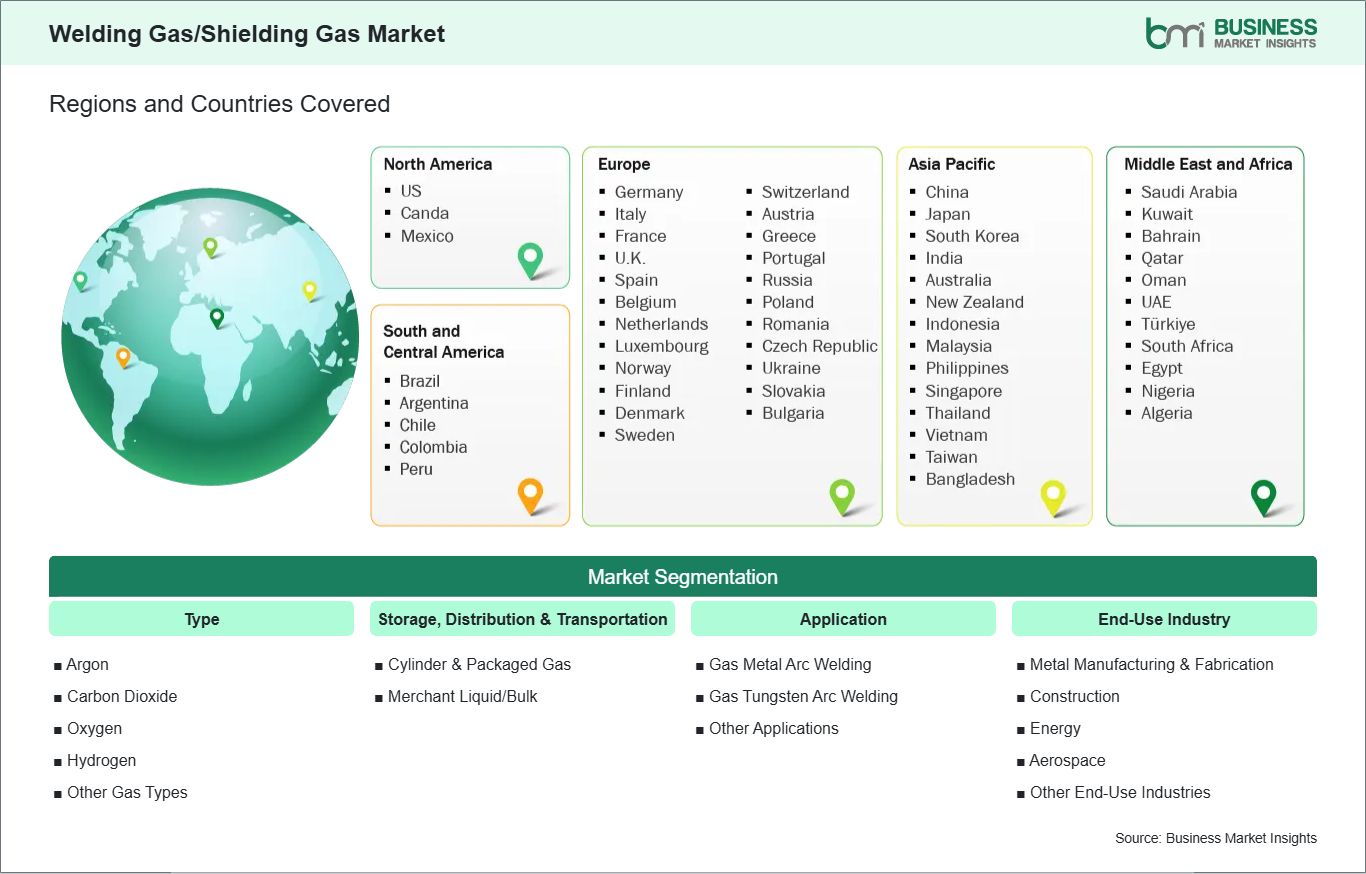
Europe holds 23.90% Welding Gas Market share in 2025 and is projected to grow at a CAGR of 4.9% through 2033. The region has advantages, including advanced manufacturing facilities, automotive manufacturing, and growing investments in renewable energy. Sustainability goals lead to the need for development of fabrication plants as well as efficient welding technology application. Germany remains the dominant market in the region due to its industrialization and engineering capabilities, while Poland is one of the fastest-growing countries.
- Germany dominates regional consumption owing to its automotive industry manufacturing capacity, industrial machinery production, and advanced fabrication processes that have enabled widespread adoption of industrial welding gases.
- Poland is one of the rapidly expanding regions thanks to industrial development, transport development, direct foreign investments, and manufacturing growth.
- Offshore wind farms and other renewable energy infrastructure development projects keep driving the need for advanced welding technologies that need premium shielding gases.
- Adoption of industrial automation is driving greater adoption of advanced gas mixture solutions to enhance weld consistency, production efficiency, and manufacturing standards.
- The engineering and fabrication industries are progressively focusing on improving productivity levels, leading to more adoption of industrial gas technologies.
Asia Pacific Welding Gas Market
Asia Pacific accounts for 46.80% Welding Gas Market share in 2025 and is anticipated to achieve a CAGR of 6.0% through 2033, making it the fastest-growing region. Rapid industrialization, expanding automotive manufacturing, infrastructure development, and construction growth support increasing consumption. China remains the largest market due to its extensive manufacturing ecosystem, while India represents the highest-growth country market. Rising investments in fabrication facilities and transportation equipment production continue strengthening long-term demand fundamentals.
- China leads regional demand through large-scale manufacturing activities, infrastructure investments, shipbuilding production, and widespread adoption of industrial welding technologies.
- India records the strongest growth rate, supported by industrial development initiatives, transportation projects, construction expansion, and increasing domestic manufacturing capabilities.
- Southeast Asian countries continue attracting investments in electronics, automotive components, and industrial manufacturing facilities that require extensive fabrication activities.
- Expanding renewable energy projects across the region generate demand for welding gases used in structural fabrication and equipment manufacturing operations.
- Increasing deployment of automated welding technologies encourages adoption of specialized gas mixtures optimized for productivity, quality, and operational efficiency.
Rest of World Welding Gas Market
Rest of World represents approximately 8.70% Welding Gas Market share in 2025 and is expected to expand at a CAGR of 9.8% through 2033. South & Central America continue benefiting from mining investments, industrial expansion, and infrastructure projects, with Brazil leading regional demand. The Middle East & Africa support growth through energy sector developments, transportation projects, and industrial diversification strategies aimed at strengthening manufacturing capabilities and reducing reliance on imports.
- Regional dominance in Brazil is achieved through industrial manufacturing, mining-based projects, and transportation infrastructure which involves considerable welding activities.
- The largest Middle Eastern market is that of Saudi Arabia and is driven by energy investments, industrial diversification, and infrastructure development programs.
- Mining, metals production, and industrial facilities construction in developing countries have been creating a consistent demand for industrial welding gases.
- Gulf countries increasingly invest in manufacturing and logistics infrastructure, creating opportunities for industrial gas suppliers supporting fabrication-intensive projects.
- Public infrastructure modernization and industrial development programs across Africa contribute to rising adoption of welding technologies and associated gas solutions.