01
Market Summary
Executive Summary and Market Analysis
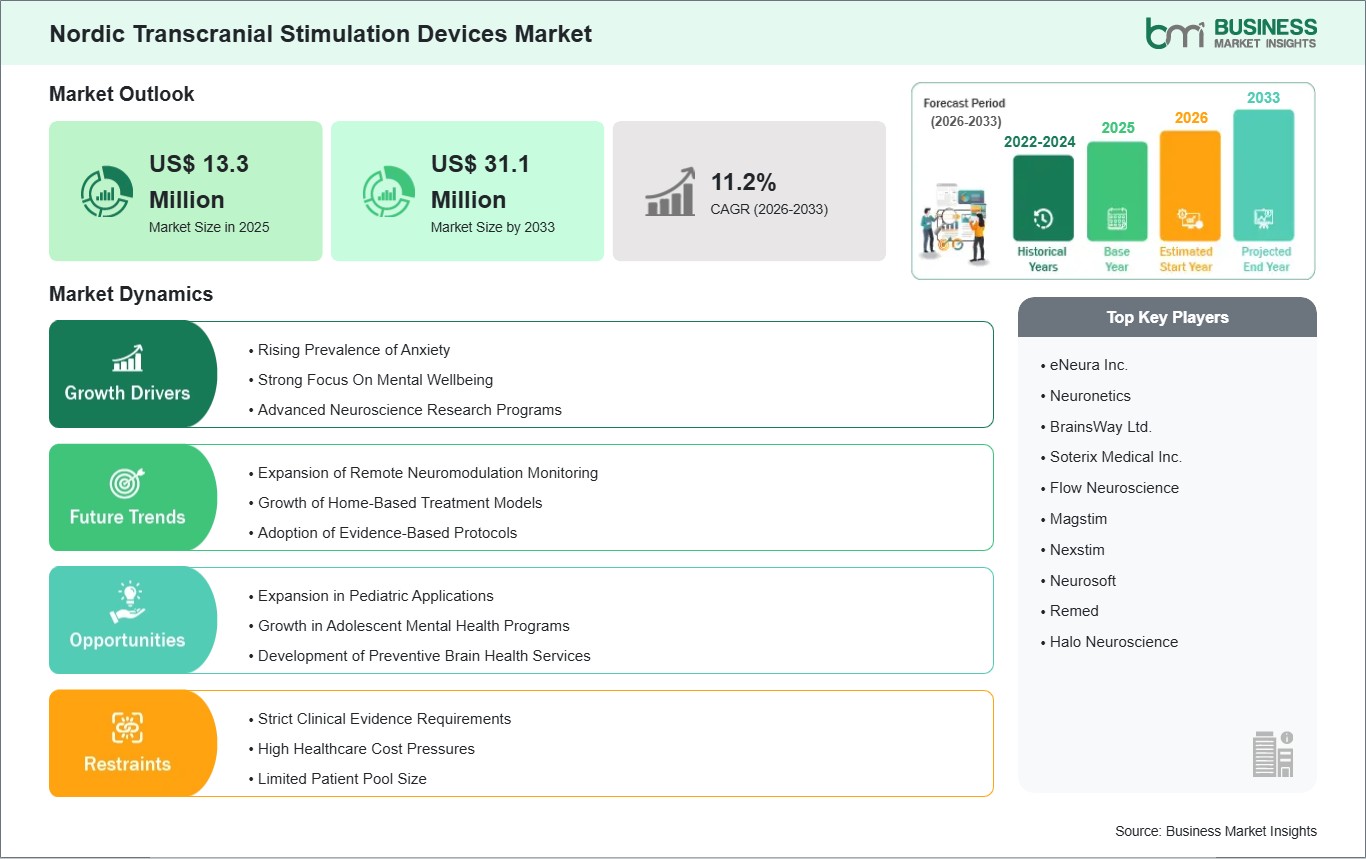
Market drivers include an interdependent healthcare environment that encourages the early integration of non-invasive neuromodulation devices in neurology, psychiatry and rehabilitation facilities, where clinical decisions are based on a protocol-driven and multidisciplinary approach among hospitals, research institutes, and medical universities focusing on cases of treatment-resistant depression, chronic pain, and post-stroke motor recovery. Among the drivers are the increasing prevalence of neurological and neuropsychiatric conditions, along with the increasing trend towards non-pharmacological treatment options that have led to the growing acceptance of transcranial magnetic stimulation and direct current stimulation devices, especially in specialized neuroscience clinics and neurology departments of regional hospitals. Another factor driving the market is the presence of advanced healthcare systems and extensive networks for collaborative research that fast-track neurotechnology innovations into therapeutic applications through funding mechanisms and cross-institutional collaborations. The market, however, is constrained by the costly process of obtaining advanced neurostimulation devices and inconsistent clinical education standards that inhibit the adoption of such devices beyond large medical facilities in cities. Device makers are reacting through the development of small portable devices as well as computer-based protocols that would make it easy for clinicians to be consistent with treatment methods, as well as encourage patients to adhere to the treatment. The combination of digital platforms with neurostimulation devices will redefine the work process of clinics through the use of remote monitoring and adjustments made based on collected data.
03
Segment Analysis
Nordic Transcranial Stimulation Devices Market Segmentation
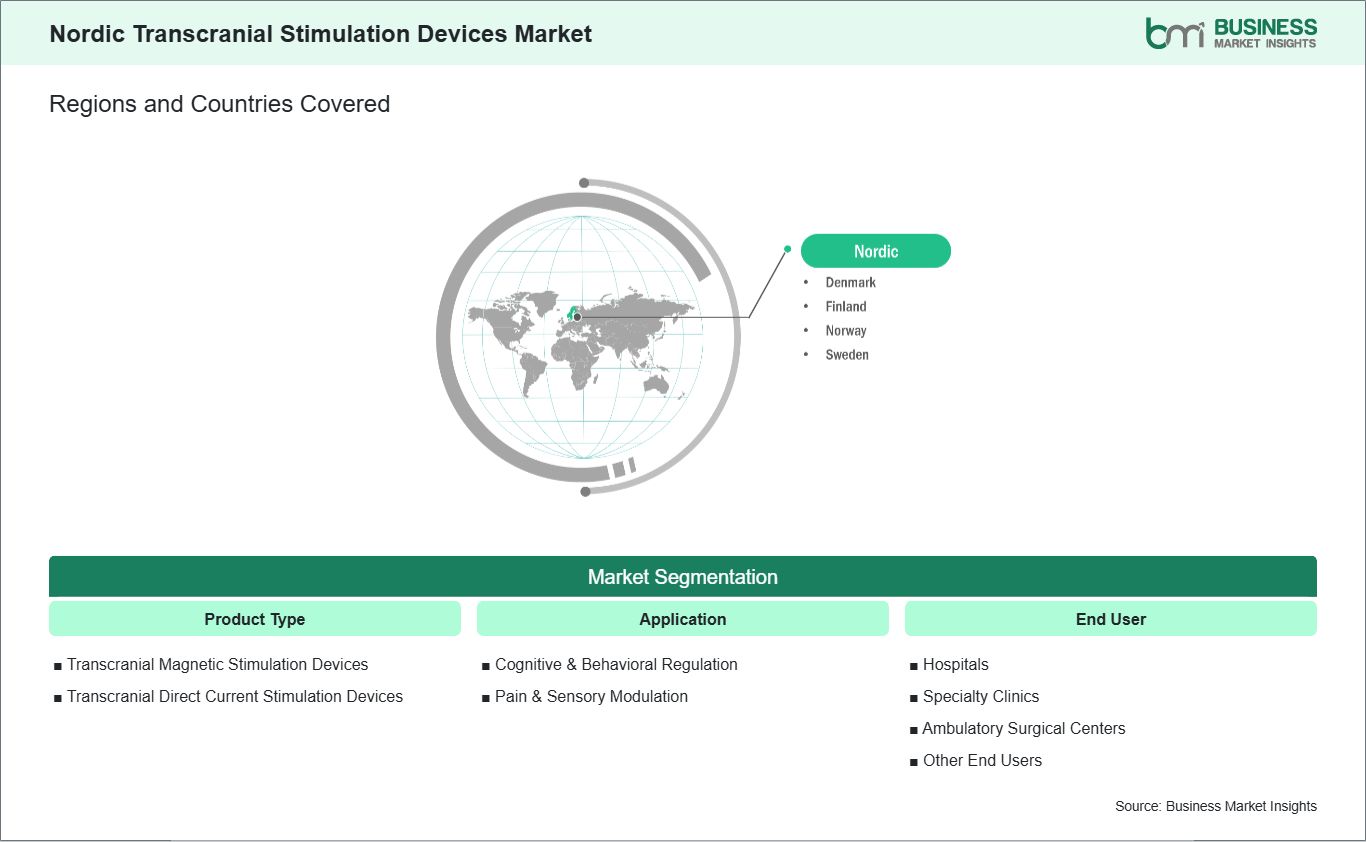
Key segments that contributed to the derivation of the Nordic transcranial stimulation devices market analysis are product type, application, and end user.
- By product type, the transcranial stimulation devices market is segmented into transcranial magnetic stimulation devices and transcranial direct current stimulation devices. The transcranial magnetic stimulation devices segment dominated the market in 2025.
- Based on application, the transcranial stimulation devices market is categorized into cognitive & behavioral regulation and pain & sensory modulation. The cognitive & behavioral regulation segment dominated the market in 2025.
- In terms of end user, the transcranial stimulation devices market is categorized into hospitals, specialty clinics, ambulatory surgical centers, and other end users. The hospitals segment dominated the market in 2025.
04
Market Forces
Nordic Transcranial Stimulation Devices Market Drivers and Opportunities
Rising Prevalence of Anxiety
Transcranial stimulation apparatuses in Nordic countries' outpatient facilities for mental health are increasingly integrated into care pathways for patients who respond inadequately to medication treatment. It should be noted that the application of such devices does not mean the replacement of any existing methods but their integration into a hybrid protocol, targeting neurocircuit modulation along with behavior-based therapies. Such an approach implies carefully selected cases rather than widespread usage.
The increasing knowledge base about non-invasive brain stimulation in clinical practice contributes to the formation of new approaches to treatment by psychiatric facilities. For example, when a majority of patients presenting at a facility suffer from anxiety disorders, there may be a tendency to prioritize patients having undergone several medication treatments in a psychiatrist-neurologist cooperation to set up appropriate referral criteria.
An increasing number of patients experiencing ongoing problems with emotional regulation seek help with neuromodulation sessions following unsuccessful stabilization with standard therapeutic combinations. As a result, treatment slots are designed to accommodate both psychotherapy and neurostimulation techniques.
Expansion in Pediatric Applications
The integration of Nordic transcranial stimulation equipment in pediatric neuropsychiatry units is currently done on a careful, case-by-case basis to address issues related to attention regulation and emotional instability. Step-by-step implementation has been recommended where stimulation treatment is only offered as a next-level option after behavioral therapy and medication have proven ineffective. The selection of cases has been made in line with developmental appropriateness.
Cases referred for consideration for neuromodulation are usually from school counselors and pediatricians who identify persistent problems with executive functioning. The evaluation and determination of candidacy involves several tiers of discussion of consent, where parents and clinical psychologists discuss the scheduling of therapy and how it will be integrated with other neurobehavioral therapies.
With adolescents, usability factors are taken into account by clinicians who track the behavioral reactions to the intervention in order to refine the settings used. The iterative approach makes it possible to implement neuromodulation within a comprehensive neurodevelopmental management program.
05
Size and Share Analysis
Nordic Transcranial Stimulation Devices Market Size and Share Analysis
The Nordic transcranial stimulation devices market demonstrates steady growth, with size and share analysis highlighting evolving trends and competitive dynamics among key players. The report examines subsegments categorized within product type, application, and end user, offering insights into their contribution to overall market performance.
By product type, the transcranial magnetic stimulation devices subsegment dominated the market in 2025, driven by its strong clinical efficacy in treating major depression and other neurological disorders, along with increasing regulatory approvals and growing adoption in hospital-based neuropsychiatric care.
Based on application, the cognitive & behavioral regulation subsegment dominated the market in 2025, driven by the rising prevalence of mental health disorders and increasing demand for non-invasive therapies that improve cognition, mood, and behavioral outcomes without pharmacological side effects.
In terms of end user, the hospitals subsegment dominated the market in 2025, driven by higher availability of advanced neurostimulation infrastructure, presence of trained specialists, and preference for supervised clinical environments for safe and effective patient treatment.
07
Report Coverage
Nordic Transcranial Stimulation Devices Market Report Coverage and Deliverables
The "Nordic Transcranial Stimulation Devices Market Size and Forecast (2022-2033)" report provides a detailed analysis of the market covering below areas:
- Market size and forecast at global, regional, and country levels for all the key market segments covered under the scope
- Market trends, as well as drivers, restraints, and opportunities
- Market analysis covering key trends, global and regional framework, major players, regulations, and recent developments
- Market concentration, heat map analysis, prominent players, and recent developments for the Market
- Detailed company profiles, including SWOT analysis
08
Geographic Insights
Nordic Transcranial Stimulation Devices Market Geographic Insights
The geographical scope of the Nordic Transcranial Stimulation Devices Market report is divided into Sweden, Denmark, Norway, Finland. Sweden held the largest share in 2025.
Sweden represents the primary market in the transcranial stimulation devices market among other Nordic countries based on an advanced neurotechnology ecosystem, early introduction of neurostimulation approaches in clinical practice, and a high degree of incorporation of psychiatry and neurology services into top-rated university hospitals. The continuous development of brain research, along with the readiness to implement innovative approaches in healthcare, contributes to a leadership position in the use of devices and conducting clinical studies. Denmark shows stable growth as a result of a highly centralized healthcare system, which ensures an equal approach to introducing innovations into all regions, as well as increased recognition of the importance of non-medication approaches to treating depression and anxiety disorders in hospital mental health programs. Norway shows a unique pattern of market growth in the presence of substantial funding and a growing focus on finding treatment options for hard-to-treat psychiatric disorders, as well as interest in more portable devices that can be used for home treatment due to a dispersed population. Finally, Finland shows high potential growth associated with a long-standing research tradition in neurosciences and collaboration between academic organizations and medtech companies. Other complementary drivers in the region involve growing programs for clinician training, growth in hospitals' procurement of neuromodulation systems, and increased interest in incorporating transcranial stimulation in multi-disciplinary approaches to treating psychiatric disorders. Sweden has maintained its pace ahead of the other markets in the region through its pioneering approach in the use of advanced stimulation techniques, while other markets follow suit by harmonizing their approaches to accommodate treatments involving device-supported neuropsychiatric therapy.
10
Industry Activity
Recent Developments
The Nordic Transcranial Stimulation Devices Market is evaluated by gathering qualitative and quantitative data post primary and secondary research, which includes important corporate publications, association data, and databases. A few of the key developments in the Nordic transcranial stimulation devices market are:
- In May 2023, Nexstim announced the commercial launch of its new NBS 6 navigated brain stimulation system and outlined plans to expand its network of neuroscience clinics in the U.S. and Europe, strengthening its transcranial magnetic stimulation (TMS) footprint.
- In June 2024, BrainsWay announced the launch of a multicenter randomized clinical trial evaluating an accelerated Deep TMS treatment protocol for major depressive disorder, targeting shorter therapy durations and broader adoption of transcranial stimulation therapies.
11
Trust & Transparency
Research Methodology
The market analysis combines proprietary research with secondary data from government agencies, company disclosures, regulatory filings, industry databases and expert interviews. Market estimates are validated through data triangulation, cross-market benchmarking and analyst
review.
View Full Research Methodology
Key Sources Referred:
U.S. Food and Drug Administration (FDA)National Institute of Mental Health (NIMH)National Institute for Health and Care Excellence (NICE)European Medicines Agency (EMA)Medicines and Healthcare products Regulatory Agency (MHRA)American Psychiatric Association (APA)World Health Organization (WHO)International Neuromodulation Society (INS)International Society for Neuroregulation & Research (ISNR)European Society for Magnetic Resonance in Medicine and Biology (ESMRMB)Company WebsitesCompany Annual ReportsCompany Investor Presentations